![]() |
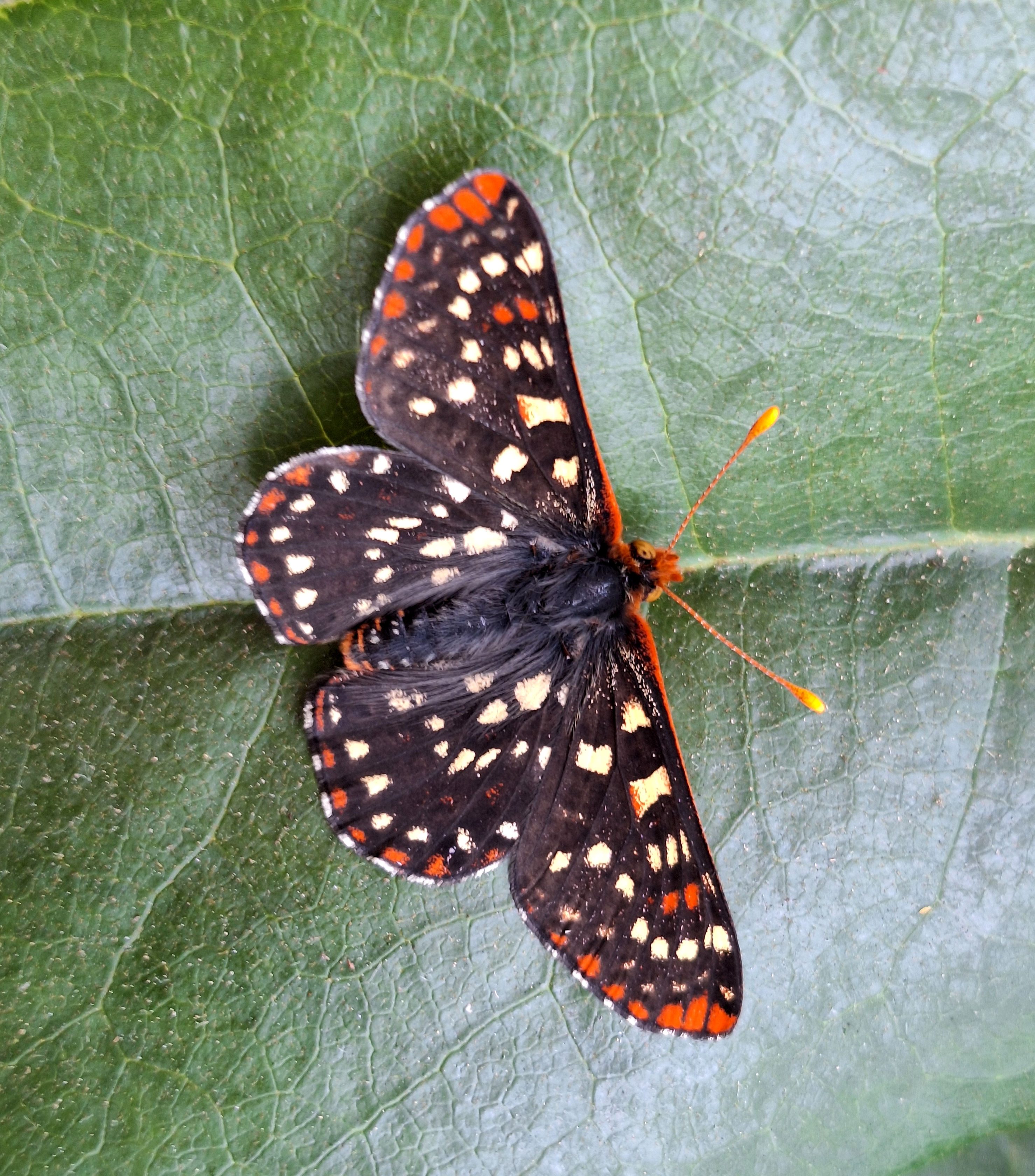
| Goldenrod, Government Camp, July 2025 |
![]() |
| Yarrow Government Camp July 2025 |
![]() |
| Lorquin's Admiral, Alpine Campground, July 2025 |
![]() |
| Hydaspe Frit, Sandra's hand, Alpine July 2025 |
![]() |
| Let me outta here! |
The first twelve blogs (Nov. 2011) describe proven sites for snorkeling on the Kona an Kohala Coasts. Particular attention is paid to those beaches that are great for children. Specific advice is provide on entry into the ocean and fish to be found at these sites along witn information on facilities. The remaining blogs detail snorkeling adventures in Kona and around the world.
![]() |
| Goldenrod, Government Camp, July 2025 |
![]() |
| Yarrow Government Camp July 2025 |
![]() |
| Lorquin's Admiral, Alpine Campground, July 2025 |
![]() |
| Hydaspe Frit, Sandra's hand, Alpine July 2025 |
![]() |
| Let me outta here! |
This week we plunged into summer butterfly watching in the Pacific Northwest. With our mentors admonition (butterflies emerge in response to humidity and temperature) in mind, we noted the streak of days over 90 degrees in the Portland area and thought, maybe it's time to look for some big orange butterflies.
![]() |
| Great Spangled Fritillary, Dougan Creek, July 2025 |
Following that relatively weak start, we moved around the corner to our third spot on Dougan Creek. At this point we had little in the bag but high hopes. Dougan Creek is a playful stream that burbles over boulders and forms pools which in the summer are home to water boatmen. These curious insects, with their feet transformed into floating pads, are a source of joy for my sweetie. Hence, this stop on the rocky beach is one of our favorites.
Its a slightly precarious descent from the wide spot in the road down to the rocky creek bed, and in our dotage we managed this with care. Once down among the boulders, Sandra was drawn to her boatmen, plying their trade in the pools next to the burbling stream. I was down on the rocks, as well, with my net in hand.
![]() |
| Great Spangled Frit, dorsal. |
Back up by our car, we noted some larger orange butterflies making their way up and down the road. One came flying by me and I thought I had it in the net, but when I stopped spinning, I found that I was mistaken.
In some circles, composed of mostly middle aged lepidopterists, this is known as the empty net syndrome. ENS can lead to an existential crisis. Psycho-babble experts from the Cleveland Clinic warn: Don't blame the butterfly!
Fifty yards up the road I could see several of these guys cavorting among the alders. I made it to their convocation without scaring them away. To my delight, one was perched on a blackberry vine, offering both an excellent look (look at those bright silver spots!) and a chance for a capture. He was fairly close and this time the net did not miss; I had a beautiful big butterfly as a reward.
![]() |
| The Stream Violet, Viola glabella |
A couple things to notice. First, the dorsal view of this butterfly does not do justice to the fiery orange you see in the field. As you can see, we brought him outside with hopes that this would improve the picture, but without enhancing the color artificially, this is the best we could achieve. It is probable that, as in reef fish, color is highly dependent on mood. Suffice it to say, there is nothing like being put in a vegetable bag and shoved in the refrigerator to put a damper on your joie de vivre.
Next, look at the size of the silver spots on the VHW. If you have the time and inclination, you can flip back to the previous blog where we presented a gorgeous Zerene from Peterson Prairie. Compare the two and you will see that although the Zerene is definitely smaller, it is the Great Spangled Frit that is left with spot envy. According to Robert Pyle, this King of the Frits, with his marvelous cream-colored submarginal band, has the smallest spots of any greater frit in the PNW.
![]() |
| White Pelicans, Tualatin river NWR |
By the way, it's damn lucky that this is a summer butterfly, emerging from his chrysalis in July. If he were to emerge on the Wednesday preceding the first Sunday following the first full moon after the Vernal Equinox, and present himself as the King of the Frits, he could very well get his ass crucified. Picture Pontius Pilate with a butterfly net and an itty bitty cross. While this might lead to a totally new religion, it would leave us butterfly fanciers bereft of one of our favorites.
In preparation for this blog, I re-read the section in Robert Pyle's book. He makes a variety of observations. He points out the smaller silver spots. He also notes that all frits are obligated to lay their eggs on violets. That's right, all fritillary caterpillars will dine on nothing less. For her host plant, the female Great Spangled Fritillary uses, almost exclusively, the stream violet, viola glabella. I pulled up a picture of this species courtesy of Mr. Google and Sandra exclaimed, "Who would have thought that a violet would have yellow flowers!"
![]() |
| Common Chickory |
Oxymoronic plant names aside, one is left with a couple thoughts. If one wants to find frits, he or she damn well better be looking in an environment suitable for violets. The obvious corollary is, if one gets good at identifying violets, he or she might very well find a fritillary caterpillar. As you may recall, some fritillary butterflies overwinter as eggs laid on dying violet debris, in hopes that when the violets start to grow in the spring the eggs will hatch, the caterpillars will eat the violet leaves and life will go on. Others, and this is how the GSF solves the problem, lay eggs in late fall, the eggs hatch and the L1 caterpillar undergoes diapause, remaining an insignificant little fellow, sequestered in violet debris until spring. When the violet starts to grow. the caterpillar comes to life and starts to dine sumptuously on viola alfresco.
The thing that caught my eye and made me spring to life like a tiny caterpillar surrounded by freshly growing violets, was Pyle's comment that the Great Spangled frit is found in Willamette Valley wildlife refuges, specifically the Finley NWR, which is not far from where I once resided. Sandra and I no longer live that far south, but I have been acutely aware of another Willamette Valley refuge, the Tualatin River National Wildlife Refuge that is just outside Portland... a mere 45 minutes away if the Portland traffic cooperates. Earlier this spring Sara's Orangetip Butterfly waws reported from this refuge. We were on our way to investigate when life intervened and the butterfly expedition was derailed.
![]() |
| Sidalcea diploscypha aka Fringed Checkerbloom |
But now we had another reason to visit the Tualatin River NWR and yesterday we did just that. Portland traffic was remarkably benign, and we arrived at the refuge a little after 9:30. In the car park I accosted a woman dressed for a nature hike. We were soon joined by her husband who knew quite a bit about butterflies. I suspect he knew much more than I was willing to receive at the moment. He provided what I asked for...the shortest way to get to a wet area that might support butterflies. Along with his hiking instructions, he opined that he didn't think we would see many butterflies, but we were bound to see pelicans.
We were soon on the trail. While it was warm enough for butterflies even before 10 AM, experience suggested that they would not be seen that early. So as we walked, we noticed that there were a variety of thistles, a remarkable butterfly magnet, and a surprising number of other wildflowers.
And there were pelicans. These were white pelicans, which have moved into the Willamette Valley as breeding birds for well over a decade. That I was unaware of this is a bit of a mystery. These are large birds and the lake where they reside is within view of a major highway. Not only that, but there were a lot of them, more than two dozen, for sure. We didn't get especially close, and Sandra did her best to get pictures.
![]() |
| Grindelia integrifolia aka Puget Sound Gum Weed |
We also saw a pair of Lesser Yellowlegs and a snipe. The latter is a bird which I haven't seen in many years. When the light was right the snipe glowed a handsome rufous, which Sandra's picture fails to capture.
The trail we had chosen led across a huge, sunbaked field, dotted with shallow lakes. It was apparent that this habitat, as opposed to the cool riparian habitat near Dougan Creek, would not support violets. As it has been so hot lately, I was surprised to find a number of wildflowers. Google Lens which is easily found in the Google Photos app is a remarkably adept at identifying both flowering plants and butterflies. Thus, I was able to photograph and identify three flowers that I believe you will find interesting.
The first we saw was Common Chickory. This handsome blue flower is supported by a root that back in days of less affluence was dried, ground and used as a poor substitute for coffee. Although I have associated chickory with the rural south, this herb is widely distributed in North America.
Next was a pretty violet flower that occurred all along our trail. This beauty is fringed checkerbloom. It's a member of the mallow family, is found in the valleys of California and Oregon and, aside from being beautiful is of little interest.
The last flower I would like to present is Grindelia integrifolia, which bears the common name Puget Sound Gum Weed. Despite its mouthful of a name, this plant is perhaps the most interesting. It is native to the Pacific Northwest and is one of those plants, like asters, that bloom in the summer and into the fall. In this way, they provide nectar for butterflies and bees later in the season. In addition, this plant is used in herbal medicine. Native Americans used Grindelia for respiratory diseases. Modern herbalists use it as an expectorant, an anti-arrhythmic and to calm your flustered nerves. I'm including here a link for a you tube video featuring a young lady herbalist who handles a plant on the shores of Puget Sound and gives you the complete rundown from her perspective.
https://www.youtube.com/watch?v=UiJb_kCsxKc
If you don't want to go to all the trouble of processing PGSW into an elixir, you can buy Grindelia capsules from Amazon.com. And yes, the apocalypse has arrived.
At about 11 AM Sandra spotted a Western Tiger Swallowtail, which aside from a few cabbages was all we saw in the way of butterflies. She got this nice photo of a soaring pelican as we walked back to the car.
There are miles and miles of trails at this refuge. We saw a number of people out for a walk. Dogs and joggers are prohibited. If one were prepared for a longer walk there is undoubtedly good butterfly habitat at Tualatin River NWR and perhaps we will tackle it again this season.
jeff
![]() |
| I'll see your Yellowlegs and raise you a snipe. |
Its a tough drive to Trout Lake from Vancouver, the better part of two hours, including a winding drive over a small mountain named Cape Horn. However, if you want to see butterflies, you ain't gonna see them at Vancouver Mall. And so, Sandra and I picked the best day, with a predicted high in the low 80s, to make our pilgrimage to our mentor's favorite early summer spot.
![]() |
| That famous lepidopterist, Huckleberry Hound. |
Peterson Prairie is 15 miles southwest of the tiny metropolis of Trout Lake and the if you weren't interested in butterflies, you would drive by it on the way to the huckleberry fields. I don't think I would recognize a huckleberry if I met it my bowl of corn flakes. Probably the closest I ever came to huckleberries was on Saturday mornings, ever so long ago, when my brother and I would watch Huckleberry Hound. And what, you ask, does this possibly have to do with butterflies?
Caitlin had warned us that it was going to be a little early for the two signature fritillaries for Peterson Prairie, Zerene and Mormon. In fact, at 3,000 feet, it was a little early for all sorts for things. But not for Ochre Ringlets, that small ubiquitous butterfly that a month ago we found at the Steigerwald Refuge in Washougal. When a butterfly makes it all the way into Washougal, you know it's a butterfly that is willing to adapt to ordinary, west of the Cascades habitat.
![]() |
| Ana's Blue and Zerene Fritillary in the lab. |
Starting a little after 10 AM we played through the ochre ringlets and annoying little grasshoppers and started seeing some good butterflies. My first was a California Tortoiseshell. He was a beauty and sat in the weeds by my feet for 15 seconds. You will recall that we saw many California torts a couple weeks ago at Alpine on Mt. Hood and the prediction is that this is going to be a very good year for that handsome species.
Flying early were numerous small blues. This was the first species we netted. It was impossible to tell through the bag what we were looking at. Cait had told us that Anna's, a fussy species seldom seen, might be at Peterson Prairie. These small blues continued to fly for the two hours we worked the meadows, and I got some pictures, but none were good enough for us to make an identification.
![]() |
| I'm thinking another 30 seconds in the freezer. |
When we got our specimen home we took multiple pictures. I sent one to Caitlin in my 2 AM email. (It's amazing the amount of work an old guy with a cell phone can accomplish in the wee hours. Anyway, this morning I was greeted with her reply. She identified this small blue as an Anna's, calling our attention to the trace of yellow in the last spot at the base of the hind wing. I can just make it out. Can you?
That is why she is Caitlin LaBar and you're not!
A word about my photograph. We try not to take too many butterflies. Unlike some lepidopterists, we do not collect our butterflies. Rather we just take pictures and then release them. Unfortunately, if you have moved a butterfly 50 miles or more, it is unlikely to wing its way back home in time to hook up with a partner and make fertile eggs, which is the bottom line imperative of most animals.
Equally unfortunate from the standpoint of the individual butterfly, to gain a full measure of cooperation, we refrigerate them to slow their metabolism, rendering them more tractable and photographable for a period of time as they warm. The effect of refrigeration on a butterfly is far from uniform. Some come out with wings up, and in a couple of minutes unfold their wings, and we take them outside for one more set of photos and then off they fly, into the wild blue yonder, if you will.
![]() |
| A Zerene Fritillary in the palm of your hand. |
Sadly, some butterflies are a tad recalcitrant. A few hours of refrigeration has relatively little effect on these reprobates and they are still active, without a period of stillness. In this case, we put them in the freezer for a very short period of time. We start at fifteen seconds and work our way up until the desired state of cooperation is achieved. In the case of the zerene, he failed to respond to simple refrigeration and ended up getting thirty seconds of freezing. I hate to say it, but I think of Colonel Klink putting poor little LeBeau in the cooler. Now think of a Nazi somewhat more malevolent than Werner Klemperer. Now think of me, minus the swastikas. Ouch!
Well, as you can see, we ended up with a pretty good set of pictures and Mr. Zerene survived to fly away. But it was a close run thing. While we were waiting for the Zerene to come around, we brought out the blue. He wasn't completely cooperative, but was spared the freezer. We put him on the same platform with the Zerene, and he proceeded to walk back and forth from one end of the wood to the other, a bit like a mechanical toy.... a very small toy and one in which the battery, instead of running down, progressively gained in strength. Occasionally he would bump into the Zerene, causing him to twitch, but not fly away.
![]() |
| Zerene Fritillary, Trout Lake, Wa. July 2025 |
Putting myself in the place of Mr.Zerene, I picture myself in an airport lounge. I've just flown on a red ey for five hours and I'm trying to sleep it off. At this moment a six year old child in a blue jumper comes along and feels in my pockets for a possible lump of candy. And I twitch, Poor Mr. Zerene!
I finally got a suitable picture and soon thereafter the little blue flew up into the window. This is a bad career choice. It's almost impossible to get them down out of a window. Serves him right for bothering Mr. Zerene.
Back to the prairie, we caught the blue and a Western Meadow Frit in the first meadow, the one nearest the car park. Placing them securely in the refrigerator bag, we made our way down the highway and strolled down to the second meadow. On entering the meadow, I saw two bright yellow birds almost 100 yards away. They were perching on a stump which put them a foot or so above the grass, and swooping out for short forays over the prairie. As I got closer, I could make out their red faces. These were Western Tanagers flycatching! I hadn't observed that behavior in this classic western bird before. By the time I got my camera set to take a picture, they had departed.
![]() |
| A Western tiger Swallowtail nectars on a Columbia Tiger Lily |
As above, at about this time I caught a Zerene, which, as you can see from the pictures was a very handsome insect, indeed. Caitlin was interested in this one, as she thought it was early for it to appear in her prairie. There were darker fritillaries that neither Sandra nor I could get in the net. This was not for lack of trying and i'm lucky I didn't break my leg chasing after these guys. Cait suggests these were Hydaspe Frit, but lacking a specimen, I would hate to say for sure.
After 11:15 we were suddenly joined by a half dozen Western Tiger Swallowtails. Like the Ochre Ringlets that started the day, this is a butterfly that we see in the lowlands and have not previously seen here at Peterson Prairie. I'm leaving you with a picture of one of these beauties nectaring on a Columbia Tiger Lily. Pretty sweet.
jeff
![]() |
| Trout Lake lies in the shadow of Mount Adams |
Last week we took what has become our annual family vacation to Black Butte Ranch near Sisters, Oregon. This time we started out with our grandchildren while my son and my DIL competed in a 24 hour relay race, running circuitously from Diamond Lake to Bend.
![]() |
| This Western Sulfur female is identical to Christina's. |
This adventure might have had a better beginning, but the weather for those first two days was deplorable. Our friend Bob Hillis was simultaneously attempting to watch butterflies in Southern Idaho. He was experiencing the same cold, windy weather and reported that conditions were ideal for watching trees and rocks, but not fragile insects. Meanwhile, we had two high energy ragazzi couped up in the house fighting over board games and watching obnoxiously loud cartoons. Just like David Muir, I can lead with the weather. Its 100 degrees in Boston! Ok. It sucks. Who cares?
By the third day, the weather had improved, James and Tara (Or as Valdar would say, the Parental Units) had found their way to Black Butte and Sandra and I were on our way to the Metolius Preserve, ground zero for Cascade butterflies. This was the first day after the unseasonable storm and the ground was just warming up. The conditions were really pleasant, if a bit cool for butterflies. The best thing was that we were out walking in the moist woods, and it was really quiet.
![]() |
| Anna's Blue, Metolius Preserve, June 2025 |
From a butterfly perspective we collected a medium sized yellow butterfly. On photographic examination, (back at the ranch), it looked just like a Christina's Sulfur, which would have been a few hundred miles out of range. We sent our picture to Caitlin LaBar and she replied that it was a female Western Sulfur. Not only is this a fairly common butterfly throughout much of Oregon and Washington, but its picture is on the page preceding Christina's Sulfur in Cait's book, our standard reference. In our defense, the female Western and Christina's Sulfur appear identical to me. The fact that the photo was on an adjoining page was a little embarrassing.
That night we were regaled, over an appropriate beverage, with stories from the race. The highlight involved Wie, who I have known since he was a skinny little Vietnamese second grader. He has grownup to be a big, athletic beast who can beat anybody at any sport you might name. In the early morning hours, as the team approached Bend, Wie ran a twelve mile leg over Mt. Bachelor, in the dark, in the snow! The race committee gave a special medal to the runners who completed this leg, presumably bearing the visage of a Yeti.
And that is how we celebrate the Summer Solstice in the Oregon Cascades.
The next morning, Tara herded the cats to the lodge pool, James worked from home on his computer and Sandra and I headed back to Camp Sherman. The weather was getting progressively warmer and there were more butterflies on the wing.
We saw lots of good stuff, ten species in all, but the highlight was clearly two Anna's Blue Butterflies. These are small blue butterflies, so until you get very close, probably taking a picture for a very good look, you probably don't know what you are looking at. In this location, Silvery Blues were common. Silveries are not especially large, and the blue of the Anna's male is similar to that of the silvery. Hence the need for a good photo.
Anna's Blue butterfly is so uncommon, that when Cait saw our pictures, she wanted to know exactly where we saw it. With this in mind, I'm including more than one picture of the Anna's, one from the field and one from the lab. Cait said this butterfly is found sporadically in small pockets.
![]() |
| The Wild Forget-Me-Not Moth in Sandra's hand. |
Our second Anna's was resting on a fern. This is a good year for ferns at the Metolius Preserve. I'm not sure if this is good for butterflies. Anyway, we took his picture and he flew away. The picture we took was blurry, but it shows a lot of orange in the dorsal wing surfaces.
Finally, you see the picture of the ventral surfaces taken under controlled conditions. This, presumably, is the one Cait used for her identification. Something to note: there is a substantial difference in the ventral surfaces between the sexes in this butterfly. This is a male and it matches up with the picture in Pyle and LaBar.
Finally we got back to the car. As we left the parking lot, we got a text from Tara saying there were lots of butterflies around the pool. This accompanied a photo of a substantial black and white moth on her leg.
![]() |
| Gnophaela latipensis, Black Butte, June 2025 |
I wouldn't know a forget-me-not if it forgot me without a second thought. However, also according to Wikipedia, this moth doesn't eat forget-me-nots. Rather, while living in a variety of habitats mostly in Oregon, and including Ponderosa Pine forests, it dines on two species of Dog's Tongue, which sounds a bit like one of the pirates from Treasure Island. Dog's tongue is an unassuming weed with blue flowers and long floppy leaves that must have reminded someone of, well, a dog's tongue.
That venerable organization, Pacific Northwest Moths, notes that this moth is a plant specialist and the caterpillars insists upon Hound's Tongue. Obviously they are not pirates. La de da. This must be a good year for canine glossa in the pine forests around the pool at Black Butte.
![]() |
| Western Sheep Moth Hemileuca eglanterina, June 2025 |
We have not seen this insect previously over a great many years. It is big enough and it was so common that if it had been present even a disinterested urbanite could not have been unaware of them. So something is going on at the Butte. Perhaps a bumper crop of Dog's Tongue? Climate change? Trump's under-publicized tariff on Fleabane?
Soon enough, the cock crowed and our final day of butterflying was upon us. We made it back to the preserve a little later than before, hitting the Lake Creek Trail around 10;30. This day, as predicted, was hotter. Almost immediately I spied something strange in the sagebrush. Of course, this wasn't sagebrush, but to us non-botanists it might as well be. But not to butterflies...or moths. Hanging from a branch of the brush was an object about three inches in length. It was pink and yellow, shaped like a butterfly wing in profile. And I said to myself, " Why the f... would a child hang his colorful, rubber toy on the sagebrush? (The fact that it was already f...ing hot explains my cursing.)
I called Sandra over and she convinced me to pick it up. The material had some bulk to it, but it wasn't rubber. And as Sandra turned it over she saw a legion of wiggling legs and shrieked, "It's alive!" Well, if you know my girl, you know she didn't shriek. Rather, she sort of propped it up on her wrist for a picture of its face and then she laid it down in the dusty shade so we could get a picture of the wing. I then returned it to the sagebrush, which may or may not be Peck's Penstemon. Who the f... knows?
![]() |
| Is the Western Sheep Moth going to eat Sandra in lieu of a sheep? |
Like many animals, a picture takes the place of paragraphs. You can see the incredible mustard colored hair, the feather like antennae and the large colorful wings.
We proceded to retrace our route through the riparian woodland, seeing a Zerene Fritillary fluttering on some wet soil and a Clouded Sulfur hiding among the ferns. But too soon we returned to our vehicle for some AC and water. While we sat there cooling off, I used Google lens to identify the hairy beast. This previously unknown critter was a Western Sheep Moth. Wikipedia says that it is day flying and not uncommon. So why haven't we seen it before? Heaven knows, it is difficult to overlook.
Despite the fact that he is deputized by the State of Hawaii and UH Manoa to save the Kamehameha Butterfly, my mentor, Daniel Rubinoff, is a moth guy. So I wrote to him for some answers. "Is it called a sheep moth because it is so wooly, albeit the wool is a hideous yellow color, or does it actually eat sheep.?"
![]() |
| Mustard colored hats sold by SheepMoth.com, Girl sold separately |
Daniel wrote back saying that it was so named because it inhabits mountain meadows where they (shepherds, I suppose) graze sheep. "It's in the book!" he said, meaning Insects of California to which he a co-author. He went on to say that he did his Phd on that genus, Hemileuca.
Of course, the moths eat very little, certainly not sheep. And as far as I know, they don't taste like sheep. But they do have that nice, mustard colored wool. Next time I find one I think I will harvest the fleece and knit myself a cap for use in the Oregon summertime.
jeff
On the bank above Dougan Creek, these Lorquin's Admirals herald the beginning of spring.
The weatherman has been struggling to put together a warm spring in the Pacific Northwest. It was warm for a couple days a week ago and Sandra and I made it to Dougan Falls where we saw a profusion of Snowberry Checkerspots and small Lorquin's Admirals. On the last day of this run we actually flirted with triple digits. But then a cold spell descended upon us. Looking for butterflies in temperatures lower than 60 degrees is a quixotic mission, so we took a few days off, watching the weather for the right day to make a journey to Mount Hood.
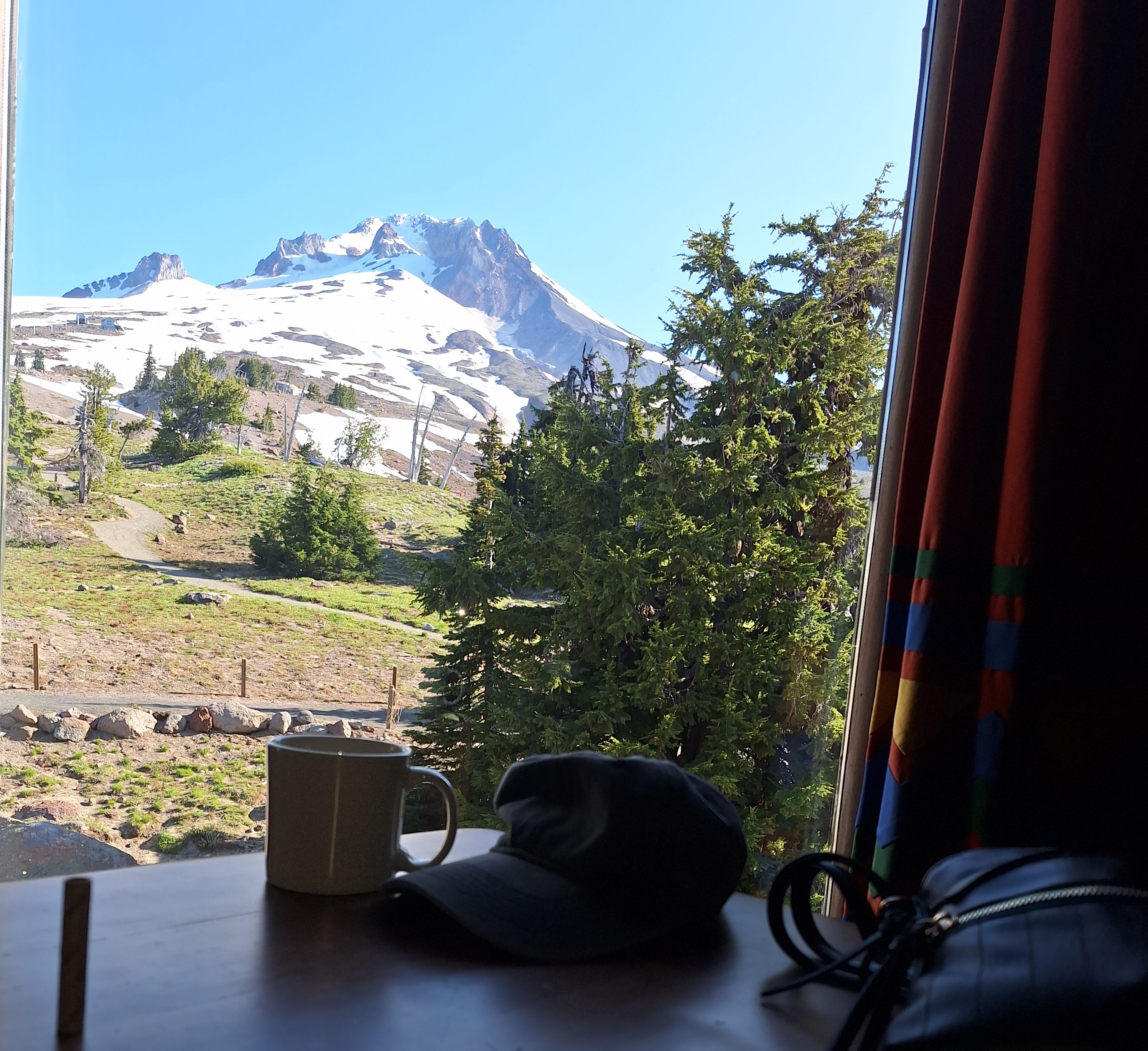
![]() |
| Timberline Coffee 2025 |
We decided that yesterday, the 17th of June, would be the best day this week. And so, 8:30 in the morning found us on the third floor of Timberline Lodge enjoying a cup of delicious coffee and a postcard vista of the mountain. By 9:00 AM we had finished our java. Out on the terrace, looking up at Mt. Hood, we noted that that the profusion of wildflowers that we anticipate for later in the summer was still in the offing. And so we returned to the car and descended 500 vertical feet to Alpine Campground.
The first thing we noticed was that the campground itself was closed. This wasn't a significant problem; we parked outside the gate and had the area all to ourselves. In a month we expect to see a meadow of asters, but we were too early for that lovely purple carpet. Lucky for us and our lepidopterous buddies, there was a sprinkling of different wildflowers.
![]() |
| Polemium pulcheria aka Jacob's Ladder, Alpine Campground |
Initially I didn't see any butterflies and so I amused myself by taking pictures for the wildflowers. Of course, being a very poor excuse for a botanist, I shared a few of these pictures (in my post trip missive) with our guru, the redoubtable Caitlin LaBar. She replied, "I don't know what those purple flowers are, but the pink ones are a type of Phlox and the yellow is Birdsfoot Trefoil." It's hard for me to imagine that Cait doesn't know what the purple ones are...she knows everything!
Of course, there is someone who truly seems to know everything and his name is Mr. Google. After a quick tutorial, I was able to use Google photos on my phone to put a name on the purple flowers: Polemonium pulcheria, sometimes known as Jacob's Ladder. Heaven only knows why (get it?) It's found in the mountains from the Yukon to Arizona. And if you rub the leaves it emits the odor of a skunk. So if you want to be popular with the ladies, don't rub the leaves.
![]() |
| California Tortoiseshell warming in the morning sun. |
Anyway, as I was strolling along, I saw a couple medium sized orange butterflies. One flew in front of me and landed at a convenient height in a conifer. Low and behold it was a California Tortoiseshell. This guy was extremely cooperative, basking in the morning sun, affording me the opportunity to capture this luscious photo.
I had heard that California Tortoiseshell was common around Timberline Lodge. In as much as it migrates from the south, I had assumed it would arrive later. Obviously, this was wrong.
We explored the meadows around Alpine Campground. On the opposite side of the road, where there is a very pleasant meadow, I ran into some purple lupine, the aforementioned Phlox and the curiously named Pussypaws. These, of course, are plants, not the dismembered limbs of felines. I saw a few tortoiseshells in the woodsy margin surrounding the meadow, but no other butterflies.
Deciding that we had done all the damage we could at Alpine, we headed down to lower elevation about 10 AM. First stop was our favorite snow park, Snow Bunny, where children go sliding in the winter and we look for butterflies in the summer. Immediately on disembarking, I caught an unusual moth among the weeds.
![]() |
| Sandra's Silvery Blue perches on her hand. |
It's a shady quarter mile walk through the woods, up a service road, to the steep slopes the sliders use in the winter. This road serves as a route for a seep throughout the summer. On this day the wet ground was littered with tortoiseshells. As we emerged from the trees, I took a failed swipe at a medium sized white butterfly and in short order Sandra caught a Silvery Blue. We were hoping for Sara's Orangetip, which is supposed to appear along with the Silvery Blue, later in the season, at higher altitudes. The status of the Orangetip, on our lifelist. remains unchanged.
![]() |
| Birdsfoot Trefoil at Snow Bunny. |
It was in this meadow that we found the aforementioned Birdsfoot Trefoil. I wouldn't have known a Trefoil from a tin foil, but this unusual wildflower caught my attention. Note how it produces small budding seed pods at the ends of the petals. Supposedly the seeds reminded someone of a bird's foot.
Earlier in the day, as we drove up past Government Camp, which is a small commercial area at 4000 feet, near which the steep road to Timberline begins, I noticed that there was a ski area creating a meadow. "Why not try that spot for butterflies?" I thought. And so, after we left Snow Bunny we added another stop to our route.
![]() |
| Greenish Blue Butterfly, Government Camp, June 2025 |
Before going on, I have to tell you that we have stopped in this area many times. A large parking lot, that undoubtedly is used by skiers in the winter, is anchored by a chalet that houses the only designated rest area (i.e., clean toilets) on Mt. Hood. U.S. 26 is the chief route between Bend and Portland., so this is a well-used rest area. Suffice it to say, on those many instances when we have stopped, we have parked near the facilities.
Much to my chagrin, when we parked near the buildings that service the ski area, we found that the parking area is bounded by a substantial drainage from the mountain. There are willows, tall grasses and a ditch with slowly moving water. This, of course, is a lepidopterist's wet dream.
![]() |
| Hoffmann's Checkerspot, Government Camp 2025 |
There were a couple small black butterflies. Caitlin has taught us that these small black butterflies are invariably duskywings. If you look very closely, they are not solid black, but at even a short distance they appear black as a banshee. In this case, they were either pascuvius or dreamy duskywings ( a genus of skipper). I was unable to get one in the net, although I got a quick, excellent look at one of these small insects sunning himself in the short grass. Unfortunately, lacking an excellent picture, our mentor is unwilling to guess which of the two it might have been.
We could see the snowball like blossoms of bear grass growing in the meadow/ski slope a hundred yards uphill. (this is a ski slope after all), and so I decided to take a walk that far up the hill. As I rounded the doublewide associated with this small ski operation I looked down at a small blossom growing in the grass and, to my surprise, I saw a Snowberry Checkerspot butterfly. This is a very distinctive insect, and I have lots of experience with it. In fact, I saw a dozen a week ago. While I was deciding whether to net it or try for a picture it flew away.
![]() |
| Hoffmann's Checkerspot, ventral June 2025 |
I made it up and took a couple pictures. (If you look carefully, you can see Mt. Hood peeking over the top of the hill.) The way back down was uneventful. Sandra let me waste another five minutes by the parking lot, but there were no more surprises.
Back home, we took pictures of our victims and sent Caitlin some of the photos and the salient field notes. For the most part we were able to make our own identifications. As noted here, that small reddish butterfly was a Hoffmann's Checkerspot. Last year, when we saw it at Alpine Campground, this was a really big deal. This year, a month earlier and 2,000 feet lower, it wasn't quite so exciting, but still, this is a rare insect with a range restricted to the crest of the Cascades in the western states.
![]() |
| Bear Grass, Ski Lift and Mt. Hood, Gov't Camp 2025 |
It took but a moment's reflection for me to pose the question, "Can you see Hoffmann's and Snowberry Checkerspot in the exact same location on the same day in June?" I sent this question in an email to Cait.
Now...my older son has over the last few months become enamored of AI...artificial intelligence. He started out by using AI for his computerized art. Now he doesn't go to the washroom without asking AI if his tissue is correct for the circumstances. And he's got me doing it, albeit to a lesser extent.
In any event, I asked this question of Google Gemini and, to abbreviate the answer, Gemini said yes. It noted that the two are both found in moist forests, and they fly at the same time of year. While the habitat for Hoffmann's is quite restricted, Snowberry Checkerspot is found over a fairly wide range, including mountain environments. A few hours later Caitlin said the same thing, using, I assume the intelligence that was gifted her by our maker, the God of Abraham.
![]() |
| Snowberry Checkerspot, Dougan Creek, 2025 |
So,
holy Moley, two checkerspots at the Government Camp rest area! Is that a good day butterflying, or what?
jeff
![]() |
| The Painted Lady as created by AI, Chuck Hill Graphics |
Recently, Sandra and I spent ten days south of the border. We had not been to Mexico since Covid hit back in 2019 and we were eager to renew our acquaintance with our southern neighbor. In the past we had flown to Mexico City and taken one of the delightful first-class buses to another Mexican city. This time we flew non-stop from DFW to Oaxaca.
![]() |
| Bienvenidos a Oaxaca |
We stayed in the centro, on the pedestrianized street, Macedonio de Alcala, two blocks from the ancient templo Santo Domingo de Guzman. Right in the heart of the old city (construction began on Santo Domingo in 1551), this was an area with relatively few trees and weedy patches,. Not only that, but from the beginning it was hotter than a horno. And so, we didn't expect to see much in the way of butterflies.
Curiously, this was not entirely the case. On our first two mornings we saw a couple species on the streets near Santo Domingo. One was a large grayish white butterfly. We were able to spot this beast flying on many occasions (at the right time of day it wasn't uncommon) but we never got especially close. We didn't bring a net and so we didn't catch one for good examination. This guy liked to fly up, so even if we had a net, it wouldn't have come into play with this species. As with all the butterflies I will mention in this blog, with a single exception, this will mean that we used distribution and a few other clues to make our best guess, but that we can't put a definitive name on the butterfly. And all the pictures of animals, unless otherwise noted, will be borrowed from the internet.
![]() |
| White Angled Sulfur Anteos clorinda |
Taking into account all those caveats, this may have been a white angled sulfur. This is a big whitish butterfly that occurs from the southern US down through Central America.
We saw one other butterfly, a smaller brownish orange fellow. Never got a good look, but he was there flying around in the mid-morning.
That was about all the cobblestones would yield for wildlife observation in this often shabby old city. But, true to the title, I want to tell you about the morning we spent at Monte Alban.
Monte Alban is a Zapotec ruin on a hill overlooking the city of Oaxaca. It is literally right out of town. The ruins are perched on a flattened hilltop about five hundred vertical feet above the city. The miracle of Monte Alban is not in its fantastic pyramids, for there are none. This is no Chicken Pizza, Uxmal or Tikal. Rather, the miracle is that the stone age Zapotecs moved the earth on the hilltop around to create a large flat space for their courtyards.
![]() |
| Emerald Swift Lizard Scleoporus malchitis |
After a remarkably bumpy ride in a well used tour van, we arrived at the site. Before heading to the ruins our guide wanted to show us the stones near the car park and explain how the Zapotecs carved them. There was a panoramic view of the city, which was mildly interesting. But the situation was dominated by the guide trying to fill time with a long explanation about the rocks. While he was droning on, I spotted a couple birds. There were House Finches, at the southern edge of their range here in Oaxaca, and a Southern House Wren. This latter is a smallish brown bird, fairly unremarkable with ochre colored flanks. Are you asleep yet?
![]() |
| Mexican Fritillary Butterfly |
We caught up with the guide at the museum where he spent way too much time talking about a few stone panels that may have been lifted from the ruins for safe keeping. Finally, we got on the trail to the ruins. We had gone about fifty yards in the blazing sun (at ten am it was already oppressive), when a man appeared out of nowhere with two little stone carvings. One was carved from stone and one was made of clay. One was Zapotec and who gives a shit what the other was. It was time to throw Sandra under the bus.
![]() |
| Dionne juno at the butterfly house |
I explained to the guide that my wife was sick with the heat and altitude and we needed to get her into the shade. He kindly told us that it was about a quarter mile to the ruins and we should meet back at the bus at noon. Look for the wood ramp leading out of the courtyard. In the words of the immortal Martin Luther king, Jr., "Free at last!"
On our little quarter mile hike, we saw a Grayish Saltator. If you have never been to Mexico, this large drab finch would be a life bird. But it is ubiquitous in the land of the margarita. So at least we knew what it was. There were a number of butterflies, fairly large with pale dorsal hind wings, and my research yields nothing to correspond with my memory. Rats! And there were small spotted butterflies that were probably Mexican Fritillaries.
Every now and then we would see a medium sized butterfly of bright orange. It never landed, but we got lots of good looks on the wing. Later in our trip we hooked up with the lepidopterist at the butterfly house at the Chapultepec Zoo. She was certain that this butterfly was Dionne juno. So there is one for sure, and here you see my picture from the butterfly house.
Soon we were down in the plaza area of the ruins. This is a large flat area with stepped stone walls, some as high as fifty feet. The area covers about 50 acres and, as I said before, there are no pyramids or other interesting structures to distract you. Look at it as the Zapotec's architectural answer to the Southern House Wren.
Luckily, in the nearby corner of this sprawling, sun drenched complex there were a couple large leafy trees with two benches underneath. We were saved!
So Sandra sat on a bench, and I made short forays out into the blazing sun to see what was around. I managed a picture of the small lizard with black and white stripes you see here. I have no idea what it might be, but there were a few of them scuttling among the hot, dry weeds.
On another quick circuit I spotted a vermillion flycatcher. This is a beautiful red bird with a broad range, easily seen in the southern US. Like a good flycatcher, he finds a preferred perch from which he shoots out to nab a flying insect, returning to the same perch to enjoy his lunch. This guy was hanging around and, as she recovered, Sandra was able to look through the binoculars and get a good look at the fancy fellow, perched on a small tree twenty yards from our shady refugio.
![]() |
| A shady tree for Schmoopie! |
Soon we saw the butterfly that would make the trip memorable. As we watched from beneath the shade trees, a large black butterfly with golden bands flew by. This was one of the most beautiful butterflies I have ever seen, and he was big! The golden bands were wider than one might expect, more so than a Red Admiral, for example. And the butterfly flew slowly around us for several minutes.
At one point he landed on the shade tree only twenty feet away. Sadly, I wasn't quick enough with the phone camera, so no picture for me.
Using the method I described in my caveats at the beginning of this blog (asking Mr. Google for images of butterflies we might see in southern Mexico) I deduced that this incredible beauty was the Guatemalan Catone, Catonepele mexicana. It seemed to be in range, and I was satisfied. Luckily, I sent a field report to our friend Peter Krottje. Peter is a better scientist than I, and he sort of encouraged me to write this blog. In the process of doing so, I realized that I had made a mistake.
![]() |
| Catone for your sins, Glassberg , Butterflies of Mexico |
Using the above method, I realized that there was a tremendous sexual dimorphism in the Guatemalan Catone, and so I consulted Butterflies of Mexico by Jeffrey Glassberg. Schmoopie had purchased this volume a year or so ago, apparently anticipating just such a situation. By the way, there are so many butterflies in Mexico that I find this book difficult to use.
But look at the picture of the page with the Guatemalan Catone. Not only is there dramatic sexual dimorphism, but...Holy Shit! There's a second species!
And so, it turns out, there are two similar species of Catones, one on the Pacific side and one on the
![]() |
| West Mexican Catone, Putla Villa de Guerrero, Oaxaca 2024 |
A friendly guide pointed out the wooden ramp and we escaped the large flat home of the Zapotec priests, richer by one golden butterfly.
jeff