Sunday, July 2, 2023

Central Oregon Part 3...The Case of the Cascade Caterpillar

    For those of you who have been following the blog this spring, you will recall that Sandra has taken an interest in caterpillars.  This is the second most obvious stop in the lifecycle of butterflies and moths. An entomologist's mantra might well be: egg, larva, pupa adult...ommm.  

Courtesy of ASU  Ask a biologist!

  Butterfly eggs are tiny and it takes a real scientist to describe what goes on inside.  As you will see, we are now at least familiar with such an entomologist.  A chrysalis,the pupa phase in the life of a butterfly, is mysterious.  Also, unless you are an astute observer of nature, a chrysalis may be difficult to find and,once found, would take a real aficionado to make much sense of it until the butterfly inside is ready to emerge.   


A love of Wooly Bears is hard wired in my DNA
   Caterpillars, on the other hand, are known to all of us.  From an early age most of us encountered a Woolly Bear wandering near the woods on a fall afternoon.  The mere thought sets me to seething with atavistic pleasure.  Dogs, fires and woolly bears, I'm sure they are hard wired into my DNA. 

    At the other end of the spectrum, if one found the caterpillar of the Cabbage Butterfly, known as the "cabbage worm" crawling in his salad it would almost certainly evoke a degree of hard wired horror.

    As caterpillars grow they molt and each successive organism is called an instar.  The penultimate instar goes chrysalis, the magic occurs, and the next thing you know, you have an emerging butterfly.  Until this week, that is about as far as my knowledge went.  Following our trip to Central Oregon, Sandra presented her picture of the caterpillar on the rock near Sparks Lake to a Facebook group dedicated to caterpillars.  A few weeks ago this group provided identification for the Oak Tent Caterpillar that we discovered in Klickitat Canyon.  In this current instance, a member identified the caterpillars we found wandering on the rocks as that of the Anicia Checkerspot.

Edith's Checkerspot Caterpillar wandering.


    If you have been paying careful attention, you will recall that the butterfly in that narrow patch of Lodgepole Pine was Edith's checkerspot.   And it was this identification of a related caterpillar that caused me to pose the question: If you find and identify a caterpillar, can you claim the butterfly?

   You might ask, "Who was this mysterious guesser who almost got it right?'  He was, no less than David James, author of Life Histories of Cascadia Butterflies.  Simultaneously Sandra ordered his book from Amazon and I forwarded his identification to our guide on the Trail of Butterflies , Caitlin LaBar, along with the above question...Can I add a new butterfly to my list?

   And here is what she wrote back: 

Yes I know David James...DJ tried to get me to do a PhD under him but I’d had enough of college after my MS...He’s super knowledgeable about rearing larvae and in assorted subjects like Monarchs, Leona’s, and promoting pollinator/bio pest control (limited or no pesticides) in vineyards and orchards, but doesn’t always get some other things right (hey, it’s why we’re one big networking community!). Anicia does not occur along the Cascades in Oregon (it’s over in the Ochocos and Blues), only Snowberry and Edith’s. All three have almost identical and equally variable larvae, so David probably didn’t pay attention to the location... Life Histories of Cascadia Butterflies was the culmination of 20-30 years of work, the first of its kind.  (Sandra provided DJ with the precise location so I guess he just didn't pay attention.)

     So, our new best friend has revealed a bit more about herself and, at the same time, may have made question number 2 moot, 

   David James, PhD still thinks he has it right. Do us mortals love it when the gods wrestle , or does it scare  us a little bit?

   Once we received James and Nunnalee's book, a new world of lepidoptery opened up. The first chapter is a must read for those interested in the life cycle of butterflies and provides a detailed account of butterfly eggs and caterpillar development and behavior.  The lepidopteran duo provide answers to a couple questions that were lingering, related to observations of monarch caterpillars.  With the exception of one blessed afternoon in Jim Monk's backyard, where we saw the caterpillars of the Gulf Fritillary Butterfly devouring his lilikoi vines, the Monarch is are the only species with which we have extensive caterpillar experience.  Before I let you go I want to relate one amusing anecdote and a related bit about checkerspot caterpillars.

  Monarchs, Gulf Frits and checkerspots are all brushfoots, caterpillars in the family Numphalidae.  These butterflies have evolved, modifying their front pair of legs in such a way that they are not used for locomotion, but rather more as sensory organs.  In this instance, Drs..James and Nunnalee tell us that in most species of  butterfly, the larva stay at home and build their chrysalis in association with the host plant.  Brushfoot and swallowtail caterpillars, on the other hand,  arbitrarily divide into two groups, those that stay at home and build their chrysalis on or adjacent to the host plant and those that become wanderers.

All you ever wanted to know about Edith's Checkerspot, James and Hunnalee

    This explains why those three Edith's Checkerspot caterpillars were traveling over a rock instead of munching on the leaf of an Indian Paintbrush, their favorite host plant.  These three had molted into their final instar and were wandering, off on a journey to select a distant site to go chrysalis.

    Back in Kailua Kona, Sandra and I have become regular visitors to the Crown Milkweed behind the library.  Without getting technical, we have seen monarch caterpillars in different instar stages.  And it is the only place we have seen a chrysalis in the wild.  I feel a little funny saying it that way, because there is little "wild" about a small, top-shaped, gray cocoon hanging from a branch. 

A Stay at home monarch goes chrysalis on a crown milkweed branch

   There is a legend within the library staff that a few years ago, a monarch caterpillar made his cocoon on the eaves of the library and the staff were able to watch out the window as it matured and the butterfly emerged.

   Well, last winter (it doesn't seem like winter in Hawaii, what with palm trees swaying and caterpillars crawling around) we went down to the library on a Sunday afternoon.  While I was looking for a chrysalis, Sandra found a caterpillar on the nearby chain link fence.  She said to herself, "Silly caterpillar, don't you know that the good stuff to eat is over there?"  So saying that, she plucked the caterpillar from the fence.  It wriggled furiously and screamed, "You idiot!  Put me down!  Don't you know I'm poisonous?"   And then she walked a few steps and placed the caterpillar on a milkweed leaf.  The poor caterpillar looked skyward with a shrug and said, "Damn!  Now I have to start my journey all over again."

   And that is the truth about wandering caterpillars.

jeff

The hapless monarch on his doomed sojourn.  Photo SKG


Saturday, July 1, 2023

Central Oregon 2023 Part 2, Sandhill Cranes and Butterflies at Sparks Lake

          Sunriver is a beehive of a resort community about 15 miles south of Bend, Oregon.   While Bend has become ever more fashionable, Sunriver has become overbuilt and busy.  About thirty years ago the State of Oregon created a highway connecting Sunriver with Mt. Bachelor, paring the drive to one of the west's premier ski resorts from 45 minutes to 20.   We took advantage of this delightful new highway, which in June was lightly traveled, and found ourselves at Sparks Lake, ten miles south of Bachelor, in about thirty scenic minutes.

SandhillCranes.  Sparks Lake, June 2023

     And scenic is the official word.  the road out of Bend is Century Drive, but starting three years ago it is now known as the Cascade Lakes National Scenic Byway. 

    Because the drive was so easy, Sandra and I arrived early at our destination, the overflow parking area for the Mirror lake Trailhead.  We were itching to see Edith's Checkerspot, but it was just after 9 AM, too early for butterflies. So we sat in the car admiring the huge meadow sprinkled with buttercups.  Once afoot, though, we spied two large birds a couple hundred yards in the distance.   A quick look through the binoculars revealed these to be Sandhill Cranes.  We walked about 75 yards into the meadow for a better look, still leaving a respectful distance between us and the cranes.  We were rewarded not just with some improved photography, but a glimpse at a chicken-sized chick that was being fed by the foraging adults. 

Look carefully to see the chick at the feet of her parents.


     These big birds, in contrast to Whooping Cranes, are not especially rare.  Long ago, in the Strawberry Mountains north of Burns, I was lucky to see a pair with a chick. That was at least thirty years ago.  For someone who doesn't get out much, these cranes were a very lucky find.  The Oregon Department of Fish and Wildlife put only a few breeding pairs in the Cascades, while the Malheur National wildlife Refuge, 30 miles south of Burns, represents a sure thing if you want to see breeding Sandhill Cranes.

    The pictures you see were taken at about 150 yards.

    We then turned our attention to the meadow and trooped back and forth, upsetting a couple Killdeer,  finding nothing in the way of butterflies. We then went up to the Sparks Lake Campground and over to the Mirror Lake trailhead parking lot.  Having wasted 45 minutes, we gave the meadow another go.  I walked the meadow in the manner of an under paid hunting dog for forty minutes.  I upset some more killdeer, flushed a spotted sandpiper and found one butterfly, a handsome greenish blue that was too elusive for the net.  

Killdeer with chick,  Sparks Lake June 2023

   At about 11 AM I made it back to the car and decided to take one more look at Caitlin LaBar's instructions regarding this rare checkerspot.  She had written, " Walk between the parking area and the creek...mostly in the scattered trees and gravelly soil close to the highway.  That's where most of the butterflies are.  I didn't see much out n the meadow other than Greenish Blues."  Well poop on a stick.  I'd spent two hours patrolling the area adjacent to the butterfly habitat.

   Sandra and I geared up and took off into the gravelly woods.  Compared to the meadow it didn't look like butterfly habitat.    For the first fifteen minutes all we found was a nest of Killdeer.  This brood had hatched and there were several little killdeer scuttling about in the gravel and among some scrubby dead branches.  I took seven pictures in all.  Later, I would assume that I had placed a chick in the center of each shot, but I was able to find a chick in only two of the seven pictures.  Like the octopus, killdeer chicks are cryptically colored to defeat my camera.  With luck you see the chick in the picture provided here. Of the seven photos, this is the one in which the chick is most apparent.

The Caterpillar of Edith's Checkerspot,  photo SKG
 

    Shortly after the killdeer clutch we found several caterpillars in the gravel. You see the best picture of these caterpillars here.  As a silly aside, its a lot easier to take pictures of caterpillars than the butterflies they eventually become!  And here-is a philosophical question, "If you find the caterpillar, can you add the butterfly to the list?"   The whole situation is rather Kafka-esque, don't you think?

  As I understand it, caterpillars are supposed to eat leaves and then weave a chrysalis.  Compared to a lush leaf, these rocks constituted thin soup, to say the least.  But there were three doing the same thing, so I presume it wasn't an accident. 

   We made it all the way to the creek, perhaps a quarter mile and turned back.  Suddenly I had a small butterfly sitting in the gravel.  He held still for the picture you see here.  I had no idea what it was, but I was confident it wasn't Edith's Checkerspot.  In short order we found a second similar butterfly and Sandra netted the sucker.  Wham!  We escaped the skunk!

Western Pine Elfin in the gravel, sparks Lake 2023

   About ten minutes later we were back at the car park.  Just before I turned to open the car door, flopping around in the dust, was a checkerspot butterfly.  My net descended and he was ours.  At this late date the idea that I would attempt a photograph in lieu of netting was out of the question.  

   And so, back at Sunriver, the work began. The butterflies were cooled and the boys served as excellent butterfly models, allowing me to move their hand just so after Sandra placed a butterfly in their palm,  Everyone was happy with the possible exception of the butterflies.

   I did the photo shopping and sent the results off the to Great Oz.  Caitlin sent back the verdict in a mere few hours. The checkerspot was Edith's, as we were fairly certain.  The other butterfly was the Western Pine Elfin  I remain a bit overwhelmed by the task of identifying these small butterflies, yet I suppose I should be ashamed at relying on someone else to identify them for me.  At least we have unimpeachable ID.

A cooled Edith's Checkerspot in Reid's palm.


   The Western Pine elfin is fairly widely distributed in Oregon.  It is one of two butterflies that employ pine needles as their host plant, utilizing both Lodgepole and Ponderosa Pine.  Thinking about the wide distribution of Lodgepole Pine, it makes me wonder;  have we not been looking with enough care in habitats west of the Cascades where lodgepoles are the prevailing tree?  

    The following morning we took the butterflies to a sunny spot in front of the Sunriver rental.  We started with the checkerspot and then the pine elfin.  We waited for the pine elfin to open, but instead he took off.  I stood, camera at the ready,  and chased him across the yard.  As I watched, a small butterfly landed in an ornamental pine and I assumed it to be the pine elfin.  But obviously it wasn't!

    For a few seconds I was befuddled. "What the hell is going on here?"  I asked myself.  "Are we back to one new species of butterfly?"

The Edith's Checkerspot on the lam.

    As it turned out, as I began my pursuit, the checkerspot took flight, flew past me and into the bush.  The pine elfin ascended into the lodgepoles where perhaps it found a mate.   A rare instance where we moved a butterfly from its preferred habitat to another acceptable habitat.

    The story isn't quite over, but you will have to remain in suspense until the next installment: Central Oregon Part Three...the Revenge of the Caterpillar!

jeff 

Wednesday, June 28, 2023

Central Oregon 2023, Butterflies Birds and More! Part 1

          Last week Sandra and I took our annual sojourn to Central Oregon to look for butterflies.  This was paired with a family vacation, so although we spent some quality time in the out of doors, we were incarcerated with a pair of raging beasts for at least an equal period.  

A Mother Merganser and Her Ten Ducklings Ply the Deschutes

     We blasted out of Portland, made the uphill turn at the Dalles and arrived at Sherar's Bridge on the Deschutes a bit after 10 AM.  This is the spot where we had such terrific luck a month before and we were both excited about the prospect of another puddle party at our favorite  sandy boat launch.

    As we stepped out of the car a mother merganser and her family of ducklings scuttled across the river, which made for a nice picture.  Who among us doesn't like baby ducks? 

A Tiger Swallowtail makes a touch and go on the mud.

   But as far as butterflies go, the short answer was virtually nothing.  A few Tiger Swallowtails made touch and go landings, but nothing else wanted a piece of that nutritious mud.  An Ochre Ringlet teased us in the grass nearby, but there were no other butterflies.  Not only that, but the parasitic wasps, upon which I was determined to make my reputation as the bad boy of Northwest Entomology,  were not in the hackberry bush.  Reputation denied!  

    As we sat stewing in the BOT-mobile, a pair of fishermen arrived to launch their inflatable into the rushing river.  They were a friendly sort, and like virtually everyone we meet, they were very accepting of our pursuit of butterflies.  As they were now occupying the boat launch for what I must concede was its intended purpose, we bid each other good luck and Sandra and I headed down the Deschutes.  


   Our only fruitful stop, from the standpoint of lepidoptera, was a campground about three miles further down river from our favored boat launch.  There were a few things flying, and in one of the stream side willows I took a poor photograph of a Dark Wood Nymph.  This blurry picture served a purpose, in that to identify the species one must compare the oculi on the ventral forewing.  In this case the top bullseye is larger than the one below.  Tick it off.

    On the way back to the car we spotted a couple butterflies lounging in the dusty grass and succeeded in netting one.  This was to be our single trophy on the day.  Later we had a chance to cool and photograph what turned out to be a female Sagebrush Checkerspot.  I suppose I should be proud for identifying this on my own (Caitlin LaBar confirmed the ID) for this is one drab butterfly.  I mean, how did she expect to attract a mate without the tiniest hint of make up?  Perhaps we did her a favor by taking her to Sun River where she could shop with the glitterati for a more stylish outfit! 


   By comparison, the male Sagebrush Checkerspot is a real clothes horse.  You will recall that we photographed this foppish butterfly on the aforementioned boat launch a few weeks earlier.  If this drab female is too depressing, I suggest that you refer back to the previous blog for a peek at the resplendent male.  

  Figuring that the fishermen must be well on their way down the Deschutes, Sandra and I made our way upstream to the boat launch.  When we arrived there was nothing doing, so we pulled into the shade and enjoyed a bite to eat.  Sandra then wandered down by the river while I searched for birds in the vicinity of the wasp-less hackberry bush.

   And as in uffish thought I stood / An ungulate with eyes aflame, / Came wandering 'pon the rimrock ridge, / and nibbled as it came.

My First Bighorn Sheep, Sherar's Bridge 2023

    And what was this strange large beast?  "Sandra!" I called out, ""You better get up here.  There's some large animal on the ridge!"

    By the time she got to me, the one had been joined by two more.  The trio were at least a quarter mile almost straight up, but so large were they that it took my sweetie but a trice to spy them.  We traded off the binoculars and I used the telephoto to its best advantage in getting the pictures you see here.  

    As we watched, more animals emerged.  Moving in a leisurely fashion, nibbling at the dry grass, they wandered from left to right.  As they did so, more appeared, including two or three kids.  These large, bulky ungulates has swept back horns, not particularly large, certainly not curling around like Princess Leia's coiffure.  Never the less, I was fairly sure that these were Bighorn Sheep.  They certainly weren't Mountain Goats, or domestic goats, for that matter.  And they were big, with bulky white hind quarters, the better to announce their presence.  

A pair of bighorns high up on the rimrock.

     "How many species of large hoofed mammals roam the high desert of Oregon, anyway?" I asked in my most uffish soto voce.

    So how many butterflies do you trade for a flock of Bighorn Sheep?  Especially if it is the first time you have seen this species?  Not just in the wild, mind you, but maybe anywhere.  Is there a Bighorn Sheep in the Desert Museum in Tucson, which I visited thirty five years ago?  If so, my aging memory was unable to pull it up. The Portland Zoo, where Sandra and I are members, has Mountain Goats and Black bears, but no bighorns. 


 And so, as Sandra and I made our way down U.S. 97 on a glorious summer afternoon, past Mount Jefferson, the Three Sisters, through Madras, Redmond and Bend, we had something delightful to discuss.  A whole family of Bighorn Sheep! 

A Bighorn Family High on the Rimrock.


     Stay tuned for our next installment.  We promise a few more butterflies and other delights in the offing.

jeff


Wednesday, June 14, 2023

A Visit with Chris Marshall

Realkrit's Blue Butterfly, Utah 2023  photo Bob Hillis
   Recently my compañero, Sr Roberto Hillis, queried regarding the use of  a net, from a philosophical standpoint. in the pursuit of Lepidotera.   He had just spent over an hour taking a picture of a small, elusive butterfly,  Realkrit's Blue, and was wondering how we felt about the use of nets in pursuit, identification and photography of butterflies. Before going on, I gotta tell ya that Bob is seeing some killer shit in the Rocky Mountains. I mean, who has ever heard of Realkrit or his obscure (by West Coast standards) little blue butterfly?   Bob and Kim have invited all of us to join them in St. George, Utah next May for a butterfly extravaganza.  Let's get ready to party!

   Bob Pyle is the leading lepidopterist in the Pacific Northwest.  Despite the fact that he lives in the middle of nowhere, miles and miles from any institution of higher learning, the academics from around the country, not just here in Oregon and Washington, defer to him.  Keeping in mind that he is not intimately associated with a collection, one should, I suppose, accept his position on the taking of butterflies for identification and photography. 

Robert M. Pyle, the Dean of Lepidoptery
   Bob Pyle says, " Compared to habitat destruction the taking of a single butterfly is insignificant."  Or to put it another way, it is just fine for Bob Hillis to net that butterfly, take it home and cool it, take its picture and release it, knowing fully well that it is not going make it back to the spot where it was captured.  Adios amigo.

   Sandra and I have collected butterflies for photography a few times, but now that we have a better camera,  we sometimes find ourselves taking the camera into the field and leaving the net sitting on the floor of the back seat.  At least here in the PNW,  photographing butterflies in situ is a sport unto itself.   And with the right equipment its not too difficult ...most of the time.  

    Of course, if we are going on a hike, we take a net or two, two sets of binoculars and two cameras.  Thus, we are ill prepared for netting if a strange  butterfly zips by.  We are taking better pictures, but, as you will see, we are missing out on some identifications.  And as a final philosophical caveat, I hate killing things, so maybe this is OK.

   A situation like this came up yesterday.  It was a cloudy day, but it was the day we had, so we wandered up to Dougan Falls.  We got there a bit before noon.   It was cloudy, breezy and the thermometer in the car said it was 63 degrees outside.

The Western Meadow frit, Dougan Falls, June 2023
  Our fist two stops yielded no butterflies.  Luckily, as we waited at our favorite spot, the sun came out, and things started to move.  I spotted a Western Meadow Frit on a pile of dirt.  He cooperatively flew to a thimble berry leaf where he flattened out and pirouetted until his wings were in the perfect position to catch some rays.  
 

   He was a happy little sun bather and I had the camera handy.  At my leisure I took a pretty good picture.No net required. 

  Then, from across the gravel road, Sandra hailed me.  She had a small dark butterfly and together we chased it down the road until it flew into the forest.  We stopped for a moment and then she said, "Look, there's one right around you!"  And indeed this little black bug was circling me.  I got a pretty good look for a couple seconds at this small flying insect.  The nets were in the car, so we had no opportunity to capture it.  Of course, it flew into the forest, preventing photography.  I then retrieved the net and waited for ten minutes, standing in the road with my butterfly net, looking like a refugee from the local mental institution, but no more little black butterflies appeared. 

Clodius Parnassian, Dougan Falls 2023

   Playing the sour grapes card, Sandra wanted to write it off as a moth.  It was chubby, all right, but I think it was a skipper, possibly a duskywing, of which their are two species on the wing at this time of year in Skamania County.  Its debatable whether we would have successfully netted this fast flier, but as it was we never got a chance to try. 

   The sun continued to go in and out and we were treated to another hour of butterflies.  There were lots of tiger swallowtails and Lorquin's Admirals.   And at one point we were visited by two or three Clodius Parnassians, one of which did somewell positioned  nectaring, so I could snap this picture.  Look carefully and you can see the cherry red dot peaking out under the right forewing. 

    We've already brought these butterflies home, chilled them and taken some excellent pictures, so there was no reason for any netting.  Suffice it to say, their little ghosts  linger over my guilty conscience. 

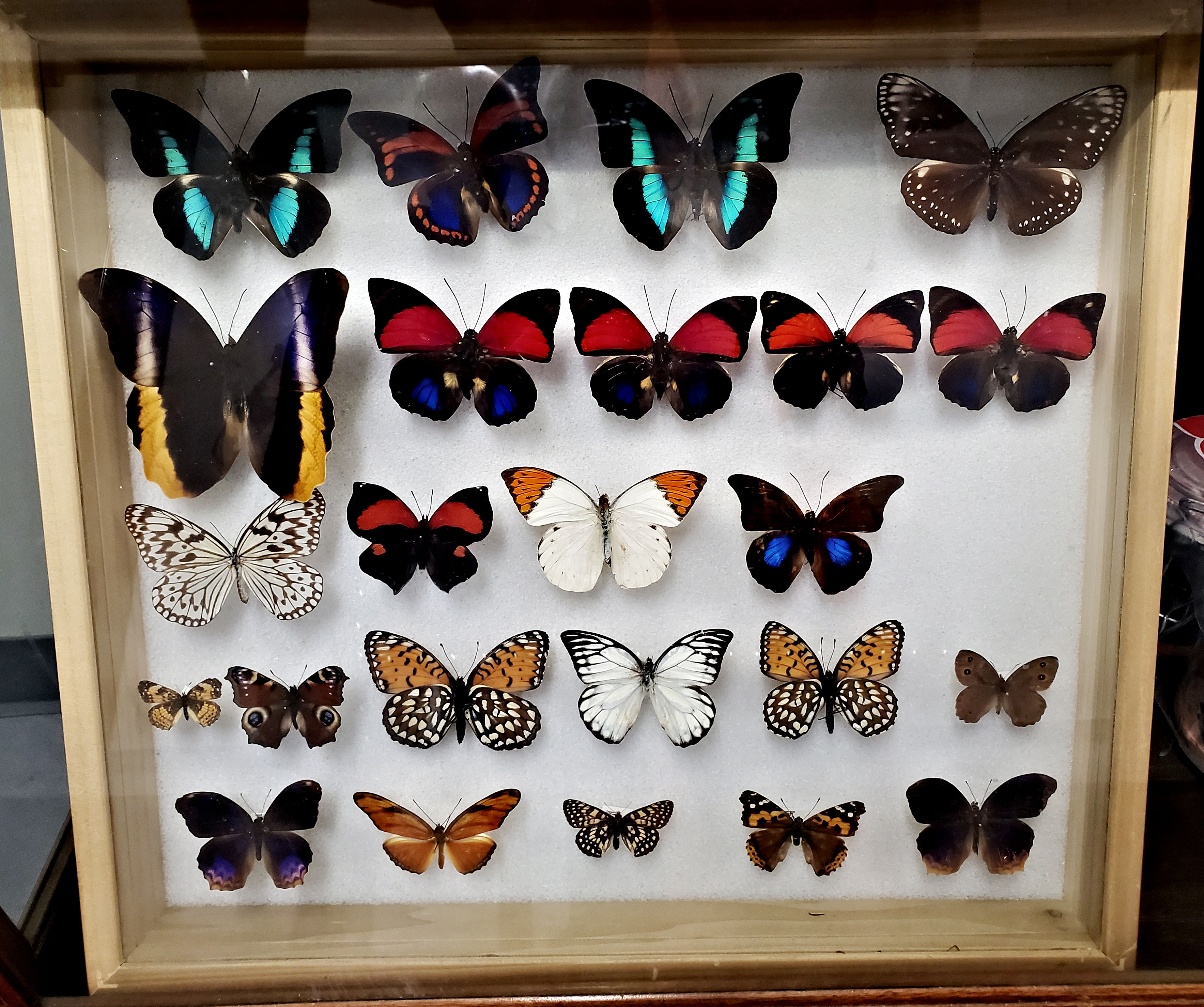
   Which brings me to the next part of the story...  Last Wednesday Sandra and I visited the Insect Museum at Oregon State University in Corvallis.   We had been invited, after a fashion, by Paul Hammond, who is the bull goose Lepidopterist at that fine institution of higher learning.  We sort of wandered in unannounced, and were pleasantly surprised to be greeted by a friendly giant wearing a necktie.  

   This well dressed colossus introduced himself as Chris Marshall, the curator of the insect museum at OSU.    We talked about butterflies and he was regretful that Paul Hammond wasn't in.  It remains to be seen if Paul would have shared this sentiment or Chris's cordiality.  We looked at his exhibits in the hallway and we talked about me donating a paper mache butterfly to the Insect Museum.  I don't know which was cooler, the weather outside or Chris's reception to my offer.  Actually, he was very nice and we may send him a butterfly just to see what he does with it.  


  Later in our visit he told us of  a convocation that OSU holds each October in which people interested in butterflies convene at Cordley Hall to share their experiences.  There are academics, talented amateurs like our dear Caitlin LaBar, and a variety of other characters.  Chris mentioned one gentleman who, at this gathering, sells jewelry made from butterfly wings.  

    Chris kept saying that he had to get back to work, but made no strong effort to shoo us along,.  I asked for a picture and he went to one of the large metal cabinets in which the butterflies are kept, brought out a tray and posed with Sandra.  Count if you can, the butterflies in that tray, then multiply it by several thousand, for there were so many rows of these large metal cabinets.  Do you remebber Carl Sagan ,the astronomer, saying, "billions and billions and billions?"  Such is the infinite number of deceased butterflies in the museums around our United States. 

   While he allowed that he, too, doesn't like to kill anything, I got the distinct impression that Chris thinks its just fine to catch and preserve insects.   

The Redoubtable SKG meets the Colossus


   Chris and I looked through a few drawers, attempting to find the butterfly from Malaysia named for Pierre Lorquin.  I saw some beautiful butterflies, but not the right one, and finally it was time to go. 

   While this was interesting in its own way,  and perhaps a little depressing, I hope it gives Bob Hillis  a perspective on the loss of one butterfly from the environment.  So let's lift up our chins, do what we can to protect the diversity of host plants and enjoy the miracle that God has given us in the fascinating multitude of insects.

jeff


A chilled Lorquin's Admiral gives his all as a model.


Friday, June 2, 2023

The Skippers of Klickitat Canyon

    Roughly speaking, there are two groups of butterflies.  The Papilionoidae, also known as scudders, and the Heperiidae, known commonly as skippers.  No one uses the name scudders, but all insect watchers know what skippers are. These are the lesser butterflies.  They tend to be smaller, less colorful and are built around stout bodies.  If one is building a list of the butterflies he has seen, he definitely wants to identify the skippers; they count as species on the list.  But if you are just sitting around browsing the field guide, it is unlikely that you will pick a skipper as your target species for your next adventure in the field.

Two Banded Checkered Skipper, May 2023

   A month ago at Dougan Falls, we were watching the profusion of Echo Azures when I noticed a small butterfly, nectaring on dandelions,  that I initially thought might be the female echo.  It was reminiscent of Metalmark, but it was tiny.  That evening it was identified as a Two Banded Checkered Skipper.  So you see, like it or not, those skippers creep onto your list.   

   Recently we asked our mentor, Caitlin LaBar, about Klickitat Canyon, one of her favorite sites relatively close to Vancouver.  She gave us instructions and we got all excited to go.  And then, as we researched the butterflies we might see,  we discovered that the specialties of the area were skippers.  There were three species of skippers, the  Propertius and Pacuvius Duskywings, and the Northern Cloudywings.  Cloudywings, duskywings? Sounds downright gloomy, doesn't it? But by the time we had fully appreciated the skipper situation we were excited for a walk in Klickitat Canyon and the trip was on.

Pacuvius Duskywing, male Klickitat Canyon May 2023

   The day we picked was cool and a strong wind was blowing in the gorge as we made our turn off Highway 14 at the Lyle trialhead.  We had been directed to a portion of the trail roughly ten miles up the Klickitat and we enjoyed views of the rushing stream as we drove on an excellent road.   

    We disembarked a bit after 10 AM and, encumbered with a net, binocs and cameras, we headed down the Klickitat.  This area is far enough east, that Garry Oaks are the mainstay of the riparian forest.  It is far from coincidental that the duskywings require the oak leaf litter for "hibernal sites", and according to Bob Pyle, the range of the Propertious coincides almost exactly with that of Garry Oaks.

Propertius Duskywith female. nectaring.

    As many of you know I spent two and a half decades in Salem, Oregon, where Garry Oaks form the backbone of the forest. The official flower of Salem, however, is the poison oak.   One Christmas, early in our tenure there, I contracted poison oak while cutting the family tree.  It was an unforgettable experience and I became an expert at identifying this annoying shrub.  But despite my caution, I managed to get poison oak a couple more times. Thusly indoctrinated, I was immediately cognizant of the lush growth of poison oak just off the trail.

   Luckily, the skippers were all over the place and posed on rocks, flowers and in the leaf litter.  So cooperative were these insects that it wasn't necessary to chase them into the forest.   We got many pictures and Caitlin verified that we recorded both of these extremely similar species.  When it came down to it, I found these duskywings to be rather attractive, in a conservative, subdued sort of way.  As you will notice, there is considerable sexual dimorphism in the duskywings. The Norhthern Cloudywing, which we missed, is a seriously dull bug, described by Pyle and LaBar as "muddy dark brown".    

Propertius Duskywing chilling in the oak leaf litter. 


   As the morning progressed, we were graced with a myriad of tiger and anise swallowtails, numerous ochre ringlets, and a few Lorquin's Admirals.  It was really quite delightful. 

jeff


Sandra found an Oak Tent Caterpillar!


Saturday, May 27, 2023

The Butterflies of the Deschutes

     Sandra and I just returned from a quick excursion to the Deschutes River and Timberline Lodge.  We met some wonderful people, saw some great butterflies and ate too much at breakfast.  It was a perfect trip.

The Deschutes River rushes through the Oregon Desert

    Our route took us to the Dalles on the Columbia River.  From there we turned south and ascended a steep passage through rolling green wheat fields, arriving in Dufur before 9 AM. There we stopped at the ranger station representing the Mount Hood National Forest, hoping to get some inside information on the roads, especially the one leading west where I planned on driving by Camp Baldwin, my Boy Scout camp from five decades in the past. 

    In the office there was a lady of approximately our age and a young gentleman we took to be her grandson.  Given the progress, or lack there of, the young gentleman ( he looked to be about 10) was remarkably patient and well behaved.  The lady was Caucasian and the youth looked to be two thirds Warm Springs Indian.  Across the desk was a plump lady, probably not a ranger as she lacked a spiffy uniform and a hat, who was doing her best to prevent the lady on our side of the barricade from procuring a wood cutting permit.  

Oregon Swallowtail, white abdomen, yellow dusting, eccentric spot.

    After a few minutes of obfuscation,  the officious secretary went in the adjacent room to look for yet another means in which she could prevent the applicant from legally cutting firewood.  As it appeared that she was never coming back, we made friends with the gray haired granny.  I asked her, "Back in 1968 did you happen to be a cute young thing and attend a dance thrown for the horny young counselors at Camp Baldwin?"  Actually we asked if she thought the route past Camp Baldwin was a good way,  on this warm sunny day at the start of the Memorial Day Weekend, to get to Mount Hood.

   No, she said, that road was still closed do to snow.  Ordinarily it would be open by now, but we just had so much snow last winter. 

Sagebrush Checkerspot, Deschutes River, May 2023

   Well, all thoughts of peri-pubescent dance parties in the mess hall went out the window and we moved on to Plan B.  What about the BLM road on the far side of Sherar's Bridge?  She wasn't sure about the condition of the road, but she did acknowledge that the road to the south would take  us to Maupin, where the was indeed another bridge across the Deschutes and a nearby road that would take us to Timberline Lodge on Mt. Hood.  She added that the road was not just on BLM land but that there was private property and Indian land interspersed.  

   We bid the nice lady and her patient grandson good luck with the firewood and headed south.  On a signpost just out of town we saw a meadowlark, no longer a common bird. Fifteen miles down a steep canyon, we made the turn onto Sherar's Bridge Highway.  The road passed through dry, rocky ranch land.  We saw a sparrowhawk hunting in the field to our right and, after a bit, a covey of quail ran across the road.  Soon we passed under a railroad bridge and into the canyon of the Deschutes, where we were greeted by a wildly rushing river and signs telling us we were on the Warm Springs Indian Reservation,  day use fees must be payed.

Sagebrush Checkerspot, ventral Deschutes, May 2023

     Obviously, we were in the middle of nowhere, and the question is, "Why?"   As you know from last year, we have made internet friends with Caitlin LaBar, co-author of the book Butterflies of the Pacific Northwest.   Last year she was kind enough to direct us to Peterson Prairie on the Washington side, where we saw a fantastic display of fritillaries.  A couple weeks ago I wrote to Caitlin, saying we were going to Mount Hood and did she have some advice for sites there.  She responded by giving us tantalizing details of her recent trip to the Deschutes:

  Today I drove down to the BLM Rec site along the Deschutes north of Sherars Bridge and hit the jackpot: 15 species! Lost count of Anise Swallowtails (over 60), at least 3 Oregon Swallowtails mixed in, a handful of Indra, several Silvery and Acmon blues, couple Gray Hairstreaks, two Echo Azures (first I've ever seen there), and some brand new Northern Checkerspots just popping out, along with a few Sheridan's Green Elfins and few other random things. The swallowtails were mostly on the sand beaches at various boat launches and day use sites, and the checkerspots and greenies were on an old road grade trail that is kind of hard to spot along the road ...

Coronis Fritillary, an oblique view, Deschutes River, May 2023
  And now, here we were, ten miles downstream from Maupin...butterfly central.     

 We crossed Sherar's Bridge, leaving the Native American's behind, and turned north onto the BLM road.  This was an excellent gravel road winding through a spectacular desert canyon. We stopped for some pictures and I heard a Rock Wren chuttering from the cliffs above.  We passed one boat launch, where there was no sandy beach and a mile or so further down the canyon, we stopped at a second boat launch.  Armed with our net, camera and binocs, we made our way towards the beach and immediately saw an orange butterfly.  Ten steps further and I saw several butterflies on the beach.  

    The most obvious butterfly was what I took for an Anise Swallowtail.  We got this excellent picture along with a lousy shot in the lateral position.  It took our debriefing with Caitlin to point out that this is an Oregon Swallowtail.  The body is basically white with three narrow black stripes, there is yellow dusting on the cell and the black spot inside the orange is eccentric, touching the edge.  In the anise that black spot is right in the middle, like a bullseye.  

Echo Azure, ventral surface, Washougal River May 2023

   Blue butterflies were all around.  A few years ago, I was unaware of these small blue insects.  But if you really pay attention, you see them frequently.  They are small and the males all have a blue dorsum.  There are many species, at least a half dozen in our area.  The trick is to find one in what I call the resting position, with the wings folded up, and get a good look, a really good look at those ventral surfaces.   Such accuracy is required that a photo is a big help.  Or, if you are lucky, you can see see a female, which are diagnostically colored but, in our experience, seldom seen.  

Boisduval's Blue, Descutes river May 2023

    A few weeks ago near Dougan Falls, Sandra and I found the Echo Azure.  As above, Caitlin saw it here on the Deschutes three weeks ago, as well. 


    In my case, I created my own little puddle party environment by urinating in the dust where these little buggers were fluttering in profusion.  And it worked!  To paraphrase the Big Lebowski, "Every time someone micturates in the dust do I have to identify a little blue butterfly?"   Above, you can see the picture, taken by The Dude, of the little blue Echo Azure at his leisure in the moist dust. 

    Back on the Deschutes,  it took a while, but I finally got one good picture of the ventral surface of these blues.  And here it is.  Boisduval's Blue.  No piddling required.


    As you may recall, Boisduval was the a big schmoo in the museum in Paris during the age of discovery.  He sent Pierre Lorquin all over the world and described and named the specimens that Pierre sent back.  Pierre Lorquin is my hero, but this particular butterfly (not especially uncommon) is named for the boss.


A good look at the ventral surfaces of Boisduval's Blue!


     There were many checkerspots, and they were all the same.  Like the "anise" they were warming on the sand and some were puddling, sucking up nutrients from the wet sand.  We got many fine shots including many dorsal and just one lateral / ventral shot you see here.  These turned out to be Sagebrush Checkerspots, a second life butterfly for the Snorkel Kids.


    Another butterfly we saw in profusion was a medium sized fritillary. It was this orange frit that had first attracted my attention as we got away from the car.  We got many good looks and a couple good photos, but these are difficult butterflies.  And so I solicited Caitlin's opinion.  I had thought it was Zerene, but she said that it was the similar Coronis.  Among other things,  it is too early in the season for Zerene.  Caitlin tells us that she has not seen frits on the Deschutes, so this one represents a small feather for our cap.  I'm giving you an oblique view so you can see both dorsal and ventral surfaces.

    The last butterfly we saw at this location was a single buffy individual.  As you can see, I got a pretty good picture.  The butterfly was quite plain, but just enough markings to declare it an Ochre Ringlet.  (Caitlin's ID, so you can take it to the bank)  Usually found in grassy habitats, it seems a bit out of place in the desert.  But of course, there are grasses growing near the river and apparently that is enough.  

A small wasp with a thread waist, yellow feet and a red abdomen.

     These were the last new butterflies that we were able to photograph.  We drove down the Deschutes another couple miles and investigated a couple camp grounds with sandy banks, but no lepidoptera.  We then drove back to the productive boat launch and backed into the shade of a shrub, where we ate lunch in the car with the AC going.   There were a few butterflies flopping around on the sandy boat launch, but nothing new.  Behind the car, though, was a shrub in which a number of small, thin waisted wasps with yellow feet and long red abdomens were plying their trade.  I was nervous to get too close and the camera never focused perfectly on one of the active little bugs.  Here is my best picture.


   Perhaps someone will know what this is. In the meantime, butterfly season is upon us and we're back in business.

jeff

Sorry if some of the photos are out of order. to try to fix this might cause an editorial dilemma of unspeakable dimensions.  Thanks for understanding.

Follow up on the wasps.  Daniel Rubinoff says:: 

those are ichneumonid wasp males I think. maybe hoping for females to come by. they are lep parasitoids probably 

Wikipedia (that all knowing scientific resource) says that there are thousands of species of these in North America.  The larva live parasitically inside caterpillars.  So perhaps the circle of life has the butterflies on the beach laying eggs in the shrub and wasp caterpillars parasitizing the resultant caterpillars.  

And Bob Hillis writes:  Thanks for the info. I am amazed at how many parasites there are, and how diverse they are. Some have really complex life cycles. I think the ones that infest the brain of their host, in order to make the host behave in a way that facilitates the parasites lifecycle are insidiously creepy. They remind me of politicians.


Wednesday, March 29, 2023

What we saw this week.

    The week began pleasantly enough at the pier.  As Sandra dropped me off, we were lucky to catch a nicely endowed lady in a miniature key lime pie bikini unloading her paddle board.  By the time I made it down to the sand, Venus had positioned her seven year old daughter on the bow of her board and was paddling out for a rendezvous at Milf Island with Jack Donaghy.

     Sometimes living in Kona can be a rough job, but somebody's gotta do it. 

    The water was clear and cold, still hovering around 75 nippy degrees Fahrenheit.  Which apparently isn't bad if you've just flown in from Sioux Falls, but makes me glad for my neoprene vest.  By the second swim buoy I spotted a small Stout Moray racing across the sand.  This guy was white, with spotty black markings, an unmistakable pattern.  I turned and followed him.  I couldn't keep up and he disappeared beneath a coral.  Luckily he was replaced by a huge pictus moray.

The Ironman side is a good place for pictus.


   The pictus is a fairly ugly eel, but they grow big.  This guy must have been four feet long and as big around as my thigh.  (That probably says more about my old white guy wimpy thighs than it does about the eel.)   He swam around and around, permitting me several close approaches.  All of which begs the question, even though this is not the most infamous species, how close does one want to get to a great big, actively hunting eel?  On this day I figured about three feet was close enough.    

   I didn't get a great picture, but on the other hand I didn't get bit.  This large gray eel is unusual anywhere else, but quite dependable on the Ironman side of Kailua pier.  Over the next 40 minutes I saw two more of the unattractive brutes.  

   Additionally, my swim turned up a cushion star and a nice pair of oval butterflies.

Snowflake Moray Eel, Kahalu'u March 2023
   A few days later I went swimming at Kahalu'u.  It was early afternoon and the place was teeming with full contact snorkelers. Luckily, there ware also a few fish.  Right at the opening I had a close encounter with the male Pearl Wrasse.  Once again he was cooperative enough for photography, but you surely had your fill of that fellow in the last blog.

    A little ways away, I spotted a tiny Snowflake Moray.  He was hiding in some rocky rubble, but poked his nose out for a picture.  He was just a little bit bigger around than my thumb and the picture was taken at about one foot.  Little danger of this shy fellow causing any damage! 

   Considering all the people in the bay, there was a nice group of fish on this sunny afternoon.  Rockmovers were plentiful.  There were a few big adults, at least two dragon wrasses and several youngsters who had just left that infant stage behind.  I tried to take a movie of one of these adolescents, still bearing the "antennae" but otherwise looking like an adult, he was  flopping this way and that, as if he were still a dragon and might be mistaken for a piece of seaweed.  My movie making failed, so use your imagination. 

Hawaiian Dascyllus adolescent, Kahalu'u 2023

   There were several Hawaiian Dascyllus babies with the bright white spot on the flank and a blue dot on the forehead.  With patience I got a flash picture of one of these guys hiding in a depression in a coral.  Around the far side of the bay, by the Rescue Shelter, I found a really nice adolescent.  He was actually fairly cooperative and I thought I had a shot worthy of a Christmas card.  But when I got to shore I discovered that the camera didn't quite achieve perfect focus.  Rats!  Anyway here is a pretty good effort at an adolescent dascyllus.


All of which brings us up to Sunday.  Sandra and I go to the Lutheran Church Which offers the opportunity to sit outside with a group of parishioners who fear that inside poses a greater risk for Covid.  In addition to the reduced risk of contracting an infectious disease, the view from the lanai, where us cowards watch the service on a big screen TV, can be pretty good for wildlife observation.   Recently, while Pastor Brian droned on, us outsiders were treated to a pair of Hawaiian Hawks as they performed an aerial mating ritual.  

Stareye Parrot imitating Saul of Tarsus on the road to Damascus.
   On this morning, we had sung the closing hymn and Pastor Brian was introducing visitors to the day's service.  At this moment, out on the lawn, twenty feet away, I spotted a butterfly We see lots of butterflies from our choice lanai seats: bronzy monarchs, yellow sulfurs and citrus orange Gulf Frits.  But this butterfly was black.  And he had unmistakable red in the wings.  A goddam Red Admiral!  

   "Look at the butterfly!" I directed my fellow lepidopterist, as I bound from my seat and chased it around the corner of the building.   The back of the Lutheran church has a wonderful border of flowers, which I perused with intensity, albeit to no avail.  I paused momentarily to question the pastor's son, who was hanging out, with poorly disguised ennui, with the much younger son of the lady who directs the choir. Suffice it to say, Calvin had not seen the butterfly. In fact, one got the impression that Calvin wished he were anywhere else.

Not a Red Admiral, but a Red Labrid Wrasse
   And so, I snuck back into the tail end of church, where Sandra had explained to our fellow Christians the importance of a Red Admiral.  I mean, All God's Creatures.  Right?

    Two days ago (see? we're getting to the end.)  Sandra and I went to Ho'okena.   We like to say that this is our favorite beach, but as I was injured on our return to Hawai'i, we hadn't been there in many months.  It was a beautiful morning and a little before nine o'clock it was time to hit the water.  

   The surf was small, the water crystal clear.  If only there had been a few more fish it would have been
perfect.  As it was, we easily got the big four, Potters, Flame Angelfish, Gilded Triggerfish and Garden Eels.  These are all seen straight out from the far end of the sandy beach.  After you see the angels in the coral, swim out another twenty yards, turn left and look for the garden eels in the sand, thirty feet down.  


   After we saw those special, if dependable, fish, we really didn't see anything great.  We did see a red labrid in the shallows and a small linckia starfish. It was, unfortunately, that sort of day.

  We decided that nothing could round out the morning better than stopping at Greenwell's Coffee for our picnic lunch.  It had been months and we were sad to find that the large tree that shaded the garden adjacent to the tasting pavilion was no more.  The tasting staff told us that it had cracked in a recent windstorm, requiring removal.. This was a big old tree and it will take many years to grow another.  Treebeard wept.

   After lunch we repaired to the nearby orange tree, renowned as the home of a tribe of Jackson's Chameleons.   The lady in the tasting room said no one had seen one yet on this day and asked,if we found one, to bring her word  so that she might worship it also.  With that sort of encouragement, we did our best work.  As we searched, we enjoyed the heavenly fragrance of orange blossoms. (Better than frankincense and myrrh.).   Aroma therapy was never so effective, and in a few minutes I found a fine male chameleon, horns at the ready, in the upper branches of the orange tree.  

Jackson's Chameleon at Greenwell's Coffee.

    As Sandra was preparing the cell phone camera, and our attention was thus diverted, the duplicitous lizard moved.  Woe is me!  It took another few minutes to find him a foot or so away, now clinging in almost vertical attitude to a branch.  While the lizard contemplated the heavens, we took a few choice, if somewhat backlit, shots, the best of which you see here.  The coffee docent was suitably impressed and we even had the opportunity to show the beast to one of our fellow java enthusiasts.

   The week ended on that happy note, with a cup of Greenwell's joe, a ham and cheese on ciabatta and a delightful look at a most curious horned lizard.  Sandra and I hope your week was equally delightful.

jeff