Friday, October 16, 2015

Fishwatching and the Ironman 2015

   In Kailua Kona, the second week of October is taken over by the Ironman World Championship.  Sandra and I volunteered in registration, where we had the chance the meet the contestants, who come
Can you see the swimmer in the middle? Photo SKG
mostly from North America, Western Europe and Australia.  On Saturday we watched the race.  

    Our best Ironman moment came in the morning.  We were down at the pier just as time expired for the swim.  The swimmers are given two hours and 20 minutes to complete the 2.4 mile open ocean swim.  We watched as the last swimmer to finish came struggling in.   When the top competitors finish the swim, they are moving right along, but not this lady.  She splashed for five minutes, as she made her way down the length of the pier, the multitude on Alii Drive shouting encouragement.  Simultaneously,  all the guides and marshals had no one else to monitor, so this last swimmer was surrounded by Ironman personnel on their paddleboards.  As she emerged, with just over a minute to spare, she received a huge ovation.  Our champions are like deities on Olympus.  Our age group competitors are like brave hobbits, fighting against all the dark forces of the Ironman: the wind, heat and waves.  God bless ya, Frodo.
     We timed it just right and we were at the finish line for both the men's and women's champions.  This is a very happy moment, the crowd lines the pathway to the finish and the leader is led to the finish line by two Polynesian warriors bearing tiki torches.  One
The Winner is Led Down Alii Drive by a Torch Bearer  Photo SKG
 is alerted to the finish, as a helicopter appears out of nowhere, presumably to document the event.. The only other time we see a helicopter in Kailua is at Christmas when Paul Allen is ferried back and forth from his yacht to his estate.   As usual, the top finishers looked like they could run another race. That degree of fitness is unfathomable.

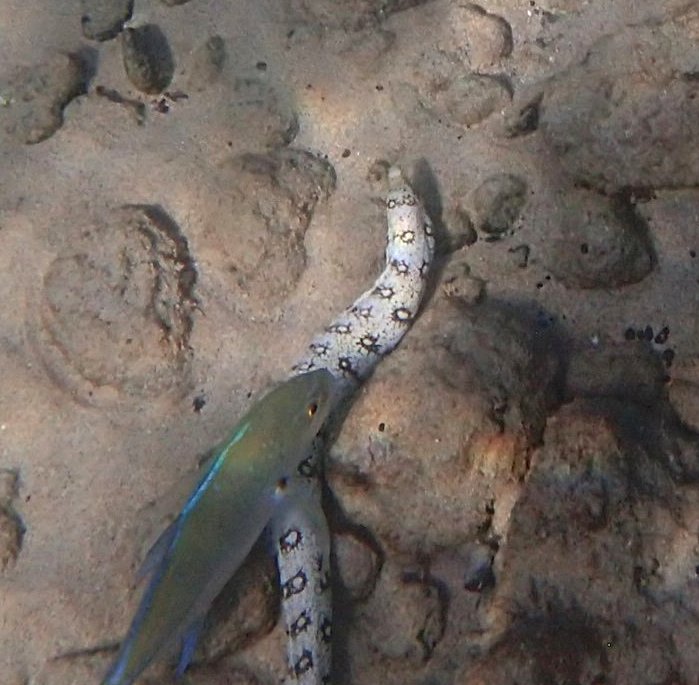
    In spite of the runners and bikers training on our roads, we still managed to get in a few snorkels.  It has been noted that the Ironmen and their families are so involved with their sport, that they do not partake in the water related activities.  I went to Kahalu'u the day before the race and the park was virtually deserted.  Luckily the water was cool, flat and clear.  While there was not a plethora of fish or invertebrates, I did manage to find a nice and cooperative example of the Dragon Wrasse.  Just before  spotting the dragon, I had a glimpse of an immature shortnose, which made three consecutive visits to Kahalu'u where I had seen that species.  In this way, the immature shortnose wrasse progressed from fish of the year to dirt fish in a week.  Having said that, I'll probably never see another one.

    On that day, I also spotted a small Elegant Hermit Crab.  As the coral has been bleaching and degenerating following our hot summer, I have had lots of opportunity to think about the ramifications.  Half
Will the last hermit crab to Leave K Bay turn out the lights.
 the time I am snorkeling these days, I am wondering which species will be able to survive in the absence of coral.  My guess is that we will have fewer reef fish and more species will be driven into the depths, where there is less damage to the coral.  My guess is that crustaceans like the hermit crabs will be even harder hit than the fish.  They require the crevices and the branches of the coral to protect them from the wrasses and their friends.  The coral also provides a substrate upon which they find their daily bread.  Setting aside this sad prophecy, we can enjoy this picture of the elegant crab with the bright blue eyes.

     A couple days after the race, Sandra and I went on a night snorkel on Paul Allen's Reef with Bob Hillis.  Aside from the usual cardinalfish and squirrelfish, we were lucky to see a brotula.  He was resting on a ledge right by the entrance to Paul's private lagoon
Bearded Cusk Eel / Photo c/o Wikipedia
 and, when illuminated, dodged into a crevice.  By diving down about six feet and holding onto the reef, we were able to illuminate him and get a peek at his whiskered visage.  This species, the only brotula likely to be seen by a snorkeler in Hawaii, is the Bearded Cusk Eel.  It is not an eel, although it has a single dorsal and ventral fin that meet to form the tail, much like an eel.  It lives in crevices and comes out rarely at night.  Hence, unless you are a diver who is poking deep in crevices by day, you will only see one at night.  This was a very lucky encounter with an extremely strange fish.

Not only that, but it reminds me of the song sung by the Cowardly Lion, while Dorothy and her companions were waiting to see the wizard:

What Makes a Cusk Eel Guard His Cusk?
"What makes a muskrat guard his musk?
What makes a cusk eel guard his cusk?
Whadda they got that I ain't got?
The Ultimate Guide to Hawaiian Reef Fishes!
You can say that again."

    And who knew that Bert Lahr was such an enthusiastic fishwatcher?  Go figure.

    Yesterday, five days after the running of the Ironman, Bob and I went up to Mahukona.  He had been there twice, same as me, but we had never been together.  (The respective better halves held down the fort at the Daylight Coffee Company.)   Similar to my experience a few weeks ago, there was no wind in Kawaihae, but at Mahukona there was a significant breeze with whitecaps offshore.

   Unlike our recent trip, yesterday there were lots of swimmers.  It wasn't like Cruise Ship Day at K Bay or any mid-morning down at City of Refuge, but here the entry is limited to the ladder, one swimmer at a time.
It was a busy day at MHK.
 This is Hawaii, so everyone was polite as he or she waited to climb up out of or flop into the water.  

    Another difference was the clarity.   The water was much more cloudy everywhere in the bay, extending even into the depths offshore.   Luckily this didn't effect the fishwatching too much.  Of course, the photography is intimately associated with water clarity.  but a good carpenter does not blame his tools and neither does a good fishwather blame the ocean.

   Early on we happened upon a Milletseed Butterflyfish.  As recently as seven years ago John Hoover called the millletseed butterflyfish, "Hawaii's most abundant butterflyfish."   Boy Howdy (that's Walt Longmire-speak) have the times changed.  The milletseed is
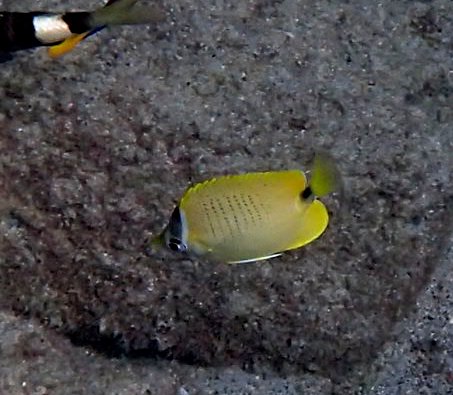
found, apparently, below snorkeling depths on a regular basis.  However, I had not seen one in almost two years.  I had wondered if I would ever see one of these yellow beauties again.   I fondly remember the schools of milletseeds at K bay and this particular fish made me very happy.

  I chased that milletseed around for a few minutes trying for a good photo.  As it turns out, I saw a second milletseed on the way in.  It might have been the same fish, but the colors seemed brighter, especially in the picture.  Could there be two?  O frabjous day, caloo callay.

     At the entrance to the bay, abut ten feet down there is a pipe of questionable utility.  Upon it I found several handsome colonies of sponges.  Big healthy sponge colonies aren't so common down in Kona and a
reticulated butterflyfish was swimming around to add more beauty to the display.  Although I got an excellent look (and I imagine you are enjoying the picture) I am not sufficiently skilled to put a name on this sponge.  Looking at John Hoover's pictures in Sea Creatures, I wonder if it might be fire sponge, so until you know better, please approach these handsome animals with caution.

    In the depths of the rock wall of the north cusp we saw an octopus.  This was my first octopus in six months.  He was a handsome fellow, swimming back and forth, changing his color from a dark chocolate to a mottled gray, matching the coral rubble.  He was about thirty feet deep and the water clarity, or lack thereof, prevented good pictures.  (Although I took a dozen, none are worth showing you.)  Every time I dove down to get a little less cloudy water between meplayful mollusc, he retreated into the coral.  I had a great time with the octopus, but sadly,
Blacklip Butterflyfish   Mhaukona  October 2015
this is another animal that needs hiding places in the coral to flourish.

     On the way back in, I dove down to get a look at that second milletseed butterflyfish and came face to face with a yellowtail filefish.  the camera wasn't turned on and by the time it came up he was hiding.  I did get that picture of the bright milletseed butterfly that you saw earlier.

    In the coral opposite the end of the pier, I saw a blacklip butterfly dodging in and out among the coral.  While I was chasing him around for a picture, a Racoon Butterfly swam nearby.  I knew the Blacklip, also known as Klein's, was small, but the raccoon seemed huge by comparison.  In fact, it is a little less than twice as big.  Persistence paid off and we finally got a couple pretty good pictures of that small butterlyfish, especially when you consider the cloudy water closer to shore.

    Well, I said I wasn't going to blame the ocean and I did anyway.  We saw other good stuff including and orange tailed immature of the pinktail triggerfish and a school of oval chromis.  Too many fish to describe in detail.  Mahukona is a really good place to look for fish and I hope to see you there.

jeff

Saturday, October 3, 2015

Fish of the Year: The Immature Shortnose Wrasse

    Ever so rarely a fish comes along that is so unexpected and delightful that it conjures the presence of a benevolent deity.  When Bob and I arranged to meet for a snorkel yesterday afternoon, I said something
Shortnose Wrasse,Macropharyngodon geoffroy , Kaahalu'u October 2015
like, "I hope we see something good."   He replied, "We are going to see something spectacular."

    We met at Kahalu'u.  Sandra dropped me off and then headed up to the KTA store for necessary comestibles.  One does not live by fishwatching alone.

There was only a modest crush of tourists at the entry and the water was only a little cloudy.  The temperature was pleasant, in the mid 80s.  As we swam towards the Menehune Breakwater I despaired once again looking at all the bleached and dying coral.  I shudder to think what Kahalu'u is going to look like in a year.  It seems inevitable that there will be a lot less coral, fewer places for fish to rest and take cover.  What has taken centuries to build has been scourged by a
Even this baby can change his color pattern.
 single month of excessive water temperature.  We may be looking at a substantial shift in the reef fish populations, not just in this bay but all up and down the coast, perhaps the entire State of Hawaii.

    It was with these thoughts that I made my turn at the breakwater, swimming over the shallows out to Surfer's Rock.  We tooled around for a few minutes and then I noticed Bob attempting a photograph.  Venturing over, it took only a moment for me to pick out the object of his interest.  It was an immature wrasse, vaguely similar to the immature rockmover that is also known as the dragon wrasse.  I'm sure you remember that fish and the incumbent admonition...don't eat the green ones, they're not ripe yet.

    This fish was the size of a small dragon wrasse, about an inch and a half long.  He was a jumble of colorful spots and sported a variety of spines from both dorsal ad ventral fins.  As you can tell from the pictures, most of the time he swam with both his dorsal and ventral fins fully extended, thus offering a strange silhouette.

    Your humble correspondent, Olympus T4 in hand, got right on it.  The two of us chased this little sprite over the reef for about ten minutes.  He moved continuously.  Not just changing his location, but throwing in bobs and weaves, jinking up and down. this behavior is unlike that of the dragon wrasse.  The dragon wrasse moves sinuously, dancing to a slow tune that only he can hear.   When chased by an eager photographer, he glides with a final swoop into cover under a stone or in the coral. 
Which end is which?
 
    This fish did   not seek cover, but relied on his quick jerky movements for protection.  He was dancing like Elaine Benes on meth.

    Do you remember the Karate Kid and his sensai, Kesuke Miyagi?   This fish posed a serious challenge for the photographer, channel Mister Miyagi and hope for beginner luck.  Would catching the perfect picture of this little fish be more difficult that plucking a fly out of the air with chopsticks?  Wax on, wax off!

    After about ten minutes of chasing around (ten minutes is actually a pretty long time to chase one small fish in a small area) we surfaced.  I asked Bob if he knew what it was and he replied that he thought it was an immature Shortnose Wrasse.  Had he seen one before?  Probably not.

     I was struck immediately by the coincidence; just that morning I had finished writing about the shortnose wrasse, Macropharyngodon geoffroy, that Sandra had found for us at Mahukona.  In the process of
Nose to nose with a baby saddle wrasse
writing about that handsome little fish,  I had looked at John Hoover's excellent pictures in the Ultimate Guide.to Hawaiian Reef Fishes.  The pictures aren't attributed to anyone else, so I assume that John Hoover took the pictures himself.  Suffice it to say, that in addition to being an excellent writer and biologist, he is a fantastic fish finder and photographer. Hoover includes pictures of two immatures, the youngest is gray with a variety of white spots and strannge fins..The older immature pictured in the book is almost like a small adult.  The fish we were chasing was not an absolute match for either of the two pictures in John's book, but similar enough to make me quite confident that this was indeed an immature shortnose. 

     We chased the fish for another five minutes,  You will note that this little guy was really dedicated to his spot on the reef...most fish would, if they didn't seek cover, just swim away.  Eventually we lost him.  In our chase I had taken just shy of 30 pictures. 
For this little fish, need beginner luck.
What you see here are the best five out of that batch.  We have checked it out with the experts and what you see is definitely an immature  shortnose wrasse  transitional between the very young fish and the older immature pictured in Hoover's book. I hope you enjoy the pictures.

jeff
    

Friday, October 2, 2015

MHK

   The other night, Sandra and I were sitting on the couch watching Bridget Jones Diary.  This is one of our favorite movies.  I mean, Colin Firth, Renée dressed up as a chubby playboy bunny and Hugh Grant as an intolerable jerk who
I will not fall for alcoholics, workaholics, or fishaholics.
 gets what's comin' to him... What's not to love? 

    Anyway, we had just gotten to the part where Hugh Grant throws Renée over for the skinny bitch from the New York office, when Sandra said, "I have a great idea for tomorrow.  After my doctor's appointment, why don't we go to Beach 69."  This was a brilliant idea. Kaiser Permanente is on the north side of town and it would be easy to slip on up to the north shore for a dip.

    I took a moment to consider this clever plan and then I suggested, "Silly Bridget. Why don't we go to Mahukona?"'

    Mahukona is a location on the Kohala coast, not so different from Ho'okena.  Both had been small communities served by boat. Now connected to the rest of our island community by road, the infrastructure associated with serving an outpost by water is
Klein's Butterflyfish, Mahukona April 2015
falling into disrepair and the human element is drifting away.  In Ho'okena there are a few more residual people and in Mahukona the landing facilities are substantially more intact, but the similarity is definitely there.  And they are both excellent places to go snorkeling.

   We had been introduced to Mahukona (some people simply call it  MHK in honor of the adjacent international airport) by Peter and Marcie.  Peter writes a blog, had noticed mine, and eventually we all connected at their favorite snorkeling spot, MHK.  For over a year Peter had been regaling me with promises of Regal Parrotfish, Fantailed and Yellowtailed Filefish.  Just recently he had thrown in Blacklip Butterfly, which I persist in calling Klein's Butterfly.  This is because not only do I like the old names but the name reminds me of one of my professors back at the Oregon School for Bewildered Anesthesiologists.  I suppose that Dr.Klein meant well, but
The Ladder Entry at Mahukona
 he could be a bit of a beast.  Now that he is a butterflyfish, the shoe is on the other foot, so to speak.

    We connected at MHK in April.  Ten miles north of Kawaihae, it might be out of the Waika-blowah wind pattern.  The fact is, it is probably windier at MHK than at Waikaloa Village.  On that day there was a steady 20 knots of wind gusting to 35.  I suspect that the wind blowing between Mauna Kea and Mauna Loa converges at this point with the wind accelerating around Kohala Mountain.  Marcie had a word for those 35 knot gusts, blasters.  One got the impression that the blasters were not an unusual feature at Mahukona as, despite the fact that the wind was having a significant
effect on the sea, our hosts were all, "let's get going."

    The entry at MHK is, to my knowledge, unique on this island.  Here there still exists a cement pier with a rusting crane.  And there is a stainless steel ladder which presumably at one time served the crews of small boats.

   There is, at this time, no facility for docking a boat, big or small, and one is pretty much obligated to enter and exit the water using this ladder.   Marcie noted that some people choose to jump in to the water off the pier.  We actually saw a couple people do this. I
Sandra and her pet Gecko, Gus.  Roaches need not apply.
 would not recommend this technique to the uninitiated, as there are rocks next to the pier and it might be hard to climb up the ladder with a broken leg or a a compressed T2.  Capisce?

    Despite the fact that the wind driven swell was surging to and fro at the foot of the ladder, the water level altering about 18 inches with each watery cycle, we all made it in.  Soon, Marcie had found both the filefish.  We swam out over the north cusp of the small bay where Peter showed us an immature Regal Parrotfish and a pair of Klein's Butterflies in twenty feet of clear water.  On the way back in, we fought a moderate wind driven current, but we were rewarded with a fine Devil Scorpionfish and a pair of Klein's Butterflies in the shallows.   All in all, Sandra and I were quite impressed with the large number of interesting fish in the small bay at Mahukona.
Regal Parrotfish, Mahukona October 2015

     As a perfect end to a wonderful snorkel, we joined Peter and Marcie at a fish restaurant in Kawaihae.   They are both ecologists with a tie-in to the University of California at Berkeley.  As Peter fed a bit of his Longboard Lager to the gecko that resided at our table, Marcie told us that it was quite possible to train a cockroach to come for tidbits, as well.  Recently, Sandra has trained a gecko to take strawberry jelly from her fingertip.  Now, every time we leave the house, Gus (the gecko) is out there throwing us a forlorn look from his perch on the railing.  We agree that we are drawing the line at cockroaches.

    All of which brings us to yesterday morning.  I got up bright and early to do the watering and play fantasy baseball.  I'm the General Manager of Sandra's team, the Kona Shave Ice (Go Penguins!), who may just
Our mascot, Pablo says, "Go Penguins!"
 bring home the bacon if the boys can hold it together for two more days.  There is a lot of pressure from upstairs not to screw the pooch at the last minute, so playing fantasy baseball took a little more time than usual.  We were all set to leave for Kaiser when I discovered that I had cleverly hidden both pairs of my dark glasses.  This was not a particularly good omen.  Hence, we called upon the augur who conveniently lives in our ohana.  He killed a gecko and examined its entrails which proved inconclusive.  With some trepidation, we proceeded with the days program regardless of the fates and without my dark glasses.

   The doctor visit went fine except Sandra was told she had to eat less chocolate while watching television at night (like that's going to happen) and we soon found our way making the left and the right to get through metropolitan Kawaihae.  One would like to think of Kawaihae as being a dusty little crossroads associated with the only deep water port on this side of the island.  That would be wrong.  A modest artsy fartsy and restaurant community has grown up here, catering to the wealthy patrons and residents of the northern resorts and the fancy Kohala neighborhoods
Hawaiian Hogfish  Mahukona 2015
 just to the north that have sprang up over the last ten years. So when one is is making that right, they have to be careful not to swing at high speed into the Blue Dragon and Coastal Cuisine.  

     Even in Kawaihae there was not a puff of wind. By the time we got to MKH, however, there was a cooling 10 to 15 knots blowing from the southeast.  Soon we were changed and flopping off the ladder into the bay.  The first thing we noticed was the water temperature:  about 80 degrees, it was easily the coolest water we had experienced since returning from the Rose City.  Almost immediately, we found dramatically less coral bleaching and death than we have seen elsewhere along the coast in the last two weeks.  As we swam along, I wondered if the steady wind that this location produces a venturi
Yellowtail Filefish  Mahukona September 2015
effect over the water, with increased evaporation.  The resultant and ongoing latent heat of evaporation then cools the water.  It makes sense to me and there is clearly healthier coral here than in Kailua and at City of Refuge.

   As we swam out, we examined the coral heads where Marcia found the two filefish six months ago.  We didn't see any filefish, but we did see a couple blustripe butterflyfish, a fairly uncommon species that seems to be a regular occurence here.  While I was looking for filefish, Sandra found a nice pair of reticulated butterflies swimming nearby.ervagor aspricaudus

    We swam into deeper water and I found a male Regal Parrotfish.  My picture does not do this handsome beast justice.  He was thirty feet away when I spotted him and as we approached he swam deeper.  Large male parrotfish in general are wary animals, so a
Pervagor aspricaudus  Mahukona October 2015
photographer has to do the best he can.  In the picture you can see the diagnostic streamer tail with the blue crescent.  We were able to appreciate the pink stripe at the base of the dorsal fin and the the pink scalloping on the flanks.  He was gorgeous!

    There were no Klein's Butterflyfish, or blacklip butterflyfish either, so we headed back in.  Passing over a ridge, I saw a yellow fish with a big black spot.  In a trice I identified her as a female Hawaiian Hogfish.  A species that must be more common below snorkeling depth, we see one of these adults about once every two or three years.  They are always deep and elusive. I took three deep dives and the hogfish let me approach within fifteen feet.  You see the best of my efforts below.

    We swam further in, again examining the coral heads for lurking filefish without results.  Just opposite the outer corner of the pier, I saw a yellowtail filefish.  This cute little aspricaudus proved to be the most
Shortnosed Wrasse, Mahukona October 2015
cooperative fish of the day from the photographic standpoint.  Its hard to take a picture of a dark fish and capture facial features, but I thnk these pictures turned out pretty well.

   After we scared the filefish back into his crevasse, I decided to take one more look on the far side of the small bay for the Klein's Butterfly.  I'd gone ten yards when shmoopie somoned me back urgently.  "Red fish!"  she yelled.  Once I returned, it took only a moment to locate the small red fish.  In fact, it was, at about five and a half inches,  the largest Shortnose Wrasse I have ever seen,  He, too, was rather cooperative and we had several opportunities to dive him and take pictures.  Unlike parrotfish, this species has proved remarkably approachable in my experience.  On two previous instances one on the PAR and the other on the Ironman side of the pier, I have encountered
At some angles the Shortnose Wrasse looked quite red.

 individuals that let me get within a foot and take some very nice pictures.  in the case of this big brute, I got withn about six feet.  Still, the results aren't too shabby.

    We took one more swoop over to the far a side, not finding the blacklip.  As hard as we worked the bay, I really don't think he was there.  Fan tailed filefish are way more stealthy, however, and I woder if Marcia had been there if we would have she would have found him.  Or perhaps she would have found an amiable cockroach with which to share our lunch.

jeff


In the event that you would like to view Peter's blog, here is a link:
  https://onebreathkohala.wordpress.com/

You will find lots of fine photographs and interesting observations. 

The Blustripe Butterflyfish is a Regular at MHK.


Sunday, September 27, 2015

Camarones de Kahalu'u and Other Delights

  A week ago, Sandra and I went snorkeling with Bob Hillis at K Bay.  Yesterday we went back, creating temporal bookends around a week in which we added the seahorse to our list. Last week the water was
A Cone Shell Hermit Crab Grazing at Kahalu'u Sept. 2015
warm and the coral was bleaching, but there were still a few interesting things to admire.

    Swimming across the bay towards the breakwater, we ran into a small yellow immature of the Orange Shouldered Surgeon.  I nabbed a couple good photos and I believe we can say that this fish was so young that it did not yet have any evidence of the orange band that gives the species its common name. A few days later on our seahorse adventure up north, we ran into many of these immatures, all lacking the orange shoulder.

    At the same time we saw the baby surgeon, I spied a cone shell hermit crab, aka "Stripey" nestled among some algae.  More often, I need to pluck a suspicious cone shell off the bottom and hold it for a while before the eponymous hermit pokes his nose out.  What a treat it was to see Stripey going about his business independent of our intervention.

    Out near Surfer's Rock, Bob, employing his notoriously sharp eyes, found some shrimp and was lucky enough to take the picture that you see here.  He sent the picture to me
Eye Spot Shrimp S. neglectus  photo Bob Hillis
and I played around with it to the extent that my aging photo processor would permit.  I was pleased to note that Bob had captured on film a species that I have seen several times at Kahalu'u, but never been able to photograph or definitively identify.

    Not being certain of my identification, I sent the picture to John Hoover who verified, in a playful way, that Bob had photographed the Eye Spot Shrimp...the green legs were a pretty good clue. One might think that the name of this species would have something to do with those handsome flanges that seem to shield the face of the tiny shrimp.  (In the event that you are unimpressed with Bob's photograph, you should know that this animal is smaller than even a modestly self-respecting cockroach and twice as shy.)  The shrimp actually has two bulls eye spots on its aft thorax that suggest its common name.

   So, you might reasonably ask, what about those handsome anterior shields?  both times I have seen this sprightly creature those anterior shields were elevated. My research on
Giggity, Giggity!  Let's Put On Our Antennal Scales!
  the internet did not yield any small shrimp with shields up. I suspected that they might be sensory organs, but I was loathe to pass them off as such to you without corroboration.  In John Hoover's Sea Creatures book, the Eye Spot Shrimp just sits there, possibly on a wet plate...I think that its sensory days might have passed ante fotografum.

    So today, as I was dealing with my email, I was required to fiddle with my Linkedin account.  Not that I am all that important in any business sense, but in the way of social media, Likedin seems to have its hooks in me.  In the process, who should I run into but Marta DeMaintenon, who is constantly updating her Linkedin status commensurate with her advancing academic career.  I became linked to Dr. DeM several years ago when Sandra and I were learning about hermit crabs.  She was the hot young invertebrate zoologist at UH Hilo to which I was referred and I have victimized her ever since.  Poor Marta.

    Being a good sport, she responded promptly, saying, "Pics are blurry but I'm guessing they're antennal scales. It's a structure attached to the base of the second antenna, and certainly has setae that would be sensory, but the specific nature of the beast is
The Banded Coral Shrimp Peers Out of Grendl's Cave.
beyond me. I think for slipper lobsters, they're the same as the big flaps in front that those guys have in lieu of long antennae."  Marta didn't waste any time researching her answer, but being brilliant, she was able to bolster my suspicions wiki wiki. 

     As long as I was asking her questions, I might have asked why in God's green earth, did a beautiful and highly educated woman like her want to be Linkedin with me?  Does she have a particular vein of masochism that we here at the Beach Blog should know about and exploit?  Anyway, antennal scales: springy, bristly sensory organs...I bet Glenn Quagmire wishes he had a couple.

     We cruised around the rest of the pond.  Just before Sandra went ashore there was a gentle pattering all about that, as it turned out, was rain drops falling on the water.  This was a pleasant sound and the rain actually cooled the
Sandra In the Rain With Diamonds.
water surface.   A few minutes later, as Bob and I were headed in, a large moray eel  came shooting by and took up housekeeping in one of the folds of the pahoehoe right in the entrance.  As it went by I thought I saw something peculiar about its head.  Looking into Grendl's cave, I saw not only the eel, but a large banded coral shrimp.  Had the eel brought along its own housekeeping unit?  Despite the eel peering out at me like the pit bull that lives with the drug dealer next door, I worked my way in for a picture.  As you can see, my best effort will not end up in National Geographic.  However, this was the first banded coral shrimp that I have found on my own and I was really pleased.

    Scooting ahead to the end of the week, Sandra and I returned to Kahalu'u yesterday. In the intervening week, the water temperature had dropped at least five degrees, into the low 80's.  Sadly
Stonefish Courtesy of SKG Graphics
 the coral bleaching was even more obvious.  Several patches looked irreversible.

    Out around Surfer's Rock, Sandra hailed me.  "Stonefish!"  She had spotted a Devil Scorpionfish under a coral head.  This was a beautiful individual in about three feet of fairly clear water...gray and brown stripes, lots of filaments on the skin.  His tail stuck out of the shadow created by the over hanging coral head and I believe this confused the camera.  Although there is always a bit of current in that part of the bay, I can't complain about conditions. I took several shots just two or three feet away from this cooperative scorpionfish.  Do you like Sandra's graphics?

    On the way in, Sandra found a large green Dragon Wrasse.  A happy end to a productive week.

jeff
Don't Eat Me.  I'm Not Ripe Yet!


Thursday, September 24, 2015

The Tail of the Smooth Seahorse

    Somewhere north of the  airport there is a secret bay.  (Actually the bay is not so secret, but multiple parties have asked that I don't go out of my way to advertise the location in this blog.)  Over the last couple years there  have been rumors that seahorses exist in or near this bay. The lady concierge at the Mauna Kea 
Smooth Seahorse, Secret Bay  Photo Bob Hillis
Beach Hotel was the first to alert me to their presence.  A month or so ago, in his capacity as a dive guide, Bob Hillis was appraised of seahorses in the secret bay by a client diver.

     This was just too tantalizing and the fab four (Bob, Kim, Sandra and Jecko) made a special trip to the secret bay with the intention of tracking down this unusual fish, which by all accounts is quite rare in these very Sandwich Islands.   Suffice it to say that despite Bob's sharp eyes and Sandra's delicious sandwiches, we were unsuccessful.

      Then a week ago, as Sandra and I were trying to stay cool (yet another unsuccessful enterprise) Bob called.  He was driving home from the secret bay and had found the seahorses.  Although he was unavailable to go back for several days, he gave
An Ulua Hunting With a Snowflake Moray in Secret Bay
me some instructions as to the location of the seahorses.  Later that evening, he even sent us a picture that he hoped would aid in our finding them.  And he included this admonition:  The seahorses were in eight to ten feet of water and although they were associated with sticks, they were only found over the sand.

    The next morning was beautiful and Sandra and I made the drive north with high hopes buoyed by the gorgeous weather.  We hit the water about 9 AM.  Immediately I saw a large snowflake moray hunting with a small ulua.  I took a couple nice pictures of these fishes engaged in their symbiotic endeavour and then schmoopie and I swam to the spot that Bob had described  There was a secret landmark on shore.  Bob had instructed us to line up with the landmark and then find a spot eight feet deep.  Unfortunately for the Snorkelkids, X did not mark the spot.  We worked the area he had described, looking for seahorses clinging to sticks for about thirty minutes.   Curiously, in this location there were not many sticks.   After a half hour of fruitless searching we treaded water and held a pow wow. 

      "You know," I said to my beloved, "Bob's eight feet might be deeper than ours, but there is no deep water around here associated with that secret landmark.  And not only that, Bob has very sharp eyes."   We enlarged our area of search to no avail.

    At 45 minutes we swam to a different part of the bay where I knew there was more debris.  Lined up with the secret landmark, now forty yards away, I found lots of sticks.  In fact, the majority of these would be better described as small logs. "It would be a mighty big seahorse,"  I said to myself through my snorkel, "that would coil his tail around one of those."  Most of the sticks and logs were deeper than 10 feet, but Bob is such an adept diver that I thought his eight to ten feet might actually be twelve to fourteen.  Diving down to the sticks that were over the sand (much of the debris was over rocks and coral), I still did not find any seahorses.  Another 40 minutes passed and, finally exhausted, I went ashore.

     As I went to shower, I met a gentleman and two ladies who were serving as docents for the secret bay.  I asked if he knew about the seahorses.  At first he denied that there were any.  When I mentioned my friend's success just the day before, he became alarmed and shushed me.   Yes, he said sotto voce, there were
seahorses in the bay.  He quietly related that they had been introduced by the seahorse farm located at the natural energy lab.  Although the secret bay is supposedly protected from fisherman and collectors, he was eager for their presence to remain, well, a secret.  He noted that they were very hard to see and perhaps I had not been sufficiently discerning in my search.  Or to paraphrase John Lennon,  "Gotta be good looking cause they're so hard to see."  Interestingly, as you will soon see, he agreed with me that it was more likely to find the seahorses in the deeper part among the sticks and logs.

     That evening I contacted my friend and shared our failure.  He promise to guide us after the weekend, when he had to work.  On Monday, a small fly landed in the ointment.   Friends from San Diego had appeared out of nowhere.  On Tuesday he was taking them (at great expense) on the dive boat with the promise of a frolic with dolphins. And how would we like to go with the whole gang on Wednesday to look for the seahorses? In general, I like to conduct my explorations on a small scale.  Two couples is more than enough if I get to choose.  But we really weren't given a choice and the seahorses were looming large.

      We all met at Bob's condo down by the beach.  Team Seahorse would be composed of nine players, same as a baseball team.  (And then the Mormon said, "I've got seventeen wives and if I had one more....)
Smooth Seahorse, Secret Bay, September 2015   jwh
As we became acquainted, I detected a mild undercurrent of dissatisfaction.  Apparently the dolphins had not shown up, turning the previous day's outing into an expensive boat ride.  Suffice it to say, this put a little more pressure on our seahorse finder to produce.

       An hour later we assembled on the shore of Secret Bay.  Luckily, the San Diegans were all adept swimmers.  I would say snorkelers, except my new friend Mike is so comfortable in the water that he eschews a mask and snorkel, choosing instead small fins and racing goggles.

     Our guide took us right to the spot he had described a week before and found a smooth seahorse immediately.   After we all had a good look and your correspondent took the accompanying photograph, we got together at the surface.  Bob said, "Isn't it interesting that the guy (the reef docent) said they were somewhere else?"  Or to put it another way, to assure my continued lack of success the reef docent was a font of disinformation.

    There are several points I would like to make about the smooth seahorse, Hippocampus kuda.  First, it
Our New Friend Mike (AKA Aquaman) Points to a Seahorse
is  not quite as large as you might expect.  When ichthyologists measure a seahorse, they uncurl it so it may be five inches long from the tip of the tail to the end of the nose, but in its normal attitude this is reduced to three inches, top to bottom.  This species is kind of thin, compared to some seahorses and it does not have dorsal spines. Worst of all, the Smooth Sea Horse covers itself with filamentous algae and silt; this fellow wears a seriously cryptic coat!   The lumpy box crab has a similar modus operandi and unless it moves, one is hard pressed to suspect that it not just another silt covered stone,

    One final observation:  the Smooth Seahorse does not necessarily hang onto a stick in an erect position.  It wobbles down near the sand and frequently sort of drifts long the bottom, not attached to anything.  When approached, it turns away, denying the observer the classic seahorse silhouette.  Put this all together and I would suggest you get yourself in the right spot and look very carefully at every small bit of stick and weed on the bottom.  If you are lucky, you will have brought along someone with very sharp eyes.

     The pressure was off.  the Mudville Nine swam around looking at the other things that the secret bay has
Now That's What I Call Crabby!
 to offer.  I found a couple colonies of hydras and had a quick glimpse at a fantailed filefish.   As we swam towards the deeper part (where the seahorses aren't) we found a box crab scuttling across the bottom.  I was able to dive close enough to get the clear picture you see here.  Over in the deep, Bob found a crackerjack lobster carapace. I must admit, that it was really fun to swim with the large group in this relatively safe location.  Ashore we had a nice tea replete with self-satisfied congratulations and promises to get together and do it all again.   

    One can find the Ocean Rider Seahorse Farm at the end of the Natural Energy Lab, spitting distance to the runway at KOA.  Although several years ago they charged only a five dollar donation to look at their project, TripAdvisor correspondents suggest that the fee is now exorbitant.  If you check out their web site, on the other hand, you will see that they may be doing some very important work.  As the docent at the secret bay was apparently spreading disinformation left and right, I can not confirm that the seahorses we saw were introduced.

jeff
      

Sunday, September 13, 2015

Summer in the City Or the Missing Link

       At long last Sandra and I made it to the City of Refuge.   City is one of our favorite places to go snorkeling, but between upper respiratory infections and hurricanes, this was really our first opportunity since returning from Portland.  On this sunny morning, we
Nants Ingonyama Bagithi Baba
were lucky to be accompanied by Bob and Kim Hillis.

     Even before we got out of the car I could see swimmers congregated in the area that dolphins frequent.

  A moment's observation revealed that the dolphins were indeed in attendance, so we donned our gear wiki wiki (as quickly as possible) and headed out to the dolphins.  Sandra and I enjoyed a few close passes and nabbed some photos.   The pod sported two fine looking babies.  The circle of life. Nants ingonyama bagithi Baba.  This,of course,  begs the question, "Is the spinner dolphin the lion of the Kona Coast?"  Given his nobility and strong family values, I'm inclined to vote yes.  And rumor has it that this season the Aloha Theater will be showcasing the premier of the Dolphin King.

Hele Me Hoohiwahiwa Nai'a

     After about fifteen minutes of communing with the dolphin king and his heir apparent, Sandra and I headed over to the north cusp.  Along the way we saw a lot of Thompson's surgeonfish, which after all these years I am finally finding a bit more common than I previously thought. Or perhaps they actually are increasing in numbers. 

      Out on the reef in about twenty feet, I saw a fish that I had long speculated about, a Very Long Nose Butterflyfish (Forcipiger longirostris) that was clearly transitional between the yellow form and the black, which is actually very dark brown.  Because of the way I remembered my two experts comments (Jack Randall and John Hoover in their signature field guides), I had accepted that these two morphs were created this way from conception and did not change from one coloration to the other.  This is how I described the fish to Jack and John:

    This fish had a black face that seemed to extend further caudally than on the yellow variety.  The flanks  appeared to have a yellow ground with rows of black scales
 lying over.  This gave the flank a dusky or bronzy appearance, most unlike the bright yellow of the usual yellow variety.

     This unusual fish swam into the coral head you see in the picture, out and over the top and down the other side.  Immediately he swam under a coral about twenty feet down and refused to come out. 

   While all this was going on, I nabbed three pictures, the best of which you see here.  Yes, I agree, its not a very good picture.  In fact, I included my field notes above to compensate for this poor photographic effort. Sometimes God grants you the opportunity to take a beautiful picture and sometimes you take what you can get to document a sighting.  Clearly this is a type 2 picture. 

    In the event that you think I can't take a fish picture, I am including a nice one of a mixed pair of longirostii taken a year ago at City when we went searching (vainly) for the frogfish with John Hoover.  All kidding aside, this demonstrates what we usually see rather nicely.
    It turns out, I did not need to ask Jack and John their opinion of the transitional longirostris.  In the Ultimate Guide... Hoover writes, "Occasional individuals ...turn completely blackish brown..."  I actually read this description (inadequately) before sending off my query.  Do I enjoy living a life of faux pas?  Not really, but sometimes it seems that way.  On the other hand, poor reading skills seem to give one the opportunity for individual thought.   

Transition longirostris, John Hoover's iPad app

      In his reply to me, John Hoover said, "Jeff, Of course they change from yellow to black! And probably the other way too. See lower right photo, taken on Oahu. (This is a screen from my iPad app). - John.

   Not only did my expert chide me (ever so gently) but in the manner of all good authors he encouraged me to purchase his latest product.   To repay his kindness, I am passing on the plug for the iPad app and I'm also including here the picture from the page that he sent along.  I don't own an iPad, but we do have a few android devices.  I'll find out if this app is available for us android users and, in the spirit of the great Sarah Palin (who I believe is one of the pioneers in poor reading skills!) I'll get back to ya on that one.

    Jack Randall's reply was a bit more amusing:

Jeff:     In 1961 I published the description of the very dark brown Longnose Butterflyfish as Forcipigerinornatus (meaning not ornate).  You can imagine my consternation when a friend, who had one in his aquarium, called me to say it was turning yellow.    Aloha, Jack 


A mixed pair of F. longirostris, City of Refuge, Sept. 2014


     In case you missed it, Jack Randall has been naming fish for more than half a century. Wow!

    As a final follow-up, I discovered that it is highly likely that all lonirostris are born yellow and only the brave ones on the turn black. This seems to happen more often on the Kona Coast than anywhere else on the planet.  John Hoover passes this down to us groundlings from the work of Richard Pyle.  The internet is an amazing thing and I was able to google Dr. Pyle who, as you can see, looks like he ought to be on the Orca with Quint and Richard  Dreyfuss comparing scars.   When he is not fighting enormous sharks, he serves as a zoologist at the Bishop Museum.  Arr!
When I was a squirt, every kid wanted to be a harpooner.
     After the exciting encounter with the longirostris, the Dolphin Queen and I swam back to the two step entry. (I am repeatedly annoyed when City is called Two Step. And I really like beating my head against the wall because it feels so good when I stop.)   Here Sandra went ashore and I hitched up with Bob to go shark hunting.  Our friends the DeLukes saw the shark here about a month ago, so we knew it was possible.  And, like Quint, I was obsessed in my search for the shark.

     Bob knew the place where the resident white tipped reef shark hangs out and had attempted to impart that information to me.  A few months ago I had attempted to find the shark following his instructions, but to
no avail.  We swam south across the bay, closer to the National Park than I had ever been, and then followed the shore towards the sea.  Bob finally stopped at an area of healthy coral and showed me a small alcove where two large coral heads almost meet.  Only ten feet deep at  the top of the overhang and perhaps
Hina and Ku Send Birthday Greetings to Don in New Hampshuh.
twenty feet wide, this shark puka is less than fifty yards north of the two remarkable tikis in the park.  I had in fact been very near this spot in my previous search, but did not go close enough to the south shore.  In any event, there was no shark at home on this day. 

 
    The four of us enjoyed a sumptuos lunch at Chez Sandra, which looks remarkably like a picnic table by the bay, and then it was time to go home.  As our guests disembarked, Kim Hillis looked at me and asked, "Can't I get back in the air conditioned car?"  Its been that sort of summer here in Kona.  I hope your fish watching is as hot as our weather.

jeff


Thursday, September 3, 2015

From the Land of Hotter Water

   This week my lovely wife rejoined the fish watching team.  Depending on what you like, its a really good time to be a snorkeler in Kona.  The ocean water is really warm and it
Now that's what I call fine dining !
is so darn hot that when you are done with your swim, the cold shower feels simply mahvelous, dahling..  So good, in fact, that we are tempted to take a tray table to the beach and have dinner while enjoying a cold shower.  I believe Cosmo Kramer pioneered that idea and this summer in Hawaii, it seems like he was really on to something.

    The day of Sandra's return, we went for a swim on the Ironman side of the pier.  As we strolled down to Alii Drive, we were shocked to see a pod of dolphins swimming between the fourth swim buoy and pier; they were as close as I have ever seen them.   Of course, by the time we changed into our snorkel gear, the dolphins and their attendant school of paddle boarders were long gone.  A day late and a dolphin short once again. 

     Schmoopie and I had a really nice swim.  There was a whitemouth moray near the pier and  a couple of juvenile dascyllus to keep us interested.  On the way in,
Pebbled Butterfly  C. multicinctus  Kailua Kona 2015
I found a Blacktail Snapper chilling (as if that was possible this summer) under a coral head.  He hung around patiently while I snapped his picture.  This handsome fish is clearly becoming more common.


     As  I was photographing the second dascyllus, who was dodging about a cauliflower coral in the clear water by the pier, I managed to nab these nice pictures of a Pebbled Butterfly and a Freckle Faced Hawkfish.  Common fish, to be sure, but not so easy to get an excellent photograph.

    The following afternoon I went out with Bob Hillis out on the PAR.  Between colds and bad weather, I hadn't even seen Bob, much less went fish watching with him, since our return from Portland.  In 
the Inner Harbour, on the first look after putting on the old flippers, I saw a small gurnard.  Bob was happy, saying he had never seen one in there.  I, in turn
Mr Freckleface hard by the Kailua Pier.
recalled seeing one with Sandra a couple years earlier.  She attempted to warn the nearby bathers of the danger, which, as it turns out, is non-existent.   This is just as well because the tourists paid her no heed, the Philistines.

       Out on the PAR, there was a moderate amount of surge.  There were plenty of Whitespotted Surgeons and I took the picture you see here.  A lucky shot which combined a well illuminated subject caught in crisp focus by adept panning as he swam by.  Que suerte, no?

    Bob is prone to dive down and look into caves and under things like disenfranchised rudders.  On one such venture, he chased a pair of of reticulated butterfiles out from under a dismembered portion of a long forgotten cement pier.  By comparison, I'm happy
when I chase a gecko out from behind a picture hanging on my living room wall.  On another dive, he reported that there was a turtle harboring beneath a small lava outcropping about fifteen feet below the surging surface.  

    As you may recall, I don't have a lot of lost love for green sea turtles.  Like some small children with vindictive parents, the turtles have a propensity to get me in trouble.  My new best friends back in Camas, Wa., the Redoubtable Gail and Martin DeLuke, like turtles quite a bit.  I know this because Martin made a disc for us with pictures of all the good things they saw in their four weeks here in the land of mahalo.  As a solid third of Martin's pictures were of turtles in various stages of undress, I feel safe in saying that the DeLukes really like turtles.  It is of some related interest that Gail teaches school and thus is the one to decide who gets in trouble.  I hear through the  Washougal  underground that she wields a wicked ruler.  Even as I write these words, I can feel the back of my hand throbbing in pain.  I won't do it again,
Bob Hillis, "I tot I saw a Puddy Tat"  Or was it a turtle?
Mrs. DeLuke.  I promise.

   There was no way  I was going to dive fifteen feet to see a damn turtle, so we moved on to other flotsam, jetsom, caves and wreckage. Not to mention the occasional fish.  Maybe if Martin had been there, he would have dove down to see the benighted turtle in his cavern.  There is little doubt that he is a better man than I, held in especially high esteem by the Sandwich Island Society of Sea Turtles.   He's got the pictures to prove it!

   But I digress. 

     We swam out about twenty yards further than I had gone previously, crossing a lava reef outside the little lighthouse.  As I turned to go back, I discovered that I was in a significant current.  I tucked the Olympus in my pocket and swam like hell for about a minute, finally achieving a patch of slower moving water.
Forster's Hawkfish,  P.forsteri  Kahalu'u Sept 2015

    A bit later I appraised my swim buddy of this experience and he replied that he suspected that there might be a strong current going around the point, so he swam further out and around.   Hmmm.  Sort of makes you wonder when he was going to tell me.  About the time I reached Maui?

    Yesterday afternoon,  Sandra and I made it to Kahalu'u.  By 2 PM many of the people from the cruise ship (I am no longer permitted to call the Rubber-nosed Geeks or Sea Going Rats) had headed back for the afternoon buffet.   Out near Surfer's Rock we saw one of  our favorite immatures.  I call it Forster's Hawkfish, it being the child of Mr. and Mrs. Freckeface, aka P. forsteri.  Young master Forster is a handsome lad with a jaunty chartreuse cap.

    A bit further on we saw a busy bluestripe cleaner wrasse plying his trade on a black durgon.  Would have made a great picture, but I wasn't fast enough.


  As we headed in for a landing, I was struck by how warm the water was near shore.  On this afternoon I believe it topped 90 degrees at the sand channel entry.   The cool shower that followed felt especially good.  I kept looking around for Kramer bringing a tray table and a cool green salad.


jeff