Thursday, February 27, 2014

James and the Surge Wrasse

    A day or so before he left for Portland, James and I took a trip down memory lane, i.e. we went snorkeling at Kahalu'u.   We have been swimming there together since he was three years old, or to put it
Surge Wrasse at Kahalu'u
 another way, for 27 years.  when he was three, he would wear inflatable water muscles and swim goggles, hang on my back and take quick excursions to look at the fish.  A Kodak moment if ever there was one.  And may, I add parenthetically, thank goodness those 27 years have been kinder to us than the company founded by George Eastman.

    Early in the swim, James was reminiscing about the Saddleback Butterfly, which we saw together as a life fish when he was 6.  I can still remember the thrill of seeing some of our gorgeous fish for the first time.  Its only a lefefish once, but I have to admit that they are still beautiful.

    Anyway, we swam for a long time, almost an hour, before we saw something notable.  Finally, we spotted an immature surge wrasse.  He was a big one and he was eating something large, choking it down actually.  At the surface, James asked me what I thought it was. I replied,  "I hope it was a shrimp but I'm afraid it was a plastic bag." At any rate this
Surge Wrasse,  Thalasoma purpureum,  Kahalu'u  Feb. 2014
handsome guy swam around the rocks for a while affording us the opportunity for these pictures.  In the process we saw a second, smaller surge wrasse.  What a treat!

    Our friend John Hoover notes that a good field mark for this unusual fish is the triangular marking on the snout.  That triangle, that seems to point just inside the eye, is quite obvious in these pictures.  The other thing that is obvious is the bright orange patch at the axilla, roughly the shape of the United Kingdom.  This is the sort of thing that your brain seems to filter out, but when you face it in the middle of your photograph it is starkly undeniable.  I did nothing to enhance this bright orange marking.  If I was able to photoshop, I would have repainted it a few shades less brilliant.  At any rate, if your eyes and brain are fast enough, this may be a good field mark, as well.

    As I have gained experience with the immature Surge Wrasse, it has become apparent that (field marks aside) it looks quite a bit different than the immature Christmas Wrasse. The Christmas Wrasse immature is a light colored fish with fine dark bands interspersed with light blue.  Its overall affect is delicate.  In addition to being larger (sometimes), the immature surge is a darker fish with bold brick red markings.  When I see an immature Surge Wrasse, I get the impression that he knows he is going to grow up to be a beast.

     Having finally seen something of merit, we shrugged off the cold and continued our search.  A few
Bullethead Rockskipper  Blenniella gibifrons  Kahalu'u  2/14
minutes later James summoned me to a surprisingly intact head of Everman's Coral where a Bullethead Rockskipper was sitting.  This is not an unusual animal, but ordinarily this blenny darts back into his hole before you can get the camera out.  This guy posed cooperatively for a couple minutes.

    It was time to get out, but as we swam back towards the entrance we saw a medium sized Dragon Wrasse swimming around a piece of rubble.  I waited for my chance and then took a poor picture to document the sighting.  For some reason James decided that this was the moment to become a fish photographer.  To the best of my recollection, the last time he consented to take a fish picture was during his previous visit when he made an attempt at the Flame Angelfish at Ho'okena.  That fish was small and deep.  Though he gave it a good try, his effort was doomed.  The Dragon Wrasse was 25 feet closer and he dove repeatedly, working hard for the best shot.  In the process, he came up with a very nice picture of this interesting immature wrasse.

James captured this gorgeous shot of the Dragon Wrasse!
    After he completed his near drowning photographic experience, we got a fine look at a Lagoon Triggerfish.  I quickly explained to him that the lagoon is so beautiful that I have found it an irresistible subject;  I've got  too many pictures of the Lagoon Triggerfish and have vowed not to take any more.  This was the only lagoon he saw on his very quick trip, so we appreciated it without another photograph.

    Sadly, James did not see a Saddleback Butterflyfish on this trip.  So I suppose he will have to return once more to these Very Sandwich Islands!

jeff


Aloha nui loa, James.  I guess you will have to return!

Wednesday, February 19, 2014

Valentine's Day 2014


    Last Thursday we went to Keahole Intl. and retrieved James and Tara.  The plane landed about 12:30 and  we were down to the pier and in the water by 2:30.   Is this a fish-crazy family or what?  Early on, Sandra saw a scribbled filefish, which headed out to sea before the rest of us
Lei Triggerfish, Kailua Kona February 2014
could get to her. Shortly thereafter, Tara found a really nice flounder.   Out in front of the palace, we scored this nice picture of a Lei Triggerfish sporting a yellow lei.  This fish can change the color of the lei from brown to dark brown, which is more common.

   Soon thereafter, Tara and Sandra, pleading cold water retired to the sunny beach. 

    I hadn't been snorkeling with James in a couple years, so we immediately made the most of the opportunity by spotting a pair of Scribbled Filefish.  They were reclining just above the bottom out by the last swim buoy, exhibiting that insouciance classic to the species.  I was quite excited, as I had not seen an actual pair of scribbles in a very long time, perhaps as long as ten years.  Sandra is hoping that her favorite fish is making a comeback.  How appropriate to see a pair of this delightful
A Pair of Scribbled Filefish, Kailua Kona  2014
species on the run up to Valentine's Day.   Its almost enough to send me into a chorus of that Jackson Brown classic, "Scribbled Filefish in Love."  In the name of good taste (of which I have none) I will spare you the lyrics to that fishy ballad.

     On the way in, we spotted a nice pair of longirostris (the Very Longnose Butterflyfish) sharing a cauliflower coral.  The image is almost as cloying as Lady and the Tramp sharing that last piece of spaghetti out behind the Italian Restaurant.

     For the grand finale, James and I, being the bad boys from Polk County, crossed the floating line and swam over by the pier, where, for some reason,  the water is almost always more clear.  We were rewarded with a fine look at a Whitemouth Moray.  As you may recall form a previous blog, I needed this ordinarily easy eel for the 2014 list, adding a bit of excitement to this otherwise expectable sighting.

    As we made the final turn for home we saw a school of what I deemed to be the smallest immatures of
Immature Polynsian Halfbeaks, Kailua Kona Pier, February 2014
needlefish in my experience.  Sandra had seen them on the way in and compared them to those tiny pencils that are provided at mini-golf courses and public libraries.   (Where do they get those little pencils, anyway?)  It was only when we got home and put the SD card into this very computer that we realized that what we had seen was a school of immature Polynesian Halfbeaks.  Over the last month a school of halfbeaks has been hanging around the pier.  They had become a fixture on our reef.  Well, now we know what they were up to.   A year ago, my editor accused me of photo shopping the red tips on a picture of halfbeaks.  The sad truth is, I am not half that clever.  As you can see, these Mini Coopers have itsy bitsy red noses.  And I ask you, "How cool is that?"

     For pre-Valentine's Day dinner, we had fish.  The pupu was two kinds of poke from Costco.  If you are
Longirosris in love.  
a fancier of raw fish, the poke counter at our Kona Costco is something you should be aware of.  They offer eight to ten varieties of seasoned seafood, mostly raw, and are happy to give you a sample. This is local fresh fish, prepared by experts and offered at a price you can hardly believe. I had chosen ahi shoyu in a sweet soy based marinade with caramelized onions and blue marlin kajiki, which was flavored with a delightful combination of Asian spices and little bits of this and that.  For the entree, Sandra cooked up some pasta topped with al Fredo sauce and smoked ahi.  Our guests are fish lovers and they were not disappointed.

     Valentine's Day was cloudy, but we were not deterred.  The four of us headed south and we made Ho'okena by 9:30.  As we stood on the beach, we watched a group of swimmers come in from the
 area where we might expect dolphins.  We watched for about ten minutes and did not see any fins.

    Soon we were in the water which was very clear.  I struggle for a less harsh way to say cold, but just like everywhere else in the last week, cold is what it was.  Mr. Google claims the water is 77 degrees F.  This is hard for me to believe.  I suggest that if Mr. Google is so damn sure of himself, why doesn't he put on his speedo and hop in our frigid ocean! 

   At any rate, we swam for less than five minutes in the cold clear water when right below us I spotted a pair of Flame Angelfish!  They were about 25 feet down.  We watched them for about five minutes, until Sandra insisted that we swim on in the vain hope that activity would warm her up.  Before we swam away, we saw at least three flames and a pair of Potter's Angelfish associated with this coral head.  I got a few pictures, the best of which you see here.   In my defense I've got to remind you that I can only dive about 12 feet, which was only halfway down to these small, active fish.  But what could be more appropriate for Valentine's Day than these gorgeous valentine-red fish.  (We have seen Flame Angelfish at Ho'okena before, but none in over a year.  Isn't it nice to know that they are still there?)

The Flame Angelfish retreats into the coral
 We swam for another twenty minutes, turning up some usual suspects.  On the outer reef we were overtaken by a pair of angling kayakers.  Listening to their conversation, it became clear that in the early morning there had been a pod a dolphins in the bay.  The dolphins departed just before we arrived.  In my experience this constituted very bad luck.  I mean, don't the dolphins usually stick around until 11 AM?  Oh well, I'll trade those beautiful Flame Angelfish for dolphins any day.  Suffice it to say, Tara and James were hoping for both. 

     Well, so it goes.  We had a nice lunch.  Sandra read her book and Tara went sun bathing.  James and I walked along the lava rock beach in front of the Ho'okena sign where we saw a cute five inch Yellow Margin Moray hunting in the shallows.

    On the way home, we planned a stop for a coffee sampling.  James and Tara are quite the coffee connoisseurs and hoped to buy something delicious.  Tara consulted The Big Island Revealed and chose
Does it get any tastier than this?
 Greenwell Farms in Kealakekua.  Greenwell's turned out to be quite the little tourist attraction.  The tasting was held on the verandah of a quaint old house amid the coffee plantation.  Not only wree three coffe trees, but the site offered a killer view of the coast a couple thousand feet below.    In addition to people whose only job was to sell you coffee for $35 a pound, there were tour guides to show you the coffee trees and explain the production.  Being coopereative customers, we all sampled the multiple brews available for purchase (And I have to admit that the offerings were delicious, even to your humble correspondent, who regards Yuban Dark Roast as the highlight of the morning.)  As I was sipping from my tiny paper cup,  my eye was attracted to a plastic model of a Jackson's Chameleon perched in a basket where it served as a paperweight for some brochures.   I wondered aloud, "Wouldn't it be sweet if there was a chameleon here?"

Jackson's Chameleon at Greenwell Farms
   Just behind me one of the ladylike coffee selling docents said,  "There's one right over here ."   In the words of Country Joe and the Fish, "My nose went up like an infield fly!"  And While Joe McDonald might have been "Fixin' to Die", I was suddenly fixin' to die and go to heaven.  I have searched high and low for a chameleon for thirty years in Kona.  I have searched around my home and garden.  I have stalked around arboretums, cemeteries and tropical gardens at a variety of altitudes.  I have scoured the church yard up in Holualoa. On several occasions I have received reports of sightings from my neighbors.  And most brutal of all, just last year a good friend at Alii Villas emailed me a picture of a Jackson's Chameleon crawling in a bush right outside his porch at Alii Villas.  Oh, the cruelty!

    Well the nice lady, looking very GQ in her navy blue Greenwell Farms T shirt, walked Sandra and I about fifteen feet from the verandah to an orange tree (I could tell, because it was laden with lovely ripe
Should we make Carl the official mascot for the Quetzales?
oranges).  Pointing up to a spot just out of my reach in the branches of the orange tree, she said, "There he is."  Initially he was difficult for me to spot because (now follow the logic here) he was a chameleon.  Green like the leaves of the tree, he had bright yellow eyes and three magnificent horns.  This was an absolutely gorgeous animal!  Commensurate with the beauty of the chameleon and the importance of the moment,  I proceeded to make a complete nuisance of myself taking pictures from this angle and that.  All the while, those independently moving peepers were keeping an eye on the goings on.  As if she had not done enough, our charming docent  (who I swear bears angel wings and a halo) took us to another tree so we could admire and document an immature chameleon.  And then (can you even imagine that this could get any better?) she summoned one of her buddies who coaxed Mr. Green onto his hand and transferred him to me.  Another flurry of photos ensued!

Immature Jackson's Chameleon at Greenwell Farms

     While all this was going on, my son and his lovely wife completed the tasting and purchased their coffee.  Then with consummate stealth, they trapped me in one of those dork-size butterfly nets you can rent at the Kona Home for the Bewildered.  Somehow, they got me into the car, thus ending the chameleonathon.  Home we went for a delicious Valentine's Day dinner.  You can be assured that once in dreamland, Flame Angelfishes and Jackson's Chameleons danced in my head. 

    We have another couple of guests coming in a few weeks, and if you think they are going to make it out of Kona without a visit to Greenwell's Farms, well, that's just silly.

jeff


Does this guy look happy or what?

Monday, February 10, 2014

High Season on the PAR

   After a week or so of bumpy water and cloudy weather, we finally had a beautiful day in Kailua with corresponding low surf.  After completing our chores, Sandra and I got our stuff together and went down to the pier.  Despite the cloudy weather, there is no dearth of tourists in Kona this February and the beach in front of the King Kamehameaha Hotel was busy.
 
Ahu'ena Heiau  at the King Kamehameha Hotel
    Of course, there was room enough for us to get in the water, which  at least in the inner harbour was really cold.  Swimming out as fast as I could, I scored a good, quick look at the Surge Wrasse that must live in the rubble around the breakwater past the heiau.  More and more, I am realizing that there are a lot of fish living in the rocks that we don't see.  This may be especially true for the surge wrasse.  Having seen him twice in this locale, I have a strong feeling that this unusual fish is a resident and persistent observation should yield a look.  And you can repair to your lists and check him off.

   Which brings me to another topic.   This January 1st I started a new list, the previous list having run for two years.  Curiously, this is just about the amount of time it takes me to fill up a checkbook register.  (I can't say for sure if the two are related.)   Regardless of household economics, I saw 107 species in January and with yesterday's additions, the list has blossomed to 114.   Curiously there are plenty of easy fish to be added.  This may in part be attributed to sloth on the part of the author.   For example, we have not ventured to Ho'okena or the city of Refuge in 2014.  But some
Surge Wrasse near the King Kam pier
species like whitemouth and snowflake moray eels have yet to be recorded.  It is my contention that they are hiding in the rocks, prepared to spring forth to add a bit of cheer when things look bleak.

    Well, let's see.  We left our hero and his lovely wife afloat in the chilly froth.  Off we swam across the small bay that fronts the luau arena and onto the PAR.  I was looking hard for Potter's Angelfish, having a strong idea where he should be found.  But he, too, is waiting in the recesses of the reef for things to become bleak.  For today, he remained secluded in his rocky amparo. 

    So on we pushed, me heading for the outer reef where long ago (from the perspective of the new list), way back in December of 2013, I had encountered the five stripe wrasse.  Sandra was following bravely, apparently without a clue as to what I might be up to.  Just as I started heading toward the distant reef, Sandra and I were separated by two kayaks and a paddle  
And she meets him on the bottom in a limo, Its such a funky scene.
board.  Never before have I encountered kayaks and swimmers in this location.  I mean, we were way out there; I rarely see even a single swimmer this far out.  The flotilla paused to disembark three snorkelers and then proceeded en masse towards the pier 200 yards away.

   While this was going on, Sandra , on the far side of the flotilla, was enjoying a brilliant look at a Scribbled Filefish.  As you may recall from the Very Funky Girl song by Rick James, "She likes the boys in the band,  Mr. Scribble is her favorite."  Suffice it to say, Sandra was in seventh heaven.  Beneath her, in the cold clear water, Mr. Scribble wobbled languidly this way and that, as is his wont.

    Meanwhile, on the other side of the kayaks, I swam over to the reef and started exploring seaward.  By the time Sandra broke off her reverie, I was nowhere to be seen.  She treaded water for a bit and then started swimming back in.

    Thinking all the time that Sandra was right behind me, I went on exploring.  I did not see Señor Cincos Rayas, but just as I was ready to give up a small school of what looked like crocodile needlefish swam close by.  I've never seen more than two crocs together, so I took a closer look.  They were darker than crocs and when the light reflected upon their flanks,  I saw the classic blue stripe of Heller's Barracuda.   What a treat!  The only place I have seen this species previously was Honokohau.  As we have currently designated that beach as shark infested, I had desponded of seeing Heller's Baracuda any time soon.
Heller's Barracuda at the Dog Beach.  Beware of Sharks.

    I watched this small school of barracuda (less than a dozen individuals) for a few more seconds and then looked up, hoping to point them out to Sandra.  Well, in the words of  PFC Gomer Pyle, "Sooprise, sooprise!"  And not a happy one, either, for my beloved swim buddy was nowhere to be seen.

     As Sandra had done five or ten minutes before, I started swimming in.   Full of anxiety, I stopped every ten yards or so and treaded water to look around.  The sea was quite flat, but the only thing to be seen was the kayaks, now thirty or so yards in front of me.  This mode of swimming was exhausting, but I eventually caught up to the kayaks near the entrance to Paul Allen's Lagoon.

    There was one chubby girl in a blue bikini paddling the lead kayak and towing to the second.   I had hoped for some interest in my search, as the paddler's visibility was far greater than mine.  However, I was doomed to be disappointed.  Now I ask you, what would you do if appraised of a lost swimmer?  Perhaps call out to your friend standing erect (hence commanding a wide view) on the rapidly moving paddle board ?  What she did was a give a cursory look and paddle away.   So much for the rules of the sea.

    The story ends happily.  Sandra was waiting at the end of the pier and called out to me as soon as she saw me swimming in.   And we were left with a variety of lessons. Clearly we need to be more aware of each other when we are in an area of congestion.  During tourist season one needs to be vigilant for unexpected confusion.  We need to keep each other appraised of our plans.  And we can't count on any help from the tourists.

Que sera sera.
jeff

Guantanamera is one of my all time favorite songs.   A great one to sing through your snorkel, especially if you are in Mexico.  Or even better Cuba, where the son originated.   I've included a link so you can sing along while you enjoy the lyrics which I have modified a bit to my own taste and situación.
\
http://www.youtube.com/watch?v=LFG7PKpRkO0

Guantanamera
Guajira Guantanamera
Guantanamera
Guajira Guantanamera

Yo soy un hombre sincero
De donde crecen las palmas
Yo soy un hombre sincero
De donde crecen las palmas
Y antes de morirme quiero
Echar mis versos del alma

 chorus

Cultivo la banana blanca
En junio como en enero (como enero)
Cultivo la banana blanca
En junio como en enero (como enero)
Para un amigo sincero
Que me da su mano franca

-Chorus- 2x

Mi verso es un verde claro
Y  carmin encendido
Mi verso es un verde claro
Y carmin encendido
Mi verso es un pes en la bahia
 Que busca un piedra amparo

chorus
      

Wednesday, January 22, 2014

A Night Snorkel at the Pier

Al oooo ha!
    One of my long time ambitions has been to go night snorkeling at the pier.  Last night that ambition was realized when Bob Hillis and I went for a swim off the beach in front of the King Kamehameha Hotel.  We arrived around 7 PM, just as the floor show of the hotel luau was heating up.  Between the lights from the hotel, the pier and the luau, the beach was well illuminated.  On the surrealistic side, there was a group of a dozen spectators standing on the pier, overlooking the bay, seemingly enjoying the show without actually being able to see it.  I can only imagine that they took some delight in watching us turn on our lights and swim out towards the heiau.  I'll take a waterproof flashlight over one of those fiery torches any day.

    Before we go further, I must confess that none of the pictures here (except the last from three years ago) are my own.  Although I attempted to take some pictures, the sea was bumpy and there was some back and forth surge.  I had the flashlight in one hand, of course, and when I put the camera in the other I was pretty much out of control.  It was lucky I didn't kill somebody...like me!  I have tried to find pictures representational of what we encountered.  And lastly,  I do not willingly go to luaus.

Regal Slipper Lobster, One Curious Crustacean
    We entered within an hour of darkness and the fish we saw immediately were mostly diurnal fish settling in, a ot of Convict Tang and Moorish Idols.  I noticed a couple Ambon Tobies just sitting on rocks.  Puffers are apparently safe at night and do not need to hide in a crevice.

    Out by the heiau it was darker and we started to see Iridescent and Bandfin Cardinalfish.  These were the only cardinalfish we would identify this evening.  Really, they are the only ones that are likely and big enough to be easily seen.   As we went further out and it became more definitely night, the cardinalfish became more numerous.  

We also started seeing both Regal and Sculptured Slipper Lobsters.  The regal was a new species for me and extremely beautiful.  It looked so different from the way it is pictured in Hawaii's Sea Creatures that at first I did not recognize it.  The thorax on the individuals I saw was gray as opposed to the brilliant orange and blue elsewhere on the body. The antennae on slipper lobsters are two rounded projections, looking a bit like a pair of shovels projecting from the head.  In the case of the regal, these are a grayish purple lined with optical orange.  Nice!

      In the bay we saw numerous Palolo Worms, or more precisely segments of the worm which are set free
Bandfin Cardinalfish
 from the body to go forth and multiply.  In our lights they were white, five inches in length with a bit of a fine wave for the last cm at one end...presumably the reproductive part, or perhaps having to do with locomotion.  These worm fragments are edible, but we did not partake.  

    Out in the bay our location was continuously confirmed by the lights on the pier and the many bright lights flashing from the luau.  The number of cardinal fish increased as the night wore on, hunting quietly in mid-water.  There were a large number of small red fish, possibly a species of squirrelfish that I am unable to identify.

    Another interesting spot by Bob was a bright red crab, possibly the Red Swimming Crab, hanging out in some coral.  He also saw a 7/11 crab that I could not find.

Jeweled Anemone Crab
     On the way in we saw a large Jeweled Anemone Crab.  The last time I saw such a large hermit crab was in Fiji about 14 years ago.  This reddish brown beauty has big furry legs and claws.  He crawled under a chunk of rip rap, but we could still dive down for another look.   I had never before seen a crab of this magnitude in Hawaii.

     Just a bit further on, still in the rip rap, we spotted a Tiger Snake Eel peering out from the rocks.  Flesh brown with large dark brown spots of different sizes, he might better be called a Clown Snake Eel.  I guess the naming committee didn't think there was anything very funny about snake eels.  We were able to dive down and look this big boy right in the eye!  Surprisingly, this was not a life fish for me.  Three years ago on a cloudy, bouncy afternoon, we saw one swimming free only thirty feet seaward of this very spot.  I had the presence of mind to snap off a poor photo with the old camera.  While it won't make the Louvre, it was good enough for John Hoover to make the identification.   
Tiger Snake Moray, Kailua Kona Pier, Jan 2011

     By the time we made it to shore, I was freezing.  The luau was breaking up and the tourists were making their way back to the hotel.  Our audience on the pier had wandered off, as well.  Time to go home for a warm shower, a hot brownie.

jeff

Saturday, January 18, 2014

A Five Stripe Morning on the PAR

   We had lots to do yesterday, as we were hosting a party for Sandra's service club, Las Borachas.  Thus, I had to squeeze in my swim a bit earlier than usual.  On the beach in front of the King Kam, I watched a fit
Rock and roll on the PAR
 young lady instucting a couple of a certain age in the art of paddle boarding  It was a lovely morning for a
paddle or a swim and I was putting on my fins in the Inner Harbour about 9:30. 
   
The water was clear and not nearly as cold as I remeber from this time last year.  Everything was going so well that I swam all the way out to the lighthouse.  Out there a modest swell was hitting the reef, making close approach a little dicey.  But as i watched the coral on this wave swept lava, I saw a beautiful, mature Fivestripe Wrasse.

    Getting close was no longer a question but an imperative.  Working in close I got three pictures, one of them in delightful focus.  Can you believe how pretty this fish is?  At the same time, a school of bicolor chub swam by and I caught a couple pictures of them them for good measure.
A Pair of Bicolor Chubs

     The Fivestripe Wrasse is a beautiful fish that lives in the most turbulent shallows.  I have seen a couple in front of Kona Makai.  Most memeorably, John Hoover and i saw one on that stormy day when he took the picture of the Phoenix Island Damsel that appears in his book.  And I saw at least one on the shallow reef near the entrance to Paul Allen's lagoon.  Unlike all those fish, this guy was not living on top of a shallow reef, but appeared to live among the coral on the face of the reef, just below the surface.  When a wave came in, he would slide over the top and the back out as it receded.  What a daring fish.

    Back on the beach, I shared the shower with the couple who had returned from theor paddle boarding experience.  In their own way, they were daring fish. too.

jeff     

The Fivestripe Wrasse, Kailua Kona, Jan 17, 2014.  3 ft. A Fish as Beautiful as it is Rare.

Wednesday, January 15, 2014

Kua Bay

     Recently I received an email from one of our regular readers asking if we could meet, exchange notes and possibly go snorkeling together.  Shortly after that Sandra and I met Bob Hollis at Kahalu'u.   Bob is a retired park ranger from Southern California and enjoys identifying fish as much as I do.  Or as he puts it, he's a fish nerd.  Yesterday, at his suggestion, we went to Kua Bay.  He was very enthusiastic and I was more than a little curious.  Kua Bay, also known as  Manini’owali Beach, is one of two parts of Kekaha Kai State Park, the other being closer to the airport and accessed by a road so rough that I deem it impassable in a passenger car.

Kua Bay on a Sunny Day
     Sandra and I have been snorkeling at Kua Bay before and had a tough time getting out.  As the entrance is across from a national veterans cemetery, we named it Cemetery Beach and took it off our list.  Bob thought that yesterday would be a good day to go there as the wave predictor forecast small surf.  If the surf had been small the day Sandra and I went, we almost certainly would not have had any trouble. 

    If you check out Tripadvisor, you will find that this beach is a favorite of people who like to "go to the beach."   We arrived before 10, parked without problem and walked down to a glorious patch of soft white sand.  The sand is so fine that it made me wish I had brought a grass mat or sand chair on which to place the bag containing my mask.  There are no tables down on the beach and the fine sand gets on everything, including the inside of your mask. 

     The soft sand extends some distance into the water making for an easy entry if there is low surf.  Like Magic Sands, and other such beaches, when the surf is high, the beach is used for surfing and losing your
Paletail Unicornfish  Longshore Photography
equipment on entry would be a definite risk. We got in easily and headed out past the lava on the right (north) side of the small bay.  We curved around to the north for about 75 yards.  As we did, the water became quite clear.  Snorkeling over a lava reef about ten feet deep we saw many of the usual suspects and  the coral was delightfully intact. 

     At that point, where the lava shore is parallel to the sea, the bottom drops away to about twenty five feet.  Here, looking at a fine flotilla of black durgons, I caught sight of a pair of Paletail Unicornfish.  they were a bit shy, but my chase got me close enough to admire their small horns.  What a treat.  Bob said that he sees them occassionally.  If my records are to be believed, I had not seen one in two years. 

My best picture of the Paletail Unicornfish
     After a few minutes of chasing the unicorns (Does this remind you of that old song by the Irish Rovers?) we pushed, eventually swimming about another hundred yards.  Along the way I spotted a Bridled Triggerfish working furtively among the corals on the bottom.  He was the dark morph with the white caudal peduncle, which we see commonly at Ho'okena, but nowhere else.

    As we turned for home it was apparent that the wind had come up and, this being time for the Winter Olympics, we were swimming through the moguls.  On the way back we got another look at the Paletail Unicorns, but now there was a school of twenty, all with nobby little horns.  And a bit further on we came upon a mixed school of damselfish including Oval and Three Spot Chromis. 

      After our long swim the exit from the sea went without a hitch.  Gathering up my gear I got things wet and sandy.  In response to my muttering, Bob replied, "Sand at the beach, what a novel concept."  So you
Paramedics Respond to the Shark Attack at Kua Bay
see, he's not only a very good  fish nerd, but he's also a cynic. 

    Kua Bay is famous for something other than a great beach.  Last June there was a non-fatal, but very real, shark attack involving a tiger shark and a snorkeler.  Neither Bob nor I have seen a tiger shark in the wild.

    As he drove he pulled out a self applying military tourniquet that he carries in his pocket while swimming.  The way things are going in the Aloha State, this could make for a very useful Christmas present for your snorkeling relative.  The threat of sharks not withstanding, we had a great swim, saw some wonderful fish and enjoyed regaling each other with lies. 

jeff

jhill257@gmail.com


Sunday, January 12, 2014

Bird Watching tin the vicinity of Coff's Harbour

This blog is intended to follow the blog on Sapphire Beach, which in turn is intended to follow the episodes on Dorrigo Park...  And please remember, it is impossible to take pictures of birds, so the pictures you see here are not mine.  I believe they were created by Black Magic.


      Well, such is my pessimistic view of the western world.   Meanwhile, back at Sapphire Beach it was time to get on with my own memories.  Pierre, full of energy as usual, appeared on time at 9 AM.  There was something intuitive about the Australian road signs; even though he hadn’t been to Sapphire Beach for a while he was able to find the park without difficulty.  Amazing!
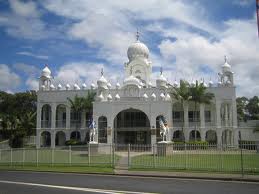
   
The Sikh Temple at Woolgoolga...from theFront
Off we went, driving north with the Southern Emu Wren as our target species.  This was a noble goal.  the bird is small, the size of a fairy wren, has a long wispy  tail, unique in the bird world as far as I know.  the bird gets its name because the tail reminded someone of the loose plumes that cover an emu.  (Not because it grooms or otherwise hangs around with Emus.)  And the emu wren  is really hard to find.  Mike and I, twenty years before, had kicked some serious birding patoot, but had not seen an emu wren.  As I now understand it, the reason is pretty obvious.  Emu wrens live in seaside heath.  A habitat of specific plants in land just higher than that which would sustain salt marsh.  While it is not a really rare habitat in Eastern Australia, you don’t end up in this habitat by accident.  

There are a couple other birds there, but it is not a trove of new species.  It seems now that Mike, who was the guiding force in our tour, made the decision not to look for the emu wren because it would take a lot of time and not yield a lot more species.
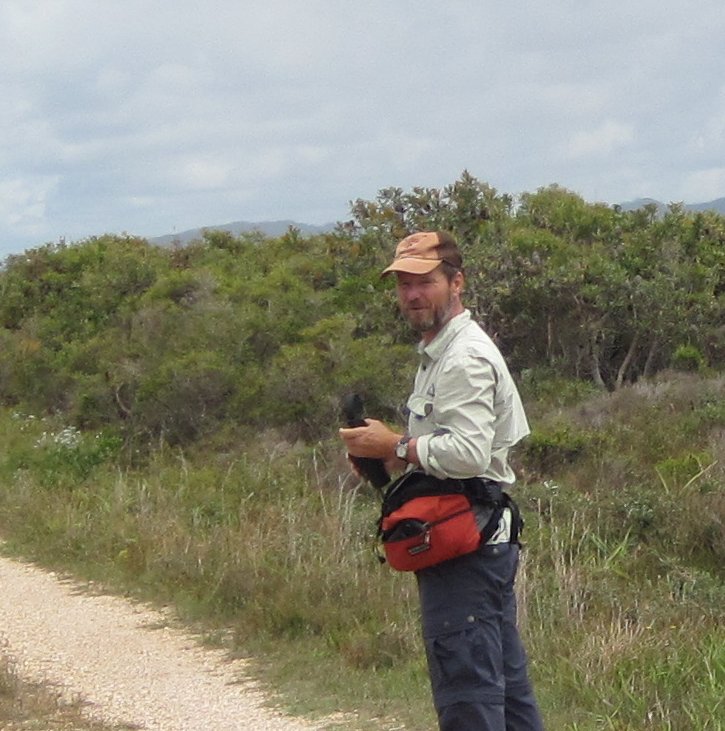
Pierre Charboneau on the heath.
    On our way to Red Rock, home of the emu wren, we passed through Woolgoolga, which boasted the biggest Sikh temple in NSW.   We were able to see the back of the temple from the  road as we drove by.  Unlike Hindu temples, resplendent in color with stacks of Gods both human and animal, this edifice was plain gray stone with a smattering of sedate spires. and a central dome.  The picture I include is from the front, which I didn’t see.  The back side, which we saw from the road was, no surprise,  less grand.

Soon we were in Red Rock, the name would become more apparent in a while.  Pierre parked where the road transected a large flat area of low lying brush.  He got out his tape player and off we went.  For the better part of two hours we walked this low lying brushy area.  We saw one new bird, a consummate little brown bird that only a bird watcher might deign to give a second look.  Does the name Tawny Grassbird excite you?  Even if you had been smoking grass this bird would seem dull.  
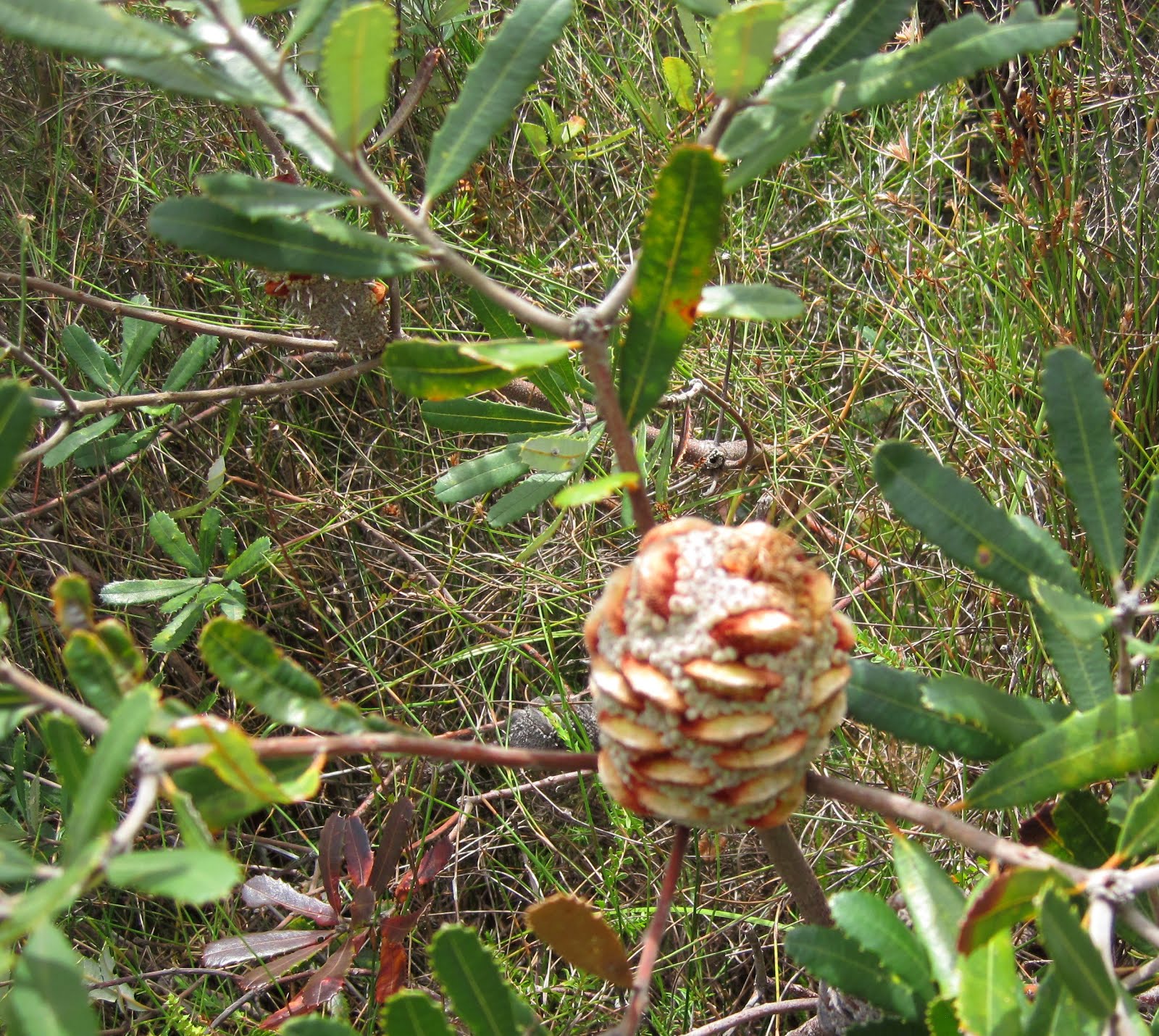
Banksai on the heath at Red Rock
   So dull was the birdwatching, that I ended up taking pictures of plants, specifically the low lying Banksia that formed a substantial portion of this unique habitat.   Banksia is named  for Joseph Banks, who was already a famous botanist when he sailed with Captain Cook on his first voyage to Australia.   He was the botanist for which Botany Bay is named.  Banks is credited with the discovery of eucalyptus,  acacia and, obviously,  Banksia.  There are over 100 species of Banksia, all but one of which is endemic to Australia.   Many of them have columnar flowers and are used in gardens the world over. Naturally, the ones on this heath were more prosaic.  
    
   Pierre’s discerning eye noted that a lot of invasive plants had appeared on this particular patch of heath since his last visit. Trudging along through the hot, humid and monotonous heath, I was tempted to charge this up to sour grapes. Or sour Banksia, as the the situation merited.  I could not tell, but habitat destruction can be pretty subtle and It could well be that changing plant variety resulted in our failure to find the Emu Wren.  Despite prolonged trudging, interspersed with Pierre producing a variety of twittering noises from his player and my loud American pishing,  we had no luck.  By the time we made it back to the car, sans emu wren, I was ready to look for something easier.
Really Red Rocks!

     To placate the passenger, Pierre declared that we would start birding the American way.  That is to say, driving rapidly from spot to spot, hopping out to look at something seen from the car to or to look quickly for something likely to be at a certain location.  At times, in my experience, the American way also involves the imbibing of potent beverages, thus to enhance the spirit and imagination of the hunters.  That was not to be the case on this Australian afternoon, but the rapidly passing scenery would be more amusing than a trudge through the heath.

      Our first stop was at the Red Rock park.  We were hoping for shorebirds, but the tide was too high and we had to settle for a family fishing from the bank and a couple Australian pelicans (the largest pelican in the world).  Some terns sat on an island about 200 meters distant.  

     We drove from teh park to a small car park, where we  walked down onto the beach onto the eponymous very Red Rocks.  Aside from the red rocks, we saw some Little Terns and vowed to return later.  heading back to the main road we passed a caravan park.  It didn't look as homey as Sapphire Beach, but it was right by the beach and if you wanted to sty someplace adjacent to shore birding, it might be worth a go.    
Mistletoebird
    Recognizing that for shore birds to appear on the tide flats that were still submerged,  we needed to wait for the tide to fall, Pierre took us to a patch of woods near the sea.  As we walked the trail, I mentioned the Rose Robin that Sandra and I had seen in Dorrigo and wondered if another beautiful red bird, the Mistletoebird might be seen around Coff’s.  It was like a premonition, because shortly Pierre brightened and said, “Do you hear that?”  Of course I heard nothing, but he heard a Mistletoebird that was high in a nearby tree.  We scrambled around for a good vantage point and Bam! There it was... a great look at a gorgeous little bird.  the mistletoebird was hanging on the side of a tree about thirty feet up.  Usually associated with berries, it was acting as if it might be gleaning bugs from the bark.  We enjoyed it for several minutes before it flew off.  

     This was excellent luck.  The Mistletoebird can be found anywhere over a large portion of forested Australia, usually in forests where mistletoe is growing (it feeds on the berries).  But it is not common and I had not seen it on our first trip.  
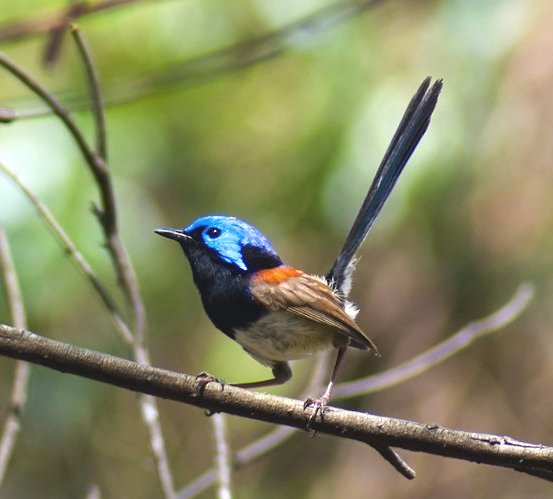
Variegated Fairy Wren
     Just as we turned back towards the car, Pierre heard a fairy wren twittering in the trees.  We had talked about me needing the Variegated Fairy Wren for the trip and he was sure that was what we were hearing.  By this point in the narrative, you may begin to understand what makes a really good bird watcher.   Good eyes help, but to get to the next level one needs to be able to recognize the calls of the birds.  If one looks hard for every twittering bird, he will see the same thing over and over.  But the difference between the twitterings of one fairy wren and another is subtle at best.  

     This bird was a bit elusive, but the increased bird activity had us excited.  Off we charged into the brushy undergrowth.  There had been a fire here recently and we were chasing the bird through charred stems, accumulating a fair amount of soot as we scrambled and pished, trying to get the wren to show itself.  Finally we got our look and Pierre was right again.  Chestnut brown cape and an electric blue face.  A male Variegated Wren.  And me wearing my soot streaked khakis like a badge of honor. 
     As we walked out of the  car Pierre recognized the burbling call of the bird known in Oz as the Green Oriole.  Its a fat green bird that favors tree tops and a little dancing around the base of his tree soon afforded us a glimpse.  As we walked back to the car, Perre waxed eloquent on his favorite subject, his wonderful wife.  It is very cool that they are still so devoted after many years.

Southern Emu Wren
    Back at the car it was time to finish off our trip to Red Rock with a last look at the tidelands.  As we drove, Pierre stopped suddenly.  On our right was a series of modern houses facing, on our left, a vast heath much like the one we had walked through at the beginning of the day.  Heaven knows what he saw or heard, but we were immediately on the edge of the heath.  Way out, perhaps 150 yards, Pierre spotted something that he was convinced was Emu Wren.  He encouraged me to pish.  Soon even I could see movement.  Three of these tiny birds made several flights towards us.  Pierre was very excited, repeatedly commenting that his usual experience was for the emu wren to pop up out of the heath and disappear immediately back into the tangle.  I got three pretty good looks as the trio of birds made their flight of about twenty  yards, disappearing as a group at the end of each flight.  As they flew, it was possible to make out thier delicate blue markings.  More impressive were their trailing, wispy tails which waved behind them like a bride’s train.  Nothing like waiting for twenty years to see a bird and  missing it in the morning to make this a special experience.  I was really happy and Pierre was vindicated.  “We got them the American way”  he cheered..  It is the essence of bird watching that a small bird hard to find in a vanishing habitat is treasured above the biggest, most colorful bird that is found easily.  
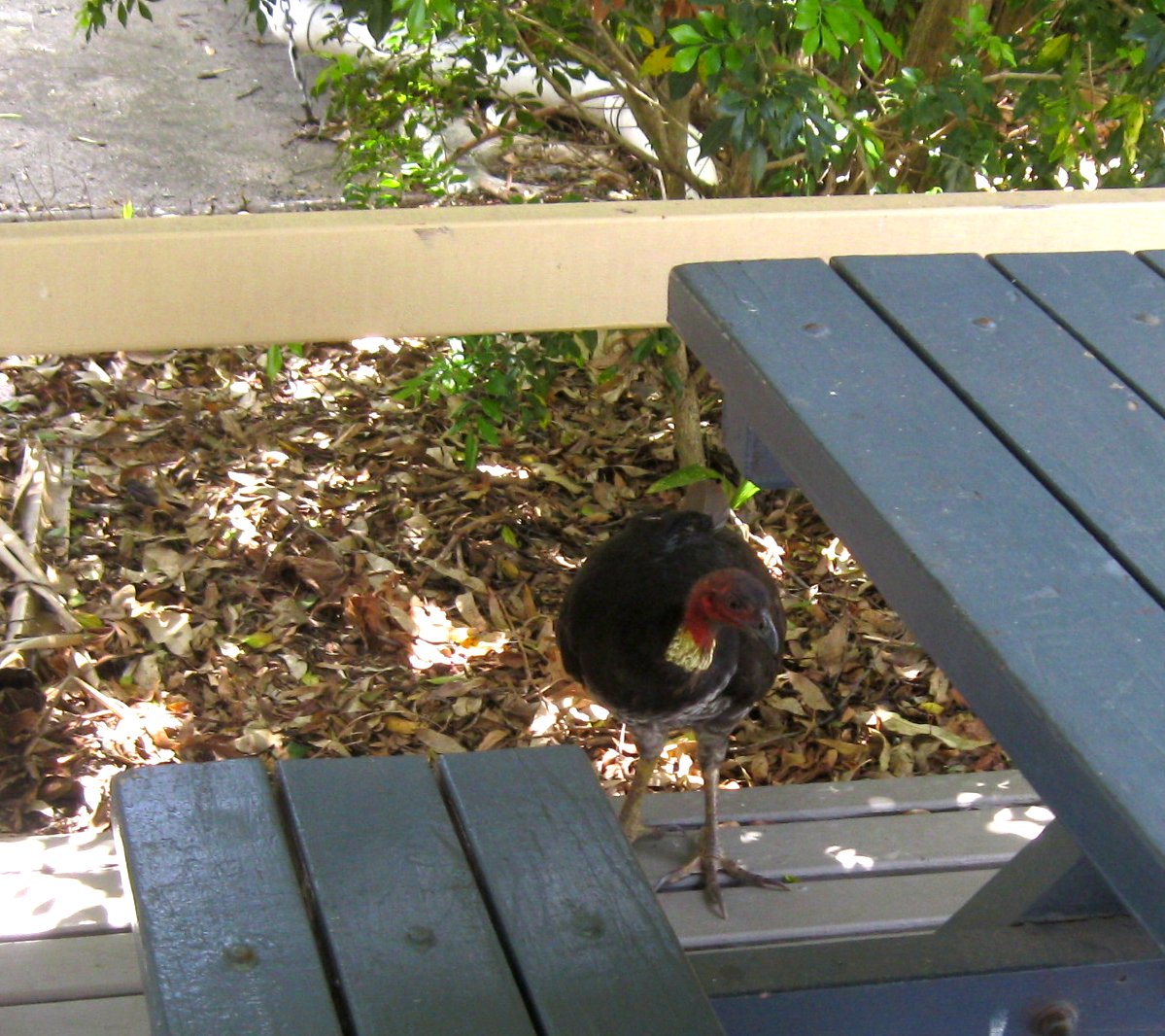
Why not share your lunch with a Brush Turkey?
     
The Red Rock Park was around the corner . From the park we were now able to see many sandy islands.   Around the corner we stood on the red rocks and looked for more shore birds.  We eventually seeing the Red Capped Plover far, far away cavorting with some curlews and, a bit closer, the Pied Oystercatcher fossicking on the shore.   Nearer yet,  we saw some Little Terns, about the size of Barn Swallows, cavorting over the bay.  

    Back at the ranch, Pierre and I shook hands, he departed to take care of his parents and I returned to our small trailer and my beloved Sandra.  See?  I  too can be a devoted husband!
    Sandra related her days experiences, mostly hanging around the holiday park, but with an encounter with a Brush Turkey.  Just like the Ibis that tried to steal her lunch in the Sydney Botanical Gardens, a turkey had hopped on our verandah while Sandra was trying to eat lunch.  He didn’t get any lunch and Sandra got his picture.

     To compensate Sandra for her day stuck in the park by the beach with the brush turkeys, I pulled myself together, got explicit instructions from Sam at the park office and we headed off to dinner in Coff’s Harbour.   Explicit instructions were  clearly required, as we had failed to find a restaurant the night before and ended up eating in the cabin on supplies that we had purchased for the final leg of the trip.  
   Luckily, we were getting better at this.  Having made it onto the freeway,  we took the correct exit and found the restaurant district without a hitch. We were pleased to find that we had indeed driven right by this long block of restaurants the day before.  So adept was I in negotiating Coff’s on this warm afternoon,  that we arrived at our destination about an hour before the restaurants opened.  

    Sandra and I strolled the restaurant block, named for the pier, though it was about two long blocks away.   Chinese, Thai, Italian and Indian cuisine was represented, along with a wine bar and a pub.  We settled on the Tandoori Oven and spoke with the proprietor who assured us he would open in less than an hour.  
    Having time to burn, we boarded the Corolla and, just around the block, found a combination gas station and liquor store.  These are not terribly uncommon in Australia.  Having fueled the car and once again marveled at the price of beverages in Oz, we headed down to the pier where we enjoyed the ocean breeze.  
   
Trip

   Trip Advisor Review  Tandoori Oven

   Sandra and  I dined happily at The Tandoori Oven in Coff's Harbour.  the restaurant is two blocks from the pier.  We were directed by our hotel to park in the lot across the street.  Parking, though usually free in Coff's, is surprisingly hard to find at times.
    This restaurant is found on a block that boasts at least six other dining establishments, from Pub grub to iItalian and Chinese, and there is a fish and chips place in the grocery mall across the street.
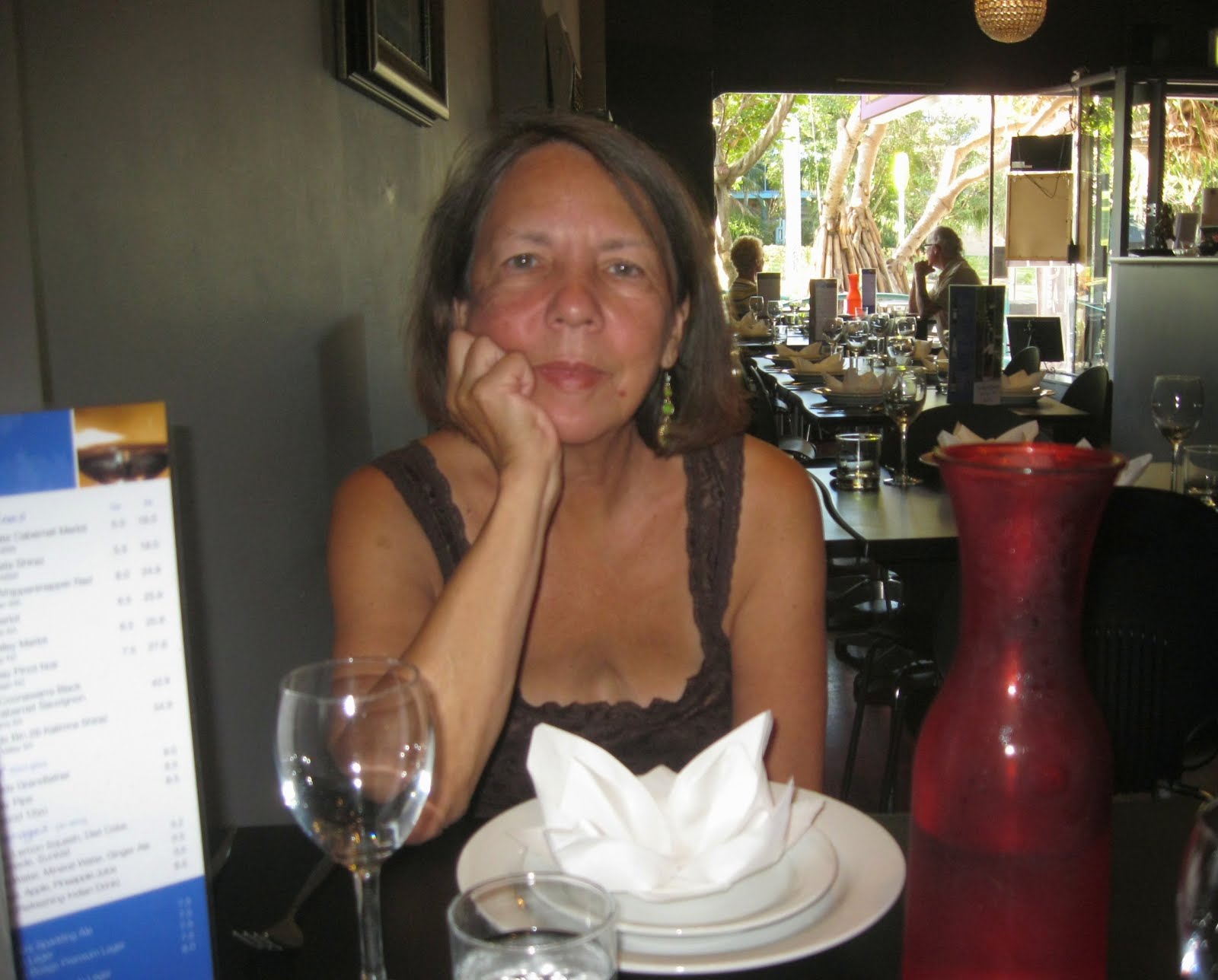
Sandra Awaits her Lamb Vindaloo in Coff's Harbour

    We were surprised to find that this is sort of a fancy restaurant.  I love Indian cuisine.    As a consequence I go to a lot of Indian restaurants, and this is easily the nicest I have been to in years.  Lots of chrome and glass and napkins folded to resemble a lotus blossom.
    
   The service was prompt and gracious.  The food was good, but not great.  First, it was spicier than we had hoped for.  There may be a larger Indian clientele here in Coff's to account for this, but if we were in the position to go again we would ask for mild, comfortable that the food would be sufficiently spicy.
    Additionally, the food was not spiced exactly as I might have hoped.  Its always fun to taste someone else's take on one of your favorite cuisines, and Indian allows a lot of room for interpretation.  It was certainly tasty and the portions were generous. 

    Or to put it another way, I didn't want to berate the restaurant, but the following day in Gloucester I improved the leftovers by adding sugar and a couple creamers.   Stay tuned as Sandra and Jeff bid goodbye to the beach and head into the mountains of New South Wales.