Wednesday, October 11, 2017

Swimming with the Ironmen on Paul Allen's Reef


Last Friday we got up bright and early and parked down by the pier around 8 AM.  As the competitors for the I
The King Kam Hotel.  Where are the Ironmen?
ronman had arrived and were training for the big event, parking was at a premium.This day Sandra and I were lucky to be joined by Kim Davison from the Methodist Church.  It is one of my pleasures living in Kailua to introduce friends, who have somehow avoided the event, to the joy of the Ironman. Hanging with the competitors at the pier has proven to be one of the most enjoyable for me, and we hoped Kim would  have a memorable time.

   As the Ironman side of the pier was full of ironmen churning back and forth in an expanded swim lane, the better to accommodate the multitude, we chose to swim on the Paul Allen side in front of the King Kamehameha Hotel.  The three of us donned our swim gear and left our clothes in front of the beach boy shack.

    The beach and the lagoon were almost empty, in contrast to the rest of the village and especially the other side of the pier where the competitors were training.  As we headed into the water, which Sandra and Kim thought was cold (in fact I put it at 82 degrees) we encountered a handsome young man and his six year old daughter who was frolicking by his side.  I asked if he was a competitor and he allowed that he was.  And he had a story that he was eager to relate.

   Johann was from Switzerland and he was 40 years old.  He  had competed in Kona 16 years ago, as a relatively young man. .  On his 40th birthday his wife had asked him if he thought he could qualify for the Ironman again.  I suppose she wanted a family trip to the Big Island.  Or perhaps she wanted Johann to buff up.  Regardless, he whipped himself into shape and, he being now able to check a new box on the entry form, qualified for the 40 and over age group.  As he finished relating his story, his daughter shrieked merrily, tossing her flaxen locks she grabbed his hand and he spoke to her in some inscrutable tongue.  Swiss-German, I presume, but have you noticed how foreign languages never
Two Flowery Flounders.  Which one gets to be on top?
sound the same as they do on the instructional tapes when the natives are speaking to one another, or in this case their children?

    Well our mini-interview was over and it was time to swim.  Just inside the small jetty by the heiau Kim spotted a whitemouth moray hunting.  We watched the eel for a minute or two and as we did he swam over a pair of flowery flounders, lying on the bottom in about five feet.  Kim had never seen a flounder before and enjoyed the hell out of it.  Although one would suspect that she has enjoyed flounder with some lemon and tartar sauce, she had never considered the curious physiology of this curious group of fishes.  Among other things, she wondered how the flounder avoided sucking sand into the breathing apparatus on the side that faced the bottom.  What a twisted world the flounder inhabits, I explained, with all the important structures, eyes, gills, cat and wives, rotated to the top.  How many flounders were going to Saint Ives?   Well there were two here, which is sort of unusual.  I wondered if they were getting in the mood to make the two headed flatfish.  Even my photographic efforts couldn't interfere with true love, fishy style, so I wouldn't be a bit surprised.

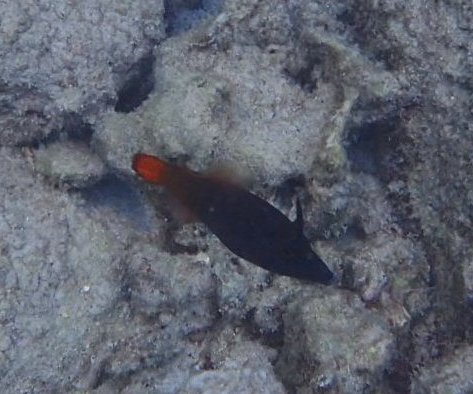
   Out in the bay we were lucky to spot a yellowtail filefish.  he wasn't terribly deep, perhaps eight feet, and he was more cooperative than most.  I had not seen one on the Paul Allen side before two
Yellowtail Filefish, Kailua Kona Pier, October 2017
years ago and this one was closer to the pier than any previously.  Perhaps they are getting more common.

   Out on the PAR we admired the dead coral, which is neither better or worse.  This being the end of summer, we should be thankful that no major bleaching occurred in 2017.  The main reason to admire the dead coral flat here, about 15 to 20 yards from shore, is the opportunity to look for Potter's Angelfish.  We had prepared our guest to look for this blue tailed beauty, but none were found.  We all spotted four voracious crown of thorns starfish, though.  This was a new species for our guest and she was quite pleased.  Knowing that the crown of thorns eats coral polyps, and that this particular reef has so few polyps to spare, we were less than overjoyed.

Yellowtail Surgeons and Kim Davison Brave the Surf
   My last treat for Kim was a look at the spotted surgeon.  I swam over by the steep lave reef that forms Paul Allen's beach and sure enough, there were three of these dinner plate-sized surgeons cavorting in the surf as it exploded against the lava wall.  My friend Kimmy is not a wuss, but she was a bit
cowed, intimidated if you will, by the surf crashing against the rock. It took a bit of persuasion.  Finally, though, we coaxed her within five feet of the reef and she was able to see the spotted surgeons as they swam though the surging bubbles.  Brave Kim, happy fish.

    Sandra had seen enough spotted surgeons, and has tasted the vengeance of the lava and the waves, so she watched this introduction to the surf on the reef experience from a safe distance.  Not that there was ever any danger.  Just keep telling yourself that and things will be fine.

   On the way in, we spotted a reef lizardfish reclining on the rip rap on the outer part of the jetty.  Usually not a big deal, but it was Kim's first lizardfish.  

All he needs is a mask and snorkel
   Back on the beach we headed to the showers, where we met a petit Ironlady from the Phillipines.  I was able to tell her about the 19% of my felow Hawaiians that are Filipino, the state holiday in their honor and invite her to go shopping at Walmart where she can speak Tagalog with her countrymen.
  For here in Kona we are all one big happy family and we embrace our friends the Ironpeople from all around the world.

  Maybe if Donald Trump and Little Rocketman came to the Ironman, we could all live in peace.  Perhaps I could  persuade them to look at the spotted surgeons on a particularly rough day.  Now your talkin'.

jeff

Welcome to the Ironman

Monday, October 2, 2017

The Ironman cometh and He's Bringing a Kawa Kawa

    I suppose I need to apologize for the hiatus in blogs.  We were in Portland visiting children and grandchildren, one more slippery than the next.  For the first week we suffered with the smoke blown in from
Playing at the Kailua Kona Library through October.
nearby forest fires, then a few days of rain cleared things out and it was gorgeous.  Blue skies and 75 dry degrees.  We've been back in Kailua for five days, getting the paper mache fish exhibit up on Saturday at the local library.  To quote America's greatest impresario, Ed Sullivan, "Its a really big shooo."  If you have a chance, drop by the library and take a gander.

    As the title suggests, Ironman season is upon us.  One might have thought that our first inkling would have come at the beach, freshly littered with hard bodied Ironman competitors.  But no!  Yesterday at church, of all the god forsaken places, we saw our first ironman of the season in the person of Michelle Vesterby.   With a name like Michelle you might have assumed she was French, like a plate of petit fours, or possibly an eclair.  But no, she's a Danish.

    That Michelle should have showed up two years running, as it were, to the Lutheran church is not entirely
Don't give me that freshman philosophy crap.
a surprise.  The second most famous Lutheran (after M.L. himself) is Soren Kierkegard, who is, or was, Danish.   Kierkegaard invented existentialism, the philosophy that states you should live life in such a way that it provides the most meaning.

    Along these lines, I am reminded of Professor Clifford Skridlow, as portrayed by Dan Akroyd,  in Dr. Detroit.  When Smooth Walker has rendered him non compis mentis, Clifford says, "Don't give me any of that freshman philosophy crap.  I'm talking existential being."  to which Karen Blittstein replies, "Of course you are, gorgeous."  Fran Drescher never looked
Michelle Vesterby looking good as she wins Copenhagen
better than when she played Karen.  Too bad for Soren Kierkegard that he never got to hook up with Fran...that would have given his life meaning!

    During the church service, Michelle was introduced as a guest and afterwards my lovely wife cornered her while I went off to browse on good old American pastries, brownies and snicker doodles.  Enough to make ya say, "Hallelujah."  Having brought my blood sugar up above 150, I joined the group where Sandra told me, "Not only is Michelle an Ironman, but she's a pro."   Out of the thousands that compete, only the elite few, less than 200, are professionals.  If you're  not from Europe, it may be hard to imagine  professional triathletes.  Its a much bigger sport outside the USA.

Neither petit fours or an eclair, Michelle is a Danish
    Trying to join the conversation, I asked if she was hoping to finish around five o'clock.  No, she replied, she hoped to finish before three.  We have made it to the finish line to watch the winners come in the last three years.  This happens around 2:30.   Michelle told us that she is hoping for the podium...one of the top three women finishers.  Hoo ahh.   She finished sixth two years ago and won the Copenhagen Ironman a couple months ago.  Note in the picture that, holding the winning banner, she doesn't look especially bushed. And the Copenhagen Ironman includes a swim in the Baltic Sea!  Of all the things that amaze me about the race, the fact that most of the finishers are not exhausted is the top.  The other thing that amazes me has to do with the condition of the bicycle seats following the ride.  As this is a family forum, I will refrain from being more specific.

    At this point we will bid Michelle goodbye and head on down to the pier this morning where a variety of super fit young, and not so young, men ad women are prepping for the race.  Sandra and I reminisced a bit.  Ironman season will do that to you.  I remembered that a few years ago, just before the Ironman, we saw the pelagic jelly harboring the juvenile unicorn filefish.  She recalled that last year my knee
Big Bad Rainbow Runner
was messed up and we scored a disabled pass for parking.  Ahh, the memories.

   Today the water was cool and clear, perfect for a quick two mile swim or a leisurely three hundred yard snorkel.  We swam out on the far side of the swim line, the better to avoid the hard charging Ironman swimmers.  Once past the last swim buoy, now a large yellow pyramid, the better for the Ironmen to find their way back to the beach, we encountered the bait ball.  And almost immediately we were joined by a huge rainbow runner.

   You may recall that for many years I thought opelu were rainbow runners, they are both blue jacks with yellow tails, after all.  Bob Hillis gently corrected this misapprehension a few years ago, kindly pointing out that many people make that mistake.  Which may or may not be true.  Most people, to say the least, probably couldn't care less.  Fisherman, who have a certain pecuniary, as well as culinary, interest, probably know the difference.  My guess is that they probably
Let's Eat!
don't catch many rainbow runners, which are not all that common (now that I know what I am looking at) inshore.

   Prior to today I don't think I have seen a rainbow runner bigger than 16 inches.  Sandra thought this guy was pushing three feet.  I'd settle for 30 inches.  (the  book says they achieve four feet!)  At any rate, he was a truly big, powerful predator of a fish.  He didn't flee when I chased him for a picture and we were able to watch him make a couple dives at the huge congregation of scad.

   At this point, we were super pleased with ourselves.  But only a few minutes later I saw three large jacks, or so I thought, scream by the baitball heading out to sea.  They were silvery, two to three feet in length and had a curious pattern of with and black wavy lines over the back third of the saddle.  I knew this was something I had never seen before. I looked up, ready to ask Sandra if she had seen them, but she was ten feet away.

   We circled the large bait ball, scoring a Christmas wrasse and a nice cooperative swimming turtle, ending up twenty yards out from the yellow plastic pyramid.  We decided to swim back on the inside of the bait ball, which was lucky because those fish returned, striking at the scads as they screamed by.  This time Sandra
Wavy-back Skipjack aka the Kawa Kawa
got a look.

   At home we looked at Randall and Hoover with no luck, except to find out that there are over 20 species of jacks in Hawaii.  Only six or so are pictured.  In a moment of inspiration I pulled out my ancient copy of Dr. Tinker's book, Fishes of Hawaii.  Published in 1978, it has only a few color pictures, but its got lots more fish, some black and white photos and some drawings.   We struck pay dirt on page 325, with a primitive black and white photo of our fish.  Tinker called it the wavy-back skipjack or the kawa kawa.  It is still known as the kawa kawa, now also known as the mackerel tuna.  We thought these three fish were about two feet in length, although Dr. Tinker says that these fish are never too far from shore, but occur primarily in open water.  Most caught kawa kawa, he goes on, are around twenty inches.   I thank the Nervous Fly Fishing site for the picture.  You can see the ornamental black stripes.  Also note that the lucky angler is holding a fish more like two feet in length.  The ones we saw were big and fast.  Woosh!

   Ashore we met some Ironmen who were finishing up their water training for today.  We look forward to seeing more of them in the following two weeks.  And hopefully we'll see Michelle in church.

Gramps teaches Colsen itsy-bitsy spider.


Monday, September 4, 2017

Our Queen Lili'uokalani Canoe Race

The Lili'uokalani Canoe Race as seen from Kona Makai  SKG
   Yesterday, in the late morning, just as the day was really heating up, Sandra suggested that we take our lunch down to the beach and watch the waves splash against the rocks.  This seemed like a wonderful idea and soon we were sitting in the shade at our favorite beach access condo.  We settled in, munching on scrumptious chicken salad sandwiches, listening to the waves crash against the rocks and enjoying the latest Michael Connelly novel,  The Late Show.  Its an excellent read, if you enjoy that sort of thing,  featuring a new character,  Detective Renée Ballard, who is as down on her employer, the LAPD, as Michael's former alter ego, Heironymous Bosch. 

   Renée was up to her ass in alligators, fighting off an internal affairs investigation after defeating an assault by a masochistic sex predator, when I looked up to see an odd craft heading towards us.  It was a tiny pontoon catamaran with a blue bimini top and something streaming back from a pole.  As it turns out, that streamer was a flag declaring that this unusual vessel  was the race committee boat for the largest
Chillin' at the Finish Line   Photo by SKG
outrigger canoe race in the world, the Queen Lili'uokalani Canoe Races, held here in Kailua Kona over the Labor Day weekend each year.

     Sandra and I were aware that the races were taking place, but this weekend one thing had led to another and we hadn't made it down to watch, although, with the assistance of our trusty binoculars, we were able to see some of the boats go by from our lanai.  Our little belvedere is roughly a mile away from the coast and one really couldn't say that they attended the races when viewed from that distance.

    But now here came the boats.  There were sixteen in all, spread out over about 100 yards.  With six paddlers in each canoe, they were heading into the clubhouse turn, having completed three 1.25 mile legs.  This distance is of some interest to us Kailuans, as the buoy around which these paddlers were racing was just a bit further away from the finish line that the the buoy around which the Ironman racers swim.    Most any of us can imagine paddling a canoe five miles.  Swimming  2.4 miles in an hour is a totally different 
The Canoes Come Ashore in front of the King Kamehameha Hotel
smoke. Suffice it to say, the Ironman 2.4 mile swim is an awesome feat.

    To be fair, this was the last day of the races and the premier event had taken place the day before, with women sixes paddling to Honaunau, nine miles distant, and the men paddling from Honaunau to the Kailua Pier.  We had a glimpse of the men during a commercial, while we devoted the bulk of our attention to the plight of the Florida State Seminoles. Who you callin' a couch potato?

     As the last of the canoes was rounding the buoy, I had a brilliant idea.  "Let's hop in the car and race them back to town!" I exclaimed.  So we threw our books and the remainder of our lunch in the beach bag and walked briskly (this canoe racing can be exhausting) up hill to the car, in which we then headed north.  We caught the last of the boats around the Kona Tiki Hotel, but by the time we got to Honl's Beach we were still trailing the leaders.
A Post Race Pow Wow on the Pier

    At this point, realizing that we would be slowed by the stop sign at the market, I changed strategy.  I would drop Sandra off in front of the Fish Hopper and she would dash across Alii Drive to catch a picture of the winning canoe.  I would continue on, turn around at the King Kam Hotel and pick her up going south.  This worked fairly well, except that the lead canoe was faster than I was, so sweetie was able to catch the second and third place boats as they crossed the finish line.  Wow,what a race!  I can't decide if we came in second or fourth.  The race committee, on the other hand, did not list the Blue 2009 Honda Accord among the finishers.  Go figure.

   Following the exciting race, we parked the car and made our way to the pier.  This had been the final race of the meet, and everyone was packing up to go.  The food vendors were cleaning their grills and the concessionaires were putting away their T-shirts and trinkets.  Several of the canoes were being hauled up onto the pier and loaded onto trailers.  Naturally, I was in the
Girls With Paddles   Photo SKG
way, but the athletes were kind enough to tell me to move, as opposed to crushing me with a canoe.  Over by the sea wall, I spotted a lady a few years younger than myself wearing an OHSU T-shirt.  Having just finished paddling, she was sitting on the rail and alternately drinking bottled water and pouring it on her feet.  Having completed a course of study at the Oregon Health Sciences University and, later in life, serving as an assistant adjunct professor (can you imagine a more demeaning category of academic distinction?) at the same institution, I felt empowered to engage her in conversation.

    She was a proud mother and I was soon introduced to her son, Kent, who will be  full fledged dentist in a
few months (hence the OHSU T-shirt) In short order, Kent introduced me to his vivacious  fiancée, Katie.  From the look of things, both Kent and Katy had competed in the same boat with mom.  Being a couple decades younger, they were full of smiles and did not feel the need to sit on the rail and pour water on their feet.  I asked Kent how often he trains as a paddler in Portland and he allowed that he never paddles.  A vacancy had opened up in the canoe and he
Kent and Katy.  Looking Good After a Five Mile Paddle.
was pressed into action.  One has to suppose that, this being the last race, participation was wide open, men, women, boys girls, paddlers and non-paddlers alike.  By the way, when I said earlier that it might be relatively easy for any of us to complete a five mile paddle, I was speaking from a  hypothetical perspective.  Or to put it the Australian way (there were, in fact, two Aussie crews paddling in that race) Good on ya, Kent!

   I was just happy that I hadn't been hanging around the pier a couple hours earlier.  Who knows where I would have needed to pour the bottled water!

jeff

Wednesday, August 23, 2017

Drones Die, Kim Dives, and the Hermit Sings the Blues.

   Since we have last met around the old laptop,  Sandra and I have been scrounging for a good, blog-worthy story.  We have a few tidbits to relate to you, but first, in the spirit of our sometimes neighbor Bradley Smith, a joke. 

Dive-reticulitis?   Inconceivable.
   Brad teaches college physics at the Skagit Valley Home for the Bewildered.  He tells us that to set the proper mood, he starts off each lecture with a joke. Considering his high powered intellect, these jokes are routinely sophomoric and, to be acceptable in the classroom, devoid of racy themes.  Fortunately for us, in addition to all his other accomplishments, Brad is an excellent cook.  Unfortunately for us, he frequently begins the dinner routine by telling us one of the jokes that he inflicts upon his students.  After our excursion to Mahukona (Pyramid Butterfly, Rock Damsel, et al.) Sandra came up with a joke worthy of Physics 101, and in that spirit, I present this to you. 

   As we were approaching the Pyramid Butterflies, about fifteen minutes into our swim, Sandra spotted a a lone reticulated butterflyfish.  Like many species of butterflies, the reticulated is usually seen as a mated pair.
Dwatted Dwone.
  This troubled her and she thought about it day after day.  At last, she decided that the mate had succumbed
to dive-reticulitis.  Ba-dum.

    Sandra presented that little bit of humor to me on our drive to City of Refuge about a week ago.  At the picnic table, as we were donning our dive suits, we met what we initially assumed was a handsome young
couple from San Diego.  The girl was a cute little pixie, so naturally I had to chat her up.  As it turned out, this boy and girl combo were associated with an adverting firm and were at City of Refuge filming an ad for a water-borne drone produced in China. The drone was radio controlled and could take pictures of things both under water and on top of the water.  We had noted a couple scantily clad beauties on paddle boards just off the two step entry (hardly a common occurrence) and it turned out that the drone was attempting to film them while the divers filmed the drone.
A drone's eye view.  Things were never like this back in San Diego.

   One might be reminded of Howard Wallowitz with his satellite-controlled car attempting to look up Penny's skirt.

   The guy wandered off to assist in the production and the girl remained.  According to her, she had scored a trip to Kona for the purpose of watching the stuff.  Just think, if I was a cute twenty something girl , maybe
I could score a free trip to Kona. 


    While you are trying to get your mind around that bit of aberrant sociology, I will tell you that the Chinese had sent this crew two drones.  One had ceased to function the day before and the second bit the dust while Sandra was putting on her dive skin.  Hence, the picture you see here are members of the team contemplating the second non-functional drone.
Howard can't wait to get her on a paddleboard!


    We looked really hard for a blog worthy fish.  We found some boulders way out on the north cusp, but try as we might, we could not roust out a rock damsel.  But the water was cool and clear and there were lots of other fish.  Not to mention the handsome young advertising team from San Diego.

   Last Friday we went swimming with the church ladies.  We had been threatened with another non-swimmer, a newbie of a certain age at the Methodist church, but she had decided to go on the Fairwinds, the cruising catamaran that takes swimmers and non-swimmers alike for a dip at the Captain Cook monument down in Kealakekua Bay.  This worked out well for Sandra, who has developed a healthy fear of non-swimmers.  And the new non-participant was afforded the opportunity to get rid of a portion of her extra money.  So things worked out well for one and all.

   The water was cool and just a bit cloudy.  Out by the fourth swim buoy, I spotted an octopus about nine feet down.  The water was just cloudy enough, and the octopus was so cryptically colored, that Kim and
Kim Davison.  The next Jacqueline Cousteau.
Sunny were unable to see him. Sandra, now an accomplished diver, was able to descend for a fine look at this handsome cephalopod.

   After several frustrating minutes of diving and pointing to no avail,  I swam off in search of something shallower. As I returned to the group, Sandra and Kim were talking gaily.  In my absence, Sandra had taught Kim to dive.  No more missing out on octopi for Ms, Davison!   In the case of Sandra, it was see one, do one, teach one.  She was so proud that she had me take Kim's picture in mid-descent. 

   Yesterday, mostly to get away from the stifling house, Ms. Gray and your humble correspondent wandered down to Kahalu'u.  We are in a period of what the news is calling King tides.  This has been going on for a couple weeks now, with tides in excess of two feet.  This won't sound like much to those in temperate latitudes, but when augmented by offshore winds, it has been enough to cause flooding both in Honolulu and on the windward side of this very emerald isle.  These floods have created a brown water situation and it took some fast talkin' on my part to convince Sandra that it was safe to swim.
Gotta be a hermit crab!

   The water at Kahalu'u was high, higher than we expected, and as cloudy as I have ever seen.  But it wasn't too warm and it cleared a little when we got away from the entry.  There was a good bunch of fish, including both red labrid and dragon wrasse.  Towards the end of the swim, we spotted a beautifully encrusted triton shell sitting on the coral about three feet down.  Hermit crab!  Even better, through the adjacent fenestration we could see some really large legs, a washed out orange in color, I thought they must belong to a lobster or a larger crab. 


   We directed our attention first to the the hermit, diving down and positioning the shell to coax him out for a free peek. As has been my luck of late, he just would not come out except when his triton shell was face down.  There was just enough current in the vicinity of the rescue shelter to make this experience frustrating.
  I never got a good look with my eyes.  Perhaps as a consequence of the current, but more likely secondary to operator error, I took a bunch of inferior pictures.  But luckily, there were a couple good ones where we
Hazlett's Hermit Crab Peeks Out From His Triton
captured the little fellow poking his nose out from under the edge of the shell.  In the pictures his legs look black, but I am writing that off to the lack of light in the shade of the shell.  three is no doubt that his eye stalks are rufous terminating with a white band.  So I'm calling it a Hazlett's hermit crab in a Hawaiian hairy triton.

   As for the large crab or lobster, after I finished with the hermit I dove down, held on and looked from the upside down perspective under the coral head.  A raccoon butterflyfish looked back at me, but there were no arthropods.  Perhaps you'll see a lobster the next time you go swimming.  Or better yet, maybe you will buy one or two at the market and serve them with butter and lemon.  And a cool, crisp pinot grigio.  Yeah.  That's the ticket.

jeff


Wednesday, August 9, 2017

Juvenile Barred Filefish, Disaster Strikes and a Fish Story

   Yesterday Sandra dropped me off at the pier for an hour in the afternoon, while she enjoyed the friendly confines of the air conditioned  mall.  It was a super high tide and a Sunday afternoon with a host of locals cavorting in the warm, turbid water.

    I saw nothing on the way out and by the time I neared the pier on my return I was wondering how I was
Barred Filefish Juvenile  Kailua Kona 2017
going to waste the next half hour. Luckily,  near the first swim buoy I spotted a juvenile barred filefish, the black fish with the pin point white spots.  As I was admiring him, and hauling out the camera, two kids swam over.  It was a boy and a girl in the ten to twelve range, the girl being the older sister, but just barely.  Before spotting your humble correspondent, they had been annoying an older brother who was attempting to fish.  He would throw his lure in the water and they would grab it and throw it back.

    It's a sad thing in this day and age, but a single adult, no matter how well intentioned, must consider the implications of befriending children. What a shame. I talked to them a little, but didn't ask their names, somehow figuring that might cross the line.  For the purposes of the the blog let's call them Kimo and  Jen.

    The girl was wearing swim goggles and the boy a mask.  Neither had flippers, but when you grow up swimming like a fish, perhaps they aren't so necessary. I asked if they would like to see a cool fish and when they assented we watched from the surface while the keiki filefish swam out from under the coral overhang.
Kimo   "That's a damn big eel!"
 We we all got a good look.   Kimo was surprised that a fish as big as this was still a baby.  Suffice it to say, the barred filefish is a big fish and the keikis are
commensurately large. From the standpoint of getting the kids interested, one has to admit that with the filefish shape, the fine black spots and its butterscotch tail, this is a pretty cool fish.

    The kids swam a short distance then turned together and gave me a wave.  I asked if they would like to have their picture taken for the blog and they waved eagerly.  I spent the next five minutes trying for a picture.  The filefish was just cooperative enough to make it a challenge.

   When I was done with the filefish,  I swam out beside the pier.  Near the end of the small coral reef there was a large peppered moray eel.  The kids were about fifteen feet away and looking at me, so I beckoned them over.  They swam faster that I could wearing fins. I showed them the pictus and Kimo allowed that it was, indeed, a damn big eel.

A Lovely colony of Hydras, Kailua Pier August 2017
   By this time I was having fun, so I swam back by the pier, where Kimo and Jen were hopping in and out onto the pier like a couple of otters.  There, looking in a spot that had supported the colony in the past, I found a nice clump of hydras.  I explained that they look like a bunch of tiny Christmas trees and both of the
kids were able to dive down and enjoy these beauties.  I managed one last photo opportunity, getting Kimo and Jen to dive the hydras and point.  What delightful keikis!

    Time was about up so I swam to shore, noting a dead male boxfish on the way. Alas poor Boxfish.  I knew him Horatio.  A fish of infinite jest and a host of significant angles.

    Back at the ranch, Sandra plopped the camera in to soak while I hung my swimming outfit to dry.  Inside, I took the camera from its bath and was caring for the lens, carefully sucking up each drop with the ragged edge of a paper towel.  It took just a moment, one or two sucked drops, as it were, for me to realize that
What's Missing in this Picture?
something was desperately wrong.  The ring that surrounds the lens was missing and I was able to look right in to the lens assembly.

   We hunted in the camera bag, in the trunk of the car and in the pockets of my suit, all to no avail.  With Sandra's encouragement we drove back to the pier.  I had some vague recollection that when I pulled the camera from its bag I heard a ping, like something metal hitting the asphalt. We looked all around, near the cubbies, around the shower and in the dressing room.  The ring was nowhere to be found. 

    The following morning I went for an early swim, hoping that I might find the ring in the vicinity of the first swim buoy, the first place I had pulled the camera from my pocket.  Of course, it wasn't there.  Not only that, but the juvenile filefish had moved on.  After a thorough search, I began examining the other areas I had swum the previous afternoon.  Not too far along, I ran across a longjaw squirrelfish that had been hooked, probably the night before, and broke the line by
Longnose Squirrelfish and a Web of Monofilament, Kailua Kona 2017
wrapping around the coral.  The coral near the fish, with a web of criss-crossing monofilament  line, was reminiscent of the inside of busted piano.  I dove down and cleared some of the line, but failed to free the fish. 

   I also took a couple pictures of the fish in its predicament.  These were taken with my old buddy, the Canon D10.  I had hoped to use the Canon to take a picture of the lens trim ring on the sand near the first swim buoy.  Now I was pressing it into battle for real fish photography.  An hour or two earlier, the nice man at Olympus echoed their website; the camera can be used without the trim ring and they plan to have more replacement trim rings for sale by November.  Apparently, this part which appears to protect the space around the lens is non-essential.  This is lucky, since both the T3 and the T4 shed this so-called trim ring faster than a growing hermit crab changes shells.  

    This idea of non-essential parts reminds me of a bird watching trip to Ecuador 20 years ago.  As there was a coup going on, the government had closed the airport, so our options were limited.  Thus, at the Hotel Intercontinental we had  rented a VW Fox, made in Brazil.  Early in our adventure, we encountered a mudslide covering our path.  We had birds to see, so my good friend
The Cock of the  Rock says, " Hey Miguelito.  Via con Dios"
Mikey plowed right through.  A bit further on there was a tractor with a scoop parked by the side of the road.  The tractor proved to be a harbinger of things to come, specifically more mud slides.  As we exited the third of these exciting driving obstacles, we noted that the car was dragging something.  It proved to be the front stabilizer bar.  Mike asserted that  (like the lens trim ring on my Olympus T3) the stabilizer bar on the Fox was extra and unnecessary parts.  Being a resourceful anesthesiologist, I attempted to secure the dragging bar with a roll of one inch cloth tape.  For a little while the car thus looked a bit like a narwhal.  However, when we plowed through the next mudslide the other end of the stabilizer bar was torn free.  I assume that unnecessary part is still in the depths of the Andean mud, somewhere on the old road to Santo Domingo.

    Mike was right, though, and we were able to complete our circuit of western Ecuador sans stabilizer bar.  Eventually we got the Fox back to Quito where we traded it in for an Isuzu Trooper, which we took into the Oriente.  There we survived the rest of the military coup and saw many wonderful birds including the Andean
Usain Bolt.  Some guys have all the luck.
Cock of the Rock at a lek: seven orange birds, each the size of an NFL football, bouncing up and down on a branch.  This on a misty morning hard by the Cascada San Rafael.  Those were the days. 

Mike is gone now.  I'm hoping that he's ripping through mudslides and avoiding the Federales up in heaven.  With any luck, he's out bird watching right now with St. Peter along for the ride.

   A bit further out, on the far edge of the same coral, I saw the trailing two thirds of an enormous undulated moray.   He was a gorgeous specimen with a chocolate ground and a fine white undulated pattern. And I'm reasonably certain that this was the largest undulated moray eel I have ever seen.  My thought at the time was that his body was bigger around than my thigh.  That I am a spindly white man, who's thighs in no way approximate those of Usain Bolt  (the fastest man on earth, now recently retired) may lend
Undulated Moray courtesy of Maui. net. 
credence to my assertion.  Regardless, this was a truly big eel. 

    I swam further out, not finding the trim ring or any other unnecessary parts.  On the way back, I checked in on my friend the hooked squirrelfish.  To my surprise, during my brief peregrination he had vanished.  I dove down, attempting to discover where our friend had gotten off to and came face to face with the ginormous undulated, who was welcoming enough to grace me with a real close look at his shiny, sharp fangs.  It is our understanding here at Snorkelkids that the undulated is one of the few moray eels that really wants to bite you.  In fact, I know a man who was bitten, more or less unprovoked, by an undulated moray eel.  The fact that he was a well known asshole probably had little to do with it, unless you're a big fan of karma, in which case he had it comin'.  Regardless, I was in no mood to test out my standing with Vishnu and his ilk, so I backed off carefully, without attempting a picture.

   Well.  You got an uplifting story about the keikis, a tale of tragedy worthy of the bard himself, and a heck 
Notice How Vishnu Still has All Twenty of His Fingers. Good Karma!
of a fish story.  I'm trusting that our friend the eel enjoyed his fish dinner and is none the worse for having to shoot some line and a hook out the other end.  Them eels is tough.  I hope you are too and we'll see ya out there on the reef.

jeff


Friday, August 4, 2017

Batting For a High Average at Mahukona

    Yesterday we were lured yet again to the northern Kohala coast by our friend Peter, this time with the promise of a family of Rock Damselfish, which my lovely wife refers to as the Rock Island Damsel.  What follows is an account of the outing.  As you will see, the fish watching was superb, but due to conditions, the subject fish and my human frailty, only one of several species was captured by the camera (as wielded by yours truly) in a fashion suitable for this glossy
Pyramid Butterflyfish in Their Rocky Lair
magazine.  Well, all right, its only a blog and it isn't going to make it to your coffee table, but even by those low standards the pictures are inadequate.  To make up for this, I am going to throw in a couple photos submitted by our loyal readers.

    Sandra and I got an early start and met Peter at 9 AM.  (Marla was home cleaning the estate in anticipation of their imminent departure to go watch the eclipse on the mainland.)   The wave predictor had promised completely flat conditions, but there was a modest surge.  A particularly vigorous splash attempted to wash my sweetie's fins prematurely into the soup, but she snagged them and we were soon, all three of us, swimming out of the bay.

   As we hit the deep water, Peter stopped us to admonish that the threadfin jacks were still around, so we should be alert for them, as if we weren't already.  On we swam into a mild but definite current.  After about ten minutes of this, Sandra was the first to spot the pyramid butterflyfish.  We had been hearing about this school from our friends for a while, and it did not disappoint.  A 15 minute swim from the ladder around to the south should bring you to a school of 40 pyramids, some of them over deep water, but many swimming in and out
The Home of the Rock Damsel
of rocky hideaways.  As you can see, it was a gorgeous display.  Gotta love those papal colors.   

   I suppose that this is as good a time as any to note that the swim south of the little bay at Mahukona is not carpeted with fascinating coral formations.  Much of what we swam over, and the spot we were headed for, was bare rock, possibly due to coral death over the last two decades.

   Soon enough we were swimming onward again into that pesky current.  Another ten minutes of hard work and we reached the spot where Peter had found the familia rock damsel.  A few words of explanation are merited here.  First, this is an extremely uncommon fish.  It only lives in the shallow surge zone.  You may recall that in past years, when we saw the five stripe wrasse for example, we have boasted
Rock Damsel, possibly out of the water
that we own the shallows.  Well, despite all my hubris, not to mention hours puttering around in the shallows, I had not seen a rock damsel.  Even John Hoover, no slouch to be sure, says, "They inhabit the shallow surge zone...and because of their habitat are seldom noticed." ...especially by divers, who could not possibly go into this particular habitat.   I was a bit surprised to discover these fish living in a habitat that we do not commonly search;  a collection of large boulders right at the shoreline.   Mostly when I am in the surge zone, I am on the edge of a steep lava drop off  which descends from a very shallow sloping lava flat.  Here we had large boulders forming a small inlet.  Perhaps these boulders were the rocks mentioned in the name.

   Peter guided us into the tiny cove formed by boulders against which the modest swell, even on this relatively mild day, made an exciting surge.  As you can see, there was virtually no coral in this area.  Sandra and I saw at least three individuals and at least one had a definite stripe.  Unlike the few pictures you see in field guides, the rock damsels were black, which contrasted with the significantly larger and  gray Pacific
My best effort at the rock damsel.  Can you see the stripe?
Gregories which were also present.  Although one rarely sees a picture of these fish without two stripes, we only saw one stripe.  And on at least one fish, no stripes.  And the stripe we saw was visible only when the light hit it just right.  But the shape of the fish was distinctive, which may be helpful in the future. Suffice it to say, floating rapidly back and forth with the surge, while negotiating the rocks is not ideal conditions for picture taking.  photography was further complicated by the fish, who, as noted above, were small, almost black and active.  Hence, along with my efforts I'm including  a picture taken by some other photographer so you can appreciate this highly uncommon fish.

   What, you may ask, led Peter to this particular spot.  My answer is, simply, "Hell if I know."  It was not anywhere near the place where he puts in and involves a swim through current to get there.  I couldn't see anything special about this collection of boulders and the conditions made swimming into this enclosure a little
Shortnose Wrasse 2013  Orange in front, Blue behind
dangerous.  And this was a mild surf day.  Lastly, when he poked his nose into this far flung bunch of rocks, Peter did a heck of a job noticing these small active fish with the fine white stripe.  

   We played dodge that rock for about five minutes until we all agreed that we had clearly seen the fish and that we had taken our best shot at a photograph.  As we headed out, Peter tantalized us with another pearl.  He had recently seen an Ewa blenny in about fifteen feet of Kohala crystal (yes Virginia, the water out there was really clear.) and 40 feet seaward of the rocky coast.

   Once again, and I do apologize, I must interrupt my narrative.  The Ewa (pronunced ev-uh, although until rather recently I pronounced it eee wah) blenny is curiously named for Ewa  Beach, a no account beach community just west of the channel leading in to Pearl Harbor.  Thus, Ewa Beach is west of the village that has served as the capital of Hawaii since about 1830, when it was a town of a couple thousand souls, four or five recognizable boulevards and Queen Ka'ahumanu was calling the shots.  In
Peter on the bottom looking for the shortnose wrasse. 
Honolulu, and sometimes elsewhere in the land of the hula, ewa means "to the west"  just like mauka means "toward the mountain".  No one seems to have any idea why this species of blenny is named for Ewa Beach.

   Two species of fanged blenny make it into a Hawaiian fish field guide, Gosline's and Ewa.  But  they haven't been there for ever.  Gar Goodson, the author of  The Many Splendored Fishes of Hawaii did not include them.   That small paperback was all I could find to teach myself the names of the fish way back in 1979.  Dr.Tinker's book, the true bible for ichthyologists of that era,  might have been available to me in a university library, but not in an average bookstore.  And it had no colorful pictures.  While his drawings were a landmark for amateur fish identification in Hawaii, Goodson's book led me down the path of some spectacular mis-identifications.  As Gar didn't deal with these tiny blennies, the blame must fall on the great Jack Randall, who put his name to the dead fish guide just as I was starting to make fish lists in Kona. I looked at his pictures and, perhaps because the fish were small
2012...Green and Brown Bird Wrasse Juveniles Masquerade as Fanged Blennies
and I was willing to fudge, I decided these small green and brown fish at Kahaluu and elsewhere must be Gosline's and Ewa blennies. Amazingly, I kept on fudging for the next 25 years.  Unlike bird watching, a sport in which one is usually mentored, and one that is frequently carried out by supportive groups, fish watching for me was totally self taught; no one was there to to tell me I was making a dramatic error in identification.

   Gosline's fang blenny is green and the Ewa blenny is brown.  Says so in the dead fish book.  The pictures are right next to one another and suggest that the fish are the same size.  It wasn't until 2008 that John Hoover authored the Ultimate Guide...  If I had looked closely, I would have noticed that he included a juvenile bird wrasse, which is what those green and brown fish at K Bay actually are.  So year or so ago John
An Honest to God Ewa Blenny
Hoover was contemplating making a fish identification app aimed at snorkelers and he asked me to help him delineate which fish an average snorkeler might see, as opposed to a diver.  I gave him my list and he pointed out that he was surprised I was seeing Ewa blenny and curious worm fish, as these species are found only occasionally by divers and deeper than what he would consider snorkeling depth.  Kind soul that I am, I forwarded him a picture of both green and brown "blennies" taken at Kahalu'u.  Imagine the extent of my shame when he appraised me that these were juvenile bird wrasse.   The shame went on, as what I was calling curious wormfish (which is also a rare fish of the depths) was, in fact, Gosline's fang blenny.  So in that fell swoop I lost two life fish and a large portion of my confidence.  Sucks to be me.   Only seeing an Ewa blenny for real this time, could restore a modicum of my self esteem.  And what was the likelihood of that?

   Now let us return to the Kohala shore, 150 yards south of Mahukona, with the salty shame of the Ewa blenny burning in the still un-heeled wounds of my psyche.  I was tagging behind Peter and Sandra and
looking down in about 15 feet when I saw two fish, auburn in front and bright blue behind, the coloration of
Purple Linkia courtesy of Gail DeLuke says, "Go Huskies!"
Potter's angel, which I momentarily thought these two must be.  But they were the wrong shape; they were long and skinny.  A quick dive and I ascertained that it was two shortnose wrasse adults.  Earlier in the year I saw a baby shortnose, but these were the first adults of this gorgeous fish that I had seen in a while.  I called to Sandra and Peter and dove again to take a picture.  By the time I got down to eight feet, I had lost the wrasses, but right in front of me, perhaps ten feet away was an Ewa blenny.  It was big and brown with blue stripes and a relatively tall dorsal fin running the length of its body.  Hoping that the camera might focus on this actually very small fish some distance away I took two quick snaps.  The camera did not get the fish clearly, but it is indelibly etched in my minds eye.

"Miss Scarlet, You stay away from dem dwarf morays!"
   Well, if two life fish in ten minutes time doesn't cheer you up, you need to be on Prozac.  The swim back was fairly uneventful, but our host lingered in the middle of the small bay for a few minutes after Sandra and I had showered off.  When Peter joined us ashore, he said that he had been tracking a dwarf moray.  We used to see this uncommon species way down south at Ho'okena  (from my mammy's lap, think her name was Layna) but the small fragment of coral reef that supported dwarf moray has been degenerating into dead coral and sand.  Hence, I haven't seen him in a couple years. 

   We hit for a really high average at Mahukona yesterday, but we already have something on the wish list for next time.


jeff

Pass the Dog Biscuits and the Rainier Beer!   Courtesy of Chuck Hill


Wednesday, August 2, 2017

The Return of the Prodigal Bloody Hermit Crab

    Yesterday Sandra and I went swimming on the Ironman side of the pier.   There was a modest breeze and
Bloody Hermit Crab / Episcopal Miter 2012, Kailua Pier
the water was more than just a little choppy.  Coupled with a bit of swell, it was enough to give you motion sickness, if you were so inclined. We had our swim without seeing much of interest, but on a hot day it was really peasant being in the cool, albeit choppy water.
We completed our swim by crossing under the floating line next to the pier.  Right away we saw the milletseed butterfly that has bee hanging out in that vicinity.  And then, just as we were starting to head in, I saw a beautiful miter shell sitting on the bottom.  Without skipping a beat, my heart sung with joy.  This was a five inch long shell in fine condition.  The mollusc who ordinarily inhabits the shell, I suppose we might call
Bloody Hermit Crab, D. sanguinocarpus  Kailua Pier 2014
him the miter snail, chooses to live in the sand below forty feet. The only way that shell got there was by dint of a substantial  amount of effort on behalf of a hermit crab; a crab capable of lugging that substantial shell from the depths to the coral rubble by the pier.   


    I picked up the shell and looked inside. There was a furry leg blocking the entrance.  The hermit crab inside never came out, but there is no doubt that it was  a bloody hermit crab, Dardanus sanguinocarpus.  Sandra and I are not the biggest experts on hermit crabs in Hawaii, but we have a fair share of experience
Episcopal Miter with Bloody Hermit Crab Inside July 2017
with this species.  I have pictures, which I am sharing with you here, of the bloody hermit crab hauling a long miter shell in the vicinity of the pier dating back five years.  In our experience it is obvious that different species of hermits, given a choice, will choose a certain species of shell.  Of the half dozen or so bloody hermit crabs that I have seen, at least two others were lugging this enormous Episcopal miter shell.  All the others, one at the pier and two or three at Kahalu'u, were living in much more manageable triton shells.  We have never seen any other hermit hauling around a large miter.  As you can see from the pictures, the choice seems misguided.  Sort of like asking big ol' cumbersome Russia to interfere in our presidential election.  And who would be  that foolish?

   To the best of my knowledge, based on photographs and fish lists, I have not seen a bloody hermit crab since 2014.  Suffice it to say, we are always looking.  So lets have a toast to this rare animal who, once
Bloody Hermit Crab In a Triton Shell  December 2013
again,  has found its way into the shallows of the Kailua Bay.  Confusion to the enemy!

jeff