Tuesday, June 14, 2016

The Surf Is Up and So Is the Pizza Dough!

    Over the last couple weeks things have been quite acceptable here in Kona.  The weather has remained cool (a dramatic change from last year) and it is raining a bit on most nights.  The plants in the garden at Casa Ono are loving it.  And for most of that time, we enjoyed some acceptably mild surf conditions and some good snorkeling.
The Stealth Octopus  Kahalu'u 2016
During the mild surf conditions, I had a nice outing to Kahalu'u where I spent fifteen intimate minutes  with a
small octopus.  So brave was this young cephalopod, that he allowed me to approach within a couple feet without swimming away.  From the photographic point of view, however, this encounter was a bust.  Though I held the camera right up next to the octopus, I did not get a single really good picture.  My current position is that vis a vis my camera, the day octopus employs stealth technology.  Assuming that one's goal in life is to take a brilliant picture of a day octopus, this may constitute the ultimate bummer. 

  A few minutes before I saw my brave little octopus, I had another exciting encounter, this time with a furtive fourline wrasse, Ps. tetrataenia.  He was hiding in a pocilipora coral.  By being persistent I was able to see his striped flank, his iridescent chin stripe and his red eye.  Not all three field marks at any single moment, mind you, but there was no doubt about who was hiding in the interstices of that cauliflower coral.  From a (failed) photographic standpoint, the closest I came was a picture of the coral itself.  This was not for trying, however.  I spent several minutes clinging to rocks and chunks of dead coral hoping this fish would pop out for a quick pic. To my credit, I was able to bring Sandra back the following day, find the same coral and show her the fish.  She seems to have got a better look than I did, as she observed the entire small fish as it took a quick excursion into open water.

The Furtive Fourline Wrasse (sadly not my picture)
     As you may recall, this follows hard upon my sighting of the eightstripe wrasse, the other member of the genus Pseudocheilinus that occurs at snorkeling depth in Hawaii.  Like the eightstripe, I had not seen this species for several years, although there was a time when it was pretty dependable at Kahalu'u.  The coral patch on the far side of Surfer's Rock, where we had this species staked out, is now reduced to dead rubble. Suffice it to say, I'm really pleased to have both these small wrasses on my 2016 list.

    One more Pseudocheilinus is found in the Hawaii field guides, but Jack Randall tells us that it is found below 40 feet. The Disappearing Wrasse is only 3 inches in length, a bland brick red and the name suggests that it is easily overlooked in the best of circumstances.

   By the following day the surf was picking up.  Sandra dropped me off at the pier, which in these conditions is the last refuge of a snorkeling scoundrel. (With apologies to Samuel Johnson, who claimed that it was
politics...and you didn't even know that Samuel Johnson was a snorkeler) While she went shopping I
 pretended to snorkel in the milky water. Over by the pier I found yet another cushion starfish.  That's four cushion starfish in only a couple months.  What had been a rare find is now heading rapidly toward the mundane.  On the other hand, I finally had something to photograph.  And one can say this for a starfish:  he really knows how to hold still to have his picture taken. 

   As I was standing by the cubbies, after my shower, I was passed by a mother, her teenage daughter who was brandishing a bright pink inner tube, and boy of about four or five who was trussed up in a life vest.  On second look, I noticed that mom was holding a snorkel mask!  Here, at last, was a true photo op.

    The three of them got in the water and mom and sis took turns fixing the mask on the boys face and sending him off for short snorkeling excursions.  The only thing I could think of was that this must have been his birthday wish, to become the next Jack Randall.

Never mind the sour looks.  You're not getting one of my orchids.
    As the day wore on, it became apparent that relatively high surf was here to stay for the foreseeable future.  I had just about talked Sandra into a trip to Mahukona, that little bay just south of Hawi, where the sea rushes by the entry ladder.  Now, however, we were looking for a land based activity.  That morning I had received an email from a couple who raise Cymbidium orchids outside Waimea.  They were hosting a sale and workshop.  It sounded like just  the thing.

    On Saturday morning we hopped in the car and made the drive to Waimea, arriving about 9:30.  Around 11 we made the short drive out to the orchid farm.  Bob and Jennifer are about the same age as your humble correspondent and have enjoyed some of the same life experiences, like finding a way to avoid serving in the Vietnam War.

    Bob gave us a lesson in repotting  Cymbidium orchids.  At the risk of overstating the obvious, they need to be repotted when they outgrow their container. I was surprised to find that these orchids, perhaps all
What a lovely cup of tea.
orchids, have bulbs which when handled properly grow roots and shoots.  Hence, they have a certain similarity to the dahlias that we raised back in northern Washington.  As Bob pointed out, however, the orchid bulb lives above ground surrounded by a bit of bark, while the dahlia bulb resides three inches deep in the dirt.  That is where the similarity breaks down.  But they are both bulbs and when separated and placed in a bag, they send out roots and shoots.

    Bob took apart a raggedy looking orchid, cleaned off the bulb and but it in a ziplock plastic bag with some bark.  For him, plastic works better than paper.  This reminds me of the question posed by a young Dustin Hoffman to Mrs. Robinson at about the same time that Bob and I were finding ways to avoid an expense paid vacation to the very spot where one might find Cymbidium orchids.  Wood / wire, paper / plastic, iceberg / Goldberg and nasty little men in black pajamas carrying Kalashnikovs.

   Both of our hosts held forth at length on the native range of  Cymbidiums and for a very good reasonThey are found in the wild from the foothills of the Himalayas to the lowlands of Indochina.  This is important because here in Hawaii, as  elsewhere, one needs to select an orchid that thrives in the temperature provided
Formidable!
by his home or garden.  Obviously, if you live at the beach, you want one native to Bangkok.  If you live in Waimea, you have a larger selection from which to choose.  I was surprised to hear that it gets down into the 40s in Waimea.  Bob suggested that it may dip into the 50s at Casa Ono.  Not only that, but one can purchase (for a reasonable price) a thermometer from Amazon.com that will retain the low and high temperatures for a given period, like week, which can be pretty important information for an orchid fancier.  Especially if he wants to keep orchiectomies to a minimum.  (If that isn't enough to make you cross your legs, you can look up orchiectomy when you get home.)

    After watching Bob dismantle the ratty looking orchid, I asked his lovely wife if she would sell me one of the bulbs that had started to sprout and that they had carefully placed in a pot.  We went around a couple times on this one.  No matter how I rephrased the question, the answer was the same: by the time that sprouting orchid bulb had been placed in the three inch pot with just the right amount of bark and love, the work had been done and the risk of a failed bulb (only 20% in Bob's skilled hands) had been overcome.  Despite the fact that she had a large table full of these three inch pots, she was not going to sell one of those growing bulbs.  They were her babies.

Waimea Town Market.  Fun for Everybody
    What she did offer was the opportunity to return at a later date and select a ratty looking orchid in a gallon container from the $10 display out back.  In a moment of weakness, she said that she would permit us to use the building where Bob had conducted his seminar, yell at us when necessary, and bid us adieu clutching one or two plastic bags of orchid bulbs with a bit of bark.  Now I ask you, where else on this tourist infested isle can you have that much fun for $10?   Jennifer may live to regret this offer.  Or maybe, in the spirit of Captain Renault and Mr.Rick, it will be the beginning of a beautiful friendship.  Possibly somewhere in between.

     As we leave the Orchidpeople Farm, I am obligated to impart this last critical piece of knowledge.  There are many genera of orchids and Cymbidia mostly come in yellows and whites.  So if you are purchasing a purple orchid on Husky game day, it ain't no Cymbidium.  

    As you may recall (if you are not already asleep) we left the narrative trail somewhere before 10 AM as Sandra and I entered Waimea.  Before heading to the orchid workshop, we had left time to visit the Waimea Town Farmers Market.  There are several farmers markets on Saturday in Waimea.  This one, on the campus of the Parker School, is reputed to have the best food.

European Bison.  I think I'll just sneak in and get a little milk.  Or not.
   We stayed for a little more than an hour, enjoying the relatively small number of booths selling merchandise and an equal number of eateries. Among the food offerings was a tempting Mexican stand.  We had just about decided to split a breakfast burrito when Sandra discovered the crepe lady.  This magician chefs the Magic Pan Restaurant in Hilo, but comes to Waimea on Saturday morning to make the most toothsome crepes al fresco this side of Honolulu. We had the Alaska, which in addition to mozzarella and creme fraiche contains large chunks of yummy salmon.  Oooh la la.  As we were watching the chef de crepe prepare our snack, a girl came up and ordered the chocolate crepe.  Huge scoops of chocolate and berry filling, topped with whipped creme and powder sugar.  Gotta go back.  Soon.

    While we ate, a couple strolled by carrying their bulldog in a baby pack.  for a minute there I thought I was at the Country Fair outside Eugene, Oregon.  All we needed was some naked people and a little pot.  Its sobering to think that marijuana is now completely legal in Eugene.  Do you think this has taken some of the  thrill out of living there?

River Buffalo On the farm in India
    We saw the Japanese lady selling orchids that grow in cunning little wire baskets.  There is no bark involved and their roots wave gaily in the breeze.  And we met the pretty girl with her glass teapots  who actually grows tea somewhere near Hilo.  But the show stopper was the nice couple who raise goats on the slopes of Mauna Kea and sell a variety of home made goat cheese at the farmers market.  

    The cheese was very good, we especially loved the crottin, firm, nutty and full of goat.  But the conversation was even better.  Somehow it turned to Mozzarella and the genus Bos.   I had studied Bos a few years back when I became interested in the derivation of rodeo bulls.  The cattle in India are are a distinct sub-species,  Bos taurus indicus.  They are interbred with our European cattle to make Santa Gertrudis and other rodeo stock.  This is possible because they are conspecific, both descended from the aurochs, which though wide spread thousands of years ago, is long extinct.

   Being involved in the manufacture of cheese, Erin knew quite a bit more about mozzeralla than I did.  Although she didn't want to present a full blown lecture, she let slip that mozzarella was produced from the milk of river buffalo.  What follows here is a light hearted (at times) review, mostly from that ultimate resource of the 21st Century, Wikipedia.  The very nature of this source is that depending on how you search, it is possible to find references with differing facts.  Hmmm.  With that disclaimer, here we go.  

The Italian Water Buffalo
    As you probably know, a great deal of what now passes for mozzarella is now made from cows milk.  For hundreds of years, though,  mozzarella was made only from buffalo milk.  I had foolishly  assumed that this was the European buffalo, which is actually a bison. These are wild animals, very similar to the American bison, and both belong to the genus Bison.  Shocking! If you know anything about Buffalo Bill and the Wild West, you won't be surprised to find out that the European bison was never truly domesticated or milked.  And like the American bison it was hunted to near extinction.  The last truly wild herd was killed off by the Nazis as they retreated across Poland. Following the war, only a few specimens remained in private collections.  These animals were brought together to breed and their offspring have been released into parks throughout Eastern Europe and Germany.  There they live in forests, as opposed to the prairies favored by their American cousins.  These large herds are descended from only a couple dozen animals.  This species came as close to extinction as the California condor!

   You will recall that the phrase that Erin uttered, if you will pardon the pun, was "river buffalo".  This is a species that originated in India. Curiously, the river buffalo, Babalus babalus, was domesticated about the same time that Hinduism came into being.  Indians have been coexisting with their domestic cattle for over 4,000 years.  How the river buffalo came to Europe is a bit hazy, but it was probably introduced into Italy around 600 AD in trade with nomadic tribes from central Asia who had migrated west and were living near the Danube.  River buffalo have thus been exposed to animal husbandry as practiced by the Italians for 1400
Mama Mia!  That's a tasty pie!
years. From the Ostragoths to Bertolli.  As a result, the animal that produces milk for mozzarella is somewhat different than the domestic water buffalo of India; it is commonly called the Italian water buffalo.  But make no mistake, they are conspecific and are able to interbreed.

   The first mozzarella was probably produced around 1200.  As Marco Polo returned to Venice with pasta in 1293,  it is just possible that the later crusaders had a chance to sample a slice of  lasagne on their way back from to the Holy Lands. Perhaps they traded those bronze horses that grace the facade of St Mark's (which they pilfered from the Byzantium)  for a plate of spaghetti con formaggio.

    The bottom line is that these sacred cows are of the genus Bubalus, not the genus Bos.  More people consume food products associated with this species than any other mammal.  While about 200,000 tons of milk is harvested annually in Italy, 56 million tons of river buffalo milk is harvested each year in India.  Holy cow, indeed.  Just think, if the Indians turned all that milk into mozzarella they could have 7 million tons of tasty cheese.  And that, my friends, is a lot of pizza.

jeff

Many thanks to Orchidpeople of Hawaii  Jennifer Snyder and Bob Harris and Dick and Erin Threlfall of the Hawaii Island Goat Dairy.

 
Greetings from the Hawaii Island Goat Dairy


Thursday, June 2, 2016

Lucky Linda

   Over the last couple of weeks we have had visitors from the mainland.  This means we have been enjoying elaborate communal meals and going out to restaurants.  The downside of this is that your humble reporter
Linda and Sandra on Paul Allen's Reef
may have to skip a few meals to get back into snorkeling trim.  Alternatively, I can buy a bigger swimsuit, a purchase I would prefer to avoid if at all possible.

   In addition to dining with our guests, we have had them accompany us on our snorkeling trips.  Most recently, this involved our friend Linda, who arrived with her husband Larry from Portland.  Linda and Larry have been Sandra's friends like forever and mine, therefore , for the last 19 years.  My, my, how time passes by.   Being both adventuresome and inquisitive, Linda was eager to go out with us and look at the fish.   We were a little wary as she is far from a regular snorkeler and it is a big, unpredictable ocean.

    Our first outing was to Paul Allen's Reef.  As you may recall, the Inner Harbour in front of the King Kam Hotel is our first choice for introducing uncertain snorkelers to the deep blue sea.  It is very protected with
 virtually no shoreline waves and there is a soft, sandy entry where anyone can stand and bond with the salt water.  Best of all, at this time of year, the water is not especially cold.  Linda had practiced  with her equipment in the pool and seemed to do fine, so off we went.

    As we rounded the little jetty by the  Heiau, it was obvious to me that she was putting more effort into swimming than was necessary.  Its difficult for those of us that do it every day to remember that ocean swimming is different from swimming in a pool.  There are the physical differences, like current.  And psychic differences like changing depths.  Why should hitting a golf ball 50 yards over a pond be any different than hitting it over a patch of grass.  In the words of John Lennon, "Its all in your mind, you know."   And so it is that many people when they need time to adapt before they are truly comfortable swimming to the ocean. 
Reticulated Butterflyfish  Paul Allen's Reef 2016

   The ocean was calm and Sandra and I were able to coax Linda across the bay, past the entrance to Paul
Allen's Lagoon and out onto the reef.  In the short time allowed, we saw a nice smattering of the usual stuff.  By the time Sandra spotted a handsome pair of reticulated butterflyfish, our guest had already made the club house turn and was headed for the barn.  I let Sandra swim back with Linda while I took a couple pictures of the irresistible retics.

    I figured that I would catch up with them, but as I started my swim I was stopped short.  On the inner edge of the reef, quite near Paul Allen's Canal, I spotted an aspricaudus about eight feet below me.  The yellowtail filefish is uncommon, but I now see at least one a year.  The trick to keeping aspricaudus on the list is to recognize that they are local;  the bar at the Dog Beach is a pretty good spot for this uncommon fish and the small bay at Mahukona is virtually a sure thing if you are persistent.  Having said that, I have never before seen this species in the vicinity of the pier.   From that standpoint, it was  a really big deal.  Time to repair to the 2016 Kona Fishlist and put a 1b (my designation for the Paul Allen's Reef) next to Pervagor aspricaudus.

    Part of the problem with this fish, like many fish that one doesn't see very often, is that they are secretive,  spending a lot of time inside the coral.  For this reason, we are probably swimming over a variety of stone
Yellowtail Filefish  Pervagor aspricaudus  PAR  2016
fish every time we snorkel.  In addition, the yellowtail filefish is skittish; when you see it, it seems to be aware of your attention and is immediately swimming for a hideaway in the rocks or coral.  This guy permitted me a few looks over about five minutes until he disappeared for good into the reef only four feet down.

    In Bali, the yellowtail filefish is more common and it tends to swim up in the water, as opposed to darting in and out of crevices.  But it is every bit as skittish, so we see it but we rarely get a picture
    Pervagor aspricaudus is indeed present on Paul Allen's Reef.

I apologize for the picture and present it primarily for documentation.

    On the way in,  I passed Sandra and Linda enjoying the fish of the Inner Harbour, which although  its a bit cooler than the outside, is home to about twenty species of reef fish.

                                       >))));>        >))));>        >))));>         >)))));>

    Two days ago, we scooped up our visitors bright and early and headed down to Ho'okena.  We drove through a fine mist as we traversed the highlands of Honaunau, but by the time we descended the 1500 feet
And So Does Linda!
to Ho'okena it was warm and dry, if a bit overcast.  We got Larry situated with a spectacular view of the bay and then the threesome headed down the beach.

    The wave predictor had suggested that Ho'okena should be completely flat, ideal for our novice.  This was not entirely true, as there were occasional sets breaking with one foot faces, the tail outs racing fifteen feet up the beach.

   Linda is very game, but she is also three years status post total hip replacement.  Like a 70 something Bo Jackson, who I saw hit a major league home run on a total hip prosthesis, she continues to be very active.  However, in these conditions, we were concerned that everyone make a good quick entry beyond the surf
Ambon Toby  Ho'okena 2012  Beautiful but Easily Overlooked
line.  I just don't know what one would do on this medically deficient isle if he or she suffered a dislocated total hip.  Flying to Honolulu seems the most likely.

    Suffice it to say, that with a little coaching we got our guest into the water and beyond the surf line without anything bad happening.  Soon we were all  swimming happily in the Kona crystal.  It is always fun to look at the fish in clear water as they swim around healthy coral.  Although the coral at Ho'okena is dying just like everywhere else, it is in much better shape than the PAR, which is perhaps the most damaged of anywhere on the Kona Coast.

   Sandra found Linda a nice pair of red labrid wrasses and an ambon toby, which Linda was able to enjoy as we had studied it the night before.  I was able to contribute a stunning zebra moray poking his head out of a coral, which like so many around here, was half healthy and half dead.

   After the eel, it was time for Linda and Sandra to return to the beach.  I swam in to make sure that Sandra

Zebra Moray Ho'okena 2016
and Linda cleared the surf zone with appropriate dispatch and then I headed back out for another look.

   About forty meters from shore, in about fifteen feet of water, I saw a small pinkish fish.  diving down, I got a superb look at an eightline wrasse. He was swimming above and through a coral head with some smaller juveniles, bird and saddle wrasses, koles and parrotfish.  Boy was I happy!  According to my lists, the last time I saw one of these was in November of 2011 at Kahalu'u.  There has been a fair amount of coral death at K Bay and I wonder if that is the reason that I have not seen eightstripe and four stripe wrasses there for so many years.  It seems like we would get one or both on most two week vacations twenty years ago.  The eightstripe was more difficult even then.

    I dove this fish five times.  Being a wuss, these twelve foot dives were as deep as I go. Three times I was lucky to get a picture and here you see the results.  John Hoover has an excellent picture in his book and one
Eightstripe Wrasse    Ho'okena 2016
has to suppose that if I had been diving,  I would have captured a better image.  Of course I don't dive,  so this will have to suffice.  Additionally, it is very possible that knowledgeable fish finding divers see this fish frequently. Global warming doesn't seem to have harmed the deeper coral to the same extent we see in the shallows and better habitat may mean the preservation of less common species.

    At the end of the day, for me, this was quite a triumph.

     The overcast had persisted, so it was a nice cool afternoon.  We had a wonderful lunch under the shelter.  Linda had made egg salad, which is my favorite.  A family of locals with about ten children occupied the tables around us, so we were continuously entertained as the kids raced back and forth. 
Sandra, Larry and Linda.   Three Amigos at Ho'okena


                                               >))));>        >))));>         >))));>         >)))));>

    Which brings us to yesterday.  I wanted to go back to Paul Allen's Canal to see if I could find the aspricaudus.  Or maybe I just wanted to sing Paul my new song.  (Sung to the tune of The Erie Canal.)

Paul Allen Flies his Helicopter over Kealakekua Bay
I've got a helicopter and her name is Sal
Fifteen yards on Paul Allen's Canal. 
I fly her like a bat and the natives quail!
Fifteen yards on Paul Allen's Canal.

We see some fish most every day
For the struggling coral we have to pray
And we zip right down at a terrible rate
From Keahole Airport to the Thurston Estate. 

    Well, I guess that's enough Hawaiian folk songs for this blog.

    The tide was really high, the beach full of tourists form the cruise ship.  The parasail boats were at full occupancy, and the water was full of board paddlers and kayaks.  Through the circus I swam until I reached the spot by the canal of which you have just been serenaded.  Out by the canal I saw three large eels, a yellowmargin and two whitemouths, all in a small

Eagle Ray  Paul Allen's Reef 2016
area, protruding from the coral and waving their heads back and forth.  I didn't know what that was about, but I took their pictures and began my patrol.  

    Ten minutes of looking here and there did not reveal an aspricaudus, but I did have a moderately close encounter with the glass bottom boat.  The yellowtail filefish tend to stay in one area, so I really thought I had a chance.  While searching for the filefish, I was enjoying the large number of black sea urchins, E. calamaris.  So many had crawled into prominent positions that I thought perhaps they were getting ready to spawn.  Or perhaps the rapture was imminent.   That, by the way, is our new family position. We are available to help, but in the event of the rapture we will have to beg out.
   
     Luckily for all of us, something even better than the rapture occurred.  Right below me an eagle ray
swooped in and began foraging on the shallow reef.  He was only a couple feet below me, so even on this dark afternoon I was able to get some killer pictures.  I took a few stills and then a movie in which he pivots, showing himself from all angles.  I swam with him for several more minutes as he slowly headed back into the
the Ornate Lining of the Eagle Ray's Fin
depths, which were also the waterway used by the parasailing boats.  This was only my third eagle ray of all time.   


    I can't say with any degree of certainty how many eagle rays Paul Allen has seen.  Nor do I know his position on the list for the rapture.  I suppose it is possible that he doesn't even want to be called to heaven.  For the rest of us, snorkeling in Kona might be close enough.

jeff


One more look at the eightstripe wrasse


Friday, May 27, 2016

The Rains come and So Do the Dolphins

    Up until a week ago, we were having some really good luck finding fish at Kahalu'u.   The best was the morning when we saw the  Leaf scorpionfish, the octopus and the cushion sea star all in about fifteen
Turn the army around!  We're going snorkeling at the pier!
 minutes.  Suffice it to say, one is not going to do that well routinely.  Suddenly, both at K Bay and down at the pier, fish watching became more mundane.

    Late last week I went to Kahalu'u.  I was surprised to find the parking lot virtually empty.  The lifeguard informed me that the park was closed for cleaning.  It wasn't entirely clear how snorkelers were going to impact the guys picking up palm fronds.  Or for that matter, why was the lifeguard there if no one was being allowed in the water?

   Regardless, like Napoleon, I turned the army around and headed down to the pier in search of the Prussian army.  I hadn't been out on the Paul Allen side recently, so I decided to give it a try.  The tide was high and the water cloudy.  On the way out, there was little of interest, unless one is fascinated by dead coral.  Finally, just as I was ready to make my final approach past the heiau, did I see anything of merit.  Right outside the Inner Harbour I saw a Whitley's
trunkfish and a sidespot goatfish. The goatfish was a little deeper and a little spookier than Mr. Whitley, but we got them both recorded for posterity.

      On the inside I caught a quick glimpse of a magnificent adult Surge Wrasse.  The coloration of this fish is similar to the Christmas Wrasse.  When you look in the book, you wonder how difficult it will be to tell them apart. John Hoover gives us a good tip for separating out the juveniles.  In the case of adults like this one, size alone tells the tale.  This behemoth was half again as big as any Christmas wrasse, about the size of a male star eye parrotfish.  Woof.  Both Christmas and surge wrasse are fast moving.  In this murky water I was lucky to observe him for a couple seconds, much less attempt a picture.

   The following day I took Sandra down to Kahalu'u.  They were still cleaning, but the park was open.  On this day the University of Nations was hosting the handicapped and the facility was overflowing.  We got in a
Male Coral Blenny Kailua pier 2016
quick swim and barely escaped a dust storm courtesy of the man with the five horsepower leaf blower.

    Two days ago I thought we ought to go down to Ho'okena.  I have been working on a pair of  paper mache blackfin chromis and I thought the clear water of that bay would be just the place to observe them before I put on the finishing touches.  We made the drive south and meandered down the steep winding road.  At the bottom we met a man with a sprayer who said the park was closed for mosquito eradication.

   Here on the leeward side of the Big Island, we had been in the midst of a drought.  However,  about a week ago the heavens let loose and we had a couple good rains.  In the spirit of protecting us from another dengue fever epidemic, Ho'okena was getting sprayed with insecticide.  The little community of
Paper Mache Fish Coming Soon to the Kailua Kona Library

Ho'okena and the eponymous park were one of the epidemic hot spots until a few months ago.  So I guess the spraying is a good thing. Sadly, while it may kill a few mosquitoes, it is sure to be bad for desirable insects like honey bees.  It seemed odd that there was no sign up on the main road to alert us to the park closure.  As we drove back up, we met several cars on the the way down to disappointment.

   Once again, we asked ourselves, "What would Napoleon do?"  In this case the obvious answer was,  "Aller à la Ville de Sécurité."    We took the good road down to the Puʻuhonua o Hōnaunau and were lucky to find a parking spot opposite the rocky beach.  As we unloaded, we were pleased to see that the dolphins were in.  One can never have too many dolphin
Don't mess with Napoleon's crème glacée
swims, so we changed quickly and got into the soup.  It was a very calm day (which was why we had headed to Ho'okena to begin with) so the entry and the swim out to the dolphin area all went easily.

     We watched the dolphins swim around us for about 15 minutes.  There were more than ever. Several times there were large groups surfacing on both sides of us and Sandra speculated that there might have been two pods.  One of the groups boasted a baby, about the size of a large silver salmon, who jumped repeatedly into the air.  My photographic efforts caught his splash, but no baby dolphin.

    Eventually it was time to abandon the spinners and go look for a fish.  Over in the shallows we found a large school of yellow tang and whitebar surgeons, presumably grazing on algae.  In their midst was a large trumpetfish whose yellow coloration matched the tangs perfectly.  This is one of Sandra's favorite
Trumpetfish Hiding Among Yellow Tang

associations; the trumpetfish is a predator of small fish and uses the yellow tang as a stalking horse.  Beyond that, we saw nothing unusual. We couldn't even find a school of blackfin chromis, the search for which had, in large part, spawned the morning's trip. 

    On the way in, we passed the dolphin watchers.  Sandra kindly let me stay out for a bit, while she headed to the beach. 

    Out in the dolphin area I experienced a couple close passes and nabbed the picture you see here.  As are many good pictures, this one was a bit of an accident.  The camera had been left on the close up setting.  Luckily the water was clear and things conspired to create this wonderful closeup of two dolphins.

   During a lull in the dolphin action, I noticed that a family near me were exclaiming to each other in a foreign tongue.  This was my opportunity to channel our sometimes ambassador in chief, Hilary Clinton.  Luckily for everyone involved, the water made the implementation of a private email server totally out of the question.  It turns out the family was from Quebec City, and to this I attribute my inability to identify their patois as

French.  I wished them, "Bienvenue."  to which they replied , "Merci."  International relations conducted happily, I headed back to the Two Step entry where sweetie was waiting to haul my water logged carcas onto the pahoehoe.

   We had a delightful lunch and engaged our fellow fish watchers in friendly repartee. As we made it to our car, we were approached by a nice young lady with a foreign accent.  Wearing a sun dress and a floppy pink hat,  plump pink cheeks rosy with health, she was the very picture of a day at the beach.  Renoir would have been in seventh heaven. She wanted to make sure that parking against the stone wall was permitted.  Luckily, she spoke English flawlessly and we were able to reassure her that she had found a perfectly legal parking spot.  As she guided her husband in the car, we discovered that she was from Munich.  I was able to produce, "Ich bin einmal nach München gegehen."   This may not be perfect German, but she seemed delighted.  And then she said the nicest thing.  "The people in America are so kind and friendly."   

   And that goes double for Hawaii!

   jeff


Wednesday, May 18, 2016

A Home Run and a Ground Rule Double

     Our day began pleasantly with a  bit of gardening and trip to Costco.   In the old days, perhaps less than a decade in the past, older gentlemen in search of a quick chat with a younger woman could go to the bank and engage the teller in a word or two.  Suffice it to say, on-line banking has replaced that particular avenue of pleasure with a computer screen.

We must apply Aerosolized Titanium Dioxide in Mass Quantities!
    Lucky for me, I have several friends who serve pupus at Costco.  On this day, mi buena amiga Lourdes was forking out  grilled chicken and we had a nice conversation about her daughter. who is matriculating from middle school in two weeks, and the relative safety of travel to the state of Chihuahua.  (It is Lourdes's posición that Durango is safe.  Ay, Chihuahua!)  With remarkable grace, she is able to follow my rudimentary Spanish. And she encourages me to return to Mexico, which has always worked out well.

   Following the obligatory siesta, Sandra left to visit the neighbor lady and I headed down to the beach.

    By the time I got to the shelter at K Bay, it was 2:30 in the afternoon.  I changed quickly adjacent to a family unit that, like a troop of macaques, were taking turns anointing one another with spray on sun screen.  I have never personally used spray on sun screen, but over the years I have had plenty of opportunity to
The Resplendent Devil Scorpiofish, a Home Run in any Park.
observe the application.  This particular family unit had not studied the directions, as after spraying it on they were rubbing it in.  The fallacy of their procedure was amply demonstrated by burn patches here and there roughly in the shape of human fingers.  Beldar would not approve.

    The family unit had a head start on me and by the time I got to water, the bunch of them were clogging up the narrow entrance.  "She is all the way full",  I informed them as I threaded my way through.  Naturally, they looked at me like I was from Remulak, or possibly France, which, according to the IRS, is just as bad.  Indeed, the tide at Kahalu'u was about as high as I have ever seen it.  Had the surf been up, this high tide would have proved problematic.  As the water was calm, it gave great depth and better fish watching with little current. Similar to our last outing, as I was repositioning my fins just outside the entrance,  I was blessed with a wonderful fish.  Right below me came a devil scorpionfish, flapping his pectoral fins to display the orange and yellow bands.  Although I have seen these colorful bans on the pectoral fins before, I had never had an opportunity like this.  The fish was close and expanding his fins repeatedly. 
It's Like... Camouflaged!

   First I tried taking amovie, the better to get on the KHNL news, and then I took a few stills, attempting to time the flashing of the colorful pectorals with depressing the shutter.  My movie was short, but it did show the colorful fin open and close.  Blink. As you can see, I got pretty lucky, catching the scorpionfish in crisp focus with his fins extended.  What a prize to add to the portfolio!

    As I finished taking pictures, the vanguard of the family unit swam by.  She was a twenty five to thirty something and only slightly burned.  "Look at this great fish!"  I beckoned.  It was only four feet deep, so I was able to dive down easily and point.  "Its. like ... camouflaged." she replied, when she surfaced after taking her picture.  And then Connie swam away in search of a six pack and some shredded swine flesh, leaving only the ripples as they peeled off her cone. Mmmmm. 

    I continued my circuit until I got out to the breakwater.  There I spotted a juvenile kole, somewhat more adventuresome than the majority of his brethren.  Although moving around continuously, he stayed in the open long enough for me to capture a couple pretty good pictures while holding onto a rock in about three feet.

Juvenile Kole  Kahalu'u  May 2016
    On the way in, I passed over a convoluted chunk of coral and saw a tiny blue flash in the depths.  this turned out to be the smallest cleaner wrasse that I have ever encountered.  I estimate the length of this minuscule fellow at about 8mm. Had he not been a shiny blue, I never would have noticed him.  This was going to be a challenge for the camera.  Would it discern this tiny, active fish in the instant that it decided on the focus?  I took six pictures and what you see here is the best.  I think the camera did pretty well, everything considered.  the light is right and one can just make out the black stripe beneath the iridescent blue.

    Back on the beach, the family unit had already departed.  In fact, it was almost 4 PM and I was going to have to hustle if I was to get home in time for Jeopardy!.  I made it for the second half, which featured Chuck Todd, Lara Logan and the sometimes head of the RNC, Michael Steele.  It never ceases to amaze
Infant Cleaner Wrasse Does a Number on a Baby Jacator.
me how little these important guests know.  Mr. Steele, for example was unable to come up with the country that lies between India and Afghanistan.  On the other hand, why should he?  There are, after all, no colorful reef fish in the Indus River.  And even if there were, how could one go snorkeling in a burka?

   At this point I can see cousin Don in my mind's eye, conjuring up a combination snorkel mask and bee keeper's head dress.  Salamet pagi!

   Only after Alex Trebec had crowned Lara Logan that days champion (and considering the level of play, I use that term loosely) did Sandra and I retrieve the camera from its apres snorkel ablution and look at the pictures.  she oohed and ahhred  (That is truly how they express wonder and admiration in Fenway Pahk.) at the fine picture of the Devil scorpionfish, which, from my vantage point in the bleachers, is clearly a home run. When we got to the Kole pictures, she was the first to notice the Gosline's blenny interacting with the baby Kole.  Poking his head from a convenient wormhole, you can almost hear the blenny giving the young kole the raspberries. 

   This is a ground rule double if I ever saw one.  And a great way to end a day in paradise.

See you at the beach,
jeff

A Ground Rule Double:  From His Seat in the Bleachers a Gosline's Fang Blenny Razzes a Juvenile Kole.


Friday, May 13, 2016

Leaf at K Bay!

   Some days are better than others.  And some days are way better than others.

    Yesterday I went snorkeling at the pier.  Sandra doesn't really enjoy hobnobbing with the people from the boat and it was Wednesday so the Carnival cruise ship was definitely in town.
 
Red-backed Fairy Wren  in the dunes at Sapphire Beach, NSW
     On the way down to the pier I had a pleasant chat with a gent from Brisbane.  I told him we were in Coff's Harbour a year or so ago. Coff''s is 6 hours from Brisbane, which is pretty close in Australia.  He decried that Coff's Harbour had been ruined, converted into a plaything for the tourists.

   While that small city is growing, it certainly didn't seem to revolve around the tourist industry when compared to our little cruise ship mecca.  The village of Kailua Kona is most definitely aimed at tourists.  Coff''s, on the other hand, it is being killed the way the developers killed Sisters, Oregon.  Fancy houses near the beach are replacing the forest and dunes that supported koalas and kangaroos.  In Sisters the fancy houses and condos are replacing the cowboys and blotting out the pristine views of the Three Sisters.  Those sisters, for
 those of you who don't know, are a trio of snow capped peaks that rise just south of this sometimes 
cow town.


     In Coff's Harbour, fancy new houses and condominiums are sprouting all along the beach, replacing smaller dwellings and undeveloped forest.  I presume these are homes of retirees from Sidney, not exactly the same as the pure tourists who crawl off the cruise ships to take over Kailua Kona for a few hours.  One might even accuse us of taking a slice of the same pie.  Yes.  Kailua, Cofff's Harbour and Sister's have all changed over the last 30 years.  As I said to my new Australian friend, anywhere  desirable is being is bought up and developed.

     Two years ago in Coff's Harbour, Sandra and I had stayed in a caravan park about five miles north of the city, just over the dunes from the ocean, with spectacular birding right on the property.  In fact, I am pleased
 to tell you that the Sapphire Beach Holiday Park is hanging on.  This prime property had been surrounded by fancy houses, so I give a tip of the hat to the owners, who must be tempted to sell their beach front paradise to developers.  Good on ya, mate.
Leaf Scorpionfish from the top
  
 Well, my Aussie friend and I commiserated for a while about paradise lost and then I headed down to the beach.

   If only the fish watching had been as good as the people watching.  I saw one peppered moray and was finally reduced to taking pictures of a rock coated with pink coraline algae.  Pretty, but how low can a fish watcher sink?

    the best part of the day occurred when three kids playing on the beach approached me as I was getting out.  There were curious about my swimming and what I might have seen..which wasn't much.  They were especially interested in my camera and one of the girls was over joyed to swim under water and have her picture taken.  

    Today Sandra and I timed the high tide and had breakfast down at Kahalu'u, making friends at 8 AM and entering the water a little before 9.  It was a cool day, threatening rain, but the water was super clear.  As I went through my foot friendly fin application, I was entertained by a large whitemouth moray, a saddleback butterflyfish  and a large and colorful Christmas wrasse.  We had the previous day beat before we swam a stroke.

     Out in the bay we were checking the near coral heads when I spotted a big zebra moray curled up in a crevice.  Just around the corner in the same coral was the treat of the day, a leaf scorpionfish!  He was only
Leaf Scorpiofish, Kahalu'u 2016
four feet deep, but he was chilling out on the bottom of a cavity in the coral.  So while it didn't require a deep dive, it was a challenge to get in position to photograph the fish in his lair.  I was mildly concerned that my hand holds were about a foot away from the zebra moray.  Like the proverbial lobster, I devoted one antenna to the eel and one to the scorpionfish.

    This was only my second leaf scorpionfish and my first in Hawaii.  It was Sandra's third.   As you can see, this leaf  was mottled black and white.  He cooperated for a number of profile shots.  Luckily, I took one without flash.  At home I discovered that there was just enough particulate in the water to spoil all the pictures I took with flash.  I especially like the overhead shot that shows how thin this fish is, side to side.
Gosline's Fang Blennies   Green and Brown...Who knew?

    At this time, two ladies swam by and I signaled to them to look at the leaf scorpionfish and the zebra moray.  They were really enthusiastic.   After enjoying these two remarkable fish, one of them said said that there was an octopus nearby.  I sort of shrugged this off.  Once you see an octopus, it heads for the barn, never to be seen again.

    We finally grew tired of annoying the scorpionfish and advanced to the agenda posed to me by John Hoover.  Lately he has been asking me what fish I see snorkeling, as he is writing a guide app for snorkelers.  This is a great honor.  And as you will see, perhaps undeserved.

   Apparently I gave a wrong answer regarding fang blennies and he was hoping I would clear it up. I believed that I was seeing both ewa and Gosline's fang blennies in the shallows.  The correct answer is that Gosline's fang blenny probably comes in both a green and brown varieties, although they are invariably represented in field guides as being green.  Being
Cushion Sea Star imitating an octopus
just a poor country boy from Polk County, for a great many years (up to today) I thought the brown ones were ewa blennies. These latter are much more colorful and found by divers below snorkeling depth.

   Dutifully documenting my culpability, I took pictures of green and brown Gosline's fang blennies.  I suppose if Gregor Mendel had been a Hawaiian instead of Moravian monk, he might have done his genetic studies with fang blennies instead of peas.  Then we might call them Mendel's fang blennies and children all around the world would read about them in biology class.  Or maybe they could replace Drosophila melanogaster in the genetics lab at UH HIlo.   The possibilities are endless.

    My shame documented, we moved on.  But not very far.

   The two ladies now swimming in front of us started pointing and there on a coral ten feet away was a small octopus.  In hopes of getting my name on the evening news (for something positive, of course.  I leave the negative possibilities to your sordid  imagination.)  I have been taking
Ornate Wrasse Juvenile With Ocellus
 some movies, which KHNL shows associated with the weather. This I did with the octopus, as he climbed up to the top of the coral, slithered down inside and then peered out while hanging upside down through a fenestration in the coral head.

    The movie lasts for 22 seconds.  The water is clear and the coral actually looks pretty good.  Sadly, no matter how hard I look I can not see our little octopus.  The octopus is a master of disguise, and this guy matched the color of the coral perfectly.  I guess the guys at KHNL are going to have to wait until next time.

    We really enjoyed the octopus, but our new found friends weren't done.  Fifteen feet ahead, they were pointing again.    One surfaced and said, "Look at this octopus."

    What she had brought to my attention appeared  to be a cushion starfish, so I politely asked if she had seen it swim, or move at all.  Following the expected negative, I explained about cushion starfish, which are extremely good animals in their own right.  This is the second cushion star we have seen this year.  In all my previous years I have seen only a few.   And were it not for our Indian guide, I probably would have missed this one.

   And in defense of the ladies who found him, I would be the first to admit that I have made some egregious mis-identifications.  My best (or worst,depending on one's perspective) was presenting the Great Oz with a picture of a very deceptive stick and asking him what species of small scorpionfish he thought it might be.  Talk about slinking unceremoniously form the Emerald City!  So ladies.  If you are out there, you keep finding the good stuff.  

I got it in Hong Kong.  Home of the Shiny Green Suit
    Had it not been for the leaf scorpionfish, this sea star might have been the find for the day.  On seeing the cushion star, I had nabbed a single picture.  As we had just left the octopus hiding in a crevice, the camera was set on flash.  So the picture isn't great.  You can see that this starfish is purple with the expected colorful papillae.  I spent so long talking to the ladies on the surface, that I drifted away from the starfish.  Not only was I unable to get another picture, but I could not find it to show Sandra.

    As soon as we swam away, we came to an amazing little fish.  About the size and shape of a small fang blenny, he was darting around between a couple corals.  This tiny fish, probably less than 2cm, had a series of iridescent green stripes.  I thought ruefully that this might be an ewa blenny, but I knew it was not.  Sandra waited patiently while I took a half dozen pictures, some with flash, some without.  In none of my pictures does the irridescence show very well.  But in one you can see an ocellus.  As you enjoy the picture of this little fish, consider that the ocellus is no bigger than the head of a common pin!  We never would have appreciated that with our bare yes, with the little guy darting back and forth. The only fish I know that has that brilliant green striping is the ornate wrasse.  This was clearly a fry of that handsome species.
Banded Coral Shrimp  botany.edu

   All four of us were able to enjoy this quick fellow in his shiny green suit.   (You like it? I got it in Hong Kong,  Home of the shiny green suit."  Jimmy Wah,  Good Morning Vietnam.)

    Now here is a curiosity.  I'm pretty sure that we have seen one of these shiny green immatures before. Probably at Ho'okena.   After all,  the ornate wrasse is not an uncommon fish.  However, one usually sees it at a little more depth than is offered at Kahalu'u.  Like the oval butterfly, ornate wrasse is not usually seen here.  Thus, the egg must have been brought in by the current.   It will be interesting to see how long this baby wrasse survives in his refuge at K Bay.

   At this point, our faithful Mohicans swam out towards Surfer's Rock and Sandra started making noises about being cold.  Before we could turn and burn, I spotted a banded coral shrimp hustling into a coral.  It was a brief but excellent look...too quick to get the camera up.  It is my impression that other people see these delightful candy striped shrimps fairly often.  This was only my third or fourth and I still don't have a good picture. 
Punctured Miter with Snail

   As our new found snorkeling buddies headed out, we took a vote and it was unanimous: time to go in.  On the way, though, I spotted a punctured miter on the sandy bottom.  Thinking that there must be a hermit crab inside, I dove down and plucked it from the sand.  As I did so, I realized that the mollusc was still inside the shell and that his head (or is it his foot?) had been buried in the sand,  In the next instant, I saw him withdraw into the shell.  As you can see from the pictures, it was a beautiful shell.  I'm not sure what we see inside the orifice, mutilated snail parts or an intact animal.  After checking him out, I buried his head back in the sand.  Nice mollusc.

   Ashore we sat around and looked at our pictures, made friends with an Asian family from Long Beach.  they had four girls ranging from three to seven.  The older two were actually going snorkeling by themselves.  And we were lucky to apprehend  our swim buddies at the shower.  As it turns out, they are from British Columbia and they are staying at our old haunt, Alii Villas.  I told them to look up Kyle and maybe they could get in at Kona Makai...emphasizing that it was more of an intermediate experience than a morning at K Bay.  But if the water remains calm, it should be possible and perhaps they will see something wonderful.  As we know, there is a lot out there to discover.

jeff

Ornate Wrasse Keiki playing with a small crab


Saturday, May 7, 2016

Kimmie, the Coral Creeper and the Hippogriff

   Earlier this week Sandra and I went snorkeling at the pier.  It was a lovely morning and the water was bright and moderately clear.  We swam out not seeing anything unusual until we got to the middle of the
Milletseed Butterflyfish,  Kailua Kona  May 2016
swim area, where we saw a milletseed butterflyfish.  This is a pretty unusual sighting for the pier.  As he was in clear shallow water and not especially skittish, I was able to get the picture you see here.  Pretty nice.  You can look for him about halfway between the third swim buoy and that yellow house next to the Fish Hopper.

   We annoyed the milletseed for about five minutes and then headed further out.  Near the last swim buoy I spotted a pretty nice chunk of cauliflower coral in about eight or nine feet of water.  One never knows what those branches might harbor, so I dove down for a look.  I could tell there was something in there, but wasn't at all sure what it might be...possibly a speckled scorpionfish.  Whatever it was, hiding deep inside the cauliflowers branches, it got its picture taken.

    Later, back in the Friendly Confines,  we got a look at what we had captured (photographically speaking) out by the last swim buoy.  I  had two pictures, one
Domo Arigato Croucher Roboto
of which was a blue and red smudge.  The second, in fairly acceptable focus, showed was a patch of blue, a smattering of rose red spots and a fin.  Clearly this was a coral croucher, or at least a small portion of one.  Jon Hoover in the Ultimate guide to Hawaiian Reef Fishes notes that coral crouchers are notoriously difficult to photograph.  This is proven by Mr. Google who does not have a single image nearly as good as the one in Hoover.  Except that, there are a number of photographs taken of crouchers in aquariums.  I surmise that if one goes diving at night, these fish may be captured, literally this time, when they creep out of their coral refuge to feed.  I am including someone else's picture, a Japanese gentleman if I am not mistaken, so you can get a better idea of just what a coral croucher looks like.

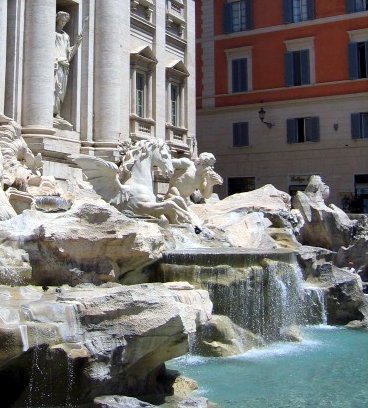
Fontana di Trevi con Hippogriffi.  Prego!
    In as much as all I had for my trouble was a picture of the flank and fin,  I could not help but be reminded of the hippogriff.

    Some of you may know that I collect really old coins.  The rest of you might cogitate upon this revelation and exclaim, "But Jeff!   Aren't really old coins expensive?  And aren't you famously thrifty?"  Or perhaps the less diplomatic among you might query, "Aren't you a world class cheapskate?"  Well, the fact is that really old coins can be had for a fairly small price if you aren't too fussy about them being what we might call museum quality.  In this instance, within the last year I was lucky to collect two coins from ancient Syracuse, home of  Archimedes and his patron, the tyrant Hieron II.  

    As an interesting aside, Archimedes was killed by a Roman soldier who mistook him for a beggar.  Back in those days paper was very precious and a great deal of mathematics and engineering was performed by drawing your calculations in the dust. The soldier approached the aged Greek mathematician and engineer, who looked up from is drawings and complained, "You're stepping on my circles!"  Suffice it to say, that
AE 17, 5.6 gms, Syracuse 405-367 BC
was his last complaint.  When the episode was revealed to the Roman general, the soldier was relieved of his head, as well.

   But on to the hippogriff.  This being a blog aimed squarely at the well-traveled and erudite, I'm assuming that you are all acquainted with the Trevi Fountain and those horse-like beasts with wings.  The product of a mating between a griffin and a mare, they are found from ancient Greek literature all the way up to Harry Potter.  Sometimes hippogriffs bear a horse's head,  while at other times they have the head of an eagle, which is how Hagrid bred them.  These latter are more dangerous, as is demonstrated by the beating that they bestowed upon Draco Malfoy.

    To bring this meaningless exposition to a conclusion, my coin dates to 405-367 BC and bears the faintest image of a horses head.  One wing, though, is very well seen...just like in my picture of the coral creeper, where one fin is clearly represented.

     Our esteemed colleague Robert Hillis took exception to the substitution of creeper for croucher, saying that if anyone was a creep it might be your humble correspondent.  On one of our last outings, Bob attempted to show me a coral croucher, perhaps in that very same cauliflower coral head out by Hulihee's palace. I pretended to see it.  But in truth, this was my first croucher.  And like my Siracusian hippogriff, I may not have a picture of the whole beast, but what I did get is unmistakable.   And pretty cool, if I do say so myself.


                >)))) ; >            >)))) ; >            >)))))) ; >            >)))))) ; >

    The next day I timed the tides and made my way down to K Bay.  I hit it perfectly, with the water in the so called sand channel about a foot deep.  Before I could change into my swimming outfit, my eye was
Ua and Her Flower Leis.

caught by a Hawaiian lady with two tables full of leis, which she was producing on the spot.  I couldn't restrain myself, so I made her acquaintance (her name is Ua, the name for rain in Hawaiian)  and received her permission for a photo of her with her leis.  As I was shooting Ua and her lovely plumeria blossoms, I noticed that she had a dog secured to the pole adjacent to her table.  And the dog was wearing a dress!

     A dog in a dress is a common image in our household.  When my beloved Sandra was a little girl, she had a dog named Buttons.  Buttons was the most cooperative of dogs, permitting herself to be gowned in a dress and a bonnet, placed in a baby carriage and promenaded through the streets of Mt. Clemens, Michigan.  Sandra always smiles when she recounts chasing Buttons down the street while wearing her dress and bonnet.  You can be assured that Ua heard the entire tale of Buttons in her finery.

Kimmie Waiuli, dressed up like a latter day Buttons. 
   Naturally I had to take a picture of the dog, who snarled at me just a little.  Ua explained that her dog, whose name is Kimmie Waiuli, recieved too much attention the day before from a bevy of keikis and had yet to regain her equanimity.   KW, as it turns out, is a rescue dog, so she may not have the transcendental calm attributed to Buttons.  On the other hand, she is doggone lucky to be affiliated with the lovely Ua.  That she was able to deal pleasantly with yours truly is ample testimony to her gentle nature!

   Out in the bay it was dark and bumpy.  While I was swimming, my mind was adrift with visions of the blog.  Kimmie, I thought, is for Mrs. Hillis, who is by no means a dog. (How we miss her!)  And Waiuli is for a beautiful fresh water pond near Hilo.

    I swam a good long time in the cool bumpy water without seeing jack, until towards the end I happened upon a
pair of  island jacks with the distinctive mustard colored spots gracing their flanks.

    As I prepared to exit, I was greeted by an adolescent night sergeant. Despite the swirling water next to the rocks, I was able to get a pretty good picture.  This is a a pretty common tidepool fish.  As a fry it has just a few black and silver vertical stripes and a yellow saddle.  If you look carefully, you can just see the last trace of the yellow saddle on this fish.

  And with that I bid you good bye, good fish and thank you for your patience.  And may all your hippogriffs have a horse's head.

jeff

Night Sergeant Adolescent.   Can you feel the surge?