Thursday, August 14, 2014

The Mystery Fish, A Well Dressed Hermit and Not an Anemone, Or My First Swim After the Hurricane

    For those of you who don't live here and don't pay much attention to the news, about a week ago the Island of Hawaii took a direct hit from a hurricane coming from the east.  There is some discussion about whether there was a similar event around 1870, but essentially Hurricane Iselle was the first such cyclonic
Surfing Iselle at the Kailua Kona Pier
wind storm originating near Mexico to hit the Big Island in recorded history.   Kona was spared completely as the wind could not surmount Mauna Loa and Hualalai.  Having prepared as best we could, we waited all night for the hurricane to hit. We rose in the morning with a profound sense of reprieve.  Kona was the least effected spot in the entire state. What a blessing.

      Sandra and I spent the morning poking along the beach.  Iselle had sent waves straight into the bay and (another first) there were surfers and boogie boarders riding the waves right next to the pier.

      The people between Hilo and the volcano were not so lucky.  Many of them still do not have water or electricity.  Two days after Iselle struck, the state voted for our next governor and senator.  Because of the
Will Mr. Ige be a better friend to the fish than Abercrombie?
 extreme damage in the Puna area, two polling precincts were closed.  The race between Colleen Hanabusa (Daniel Inouye's chosen successor) and Brian Schatz (who Governor Abercrombie appointed to fill out the term upon Inouye's passing) is still undecided.  Schatz is ahead by 1,600 votes, those two precincts are going to vote tomorrow and Collen Hanabusa is appealing to the courts to throw out the election.  What a mess.  Abercrombie lost in a landslide, so us friends of the fishes will soon find out where David Ige stands on protecting our reefs and the fish. 

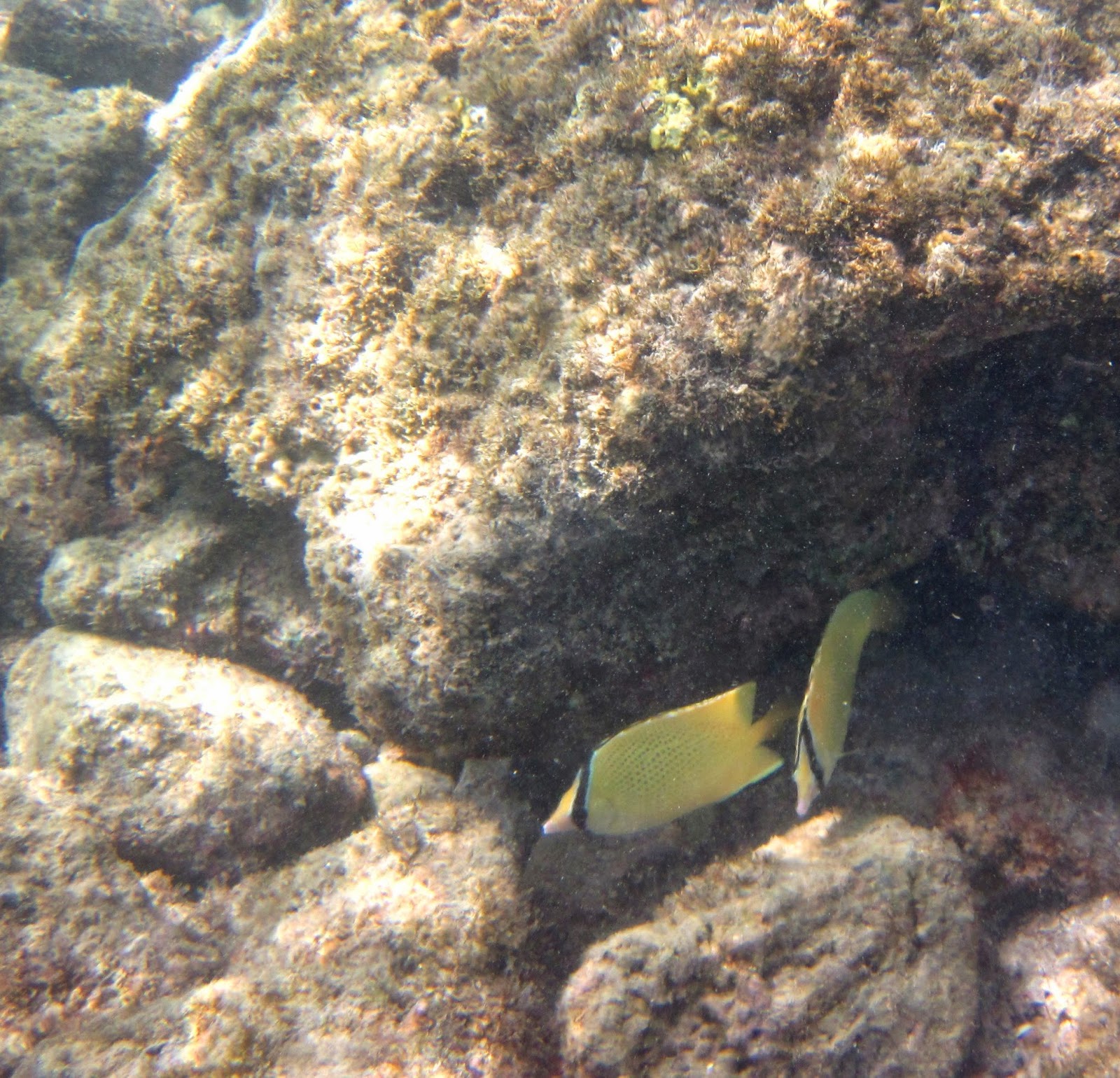
   Although there was no storm damage, it took me the better part of the week to restore our house to its per-hurricane clutter and it wasn't until yesterday that I resumed snorkeling, down the hill at K Bay.  The water at Kahaluu was warm and cloudy.  And full of tourists from the cruise ship.  Once I got clear of the mob, I swam to the left and upon a single
 lump of coral saw two pretty interesting things.  My eye was immediately attracted to a hermit crab.  Wearing a brightly colored hat with numerous ridges the hermit was sitting very near the top of the coral and permitted me two attempts at a photograph before dropping into the center of the coral. 

    When I looked at the picture at home, it appeared that the Hazlett's Hermit Crab was wearing a very small pink mushroom coral.  This didn't make any sense, so I submitted the picture to John Hoover who sent it along to Cory Pittman, who at this point is a bit of an enigma.  He is definitely a biologist specializing in marine invertebrates.  If you Google him, you will find that he is an expert on Hawaiian nudibranchs.  At any rate, its really nice to have his opinion on our finds. Cory's diagnosis is that the hermit is in a triton shell that his heavily encrusted with coraline algae. I ask you to look at those magenta rugae and tell me what you think.  If nothing else, it is the most flamboyant home for a hermit crab that I have ever seen.  Dr. Hazlett would be proud.

    On the same coral head, about two feet below the surface, I found what appeared initially to be the waving tentacles of an anemone.   As you can see from the picture, these tentacles were almost white, occurred in two clumps each about 2 cm across and were waving back and forth in the surge.  Unlike the hermit crab, this organism wasn't going anywhere.  So, dealing with the surge, I got the best picture I could. 

     When I first looked at the picture, I thought for sure it was an anemone.  But on closer examination, those tentacles looked more like infinitesimally small branching hydra.  John Hoover and Cory Pittman weighed in on this, as well.  It is their conclusion that this is the octocoral, Sarcothelia edmondsoni.  We usually think of coral as being stationary, sort of rock-like.  But of course it is a living animal and the polyp in this case is permanently extended.  Cory sent John a picture of the same species, which is in better focus than mine.  I'm passing on a cropped version of his picture so you can appreciate the feathery polyps. 

    Apparently this species of coral is not extremely unusual.  However, I had not seen it before  Perhaps you will be lucky enough to see it as well, armed with the knowledge that what looks like an anemone is actually an interesting species of octocoral.

    Finally, the title of this blog promises you some closure on the mystery fish that our friends saw (and we could not find) at City last week.  As I was working on the pictures yesterday afternoon, I discovered I had an email waiting for me from Terry Tauzer.  Here is her report:

  The mystery fish was a juvenile threadfin jack (Alectis ciliaris). Contacted Hoover and he was excited to come to 2 Step to photograph. We event back after hurricane and found three of them. Just arrived home and are downloading pictures. Will let you know if we get a good one. No guarantees...they were very quick! Terry&Rich

    Several years ago Sandra and I saw this species in the lagoon at the Waikoloa Hilton.  Six months ago we reported on some snorkelers attempting to photgraph it at the Kailua pier.  I still haven't seen it at the pier, but I continue to look.  Its a really neat little fish and I'm glad Terry and Rich were finally able to identify it.  And Terry, if you are out there please contact me directly at jhill257@gmail.com.  We would like to invite you to a Spam-be-cue, featuring our supplies left over  from Hurricane Iselle!


jeff


Tuesday, August 5, 2014

Summer in the City 2014

    The big news on the Big Island today has little to do with the identification of fish and lots to do with
Hurricane Iselle Bears Down on the Sandwich Islands
meteorology.  Which is to say, we are all holding our collective breath while hurricane Iselle bears down on us.  Nothing like a cyclone with 140 mph winds to get your attention.  Woof!

     However, one can't cower in the corner wringing their hands, so yesterday Sandra and I made our first summer trip to City of Refuge.  This idea was not unique to us.  We arrived about 9 AM to find City as busy as it has ever been.  While I was parking the car over by the eponymous national park, Sandra was busy making friends.  When I returned, she introduced me to an extremely nice couple, Rich and Terri Lewis, from northern California.  Rich is a high school teacher and
Humphead Bannerfish, Bali 2009
both he and his bride have a keen interest in the reef fish of Kona.  Not only that, but they had been regaling Sandra with tales of the morning sighting of four Heniochus butterflyfish.

     Seeing a Pennat Butterflyfish from a shore dive would be interesting enough, but they claimed to have seen something other than the Pennant.  Sadly their description didn't match up precisely with the two other Heniochus with which I am acquainted... and which are rather easy in the Western Pacific, but virtually unknown here in Hawaii.  I was thinking that one waif would be quite a find, but four would represent a breeding population.  The Lewis's had a copy of John Hoover's Ultimate Guide with them and thought it might be a bevy of the Australian Double Pennant Butterfly pictured in the guide.

    They also had a couple cameras.  Rich had a brand new Go Pro Hero.  Having left his computer back in California, he would not have any evidence from that source until he
Pyramid Butterflyfish, City of Refuge, August 2014
returned to Humboldt County.  They also had an Olympus Stylus, recently purchased from Costco.  He showed me the picture that Terri had taken of the Heniochus.  Handling that particular  camera for the first time, I asked him if he knew how to enlarge the image, which appeared as a small white smear in the lower left hand corner of a blue frame.  He said the camera came with minimal printed instructions and a disc, which he wouldn't be able to access until he returned to ....  I played with the buttons, finding a nice movie that Terri had taken including an eel and a Pyramid Butterfly.

    My efforts culminated with my inadvertently erasing the blue frame with the white smudge.  I said, "If I continue, I'm afraid I might erase your picture.  To which Richard replied,  "I think you just did."  Whoops.
"I think I saw something."
   The tale of a new butterflyfish was enough to get the Redoubtable SKG and yours truly into the water well before our usual 10 AM start.  Dodging the horde of fellow swimmers, we made our way through the extraordinarily warm water.  I guess if one is looking for fish that belong in Indonesia, it is only right that the water is as warm as the equatorial Indian Ocean.  No one was going to die of hypothermia on this day.

    Out on the north cusp, we saw lots of Thompson's Butterflyfish... many more than I had seen previously  in this spot.  Richard had reported seeing the mystery fishes a bit further out and "at the drop off."  We worked the edge of the drop first and then headed back over shallower reef.  In about 15 feet we saw a smaller Pyramid Butterfly that was associating with a coral head as intimately as an angelfish might.  In fact, we saw a colony of Potter's Angelfish, as well.  But we did not find the mystery Heniochus. 
A Small Reticulated Butterflyfish,, City of Refuge 2014
  
     As we searched vainly for the mystery fish and I puzzled over Rich's description, I was reminded of  the classic character, George Willis Jr. as portrayed by Philip Seymour Hoffman in Scent of a Woman.  "I saw something." George says, when questioned by the sycophantic headmaster. Whatever it was, we didn't see it.  And Charlie Simms, who had a better look (not to mention non-negotiable integrity) wasn't there to help us out. What I really needed was a cradle full of sea-going snitches.  They would certainly have ratted out the furtive Heniochi.  Hoo ahh.  

     On the way in we saw a very small Reticulated Butterfly, also keeping to its coral refuge.  And we saw a variety of Thompson's Surgeonfish, including a small individual that was attempting to imitate an immature Oval Chromis.  I had made that error
Juvenile Thompson's Surgeonfish.  The spot tells the tale.
a couple years ago and clearly recognized this handsome little fellow from my photograph.  That little black spot tells the tale.  And the Canon D10 strikes again.

    Back at the picnic table, we found the Lewis's preparing for another swim.  They were disappointed that we had not seen their fish and promised that if they were able to find them and get a usable photo, they would send it along.  Hey Richard and Terri, if you're out there, I'm dying to see your pictures!

jeff


If you have never seen Scent of a Woman, I highly recommend it.  If you don't have time, here is a clip from the speech referenced in the blog.
 https://www.youtube.com/watch?v=TuYhfCkRxyE


Friday, July 25, 2014

A Crab, a Fish and a Kuki'o Beach Update

  Over the last two days I have been lucky enough to experience a couple worthy sightings, one on the home court and another in a surprising location.

Snap!  No wonder he's smiling!
     Wednesday morning, after dropping off another trunk full of yard debris, I headed down to the pier.  The cruise ship was in and it was very busy, even in the water.  What a change from two days earlier when the place was virtually deserted.  As I swam out, I saw those small fish that I identified in the last blog as juvenile blue fin trevally.  As I came up with that ID on my own, with the help of Google images (an unreliable source, for obvious reasons) I gave them another look and said to myself, "Snap!  If those turn out to be maturing flagtails, I'll be eating crow again." 
 
    Snap, as defined in the Modern Urban Dictionary, is a term of dismay.  As in "Snap!  My pit bull just ate my last three oxycodones."  As it replaces a phrase or two that might cause one to be labeled coarse or vulgar in genteel company, "Snap!" can be quite useful.   But I digress.

    It was usual suspects all the way our to the palace, where I was momentarily surprised to see a fellow swimming rapidly fifteen feet below me wearing very long fins.  "Why is he swimming so fast in the opposite
Seven Eleven Crab Carpilius maculatus  Kailua Kona 2014
direction?" I wondered.  I made a leisurely loop back and was doodling along in the vicinity of the outermost swim buoy when the man with the long fins appeared at my side and said, "Would you like to see a cool crab?"

    Well, I always want to see something cool. I suppose that's why I go snorkeling.  So I followed him back about five yards and, amazingly, the crab was still there.  It was a Seven Eleven Crab, dining happily on the sand just outside the reef.  As it was only about twelve feet down, I was able to dive quite close to get the pictures you see here.  

    The crab was remarkably large, perhaps eight inches across.  In Hoover's critter book, John notes that this crab is usually seen at night.  This may explain why I haven't seen it before.  (I really ought to swim at night more frequently.)  He also discusses the distinctive coloration.  His photo shows a tan carapace with burgundy spots.  This animal had a gray blue carapace with dark gray spots.  If one uses her imagination, one might be convinced that the spots are a dark shade of violet.  Regardless, there is no doubt about the identification.  This was a Seven Eleven Crab!  Tick it off.

    In defense of the photographer, if you want to take a really sharp underwater picture, you need really clear water.  The water here has been cloudy at best since our return. 
How much air remains in your lung after forced exhalation?

   Back on the beach, I encountered my guide, whose name is Rob.  Rob likes to free dive with his Go Pro camera.  He had some amusing tales of diving with the rays at the cleaning station which segued into a description of the mild delerium he experiences when he stays down too long.  After a brief discussion of hypoxia, hypercarbia and respiratory physiology, we bid a fond farewell with hopes that we might meet again in the briny deep.

    Yesterday Sandra and I took an excursion.  Our grandchild, my very namesake, and his parents are coming for a visit in a few short weeks and we wanted to check out the beach near the Four Seasons.  It was our recollection that Kuki'o Beach might be just the place for young Keahi to become acquainted  with Kanaloa. 

    Taking the first left after Cemetery Beach,  were greeted cordially by Lono at the gatehouse and issued a visitors beach pass.  After traversing multiple jarring traffic bumps, we arrived at the parking area.  It was
Milletseed Pair in Denuded Kuki'o Bay
about 10 AM as we made our way down to the well groomed beach with the killer tidepool.  This must be the nicest place on our coast for a toddler to encounter the ocean.  We strolled over to the pleasantly shaded lawn where I noticed that there was now, in front of a couple gazillion dollar homes,  a small sandy entry to the bay.

     Sandra settled down to read her book, while I made my way to the sandy entry.  In times gone by, entering here might not have been so easy, but the rocks at the shoreline have been stripped of coral.  Swimming out, I could not avoid noticing that most of the rocks in the shallows were now devoid of marine life,  Maybe just a thin veneer of algae.  Que triste!   In spite of this lack of coral,  I did encounter a pair of Milletseed Butterflyfish.  to the bitter end, I will not lose hope that this handsome species, once so common, recovers.

     Further out,  there were small patches of coral among larger areas where coral had lived before the era of coral death.  Fish were not especially plentiful and very spooky.  There were a pair of spear fishermen
Longspine Pufferfish  Diodon holocanthus  Bonaire 2009
nearby which probably explains the nervous fish.  The water was cloudy and overall it was not the glorious Hawaiian reef experience one hopes for.

    But suddenly right below me was a Longspine Pufferfish, Diodon holocanthus.  Although I used to see this handsome fish every time I came to Hawaii back in the 80s it has become really uncommon.  I can't recall the last time I saw one in Hawaii.  Sandra and I did see one in Bonaire five years ago, so I have a photo to show you.  The fish in Bonaire were quite docile...           spearfishing is not allowed on that small Caribbean island.   This fish, quite to the contrary, took off like a bat out of hell.  It makes me wonder if spear fishermen are so indiscriminate that they take poisonous puffers, or do all the fish get jumpy when they are in area of frequent spear fishing?  Well, as any fish in the sea can out swim me,  my pursuit was in vain; I did not get a lovely photo, but at least I got a good, brief look.  Tick it off!
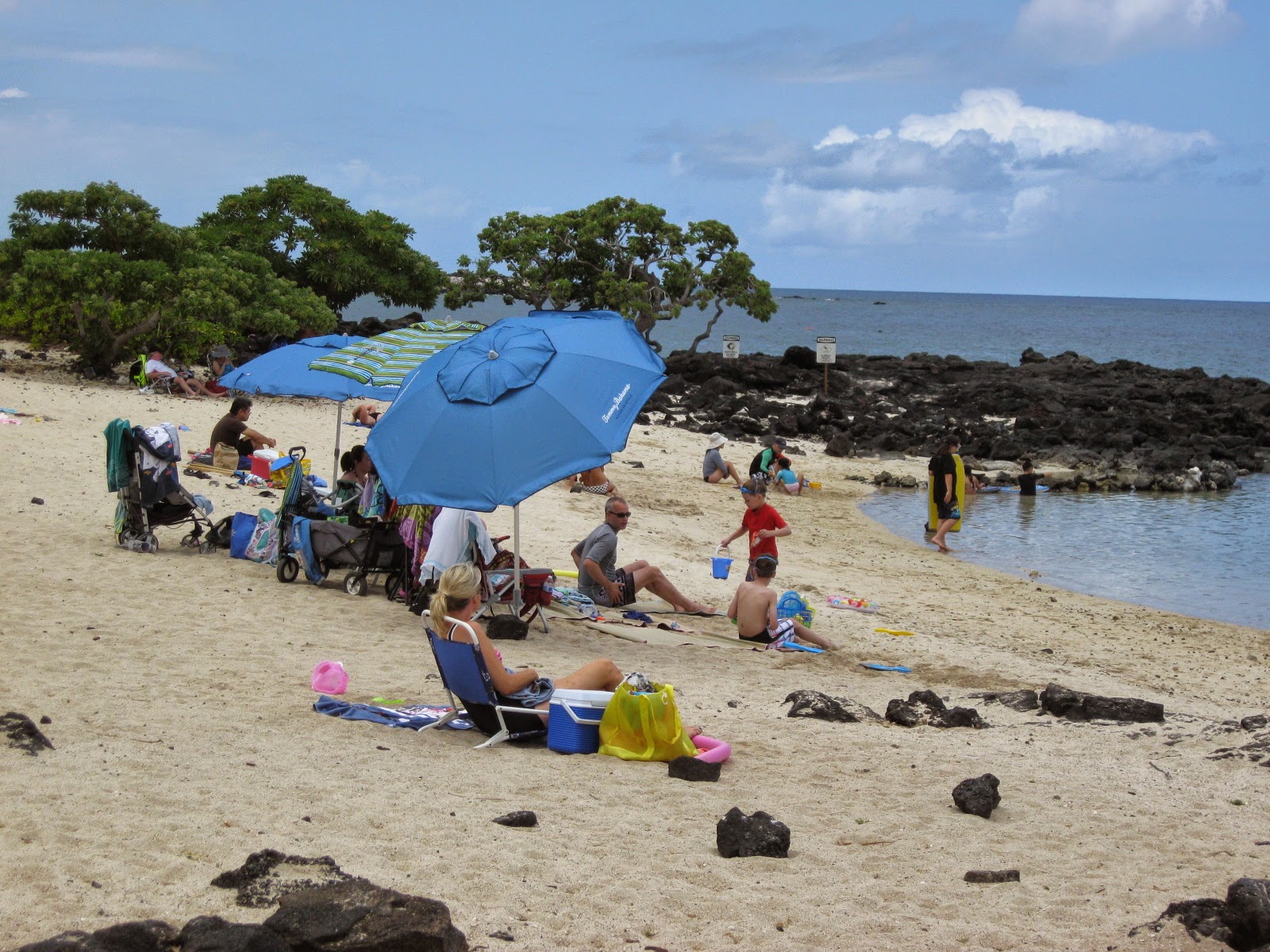
The Beach Scene at Kuki'o Bay

    On our way out we got another look at the beach, now littered with keikis in their colorful bathing costumes.  Happily, even at 11 AM on this weekday, there were a few parking spots available.  We'll see you back on this beach in early August with little Keahi!
Aloha Keahi!  Lookin' Good at the Bay Luau!

Tuesday, July 22, 2014

We're Back ... And So Are the Trumpetfish

 Juvenile Bluefin Trevally Caranx melampygus  Kailua Koan
   Three days ago, Sandra and I returned from two months in the Pacific Northwest.  The climate was cool and dry (relative to Kona, which if you are not living here this July is most assuredly hot and stultifyingly humid).  Back in the PNW there were few fish to be watched, so we were eager to renew our acquaintance with our fishy friends here in Hawaii.

    Yesterday we made our way down to the pier, which was fenced off, having  just received a fresh coat of asphalt.   Hitting the water. we were delighted to cool off, but we were also anticipating some interesting fish watching.  Summer is the time for juveniles, especially the handsome Hawaiian Hogfish.  Who knew what we might find?

    Almost immediately we saw  a few very small jacks.  Overall they had a slight bronzy sheen with delicate white barring.  As you can see, the pectoral fin
A second look at the immature Bluefin Trevally
was yellow, while all the other fins were black.  There was a small orange spot at the base of the anal fin. Due to the fine barring on the side, I had thought they might be Barred Jack immatures (Casrangoides ferdau).  As it turns out, the juvenile Barred Jack has extremely strong barring, such that at first glance you might mistake it for something else, like a poisonous puffer...pretty good strategy.

  That renowned scientist, Dr. Google, suggests that these beauties were almost certainly the extreme immature of the Bluefin Trevally,  Caranx melampygus.  This isn't surprising, as this species is far more common in our waters than barred jack.  Soon these guys will become deeper bodied, lighter and sport handsome blue finsIt was quite a treat to see them at this early stage.  With luck,  Dr. Google will post our picture, which shows the Bluefin Trevally at an earlier stage than he currently displays. 
Trumpetfish, A. chinensis  Kailua kona  July 2014

    As soon as we left the baby jacks, we began encountering a host of baby Trumpetfish.  You may recall four months ago, when in the biggest faux pas of my fish watching career, I heralded the decline of this quintessential Hawaiian species.  It can now be revealed that during  that two week period, all the adults were getting busy in the Herb Alpert suite of the Louis Armstrong Hotel.  The results of this amor were everywhere to be seen!  A couple immature trumpets is not unusual, but judging from today's observations, the species is in good hands for at least another year.

   Out by the second swim buoy I found three or four Flea Cone shells (Conus pulicarius) 
Flea Cone  Conus pulicarius  Kailua Kona 2014
perched incongruously on top of the coral.  It will come as no surprise to you that these shells were harboring  small hermit crabs.  Try as I might, I was unable to get a good look at the crab;  a couple furtive appearances of light colored legs was all we got for our near drowning experience.  Over the years I have found several instances where an unusual shell appears out of expected habitat in unusual numbers, all occupied by a single species of hermit.  By and large, cone shell snails live burrowed in the sand where they feed on worms.  When you see a cone shell (or almost any shell for that matter) sitting on top of the coral, it's highly likely that a hermit crab has carried it there.  With out certain knowledge, I have always assumed that this has to do with reproduction. Why else would an animal place himself in such a dangerous position? 
A treat for a good paddle doggy

   At this point, we can leave science behind.   The outing was completed with the requisite lady on the paddle board with her pooch (Good doggy!)  And a delightful in shore look at Mr, Scribble.  All is well in Kailua Bay.  And we're back! 


Mr Scribble says, "E Komo Mai, Sandra!"

Friday, May 16, 2014

The Rainy Season Comes ot Kailua and the Reef Fish Preservation Act of 2014

     We have now endured six consecutive days of rain.  It hasn't rained all day, everyday, but it has rained
Argus Grouper C. argus Kahaluu
 heavily every afternoon and through the night.  As a result, my snorkeling has been less frequent than it might be otherwise.   The frequency of the blogs has fallen off, partly due to the rain and also because we haven't seen anything remarkable to report.

      We have taken a couple reasonable pictures lately, albeit of relatively common fish. The first one I wanted to show you is a head on shot of an Argus (Peacock) Grouper.  I know that you've seen a million of these guys, but isn't it a nice picture?  This was a smaller fish, brilliantly colored.  And he had the moxie to face us head on instead of shooting into the coral.  This species of grouper was introduced from Tahiti in 1956.  It was intended to be a food fish, but as it is frequently ciguatoxic, it is rarely taken by fisherman.  And that is why you see so many!

     The next picture I wanted to show off is an Arc-eyed Hawkfish.  Hawkfish are doing well on our reefs
 and I was lucky to get a food picture of this handsome fish.  Most Arc-eyed Hawkfish sit still, perched on the coral, apparently under the impression that if they don't move, their prey will not notice them.  I have found that I can dive them once and get a shot, but the second time the fish is approached, he realizes that the jig is up and swims to a new perch.  If one has the time and inclination, he can make life a living hell for an Arc-eyed Hawkfish.  

    The next of  pictures is of a Dragon Wrasse.  This guy was among the largest of this fascinating immatures that I have seen.   Isn't is interesting that these wrasses do not all change into the adult pattern at the same time?  Occasionally you will see a large immature (the Dragon Wrasse phase)
and other times you will see relatively small Rockmovers (the adult pattern).  And every now and then, you see one in transition, a small Rockmover with "antennae".  I was especially pleased with the sharp focus in this shot.

    My last photos show two phases of the Threadfin Butterflyfish.   Sandra noticed this darker phase (the one that all respecting threadfins adopt at night)  and called my attention to it.  Why some of these fish retain the dark gray phase during the bright daylight hours is a mystery.  I'm including a picture of a different fish exhibiting the normal day coloration, taken at the same time, for comparison.

    Before I let you go, I want to mention an incident that occurred  in Kona early this week.  This incident has attracted national attention, due to a video clip that no self respecting TV station could exclude from it evening news.  The footage shows a fish collector attacking a diver who is creating a video of his activities.  He literally rips the regulator from her mouth.   The collector makes the ridiculous statement that he was feeling threatened by the lady photographer.   And the police are doing exactly nothing!

Threadfin Butterfly, the night coloration
    This is an issue I feel pretty strongly about. Fish collecting for the aquarium trade is hardly illegal in Hawaii.  The people on the local news (KHNL) actively took the side of the collector, despite his outrageous actions.

It is a sad fact, that the media and the government in Hawaii are perfectly happy to support anyone who wants to take the marine animals, right up to the point of extinction.  It is obvious to me that the fish collectors are having a negative effect on our fish populations and need to be regulated, preferably put out of business.  I am not holding my breath on this one. 
Threadfin Butterfly, the day coloration

      Governor Abercrombie and the Hawaii State Legislature have showed little  interest in protecting our reefs on the Big Island.  But they should.  Collecting reef fish should be no different than taking songbirds, which our society deemed unacceptable long ago.   The Migratory Bird Act was passed in 1918.  I suggest we call our congressmen in Washington, DC with the hope that the Reef Fish Act be passed in 2014 and this threat to our fish populations be eliminated. 

jeff


http://www.huffingtonpost.com/2014/05/15/aquarium-fish-industry_n_5333537.html

https://www.youtube.com/watch?v=bJ1YYA6nIws

Tuesday, April 29, 2014

    As the year has been moving along, we have been compiling our new list, which began on January 1st.  We have seen at least one new species this year, the Longtail Dragonet.  Just this week I added the
Shortnose Wrasse, April 28, 2014, Kailua Bay
 Shortnose Wrasse to the list for 2014.  I don't know how many shorties I have seen now, but I hadn't seen any until just a couple years ago.  Hence, I am always overjoyed to see this little fish and I never really expect it. 

     This isn't the case for a few fish that have gone missing in the last few years.  The Milletseed Butterflyfish has so far eluded us in 2014.  The Reticulated, Citron and Pyramid have yet to make the list, but they have always been a little difficult.  Every day that I don't see a Milletseed, my heart breaks just a little.

   Of course, there are a few other difficult fish that we have not been lucky enough to see these past four months, a couple unicornfish and a couple parrots.  But there are a few fish that we used to see routinely that just aren't here anymore.  I can't remember the last time I saw Diodon holocanthus in Hawaii.  
Great Barracuda, Paul Allen's Reef, February 2014
But of all the fish not to make the list, the Great Barracuda affects me most deeply.  I know exactly the last time I saw one of these magnificent fish, February 20, 2012 out on Paul Allen's Reef.  Little did I know on that day that this might be the last time I would see a Great Barracuda in Hawaii.   I can find no information that the Great Barracuda is threatened in Hawaii, so perhaps a 'cuda is out there with my name on it.  I certainly hope so.


      As I swam in a couple days ago, I needed to make my way through the Kai Opua canoe regatta.  This regatta features adult teams, men, women and mixed crews, from around the island.  How lucky I was to see
 
the enthusiasm and camaraderie of these adult paddlers at their premier event. The high school regatta is lots of fun, but the enthusiasm of the Kai Opua regatta can't be beat.

jeff

Thursday, April 24, 2014

Birding the Big Island with Allan Richards

      A week ago we devoted a few days to watching birds, as opposed to fish.  Our friend Allan Richards arrived from Sydney, redirecting our attention away from the sea.  Mauka, if you will.

The Gilded Triggerfish is back at Ho'okena
     The week started out with a productive trip down to Ho'okena with Anita.  The dolphins were not there, but there were more Gilded Triggerfish than ever.  You may recall that we had not seen that species this year and I was getting a bit apprehensive on their behalf.  There was lots of plankton in the water which may have accounted for the large numbers of gilded triggers.  Sandra thought the over all number of fish were down, but we did see Heller's Barracuda and three Bridled Triggerfish.

    Our best sighting occurred on the way in.  I spotted a small Flame Angelfish in ten feet of water.  If you are a snorkeler, you probably look through the guides to reef fish and notice that some of the fish you don't see occur at great depth.  Sadly, the book is usually correct.  However,  Flame Angelfish (putatively a deep water fish) are an exception, at least at Ho'okena.  Regardless, we had never seen one that shallow before.  I was able to dive right down to where the three inch angelfish hid inside the coral.  I wonder how many other people have seen the flame that shallow?

Allan poses with the Snorkelkids and Madame Pele
    The next day we drove to the soggy side of the Big Island.  Early in the afternoon we had tea and crumpets with John and Marcia Hoover.  We talked about the fish at Ho'okena and he teased me about the demise (or not) of the trumpetfish.  As it turns out, he and Marcia are very knowledgeable about the birds near the volcano and they gave us some of their best spots for nene and omao.  He also alerted us to the presence of the Bristle-thighed Curlew.  Apparently four BTCs, which look remarkably like the rather common whimbrel, were seen on the beach at Hualalai, north of the Four Seasons Resort.  John provided us with a contact, Keo Lopes, who works with the birds in that area.
 
Sunset at Kilauea
     I contacted Mr. Lopes via email and he  was quick to respond with the bad news that the Bristle-thighed Curlews had left about two weeks earlier. 

    On further investigation, it appears that the Bristle-thighed Curlew does not winter in Hawaii.  Rather, it is a migrant, breeding in Alaska and wintering in Pacific islands to the south and west of the Hawaiian Archipelago.  A few birds stop in Hawaii coming and going in April and September.  Alan had seen them on Oahu at the beginning of his Hawaiian birding expedition.  However, the BTC remains a lifebird for Sandra and me.  As there is no  organized fraternity of birdwatchers on the Big Island (with a helpful hotline telephone number) I don't know how we can expect to find this interesting bird that occurs here with such irregularity.

    In the early afternoon we collected Allan at the Hilo airport and checked in at our volcano lodgings.  That night we got a great look at the volcano.  The noxious vapors, reflecting the lava below, made a pink cloud in the evening sky.

   The following morning, Allan and I went to the Thurston Lava Tube.   John Hoover had suggested that the omao could be seen in the adjacent canopy.  Apapanes were easy at this early morning hour, and we heard the loud short trill of the omao that John and Marcia described as a policeman's whistle.  What we heard was quick, perhaps only two seconds in duration, but recognizing the call helped Allan spot one after about half an hour of searching.  Just like when Sandra and I saw one a couple months ago, this omao was not in the canopy.  Allan spotted him at eye level and we got an excellent look. 
The Mauna Kea Elepaio Is On the Verge of Sainthood

     After a quick breakfast, we left the park and made our way to the golf course, where we saw four nenes.  As it was raining, we headed back to the dry side to continue our birding.

     On our way to Kona, we stopped at Manuka State Park, which is just northwest of Oceanside.  Sandra decided to stay near the car while Allan and I hiked the trail.  The bird we needed was the elepaio, that had eluded us back at the Thurston Lava Tube.   The trail was rocky and uphill, but the habitat was worse.  I could still make out the ohia trees, but many were either covered with vines or almost dead.  Luckily, just as the H. Douglas Pratt (Enjoying Birds in Hawaii) suggested, this disturbed habitat yielded both apapanes and elepaio.   Tick it off and head on out.

    The following morning was devoted to the Palila.  We got an early start and headed up the old Saddle Road.  We saw lots of francolins and turkeys and, luckily, got a Pueo perched on a wire.  It had been about eight years since I saw this iconic Hawaiian owl.  What a treat. 

     The road at the Kilohana Hunting area was dry and inviting and we made our way up to the Sandalwood Enclosure (4.2 miles) without difficulty.  Finding the palila was not so easy.  In January, Sandra and I found one after about twenty minutes.  This time we were unsuccessful at this "best area" for finding this rare Hawaiian finch.  We did have an excellent look at the mamane-naio subspecies of the elepaio.  This was a very important bird for Allan, as the elepaio occuring in the dry mamane forest is now regarded as a distinct subspecies.  As he closes in on 5,000 life birds, Allan keeps track of those birds that may in the future be declared a distinct species.  He now has the Mauna Kea sub-species stashed in his records, should it achieve sainthood in the future. (Watch for a  plume of white smoke erupting  from the summit of the mountain.)
The Bristle-thighed Curlicue Looking for a Gin and Tonic

     We drove up to the area past the cabin and eucalyptus grove.  The three of us worked the mamane forest where we saw lots of amakihis and house finches.  After about an hour of this nonsense Sandra lost interest.  Another half hour of quiet searching finally produced two adults and one immature.  Allan and I got a great look at the immature, which was a bit streaky.  The Audubon Society guide did not prepare us for this, saying that the immature is similar to the female, whose breast is a bit less yellow than the male, but does not have streaks.  To me, it looked like a female house finch on steroids, but Allan noted the light rump, the slightly forked tail and, of course, we both saw the distinctive bill.

      Having seen every life bird that Allan might get that day, we descended towards Kailua.  On the way home we stopped at Costco, which has yet to make much of an impact in Australia.  We enjoyed a couple samples of poke, bought a bottle of wine and made our way back to Casa Ono.  That night we attended a birthday party for one of the neighbor ladies.  In describing our search for birds, I mentioned the BTC.  It can now be revealed that the Bristle-thighed Culicue lives on the beach where the River of Ornithology enters La Cienega de los Borachos.  I've seen some of my best birds in that marsh.  

jeff