Thursday, February 7, 2013

Noah's Ark at the Dog Beach (and other good news)

    Finally we have some good news to deliver.  Yesterday Sandra and I took a swim on the Ironman side of the pier.  It was the first day in a couple weeks that the water could be described as truly clear.  And we
Stripe Belly Puffer Kailua Kona Pier Feb. 2013
enjoyed an intimate encounter with a Stripe Belly Puffer.  This fish enjoys an unusual and endearing appearance, sort of like the slobbering English Bulldogs that resided in the skateboard shop back in Salem.  In the January 14 blog, I bemoaned its disappearance from Kahalu'u.  We encountered this fellow going out and then, on the return from the half mile buoy, we saw him being cleaned in front of the palace.  This was just a single fish, but that's a start.

     Today we took a little trip with two of our favorite Canadians, Jon and Verna Slater.   About a week ago the four of us engaged in a life threatening swim at Kona Makai.  It looked calm as we walked down to the beach, started to pick up as we made our entry, and by the time we got out our peaceful little fish pond was like a washing machine.  And I ain't talkin' 'bout no gentle cycle, either.  Luckily,
A Pair of Gold Rim Surgeonfish, Honokohau Feb. 2013
 nobody had to go to the hospital... or the undertaker's.  In my defense, once we made it on to the beach, there was a lot of group pressure to make that entry.  All I have to say is, "Caveat Natator, homes".

    But I digress.  the little cove hard by the Honokohau marina was peaceful and the four of us made an uneventful swim out to the reef.   The water was cool and clear.  Almost immediately we spotted a pair of Gold Rim Surgeonfish in the boulders near the shore. Its not uncommon to see single individuals of this handsome fish, but it is unusual to see a pair.  I was lucky enough to see a hybrid Gold Rim / Achilles Tang a couple days ago on the outer banks of Paul Allen's Reef.  In my opinion, its far more common to see this hybrid than a matched pair of Gold Rims.  Maybe a batch of Gold Rims is in the offing.
Milletseed Butterfly, Kailua Kona Pier  August 2012

     While Jon talked to the guide on the dive boat, Sandra and I moved to deeper water where we spotted a pair of Milletseed Butterflyfish.  Clouds of this beautiful fish were once an every day sight at Kahalu'u.   Now we see an occasional single fish at the pier or out in K Bay.  I hope you will forgive the picture of the cute immature we nabbed at the pier six months ago.  The pair we saw today were swimming in 40 feet of  water.  I got a couple pictures of the pair, but they are nowhere near as pretty as this portrait.  Its been four years at least since I have seen a matched pair of Milletseeds.  Long ago, we assumed that the schools of Milletseeds were reproducing right in K Bay.  Is it possible that they were breeding in deep water?  Recently, as we have seen only single individuals, we have begun to treat them as waifs... single fish hatching from eggs that travel a long distance from their spot of fertilization.  Do we have a breeding pair?  Are these two fish the Adam and Eve of Milletseeds?  I certainly hope so.

Heller's Barracuda, Honokohau, Feb 2013
    Heading back toward the entrance, I located the school of Heller's Barracuda.  with a variety of auditory and visual inducements, I was able to get the other members of our little expedition on to this school of uncommon fish.  Sandra and I were able to herd them into shallower water and were rewarded with a good photo opportunity.  

   Back safe on the beach, we enjoyed the enthusiastic romp of a German Shorthair and a Collie with one brown and one blue eye.  Viva the Dog Beach.

jeff

For completeness sake, here is a picture of a hybrid Achilles Tang / Gold Rim Surgeon swimming with a regulation Achilles Tang.  This photo was taken in clear,still water at city of Refuge in November of 2011.The one I saw on the PAR was dodging in the surf, right over the shallow reef.  I was all the way out, perhaps 400 yards from the pier. Suffice it to say,the
Gold Rim / Achilles Tang Hybrid,  City of Refuge Nov. 2011
situation was not ideal for photography or, for that matter, the survival of the photographer.  this luscious photo should give you good basis for comparing against the two normal gold rims that show signs of producing schools of these lovely surgeonfishes.

Our friend and snorkeling companion and all around good sport, Verna Slater, is an above water photographer.  She has kindly provided these pictures of the Humpback Whale breaching at sunset off Alii Villas.  I'm not sure how she missed the splash!


Saturday, January 26, 2013

The Proud Fish with the Golden Nose

A Peaceful Day at the Kona Makai Inlet
    On Thursday, exercise day at the Alii Villas Spa and Beach Club, the Redoubtable SKG and I found ourselves crossing the little bridge by said condos and I was struck by the pacificity of the eponymous ocean.  Luckily, I had my snorkel stuff in the car and immediately stated my intention to take advantage of the mild conditions.  So while sweetie trundled down to the ladies at the pool,  I made my way next door and down to the lava rock entry at Kona Makai.

    Indeed, the conditions were quite mild, which was a surprise, because Guy Hagi, the surfing weatherman on Channel 7 had been predicting great conditions on the north shore (for surfing).  I'd enjoyed a similar day ten days earlier.  So enthusiastic was I to enter the waterr that I forgot my fins in the car.  And I broke my first rule...don't go into the ocean
Big Eye Emperor, the Mu, Kona Makai, March 2011
without your fins.  It was so mild that day and I had made it all the way to the entry without my fins, so,clearly feeling a little fey, I slid into the fish pond,  paddled around and at the end of my half hour barefootin', old Neptune proved to be a good sport and spit me out. 

    This day I had my fins.  Mostly it was usual suspects,but early on I saw a couple handsome Achilles tang and a pair of Mu.  The reef at Kona Makai remains a good place to see the Mu, whose Hawaiian name refers to the tribal executioner.   

    Towards the end of my swim, as I was returning from the shallow reef to the deep water, I saw a fish with a gleaming golden forehead.  It was as if he had a
Red Labrid Wrasse, Kahalu'u, Jan. 2013
narrow bar of that precious metal running the length of his nose.  One almost epected to see a Porsche symbol in the center of that gleaming medallion. I had seen that fish before (only a couple times) and had a good idea that it was  one of the two native snappers.  Seeing me, he turned and swam away...I did not get any picture worth mentioning.   Years ago, in a similar situation, I would draw a picture and send it to Jack Randall.  He would usually reply with an invitation to purchase his latest book.  A photo tends to get more attention, but not this time.

     We were lucky when we got home to find a picture in John Hoover's Ultimate Guide of the Forktail Snapper, also called the Smalltooth Jobfish.  John's picture gives a hint of the golden snout that this otherwise (and most often) drab fish occasionally boasts.   There is no suitable picture on the internet of this proud fish with the golden nose for me to, ahem, borrow.  You'll just have to take my word for it.  And maybe someday, when you are peering out into the deep, you will find yourself going nose to nose with a shiny band of gold and you'll think...jobfish.  In the meantime, I am leaving you with a pretty picture of the Red Labrid I nabbed in K Bay a few days ago.

see you on the beach,
jeff

Continental Airlines, The Proud Bird With the Golden Tail
Author's note:   The title of this blog was adapted from the motto of Continental Airlines.  The Proud Bird With the Golden Tail ceased operation on March 2, 2012.   While factors such as corporate profits hastened the extinction of the PBWtGT, other nefarious forces are at work on the reefs of these very Sandwich Islands.  That the Proud fish With the Golden Nose may continue to stalk our waters, let us reaffirm our commitment to pure water, clean air, Al Gore and a hasty demise of the aquarium collectors.

jwh

Saturday, January 19, 2013

The (Possibly) Confusing Barred Filefish.

2013 Is the Year to Boogie!
     This winter has been quite a bit different from last year...the year of the creepy calm.  Starting in October we have had lots of rough days out in the bay and coincidentally the water clarity has not been all that great for taking pictures of the fish.  This winter there have been many good days for the surfers and boogie boarders.    In fact, its really high surf right now.  Not being able to go fishwatching (the beaches are closed again and I wouldn't be able to see much anyway) I whiled away the time Sandra was exercising with my good friends Tom and Marcia Pickens on the deck of  their condo, looking back towards Kailua town.  From their deck we watched waves breaking onto the first floor units at Sea Village, the units just north of Alii Villas.  Time to go to Lowe's for a shop vac and a case of paper towels.  Spectacular for us, soggy for them.

     Sadly, over the last month we haven't seen very many unusual fish in the less than crystal clear water.  Luckily, in the last couple of weeks we have a found several immature Barred Filefish.  This fish looks and behaves just differently enough from the adult that one might confuse it with something else.
Adult Barred Filefish, Kailua Pier, 3/23/11
  
     The adult Barred Filefish, as i'm sure yu will recall, comes in a rainbow of grays, with several light bars ventrally.  Its one of the bigger fish on the reef.  Even though we don't get extremely close, it is easy to identify.  And although the Barred Filefish doesn't encourage a close approach, its not particularly skittish, either.  It isn't common to see it ducking into the coral.  finally, the adult does not usually do any peculiar posturing.  In its boring gray way, it just sort of hangs out

    The immature is surprisingly different.  First, it is the color of dark chocolate.  When you first encounter it, it may have a constellation of distinct, punctate white spots over the entire  body.  The most striking feature of this baby is the bright orange tail.  On two different days, in the rubble on the
Ironman side of the pier, we have encountered a few individuals of this immature.   The first time I was so taken with the bright orange tail that I thought I might have an aspricaudus. the Yellowtail Filefish common in Bali and rare as hen's teeth in these very Sandwich Islands.

      The first thing you will notice about my picture is that it isn't very good.  What can I say, when the water isn't clear, this is the sort of picture I'm stuck with.  Second, look at the way he is spreading that bright orange tail.  some filefish, like the Fantail Filefish, posture with a spread tail routinely.  When approached, this fellow spread his tail almost every time.  Additionally, he completely and instantly lost those handsome white spots.  I'm really sorry that I don't have a picture of the spots, but try as i might, I could not get close to the fish without the spots disappearing.  and the last thing about this fish's behavior is that when you approach, he doesn't swim away (like the adult Barred Filefish would.)  He darkens his spots, spreads his tail and finds cover in the coral.
David R's picture of  P.  aspricaudus

   I have not personally taken an acceptable picture of the Yellowtail Filefish.  I have seen it once briefly in Hawaii.  I'm borrowing a photo from David R. so you can see what it looks like .  In John Hoover's Ultimate Guide he has a pretty good picture of the Barred Filefish immature.  Prior to that, I don't think any fish guide you might have laid your hands on would have showed this shy fish with the orange tail.  I'm sure with David's fine picture as a foil, you can appreciate how one might be confused.

    So you try not to be confused and I'll do the same.  and good luck to both of us.

jeff

Monday, January 14, 2013

What's Happenin'?

    It seems like the number of blogs has decreased.  With that in mind, the editorial board has decided that I push one out so you know what we've been up to lately.

   Last week we went snorkeling two days in a row at Kahaluu.  I was struck by the fact that I did not see a
Watch out for hungry Stripe Belly Puffers!
single stripe belly puffer.  I went there the second day expressly for the purpose of verification.  This fish was a sure thing at K Bay and I can't imagine what happened to them.  Whether or not you are a fan of The Simpson's , you probably know that pufferfish are poisonous...a full step past inedible.  It was a miracle that Homer survived the novice sushi chef and its unlikely that spear fishermen are going out of their way to take puffers.  This sort of leaves Al Gore and habitat change. 

      But Stripe Belly Puffers are not extinct.  Just last night on the Honolulu news they reported a SBP biting a child somewhere on Oahu.  They had our mentor Jack Randall live on channel 8 telling us that this is unusual behavior for a pufferfish.  So they're still out there, just not in K Bay.

     The word on the street was that a big swell was coming in.  Before we could be boxed out I rounded up
Sofie says, "Kick up your pinkies at the Dog Beach!"
 my Canadian colleague Doug Rode for a trip to the Dog Beach.  Honokohau was calm as could be, unlike the day when Charles, Sofie and I braved the waves.  True to its name, there were dogs on the beach.  There was a great big Hawaiian with a great big Rottweiler and a couple other dogs.  We set out on the calm bay.  About twenty yards from shore I felt some scratching on my thighs.  Was Doug in trouble?  The scratching increased and I realized that a dog was attempting to crawl over my back.  I rolled over and the dog looked me in the face then bore off and continued swimming.  I thought it was inconsiderate for a dog owner to throw a lure where I was swimming, but there was nothing out there.  Doggy was just going for a swim and for some reason he wanted to swim in my lane.  That dog ain't got no manners.

    After our close encounter with a quadruped we had a pleasant swim in the warm clear water.  Heller's Barracuda was a no show, but Potter's Angelfish, the Black morph longnose and a female Hawaiian Hogfish were there, along with a pod of dolphins out in the channel.. 

    Finally, today I went solo to Paul Allen's Reef.  The swell is now coming in as promised and it was rock and roll out on the PAR.   It was a  very pleasant physical experience, swimming with the fishies in the warm surging water.  The water wasn't clear as it was chock a block full of bubbles. 

    Just after I made the turn for home, I encountered a small turtle.  After a heart to heart talk with my editorial board, I have chosen to embrace the turtle.  And today I want to share an epiphany with you, my six readers.  (May the Great God Ku bless and protect each and every one of you.)  When one encounters a turtle swimming free it is amazingly easy to get close and take a picture.  Over on K bay, if you try to get too close, some jerk is crawling up your bung holio, telling you how protected the turtles are.  Out on the PAR with the rollers breaking on the reef, maybe not so much.  Its just you and Senor Tortuga....But I digress. 

    The reason you can get close is that the turtle has a critical choice.  If it swims faster, it will use up its
The swell pounds the wall on the PAR.
 oxygen reserves at a markedly increased rate.  And it will have to surface soon.  If you're a turtle and you don't live in K Bay, deeper is safer.  This guy changed direction a couple times, leading me within a couple feet of the breaking waves on the wall of the PAR,  but he did not increase the rate or power of his strokes.   Turtles are not Albert Einstein.  They don't think this thing through...they have a hard wired algorithm that weighs heavily in favor of swimming economically.   all this aside, it was a blast swimming with the little turtle as the waves pounded the nearby reef. 

    Well, that's it from the PAR.  In the words of Crush (the paterfamilias turtle from Finding Nemo)  Ook ook a choo.

jeff


Tuesday, January 8, 2013

The Killer Snowflake


Oh give me home where the Milletseeds roam...
   Exercise class was cancelled... the instructor had to seek out a dentist to repair a loose crown.  Not precisely what happened to Marie Antoinette, but urgent enough to preclude jazzercise in the pool.   Thus, your humble correspondent was in luck....the Redoubtable SKG would go snorkeling.  After a bit of shopping at the KTA we made our way to K Bay.  Sandra doesn't like Kahaluu when the tide is out, but the tide table calendar was right again and we had plenty of water to slither out through the channel into the cold clear water.  Yes, dear reader, winter has descended bitterly upon the Sandwich Islands.  I've been reduced to wearing a sweatshirt while eating breakfast on the lanai and the ocean water can be described generously as not warm.  Anyway, it was clear and calm as we set off together for a nice swim.

    Right away we spotted the lone Milletseed Butterflyfish that is sometimes seen here at Kahaluu.  Shouldn't someone talk to one of the aquarium dealers and get that poor fellow a mate?  Milletseeds used to swarm in like honeybees in this bay.  (We still have swarms of honeybees in Kona!)  If Milletseeds are going to make a comeback, a solitary fish isn't enough...we need to start with two.  I learned that from the Noah's Ark story back at the First Presbyterian Church in Vancouver.  Although, come to think of it, I don't think Noah had fish on the ark.  Probably back in Noah's day there was no such thing as global warming and aquarium collectors.
Geek!

  Shortly after running into the Milletseed, we saw another strange specimen.  This guy must have been looking for Dr. No, Captain Nemo or maybe Mr. Spock, ending up at Kahaluu by mistake.  All dressed up and only a Convict Tang to photograph.  Accidente!  But he did win the Geek award for his excessive get up and equipment.

    We had a nice swim over by the shuttered Keahou Beach Hotel.   The best coral remaining in Kahaluu is over in the southwest corner by the former hotel that now belongs to the National Park Service.  If our government had the brains God gave a squid, they would be operating the hotel, a local landmark if there ever was one, as a National Park Hotel with an eco-historical twist.  Like you find at Zion or Yosemite. There would be bus fulls of German tourists spending zeppelins-full of Deutsch Marks...excuse me, Euros...and the local economy would be booming. 

    But I digress.  This area by the ex-hotel is accessed with ease at high tide.  The coral is healthy but there were hardly any fishes at all.  So off we went out to Surfer's Rock.  There was nothing special doing around the rock and it looked like this might be a day for usual suspects only.

Snowflake Moray with Crab, Kahalu'u  January 2013
   We were dawdling by the rock when a fellow snorkeler directed Sandra's attention to a free swimming Snowflake Moray.  She in turn alerted me and we watched together as the eel, almost three feet long and as big around as a high quality garden hose, slithered behind a hunk of coral.  Instead of disappearing into the coral head, this fellow arched his back and struck at something.  A moment later he appeared on our side of the coral with a struggling crab in his jaws.  "He's got a crab!"  we exclaimed to each other through our snorkels. 

    We were lucky and over the next minute or so the eel devoured the writhing crustacean.  And I was right there as the death throes ceased and all that remained was an empty carapace.  I was really fortunate to take these pictures.  (I only needed my trusty little Canon D10).    
Can you see the crab in the jaws of the killer Snowflake?

     Aside from providing me with the opportuniy to show off these really cool pictures, this episode highlights an interesting point.  Moray eels look like really mean killing machines.  Every time they look at you, it seems that an eel bite is in the offing.  In fact, I've seen three lacerated digits as a result of those fell jaws and razor sharp teeth. The first two were dive guides with  "pet " eels that they fed for their patrons. Whoops! The third was our acquaintance, Maurice, who grabbed hold of the bottom near an unseen eel.  It is my highly educated guess that all three of these bites were inflicted by Yellow-margin Morays. Those sweet guys that look like your neighbor's pit bull who "would never hurt anybody.".   During the day, Yellow-margin Morays tend to stay put in the coral. They are dramatically bigger than most Snowflakes and Whitemouths, which are the eels we see hunting.   But in spite
of spending a heck of a lot of time looking at fish, we had never previously seen any eel with prey.
Yellow-margin Moray, Kona Makai, January 2011, 15 feet

  Over the last month, since returning from Mexico, we have not seen a zeppelin-full of eels.  Regardless, over the years we have seen a great many Whitemouths and Snowflakes hunting in the shallows.  From reading, I knew they were searching for crustaceans, so it was rewarding to see an eel successful in a way predicted by the learned ichthyologists. 

    In closing, I have two other thoughts:  First, if there were more crabs in the coral, perhaps we would have more eels.  And (here is a life lesson for us all) if this guy had been a little less crabby, perhaps he wouldn't have been lunch.

jeff 2012   


Friday, December 28, 2012

Diving Physiology in Sea Turtles

A Green Sea Turtle Swims Effortlessly
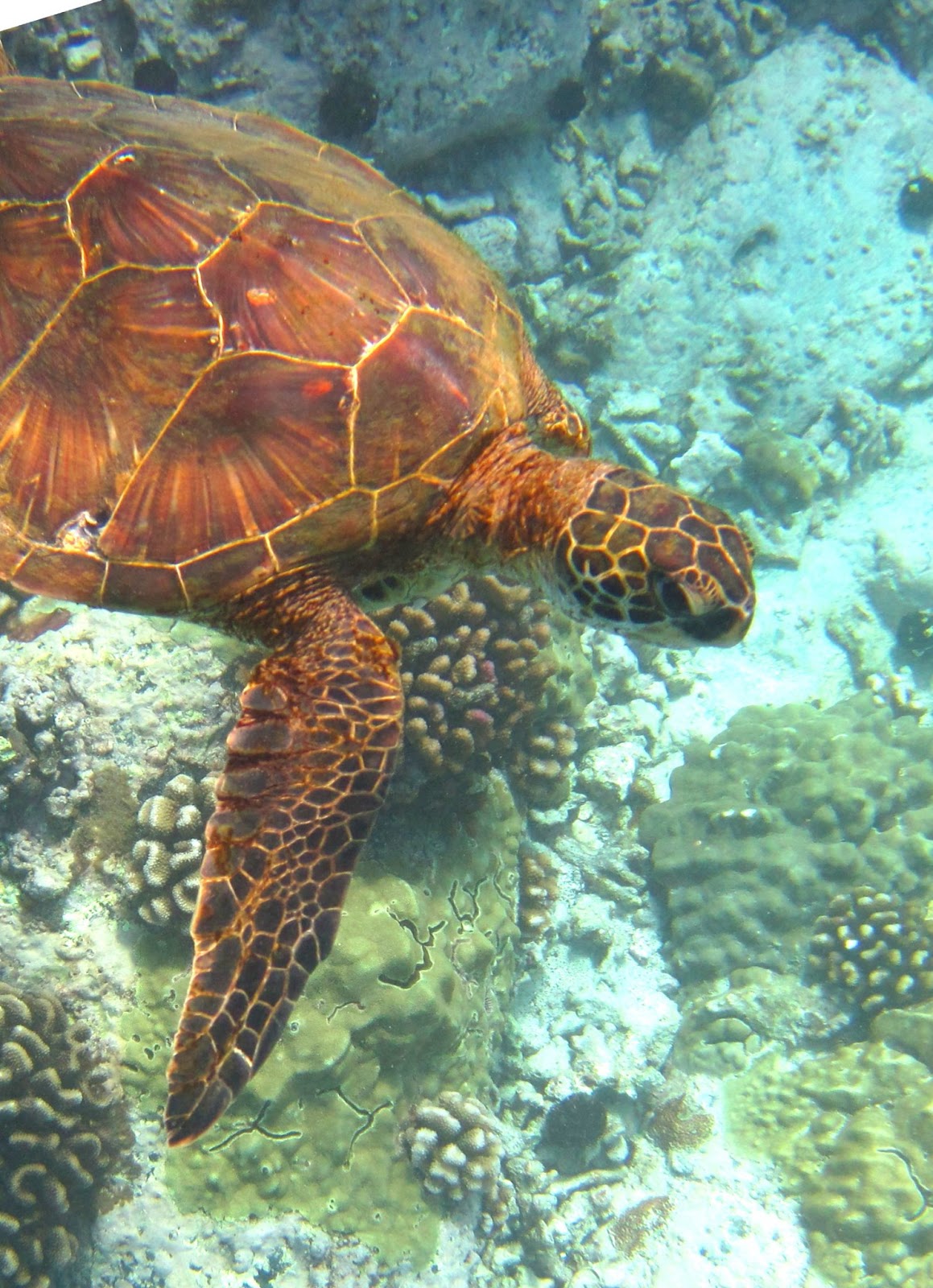
   Recently, I was swimming in front of Hulihee’s Palace.  About twenty feet below me, a green sea turtle swam out from beneath a coral head and made his way to the surface.  Once there, he gulped air four times over about two minutes.  Following this relatively small bit  of breathing (during the same two minutes I breathed in and out no fewer than 20 times) he headed back down in his leisurely sea turtle fashion.

   This got me to thinking about sea turtles and their ability to stay submerged for long periods.  We, who are swimming on the surface and enjoying a regular supply of good old uncle oxygen, take for granted the relaxed beauty of a sea turtle as he swims nearby through the clear water, not on the surface taking a breath every few strokes.  So independent of breathing do turtles appear, that it is difficult to remember that these are not fish; turtles are air breathing vertebrates.  And so the question arises:  What is their secret?   How is it that a green sea turtle can dive 100 meters and stay submerged for three hours?

After Taking a few Breaths, the Turtle Dives
    As an anesthesiologist, I needed to know a fair amount about respiratory physiology.  This subject is not just lung volumes, but the characteristics of hemoglobin and acid base status.  As it turns out, sea turtles have lungs that are a bit more developed than most other reptiles, but not the equal of the fine alveolar system that we mammals possess.  And their hemoglobin is not that different from ours.  What turtles do better than mammals, is manage their carbon dioxide and pH and, most amazingly, tolerate incredible cerebral hypoxia.

    If you are denied a breath, your pO2 will fall to life threatening levels in 5 minutes.  Our brains are not terribly tolerant of a pO2 below 70 mm Hg.  At that point the neurons (brain cells) die. 

     On the other side of the equation, if you are able to provide pulmonary oxygen but keep the patient apneic (which, in a laboratory, is not quite as big a trick as you might think) the pCO2 will rise about 6 torr per minute.  For every 10 torr rise in PCO2, your pH drops by 0.1.  Mammalian life becomes difficult below a pH of 7.1.  
    
A Turtle Swims By Out On Paul Allen's Reef
   All of that may seem more than a little pedantic, but these are simple facts of mammalian respiratory physiology.  Here are some of the corresponding facts about sea turtle diving physiology.  In an unrestricted dive, loggerhead sea turtle pO2 dropped from 112 to 4 after only 25 minutes.  In that same period, the pCO2 increased only about 10 torr (to about 50 torr) and pH did not decrease by more than .1 to above 7.2.  The numbers associated with carbon dioxide and acid base status speak to an amazing buffering ability in the sea turtle blood.  (an incredible amount of carbon dioxide is converted to some other substance like bicarb).  Isn’t it amazing that a turtle can completely recharge this buffering system in a few breaths?  Or to look at it another way, if you were to carry around all the CO2 you discharge over three hours, you would need a 15 gallon bag (assuming that only 4% of your exhaled gas is carbon dioxide...a percent achieved at minimal exertion.)

A Green Sea Turtle in the Crystal Water of Ho'okena
Before moving on, it is important to note that researchers make a great deal of the unrestricted dive.  Not a lot of information on the biochemistry of sea turtle diving has been accumulated, because it is hard to accumulate data in a truly unrestricted turtle.  Sea turtles are remarkably adapted for diving, with their front legs transformed into hydrofoils and the sleek slope of their carapace.  But more than the physical characteristics, note the  leisurely, oxygen conserving manner in which they swim, which also produces far less carbon dioxide.  Though it seems so nonchalant, the unrestricted dive is critical to the turtle.  When in a tether, (a situation in which monitors may be more easily applied) the turtle struggles, oxygen consumption and the  PCO2 rise and the pH falls.  A struggling, or actively swimming, turtle needs to breath more often. 
    
    Most incredible to me, sea turtles tolerate an unbelievable amount of cerebral hypoxia.  Other turtles have an increased tolerance for brain hypoxia, but no other vertebrate comes close to the tolerance that sea turtles exhibit.  Intracerebral ATP (the biochemical battery of life) is preserved in the face of remarkably low arterial oxygen content.  There are articles on calcium and adenosine metabolism and the ability of the sea turtle to reduce its cerebral metabolic rate.  Medical researchers are very interested in how sea turtles defy the ravages of cerebral hypoxia and study these phenomenon in hopes that it might provide therapy for victims of
Protected Sea Turtles in Kona Spend More Time on the Beach
stroke and other brain injury.
 
     Here in Kona, we get used to observing green sea turtles at the surface.  It is my contention that us hau’olis have created a safe environment where the turtles can live at the surface or on the shore without danger of predation.  In the rest of the watery world, sea turtles spend no more than 6% of their time at the surface.  So when you are snorkeling out by the palace or at City of Refuge and you see a turtle swim out from a resting place near the bottom, just think a bit about what an amazing animal you are observing.   If you are lucky, you may see the turtle compensate for hours of underwater apnea with a few gulped breaths.

Friday, December 14, 2012

A Christmas Gift from Canon D10

Which Costume Are You Wearing This Season?
   Well, the yuletide is upon us.  Time for us to enjoy the spirit of giving.  We can all give a little by being patient with our fellow drivers (especially if they are over 90), making sure our trash goes in the appropriate receptacle and not stepping on the coral.  Just for once, hop down off Mount Crumpet and be the Anti-Grinch.

   Of course, if you are like me, its just as much fun to receive as to give.  Yesterday at K Bay it was both Yuletide and low tide, making the entry a bit painful on the feetsies.   But the water was still well this side of freezing, which was a pretty good gift in and of itself.  It was a little cloudy until one got over by the breakwater and the number of fish was hideously low.  So few butterflyfish were seen that I thought that the Grinch might have snuck into the bay the night before and taken them back to his
 Black Sided Hawkfish   Paracirrhites forsteri, Kahalu'u  12/12
aquarium supply shop to, er, fix the lights.  I fear, though, that no matter how many evil fisherman and aquarists lurk, some other nefarious force is at work...see Al Gore, An Inconvenient Truth.

   I worked my way out towards surfer rock and was rewarded with a big, fat Freckle-Faced Hawkfish.  I know, I know, its called Black-sided now, but if anyone took the trouble to look at the fish, they would see how ludicrous that name change was.  Right, Mr. Freckle?  Anyway, this guy was indeed big and fat.  You only need to hang around the Big Island Grill for an hour or so to realize that from the days of the Alii right up to the present, big and fat is a compliment in these very Sandwich Islands.  This guy was very cooperative and rewarded me with my best picture of a Freckle-faced Hawkfish ever. 

Is it a Two Spot Wrasse?
     A gift like that is nice, but on the other side of Surfer's Rock lurked the 60 inch Plasma with surround
sound.  As I turned into that shallow patch of clear water I was presented with a fish I knew I had never seen before.  He was schooling with immature parrotfish, and bird and saddle wrasses.  Irregular fins and shiny patches, as if some 10 year old girl had glued on miniature sequins, this three inch wrasse was jinking around much like a small elegant coris.  Odd body positions and sudden movement in unexpected directions.  (It is not for nothing that I do not have a super picture of Elegant Coris.  Its a common fish, but a spooky devil.)  I followed this little guy around in the still but shallow water for a few minutes, getting a number of pictures.  I wasn't sure he was ever in great position relative to the camera, so I just kept following and shooting.  I could tell he was a bit darker posteriorly and ventrally, but the irregular fins and the shiny spotted coat was what held my attention.  By the time I was done, I had convinced myself that this was a fish I had never seen before.  And I ask you,  "What better gift can Kris Kringle put in my flipper than a life fish?"

Shortnose Wrasse, imm, Macropharyngodon geoffroy  Kahalu'u 
     The rest of my swim was uneventful and I soon found myself on the beach, looking at the books provided by the Kahalu'u Reef Social Club.  Just after I had decided that my fish was a Two Spot Wrasse, a young lady from the Social Club approached and inquired politely, "Do you have any questions, Sir?"  She was in her mid-thirties, a decade or three younger than many of the Social Clubbies, and substantially less chubby than our hawkfish.  She had a sincere approach and just a hint of a West Virginia twang.  Was she channeling Clarice Starling?  I should have been nicer, but so full of hubris was I, that I said, "No.  But I have some answers."  Who the hell did I think I was, Paul Krendler?  Our relationship took a frosty turn, but I told her of my Two Spot Wrasse, what a great fish it was and how, if she hurried she might find it doing the Watusi behind Surfer's Rock.

    At this point we need to scoot ahead a few hours, the water camera has been soaked, Paul Krendler has had his nap and we are plugging the SD card into the old, but trusty, laptop.  And what we see, after a bit of
Shortnose and Saddle immatures 12/13/12
 photo shopping, is what you see above.  I'm calling it an immature Shortnose Wrasse.  The Canon D10 does not lie.  No wonder amazing sightings need to be corroborated by real evidence.  This individual is intermediate between the two pics that my friend John Hoover has in the Ultimate Guide.  In my copy of Randall, no immature is pictured.

    This was not a life fish...I saw my very first shortnose less than a year ago at Beach 69 and one since on Paul Allen's reef.  How does the appearance of this previously very rare fish jibe with the diasappearance of all the butterflyfish in K Bay?  Good question, no?

     So...am I forgiven?   Stat page for Officer Starling and the entire Social Club.  I'm sorry, already.  We have recently received a commission from Dr. Randall to look for the Silhouette Soldierfish right around the pier.  It might not be Hannibal's dining room on the shore of Chesapeake Bay, but a propeller in the skull may trump a craniotome.  In the meantime, I'll try to be better behaved, the better to avoid the looming lump of coal. Like the T-shirt says at K-mart, "I've been pretty good for the last two weeks."  Or not.

jeff


Christmas is coming, Mr. Freckle's getting fat.
 Won't you please put a flounder in the poke vat.
If you haven't got a flounder, a Saddle Wrasse will do.
If you haven't got a Saddle Wrasse then God bless you.
God Bless You, Pufferfish, God Bless You!
If you haven't got a Saddle Wrasse then
God Bless You.