Saturday, May 28, 2022

A Warm Weekend in Washington Replete with Birds and Butterflies

       Southwest Washington was finally blessed with a few days of warm weather.   As we were on the verge of the Memorial Day Weekend, this dry weather was overdue.  Sandra and I joined our son and  grandson at the Hillsboro Airport on Saturday for the Oregon Airshow.  This was a chance to meet some of  the Navy personnel from Whidbey Island, whose roaring jets  annoy my brother on a daily basis..  

The Sound of Freedom roaring through Hillsboro.
   Of course, in the near future, these men and women may very well be protecting our very way of life.   While watching an F 35 streaking into the sky, I spotted a soaring goshawk.  And over the field adjacent to the runway there were a few barn swallows.  Suffice it say, the feathered birds were much quieter than the war
birds. 

    Sunday the weather remained warm and we headed up country to look for butterflies.  We had made internet friends with Caitlin LaBar, one of the preeminent lepidopterists in Washington and she recommended an area near my other son's home in the hills approaching Silver Star Mountain, the highest peak in southwest Washington.  Our route took us by the Larch Correctional Facility (which,  despite looking like a bucolic lodge, gave Sandra the heebie jeebies) and then into rolling hills that had suffered clear cutting sometime in the last fifteen years.  Thus, we were driving through rolling country covered with willows and and alder, with small stands of remaining conifers interspersed. We were seeing a few small white butterflies along with a few of the expected birds, Steller's Jay and flickers.  

Margined white Butterfly, Yacolt Biurn,  May 2022
    Spotting a group of butterflies on our way to Cold Creek Campground, we got out and netted one.  This was a milestone, my first use of the net we had purchased some months before.  We got one of the small insects and took some pictures through the net.  At that same stop we enjoyed a good look at a Wilson's Warbler in a willow.  Sandra tried to capture the butterfly in the net, but it escaped.  

    Using Butterflies of the Pacific Northwest by Pyle and LaBar we were able to identify this tiny fellow, with wings the size of a button on your shirt, as a Spring White.  This field guide provides a lot of information, beautiful photographs, and  for each species  a  detailed range map.   They also give you the months when a butterfly is flying, which turns out to be a significant factor for identification.  .  

    At the campground, we spotted a larger butterfly, with wings as big as a nickel.  It too fell victim to the net.  This was a bigger butterfly and while our picture is very far from perfect, it was possible for us to identify it as a Margined White.   

    This was a larger animal.  Although it looked white in flight, even through the net you see that the ventral surface had a strong yellowish green cast. 

Net, 'nocs and Naked Falls.  The Lepidopterist on the prowl.
    The park, which a week before Memorial Day was still closed for camping offered a significant change from the acres of clear cut surrounding it.  Here there are mature trees and commensurate under story vegetation in a moist depression.  This spot isn't difficult to find and may offer more species a bit later in the season.  

    That was it for butterflies on this day.  We repaired to my son's house where he and the boys were playing baseball in the yard.  As I was watching them play, I noticed a few of those small white butterflies in the salal across the street..  I grabbed the net and in short order we had captured another tiny Spring White.  I gave James a chance to grab the little devil, but he had the same result as Sandra and the butterfly escaped skyward.

   Two days later, it was still not raining.  We headed east out of Vancouver, stopping at a park on the lower Washougal where we heard Western Flycatchers calling in the cottonwoods and saw a pair of Lesser Goldfinch.  Alas, there was not a single butterfly.

Spring White Butterfly ala Vlasik
    Continuing east, we headed up Washougal River Road and in half an hour we were at Dougan Falls. As we made our way the high overcast descended.  The day was becoming darker, but the rain held off.  Just before the bridge, which spans the upper Washougal, a medium sized off white butterfly fluttered skyward.  With our new found experience we could bet that this was a Margined White. 

    Seeing nothing of interest, we cruised through the parking area and took the gravel road skirting the Washougal.  Last year, albeit a few weeks later into the season, this road had been highly prolific.  Today there was nothing.  The best we achieved was a picture of your faithful correspondent posing as a lepidopterist in front of Naked Falls.  You can thank your lucky stars that he was not posing naked in front of Naked Falls!

    The drive back to the parking area was equally disappointing.  Sandra and I made the turn and headed up the road along Dougan Creek.  Last year this road, which is right beside the rushing stream, yielded many butterflies, including a spectacular look at Lorquin's Admiral.  We got to our favorite parking spot and disembarked, immediately finding some Spring Whites.  I netted one and now our new plan was thrown into action.  

Spring White Butterfly, Dougan Creek, Wa.  May 2022

      Capturing the tiny butterflies by hand (for the purpose of photography) simply did not work for us.  The distaff part of our team had proposed that we find a glass bottle through which we might try to take some pictures.  Rummaging in the refrigerator I found a bottle of Vlasik pickles with only a few remaining.  I liberated the pickles and washed the bottle out.  It was into that vessel that our newest captive was deposited.  He fluttered about for a while occasionally settling.  

   We took turns holding the bottle in different positions, striving for a workable picture through this less than optimal glass.  Although the bottle was perfect for pickles, it begged for improvement.  Nevertheless, the pictures we obtained of this male, and a subsequently netted female, were far superior to our previous efforts, taken through the net.

    On our next attempt we captured a female, far more dusky than the brilliant white male.  Sadly , our best effort to photograph this interesting insect was attempted through the portion of the jar lined with residual labeling adhesive.  On her website, Caitlin LaBar offers a myriad of  mesh cages and other contraptions that one might use in the study of butterflies.  However, sweetie and I did not find a clear glass container through which one might photograph live buttterflies.  It seems that Ms. LaBar puts her butterflies in plastic envelopes where, eventually, they become substantially more cooperative.

Clearly a pickle jar has its drawbacks.

    Before we gave up the ghost, we were treated to a close look at an Echo Azure Butterfly.  He was on the wing and despite being quite close, he eluded my efforts with the net.  One can never tell, simply by looking at a field guide, how big these butterflies might be,  I had suspected that this species was quite small, like the Spring White.   Two days earlier, I had to squelch my imagination as it attempted to turn spring whites blue.  I can now report that this blue butterfly, apparently the only blue found in Clark and Skamania Counties, is twice as big as the tiny spring whites.  Although we did not see it later in the season, in 2021, perhaps we will get another chance at Dougan Falls next week.  Assuming that there is an interlude in the cold rain.

jeff

Sunday, April 17, 2022

A Requiem for the Easter Coris. Atule mate and a Good Look at Slipper Lobster

         Easter day promised to be full of obligations,  spanning the ecclesiastic, entertainment and home maintenance.  With that in mind, Sandra dropped me off at the Kailua pier on Saturday around noon for my Easter swim.  The first thing we noticed was that the changing rooms were locked up.  Although you may regard this as the pinnacle of banality, it is hardly an insignificant piece of information.  To shutter the changing rooms on weekends, especially holiday weekends, would appear counterintuitive.  Nevertheless, if you don't want to go home in a wet suit you will be advised to check out the situation prior to your ablution.

Easter Coris, Kailua Pier,  February 2015

     Prepared for a wet passenger in her near future, Sandra headed off to Target, leaving me to brave the cold water.  As I was getting ready to swim, I made friends with a lady tourist who was perched on the curb at the edge of the pier.  As it turned out she is a recovery room nurse at Harborview, that large, ancient hospital near downtown Seattle that was the model for Gray's Anatomy. Being myself a sometimes anesthesiologist, we had plenty to talk about.  Suffice it to say, anesthesiologists love recovery room nurses, who bail us out of more trouble than we would ever admit to. 

      About six years ago, in an attempt to find a holiday fishwatching event to correspond with the annual search for the Christmas Wrasse, I decided to rename the Elegant Coris the Easter Coris.  I even toyed with the name Easter Chorus.  The male bears a handsome aqua cross on his forehead so the designation seemed perfect.  The one thing that I didn't count on was that this species, once a virtual sure thing both at Kahalu'u and the Ironman side of the pier, would become progressively rare and then essentially nonexistent.  I still take a swim on Easter with the hope of seeing an Elegant Coris, but the effort is quixotic at best. 

Peppered Moray eel, G. pictus,  Kailua Pier April 2022
    The water on the day before Easter, 2022 was cold.  We have entered the rainy season and as I snorkeled out I could see multiple fresh water geysers spewing cold water up through vents in the sandy bottom.  Additionally, the water was not all that clear.  

    Out near the third swim buoy I saw some suspicious movement in a coral and dove down to discover a Peppered Moray Eel, the first of the year.  This has been a fairly common eel on the Ironman side for many years and I have been surprised that it took this long to add one to the list.  I dove down twice for a picture.  There was a hand hold about a foot away from the eel, which I chose to disregard..discretion being the better part of valor.  

   John Hoover tells us that this eel is usually found deep, but also says that on occasion will leap clear of the water in hopes of nabbing a crab on the rocks.  Just think how fast the eel must get going, starting fifty feet down and then shooting, missile-like from the sea, in hopes of a crustacean repast.  Perhaps we should send some peppered morays to Ukraine. 

A pair of yellowfin surgeonfish by the Kailua Pier

  For those of you keeping score at home, the peppered moray brought my 2022 list up to 119 species.  I can only imagine Bob Hillis hanging his head in shame on my behalf.  Needless to say, there are several species that should be relatively easy that have yet to make the list.  Crocodile Needlefish (also called Houndfish) and Lined Butterfly have yet to appear on the list, along with the aforementioned Elegant Coris.

    I swam out past the last swim buoy and back in without seeing very much else. I then crossed the swim line into the area near the pier.  Immediately I started seeing a lot more fish.  Among others, thee was a trio of smaller Yellowfin Surgeonfish.  It was a cloudy day, so the pictures aren't as pretty as they might be.   Nevertheless, this is not the most common of fish and I felt lucky to see these at close range.


Yellowtail Scad schooling with Square Spot Goatfish

Also in the area were a group of fish that one would take for Bigeye Scad.  A closer examination revealed a bold yellowstripe on the flank of these fish.  Perhaps they were seeking similarly colored fish to school with, because these guys were hanging with a large group of Square Spot Goatfish, which also have a dramatic yellow stripe, along with the eponymous square spot.  

     If you look carefully, the tails of these fusiform fish are tipped black.  When I saw these pictures I wondered if these could be fusiliers, somehow displaced all the way from the Western Pacific.  There is a species, the Yellowstripe Fusilier, that looks quite a bit like these fish and lives on the reefs of Indonesia.  It wold require more than climate change to get a whole school of fish from the other side of the world into Kailua Bay....  something on the order of aliens.  Close encounters of the fishy kind, perhaps? 

Yellowtail Scad, Kailua Bay, April 2022

     Realizing that this was more than far fetched, I read John Hoover's account of the Bigeye Scad more carefully.  In his last sentence he notes a similar fish, the Yellowfin Scad, Alute mate, which occurs in Pearl Harbor and Kane'ohe Bay.  This species is not pictured in John's book, but there are pictures in Google images and I am here including one of them. It should be noted that this is usually called a Yellowtail Scad. It is found across the tropical Pacific, possibly more common in Australia than points further east.  I have a note (or three) in to John Hoover, but based on this photo from Professor Google, I believe we can declare a winner.  Life fish for Jeff.  Details on Big Island distribution to follow.


Atule mate courtesy of Professor Google


    One might have thought that this was enough for one day.  Certainly I was cold enough to last a lifetime.  But on the way in, just before I hit the floating line that denotes the swim area, I saw something flopping around beneath a dead chunk of coral. A quick investigation revealed a dead slipper lobster, completely intact, flopping around in the swell.

Sculptured Slipper Lobster, Kailua Bay 2022

     This was a Sculptured Slipper Lobster, P. antarcticus.  Despite that misleading species name, it is found only in tropical waters.  My picture taking was limited by the position I could get the lobster into long enough for a photo.  Or to put it another way, I could not get it to lay flat with the dorsum up.  Hence, we have a cracker jack picture of the bottom of the slipper lobster and a good picture of the dorsal side with the lobster in the lateral position.

   Here are a few things we can learn from these photographs.  Lobsters are decapods and this slipper lobster does indeed have ten legs.  You can count them!  What it does not have is claws.

    As the most interesting feature of a slipper lobster is the antennae, I did a little extra research, finding an article by Lavalli and Spanier,  The Behavior and Sensory Biology of Slipper Lobsters, 2007.   

    When I think of crabs and lobsters, my mind rushes quickly to the catching of them in a trap with progress to a pot of boiling water and hence to a plate with some lemon and butter nearby.  So how do we get the lobster in the trap?

    As in other decapods, the "smelling", which is another way of saying long distance chemoreception,  is done by the antennules, those small spike like antennae that you see protruding from the front of the slipper lobster. It was surprising to me that "tasting" is done by neuroreceptors that are on the legs.  As "tasting" is contact chemoreception, perhaps this isn't so surprising.  It is these receptors that guide your crab or lobster into the trap and on its way to our dinner.

april
Sculptured Slipper Lobster, April 2022, Kailua Bay

    The chemoreceptors in the antennules and on the legs lead the slipper lobster to food,  but it is those other antannae, so remarkable on slipper lobsters, that interested me.  The anterior quarter of the slipper lobster is two large, rounded flaps.  These are called secondary antennae.  In fact, they are large flaps that are covered with a myriad of tufts of hair-like hydro receptors.  These tell the lobster information about speed and attitude, especially as it swims.  The swimming is accomplished by flapping that large tail and those so called secondary antennae also serve as rudders; they not only receive information about motion during swimming, but adjust the course as the animal propels itself through the water.  

    Well, I did not get the Easter Coris, but we did spot a new fish and we got some insight into the life and times of slipper lobsters.  Sandra and I hope you had a wonderful Easter and that the chorus, if you happened to be around one, was singing harmoniously.  

jeff

Friday, April 1, 2022

A Tiger Haunts the King Kam or Snorkeling with the Tiger Snake Moray

     About a week ago we had some friends over for dinner.  Sandra let it slip that I wrote a blog and our dinner companion asked, "How often do you post?"  The short answer would be, whenever we find something that is worthy of  a blog.  That doesn't exactly answer her question, but we keep on swimming, hoping that something special will turn up.  Mired in an observational drought that was approaching a fortnight, I decided that I would go to the beach in front of the King Kam Hotel and turn the outing into a blog.  In the absence of interesting critters, I could talk about the condition of the reef.

    I got down to the beach just after 8 AM.  When I swim on the Paul Allen side of the pier, which is to say entering on the fine sandy beach in the lagoon in front of the Marriott (the iconic King Kamehameha Hotel is, indeed, currently a Marriott) I change into my snorkeling gear on the beach below the beach boy shack.  As I changed, I noted a significant line at the shack.  It turns out the beach boys open up at eight and the early birds were lined up to rent kayaks and paddle boards.  Like me, they wanted to be among the first out on the water.

Tiger Snake Moray,   Scuticaria tigrina,  Kailua Bay,  March 2022

    As I entered I shared a few words with the lone bather in the lagoon.  She was a nice lady in her thirties from San Mateo.  I commented that the water was a lot colder in San Francisco and she replied that she wished that the water was warmer in the lagoon,where she was standing in cool water about waist deep.  Things are starting to warm up, but at any time of year the Inner Harbour will have the coldest water in Kona.  She seemed pretty happy to be there, enjoying the peace of the early Hawaiian morning regardless of the water temperature.

    As I shoved off, I was struck by the remarkably clear water.   The winter swell has yet to subside and before we left home we had watched the surfers down at Lyman's, enjoying some big waves, so I was a little surprised at this water clarity.  Of course, the winter swell comes mostly from the north and Kailua Bay is largely protected under these conditions.

    So I swam out, enjoying the clear water but seeing nothing of note in the lagoon.  I cleared the last of the big rip rap which extends from the small breakwater and turned for a quick look among those giant rocks on the bay side.  Immediately I got my reward.  In a crevice between the rocks I saw a segment of a small eel.  This eel was as smooth as a well made garden hose and just a little larger in diameter.  I was looking at a section about five inches in length which at that moment was in motionless repose.

   The eel was a uniform ecru.  The sartorially handicapped would call it beige, but that sounds so boring.  Decorating this elegant suit were a variety of black spots.  These spots had a slightly irregular margin, some were large extending the width of the eel's dorsum, while others were smaller.  

Zebra Moray, Kailua Bay , March 2022

   Mr. Eel was only about three feet below me, so I was able to dive down and  take a couple pictures.  As you will notice, there is no evidence of a dorsal fin.  After about a minute, the eel began to move and in short order he slithered out of my view.  Despite paying careful attention, I did not get much of a look at his tail.

   This was a Tiger Snake Moray, Scuticaria tigrina, the first one in my long and checkered snorkeling career.  The Tiger Snake Moray is secretive, nocturnal and rarely seen by snorkelers.  One might think that an animal named Tiger would have stripes.  John Hoover tells us that in the early nineteenth century (this eel was named in 1828) all large cats were on occasion called tigers.  Sandra thought he might be named for some person called Tiger, like Tiger Woods, perhaps.  

Five Stripe Wrasse, juvenile, Paul Allen's Reef  March 2022
    The other curious thing about the common name is the snake part.  This is definitely a moray eel, not a snake eel. John Randall in Shore Fishes of Hawai'i, 1996, calls this eel a Tiger Moray.  This is still an acceptable common name for this eel; common names of fish do not seem to be regulated as strictly as they are for birds. Randall also placed the Banded Moray in the genus Scruticaria.   I'm pretty sure that even 25 years ago this was a mistake that should have been caught by his editor.  For the blog, I read an article from the proceedings of the Academy of Natural Sciences of Philadelphia, 1997 authored by Eugenia Bohlke and John McCosker  The authors were determined to clear up taxonomic questions about the genus  Scruticaria.  The authors tell us that the two species in this genus possess a long cylindrical body, a small head and a very short tail.    So these eels actually do look more like snakes than most other morays.

   Adults can reach 60 inches, but my specimen was probably only 18 inches in length. And I now feel relieved of any blame for not getting a better look at the tail fin, which in this genus is almost non-existent. 

Five Stripe Wrasse, juvenile, Paul Allen's Reef  March 2022
     I swam across the small bay and on the far side, hiding under a rock on the shore of the the Thurston Estate, once the vacation retreat of Paul Allen, I saw a large Zebra Moray.  On my first dive, I held on briefly near his lair, and got a look at the entire eel including the face.  Subsequent dives produced a good look at the body and that is what you see pictured here.  This was my first zebra fr 2022.

    As I approached the point that separates the small bay from the reef facing the open ocean, I caught sight of a small wrasse with a red face pattern.  I chased this guy over the shallow reef, often in less than a foot of water with lava and dead coral right below me.  I was fairly sure that this was a juvenile Five Stripe Wrasse and I was determined to get a picture.  Out of ten shots I got two that demonstrate what I was looking at, although neither will be printed on aluminum and displayed on the wall.  

White Spotted Surgeons in the surge, Paul Allen's Reef 2022
    At one point in the chase, a juvenile Surge Wrasse appeared.  I tried to swim in for a picture, but he was gone before I could get in range.  At another juncture a set came in.  I was already over the shallow reef and the wave was pushing me in.  Lucky for me, I was wearing a glove and able to stop my progress before getting a nasty scrape.  

    I cruised the open ocean for a few minutes and then made another pass at the wave swept reef.  There I found a large group of White Spotted Surgeons cavorting in the surge next to the wall.  That was a fine kettle of fish upon which to end this very productive snorkel.

jeff


Tuesday, March 15, 2022

Blood and Dragons at Kahalu'u

         One doesn't get material for a blog every time he steps into the water.  Following my experience with the wrasses, Sandra and I went back to Kahalu'u the very next day in hopes of seeing the female Blackstripe Coris.  We did score the pair of Pearl Wrasse, with quick looks at both the colorful male and the female, who with her lines of pearl-like dots gives the species its common name.  But no big blackstripe.  

Stocky Hawkfish Kahalu'u  March  2022

    In fact, the only good picture I came away with was one of a stocky hawkfish perched on a coral.  The stocky used to be the third most common hawkfish, but that is no longer the case.  Both the Arc Eyed Hawkfish and the sporty Mr. Freckle (Blackside Hawkfish) are in such decline at the snorkeling reefs in Kona that it is common for me to take a turn at KBay or the pier and see neither of those species.  On the other hand, I invariably see at least one stocky, even on a day at the pier when the water looks like dilute milk.

   On that day, about a week ago, we had a chance to converse with the redoubtable Kathleen Clark.  While she is always full of wit and wisdom, Kat was far from the most interesting thing happening in the shelter.  As Sandra and I arrived, we were surprised to see two dozen shining faces arrayed at the picnic tables.  Although I tried to be discrete, I couldn't help but notice that most of these faces were affiliated with well groomed young women.  And they had an instructor who, while sweetie and I were donning our winter snorkeling garb, was telling them what a wonderful bit of lore they were going to receive as they sat at the feet of the redoubtable Ms. Clark.  

The best looking Bulldogs this side of Honoka'a!
    The convocation broke up, the better to move to a different venue, in time for us to query one of the young ladies.  She claimed, in impeccable American English, that they were a group of foreign exchange students. They went their way, trailing a mystery behind them, while Sandra and I went out to meet Mr. and Mrs. Pearl.

   On our return, after a freshwater ablution, I was able to button hole one of the young lovelies, who was now in a swimming costume, stowing her gear in a fashionable backpack.  "So," I asked, "You are a group of foreign exchange students?"  

    "Not exactly," my victim responded, "We're from the University of Georgia. " (By which she meant UGA, not an academic institution in the former USSR.)  Further inquiry revealed that they were on a Spring Break study experience, delving into the social and environmental facets of the Big Island.  They had begun their sojourn in Hilo, spent the last five days in Kona and were leaving the following morning for the volcano.  Never one to bypass the opportunity to teach, I proceeded to stultify this sweet young thing with a complete rundown on the Kamehameha Butterfly, its relationship with the Hawaiian nettle, māmaki, and just where to find the state insect in the HVNP.  As she fled in terror I admonished her to use this information to flumox her tour guide at Kilauea. 

Flowery Flounder, almost invisible atop a rock.  Kahalu'u 2022
    Sadly neither Sandra nor I captured a picture of these young ladies. But thanks to the worldwide web,  I discovered the name of the program, Study Abroad Hawaii ( (which the catty Ms. Sandra renamed "Study A Broad, Hawaii.") and I'm able to provide a charming shot of two of the young lovelies smiling next to the Great God Ku at the City of Refuge.

   Note to Vlad the Bomber:  Don't you dare try to invade this Very Sandwich Island or my man Ku is gonna put a cap up yo' Russian ass.

  Two days after we encountered Study Abroad, Hawaii! I made an attempt to study the Ironman side of the pier.  The water was a little cloudy, but worse, there was little to write home about swimming in the sea.  From an editorial point of view, the day was saved by a gentleman, ensconced in one of the changing room toilets.  While I swapped out my swimsuit for shorts, he serenaded me with a country tune,  accompanied at full volume by a song on the dubiously named smartphone. When I told my son,Charles, about this encounter, he asked, "Was he drunk?"  to which I replied, "I think so."

An adolescent Rockmver cowering beneath a stone.

   The powers that be have removed the benches from this changing room, presumably to discourage homeless drug addicts.  Will the toilets be next?

   All of this brings us to yesterday back at Kahalu'u, where the action will segue mercifully into the ocean.  To accommodate the tide, I chose to swim at noon.  Suffice it to say there were lots of tourists, especially compared to the number we encounter as the sun rises over Hualalai.  However, this was balanced by higher water and low surf and I soon found myself out in the bay. 

 Almost immediately I happened upon a small flounder sitting on top of a rock.   He was easily spotted, but equally convinced of his camouflage.  I took this picture at about five feet and he remained non plussed throughout..  I wonder if enough is made of the flounders ability to mimic the surface upon which he is resting.  With equal facility, he can do black sand, salt and pepper sand and an algae encrusted rock.  Do you wonder how he knows what the surface looks like and accomplishes the mimicry?  I do. 

   A bit further on I spotted an octopus in a rocky crevice.  He remained brown and mostly hidden.  As photography was inadequate for the blog, I mention him mostly to point out that this is a very good year for the Day Octopus.  This is at least my fourth one for 2022. Other animals have become less common, by this particular cephalopod is having a banner year.

Bloody Hermit Crab, Kahalu'u March 2022

      Near the old hotel bar I was lucky to see three Rockmovers, one of which was in the last stages of converting from a Dragon Wrasse to an adult.  I chased him around a bit...once he realized that I wanted to take his picture he did his best to make it difficult...typical adolescent, right?  

    As I tired of the chase, I realized that right next to me were two young ladies in sneakers, which is the information you glean from the underwater perspective.  I surfaced and asked them if they would like to see something interesting and one of them accompanied me a few feet to where the large dragon wrasse was up to his antics.  She was amused for about ten seconds and we bade each other adieu.  

   Heading back towards the middle, I spotted the well encrusted shell of a large strawberry drupe.  This shell looks remarkably like a knob of dead coral and thus is perfect camouflage for a large hermit crab.  I plucked  the shell up, noting a claw in the opening, and positioned it in a depression about afoot below the surface.  I then backed off about five feet to wait.  About a minute in, I was rammed by a young male snorkeler.  Wham!  Luckily the crab ignored the episode and in another minute or so he emerged. 

A Veiled Drupe, Drupa ricina, sans hermit.  March 2022
   If you follow the blog, you might guess that this was a Bloody Hermit Crab, Dardanus sanguinocarpus.  If one is good at finding hermit crabs, and I suppose I number myself in that auspicious fraternity, this species is not particularly uncommon at Kahalu'u.  Nevertheless, it was the first one for 2022.  And, like communing with an octopus, having a few private moments with this large, hairy hermit is always special.  As he was sitting there waving his legs in the air (er, water) a fellow snorkeler swam close by.  He was carrying a camera and I pointed at the hermit.   He paused for a moment and swam on. Now this was surely the most interesting animal he would see in the bay, but he didn't even try for a shot.  Sometimes I wonder..do I just not get it?

   Before moving on, I returned the crab to his preferred orientation and took a little video of the shell, basically, as it scuttled along the coral and down into a depression.  If one looks carefully he will see a tiny leg supporting the shell, lowering it gently down the incline. It is interesting that when one finds active invertebrates, and not counting the girls and the two gentleman, I had already found three, they just keep on coming.  And so I soon found another shell that must have been home to a crab.  I turned it over and waited and waited.  No crab appeared, but as you can see, it was a beautiful shell, the former home of a Veiled Drupe, Drupa ricina.  This was a real beauty and the first one for the year.

   The rest of the circuit revealed a saddleback butterfly and many snorkelers.  As I negotiated the exit, there was a small school of Hawaiian Flagtails swimming in the shallows.  These fry were common at the pier until recently.  So we had one more fish for the 2022 list to cap off a fine afternoon of fishwatching at Kahalu'u.

jeff


Tuesday, March 8, 2022

Wrasse Me! Two fantastic fish at Kahalu'u.

    The surf was down, the chores were done, the tide was acceptable and I was changing into my winter snorkeling outfit at my favorite table in the shelter at Kahalu'u.  As I watched, a young couple arrived, toting what appeared to be a large underwater camera.  "Now that's what I call a camera!" I called out,  impersonating a hail fellow well met.  At that distance it was hard to tell just what he had in the way of a camera, (it did have an attached light)  In any event, his companion more than made up for whatever sort of camera it might have been.  

Bullethead Blenny  B. gibbifrons  Kahalu'u March 2022
 

     As I completed my preparation, the distaff portion of the duo walked by me for a closer look at the bay, affording me a closer look, as well.  "Are you the photographer?" I asked.

   "No, she replied with just  a trace of an edge., "That's Mr. Pro over there."  Finally ready and walking out towards the beach I asked her,   "Are you just the spotter?'  

   "And the editor!"  responded the gentleman photographer.  

   "My wife is also my editor," I replied, "But she finds this place too cold and too boring.  And she's not entirely wrong.  But good luck to both of us.."   

    The water was cold, but it was higher than the last time I had been to Kbay.  A week ago it was Shallow.  So low was the tide that I was scraping on the rocks both coming and going.  And there hadn't been much in the way of fish, either.  On that day I nabbed a pretty good picture of a Bullethead Blenny... a lucky shot capturing a tiny fish as the current pushed me by.  And that was about it.  Would today be any better?  At least I wasn't scraping my belly on the rocks.

Ornate Butterflyfish, Kahalu'u 2022

    Just outside the entry, I saw a Yellowmargin Moray hiding in the inshore rocks.  Not a bad sighting, but no photo opportunity.  The nearby coral heads yielded nothing special and out by the breakwater I was reduced to taking a few pictures of a cooperative Ornate Butterflyfish.  Don't get me wrong, the ornate is a very pretty fish, but among our most common butterflies.

The test of a Keeled Heart Urchin, Kahalu'u 2022

    I circled around and headed up the middle.  There, lodged in a coral was the test of a Keeled Heart Urchin.  These are pretty cool animals, being irregular in shape and living their lives crawling in the  sand, totally beneath the sea bed.  As they make their way, their spines are bent backwards like the quills on a porcupine.  This test was a pretty big one, two or three times the size of the one that Kim Hillis bequeathed to us when she left for Utah. Of course, this one had a big hole in the top while Kim's remains a perfect specimen.  I took a picture and left the test for the next lucky snorkeler.  


 About two minutes later, I encountered a fish so magnificent that it had me exclaiming, "Oh my! Oh my!"  Fifteen  or twenty feet up ahead was a large female Blackstripe Coris.  I have not seen this species for about ten years.  And in all my time in Hawaii, my total number of sightings remains on one hand.  But those three or four sightings had all been keikis, pretty little fish but just four or five inches in length. 

Blackstripe Coris female, Kahalu'u, March 2022

   This was a magnificent big fish!  Later when I met Sandra ashore, I estimated that it was between 18 inches and two feet, while holding out my hands to indicate a monster of a fish.  John Hoover implies that the females may be bigger than the males and that the species attains a maximum of twenty inches.  

    Suffice it to say, I was quite aware that for me, this was an opportunity of a lifetime.  For about five minutes I maneuvered to get close without scaring this big, beautiful fish away.  I did not close withing ten feet and I didn't get around the fish, so I was always shooting into the sun.  Nevertheless, we produced a couple good efforts.

   From the moment I saw her, the fish started moving seaward.  Despite marshaling my best discretion, she headed out sooner that I had hoped.  As I lost sight of her, I surfaced and looked around.  Of course, I was looking for the couple I had met at the shelter, but they were nowhere to be seen. 

Coris flavovittata, the Blackstripe Coris female  KBay as seen today!
                   The genus coris is a big one.  A few years ago we had two species resident  here at Kahalu'u, but starting last year, the Elegant Coris is no longer found here.  In any event, it is not a big fish.  The male Yellowtail Coris is no shrimp, but it tops out at 15 inches in length.  And from top to bottom it is no match for the female blackstripe.  

    On the Great Barrier Reef, a place I have yet to visit, there lives a complete aberration.  The Double Header, so named for its seemingly redundant forehead, somehow makes it into the genus Coris as Coris bulbifrons.  It is battleship gray and enormous.  As it attains a length of  four and a half feet, when seen in real life it must look like the ugliest submarine on record.  

   Aside from this freak of nature, the Blackstripe Coris, C. flavovittata, is the largest coris in the Indopacific.  So no wonder that I was shocked by the size of this fish.  Looking at a picture in the field guide just does not prepare you for her dramatic size.

Pearl Wrasse female, Kahalu'u March 2022
   The Great Oz tells us that this magnificent fish is endemic to the Hawaiian Chain.  John Hoover goes on to opine that the juveniles are sometimes found in the main islands while males are rare.  He says that females are uncommon.  Suffice it to say, my opinion is that the female are also rare, at least around Hawaii Island at snorkeling depths.  

    Well,  I was aglow.  If one is a fishwatcher, he lives for such an encounter.  Riding that happy bubble I swam in by the Rescue Shelter, looking around the rocks, as is my wont, for a Leaf Scorpionfish.  Nothing there, I headed towards the entrance.  Behind a large rock appeared a large fish that I initially thought was a Palenose Parrotfish.  But wait a minute, he has a red eye!  That's not right!  Another second and I realized I was looking at a male Pearl Wrasse.  Looking over my shoulder I realized he was swimming with a female, who I quickly photographed.  This was a good thing as she departed, never to be seen again. The picture was taken in fairly clear water and it's not too bad. 

Pearl Wrasse male, Kahalu'u  March 2022

     Amazingly, the male did not follow his lady love out into the bay.  I haven't seen a plethora of male pearl wrasse, but in every previous instance, I was allowed a quick picture and he was outa there.  This guy stuck around for so long that I eventually swam away from him.  Which is not to say that I didn't watch him for a long time.  He spent most of his time in the far corner of the bay which is notoriously turbulent, the water full of debris.  I followed him around and around grabbing my chances when he swam into clear water.  Eventually we were rewarded with a good opportunity in relatively clear water resulting in the picture you see here.  

   As you enjoy the picture, note the handsome green patch around the eye, the bright blue fin linings and that red eye, that I mentioned earlier.  This guy has a white belt around his waist which is a sign that he is in breeding mode.

   Pearl Wrasse are around but in my experience they have never been common and Mrs. Blackstripe was a great find.

jeff

Editor's note:  Kathleen Clark, the administrator of the Reef Teachers at Kahalu'u, says she has seen the female Blackstripe Coris twice.She has never got very close.  Note that Kathleen swims there to do a survey at least two times a week. As far as she knows, these are the first pictures taken of this amazing fish.  

j

Saturday, March 5, 2022

On the Trail of a Frogfish or A Return to the City of Refuge

    Rumor had it that there was a frogfish at City.  As soon as Sandra and I heard the news we started planning an expedition to what was once our favorite place to snorkel.  We waited for a day with cooperative surf and tides, which resulted in a delay of about a week.  But finally, two days ago, we headed south in search of the frogfish.

Ringtail Wrasse City of Refuge March 2022
    It was a beautiful morning for a drive.  To avoid delays caused by roadwork, which has plagued the route south for the last six months, we left early, motoring through Honaunau and arriving at the Pu'uhonua at ten to eight.  As we made our turn towards the national park, we sensed that something was amiss.  The area 100 yards outside the snorkeling beach, which had traditionally served as overflow parking, was full and several cars were parked on the shoulder of the road leading up towards the spot where one leaves the highway.  When we got down to the beach we were in luck... someone had just left and we were able to nab a spot right by the picnic tables, albeit negotiating a five inch drop off the macadam.  

   Once disembarked, we surveyed the road.  All the parking spots against the wall opposite the beach have been posted and barricaded.  And on the roadway up the hill, which had been the natural second choice for parking, all the spots have been similarly removed.  In total, this means that the two dozen parking spots closest to the Two Step entry are now off limits.  Bummer!

Black and Yellow F. longirostris pair.  Honaunau, March 2022

    Due chiefly to Covid, we had not been to City of Refuge for almost two years. (As far as we can recollect)  In the interim, we had heard that the locals were disturbed by the large number of potentially infected people who were continuing to use the Two Step beach and were doing what they could to discourage them.  Well, now we know what they did..they took away the parking.

   But we had ours and we unloaded our grass mat and lunch onto the end of a table.  It was still before 8 AM and there were only a moderate number of competitors for table space.  We changed and were in the water a little after eight.  As we entered, an older gent was exiting and he commented on the poor clarity.  Of course, City of Refuge is renowned for its crystal water and the clarity wasn't that bad.  As I describe our fish watching, I'm going to apply an asterisk * to the fish that were new to the 2022 list.

   The water was cool and we headed with dispatch to the north cusp where the frogfish was rumored to hang out.  We saw little of interest as we made the swim, but once we got there we found lots of fish.  There were an incredible number of Epaulette Soldierfish.  Interspersed with these were a few Spotfin Squirrelfish* which, as is their wont, were quick to duck under a ledge when someone made a move towards photography.  

Forcipiger longirostris,  Transitional,  City of Refuge, March 2022

   We had been given specific instructions as to the location of the frogfish,: in the indentation near the Virgin Mary Statue, on a coral head near the surface.  Sandra and I searched this area carefully for 15 minutes and found nary a frogfish.  While we were searching, a lady of a certain age wielding a strong German accent swam by.  I accosted her and asked if she had seen the frogfish.  She replied, "Not today."  When pressed further she said a friend had showed it to her and she had no idea where that was.  So basically she did not want to help us and was willing to tell a boldface lie to protect the frogfish.  I mean, if our information was correct she had seen the frogfish about ten feet from where we were having this conversation. 

   There were a few other fish swimming in the area, including a large Finescale Triggerfish.*   We swam further out and found many of the fish one might enjoy in this area including Black Surgeon.*   A handsome Ringtail Wrasse* cruised around us in a cooperative manner.  And then we saw one of my favorite fish.  

   Over the years I have been interested in the Long Nose Butterflyfish, Forcipiger longirostris.  Specifically, I am interested in it's two distinct color patterns: Yellow with a black face, making it almost identical to flavissimus , and another,  almost entirely black.  The black morph is more common in Kona than anywhere else. And it seems that the further south you go on our coast, the more common the black morph becomes.

A tail view of the transitional longirostris

   The black is sometimes so total and intense that when I attempt to take his picture, he appears as a black hole in the reef.  The black morph does have a thin shiny blue terminal band on its dorsal and ventral fins and tiny yellow lines at the base of the pectoral fins and tail.  All these markings are small and barring careful examination, the fish appears entirely black. The black morph is useful in that if you see one, you definitely have a longirostris as opposed to flavissimus.  Frequently one sees a mixed mated pair, one black and the other yellow.  On this day we saw at least two such pairings and one is pictured above.

   One interesting observation out of the Waikiki Aquarium is that when a black morph is brought into captivity it quickly transitions to the yellow variety.  This has apparently made it difficult for ichthyologists who hope to study it.

   Nobody really knows how these black morphs develop.  Are some born black and some yellow?  What is known is that the color is not indicative of sex and that an individual can change from black to yellow and vice versa.  Ever so rarely one sees a transitional individual.  Out here on the north cusp of the bay Sandra and I found an excellent example.  He was about fifteen feet down, paired with a yellow fish.  He stuck around for several minutes.

    Here you see my two best efforts at photography.  The second photo is a tail view and it provides a look at the trailing edge of the fin, which is profoundly black with a thin metallic blue terminal line.  Look carefully and you will see a dab of yellow on the caudal peduncle. Abutting the terminal black band we see a transitional section which becomes blacker toward the head.  One is tempted to decide, are there some black scales intermingled with yellow scales or are all the scales a dingy yellow?  Or is it a yellowish black?  And is the fish transitioning from yellow to black or the other way around? 

   Curiouser and curiouser.  Where is Lewis Carroll when you need him?


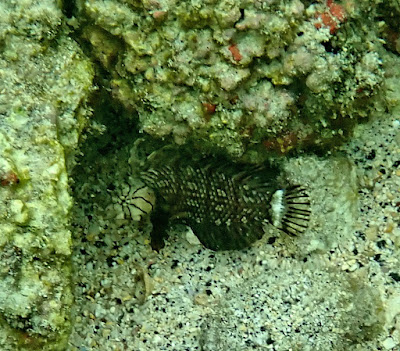
    When that transitioning longirostris left, we decided that it was time for us to go home, as well.  Just as we started our swim a small pufferfish passed us going in the opposite direction.  He was suggestive of a meleagris, now called (simply) the Spotted Puffer, which is a stupid name because a great many puffer fish are spotted.  In Hawaii the meleagris is black with white spots.    As you can see this fish has an overall brownish cast with darn near golden  pectoral fins and a hint of gold that extends onto his forehead.  And look at those prominent eyes.  Its almost as if he wants to be a French Bulldog.  

    He was swimming for all he was worth, those little fins flapping around like crazy, but he was a small pufferfish and Sandra and I were able to overtake him to get these pictures.  There is nothing exactly like it in the books so I sent the pictures to the Great Oz.  John Hoover was spending his last day diving in French Polynesia, but being the kind soul that he is, he took time out to give us his opinion.  Taking into account that he was in the middle of nowhere without his library, he voted for a juvenile meleagris, saying:  

A Giant Moray Hunting.  photo G. Douwma

Hi Jeff, Those yellow fins are weird. I don’t see any spines. A. meleagris has  an all yellow or partly yellow color variant that is rare in Hawaii but much more common elsewhere in the Pacific. I’m guessing that’s what it is.

    Dear departed Jack Randall is busy diving St. Peter's Reef and unable for sage advice.

   After this exhilarating swim we headed for the barn.  On the way we saw many Barred Filefish and several Achilles Tangs, both of which seem to be undergoing the dwindles in Kailua Kona. 

    As we approached the two step landing we saw a very large eel, perhaps seven feet in length.  He was free swimming and we observed him for five or ten seconds before he vanished into a coral. The eel was a uniform dark gray with  diagonal barring on his flanks and no greenish fringe on his dorsal fin or tail.  This was a Giant Moray, G. javanicus.*  John Hoover tells us that this species is rare in Hawaii, but I have seen it several times, so uncommon might be a better term.   Additionally he tells us that  the Giant Moray will attack unwary divers. Perhaps I was fortunate that it disappeared completely into the coral and that I chose not to dive down for a closer perusal. 

Whitley's Trunkfish  City of Refuge  March 2022.

   As we got ready to exit, I let Sandra go first.  As she swam away, I looked down and saw my first Whitley's Trunkfish* of the year.   Whitley's isn't  a rare fish, but it is highly endemic.  And a it was a great fish to end our snorkel.

   On shore we had lunch and made friends with our fellow snorkelers based mainly on the equipment they brought to the beach.  One young couple removed collapsible chairs from tiny nylon bags.  As it turned out one chair (the smaller of the two) was from REI and the other from Costco.  And our new friends were birdwatchers from Alaska.  I regaled them with my tale of the Wagoners, who worked as lecturers for the Audubon Society and attempted fish watching at Kahalu'u in the mid-eighties, before there were good field guides.  In return, the young gentleman told us that he had worked for a year as a biologist at the Kilauea Lighthouse on Kauai.  Albatross and Red tail Tropicbirds...Check it out.. 

   All this chitter chatter was too exciting so this handsome young couple picked up their masks and fins and headed to thetwo step entry.

   Elsewhere on the beach there was a very attractive young woman. I believe she might have recently escaped from Milf Island because she was affiliated with a three year old daughter so cute and well turned out that it almost broke your heart.  Upon her escape, she and her husband had purchased a small cart that was almost as cute as their daughter.  The cart was full of beach toys, lunch and snorkeling gear. 

Pure Outdoor collapsible cart.  Adorable family sold separately.
   Soon, the lady went off snorkeling and I went to change my clothes.  On exiting the porta potty who should I run into but dad with his daughter in hand.   Leaving out the part about where his pretty wife might have just escaped from (why confuse the issue and open myself up to bodily injury?)  I told him that I had been admiring his cute little cart.  He said that it was completely collapsible and came in handy here at City where one is currently obligated to schlep their belongings from hell'n gone down to the beach.  The part about Milf Island never came up.  

   He thanked me (for complementing his cart, I guess.)  and shortly there after,  Sandra and I were back on the highway.  No frogfish to show for our efforts, but the list for 2022 is now up to 105, which is exactly how many species the Wagoners saw at Kahalu'u in a year and a half.  And that's it from the beach.

jeff


Friday, March 4, 2022

Snorkeling With Colsen

    Sandra and I spent last week with our son, James, and our two wonderful grandchildren, Colsen and Reid.   This was only their second trip to Hawaii.  And due in part to Covid, they have done less swimming than one might hope.  

     Both were eager to get in some time at the beach.  And it seemed like they might both take to snorkeling right away.  However, when we got down to the ocean the process was slower than we had hoped.  Reid never made it past hanging onto his dad as they swished around in the shallows.  Colsen

Colsen goes on his first snorkel.

eventually had one good outing.

    However, things began slowly.  On the day of arrival we made it down to the Inner Harbour.  Colsen was eager to put on his new mask, but unwilling to do more than crawl around on the sand in four inches of water, occasionally immersing his face, presumably capturing a quick glance at the sandy bottom.

    Day two was just a little better.  On the second full day of their trip we went to the Ironman side of the pier and, with his life jacket on, Colsen permitted his father to tow him out past the first swim buoy. He was amazed at being in the water with live fish. 

  It could be that on this first outing he saw only a few Square spot Goatfish.  This is a pretty common fish, but to his eye it was big and infinitely interesting.  this was an existential accomplishment.  He had gone snorkeling.  And seen a fish.  A Big Fish!

It's a milletseed!  This one was at Kawaihae.

   While Colsen took his inaugural snorkel, Sandra escorted Reid across the pier where they saw quite a a few fish just standing near the boat launch.  Among others, they saw a Pacific Boxfish, some yellow Tangs, and a Milletseed Butterflyfish.  This latter was thanks to what my beloved described as a homeless person.  She was looking at the fish and out of nowhere a gentleman said, "Its a milletseed."  And he was right.  

    At this point I have to note that fine couture is optional here in Kona.  In fact, there may be days that the only way you can tell that I'm not homeless is the my lack of a shopping cart full of worldly possessions.  

   For the next 12 hours every car ride was punctuated by a recounting of grandmas fish watching prowess.  Reid would commandeer a copy of John Hoover's fish book we keep in the seat pocket and proclaim.  Grandma saw this, Grandma saw this.  In the upcoming movie she is played by Jacqueline Cousteau.


   The next morning we hit the road early and were at Ho'okena before 8:30. On the way, as we passed through Honaunau,  Sandra pulled up an ancient version of Little Grass Shack and I spent a few grandfatherly minutes attempting to get the boys to sing, "Komo mai, no kauai, ika hale welakehau."  which as the old Hawaiians know means, you are welcome to come into my home and have a good time. Now that's Hawaii!

If you are so disposed, you can clip and paste and listen to Bing Crosby sing this Hawaiian favorite.

https://www.youtube.com/watch?v=a9rOSD38_Ao 

    So we made it down the long curvy road to Ho'okena, admiring the old stone walls and a few cows. And we sang our way into the parking lot at an hour when many a vacationer is still in bed, but  just in time to nab the last parking spot.  It is tourist season and no mistake. As we unloaded, arriving cars circled and were turned away by a designated parking attendant. 

    Soon our stuff was on a shaded table and the boys were down on the beach boogie boarding the tail outs and playing in the soft black sand.   While they enjoyed the beach, Sandra and I took a quick snorkel.  The waves were small and the entry was easy.  Soon we were out at the dependable coral head that produced Potter's and Flame Angelfish.  We didn't find the Gilded Triggerfish, but on the way in we happened upon a handsome Scribbled Filefish. Once a common resident at Kahalu'u, this beauty is getting progressively more difficult.

Mr. Scribble at Ho'okena.
    Along with the flamingo,  Mr. Scribble is Sandra's totem, making each now uncommon sighting an occassion to celebrate.

She likes the boys in the band / Mr. Scribble is her favorite. / And she'll never let your spirits down, / Once you get her off the sand.

  Thanks to Rick James.

   We made it back to the table in time to help dish out snacks and sandwiches to the boys and then it was time for Colsen to go snorkeling  For real this time    

     Once again wearing his life preserver, he made it through the small surf and the allowed James to tow him for about 150 yards, out and back.  

We had been swimming only a short distance when up ahead we got a solid, if fleeting look at a Paletail Unicornfish.  It was a nice adult with his horn protruding like the nose on a  fish that Ringo admired through the porthole on the Yellow Submarine.   

An Intricate pattern on a Cushion Starfish Ho'okena 2022
    A bit further on, we saw an amazing cushion starfish.  This was so unusual that I sent a picture to John Hoover, hoping that it might be a new species for my list.  John was in French Polynesia, diving on an obscure reef and having the time of his life.   (Its a tough job but somebody has to do it).  Nevertheless, he took time to write back, saying that no matter how much this echinoderm resembled a Hopi pot, there is only one species of cushion starfish and that is what this was. 

     On the way out we veered south over the sand and found a trio of Gilded Triggerfish.  As with the unicornfish, James and I got an excellent look in crystal clear water, but it was hard to tell if Colsen was able to focus on these fish that had to be at least ten yards away.  But James was a good guide and maybe he did see them. 

Potter's Angelfish, Ho'okena 2022


    Because we had veered so far left, we over shot the angelfish coral.  Eventually we decided to turn back towards the beach and caught the angelfish on the return.  Colsen was amazingly patient and, as far as I can tell, saw both the Potter's and Flame Angelfish.  In addition, there was a wnderful big Yellowmargin Moray lounging in the coral about fifteen feet below.  I dove a couple times to point him out and eventually Colsen saw the monster. 

   On the way back in I spotted an Ornate Wrasse.   While this is not really remarkable, it was my first one for 2022 and that is both surprising and a bit sad.  As James towed Colsen to shore I spotted an octopus, which was quick to dodge into cover.  By the time I gave up on him, James and Colsen were on shore waiting for Gramps.

    When we returned to the table, we found Grandma Sandra and Reid, who had made a foray along the lava rock beach in front of the old town of Ho'okena.  They had watched a boy reel in a goatfish while standing on the old cement landing.  Sandra was disappointed that they hadn't seen any fish, not even a crab. On the other hand, what boy doesn't revel in the catching of a fish!


    There was somebody waiting for our parking spot as we left and, as we drove out of the park, a dozen cars were parked along the side of the road.  Following the pre-vaccine period of the pandemic, tourists have returned to the Big island in droves.  Many of our best snorkeling spots are now well known, so be you visitor or kama'aina, plan accordingly.  But be assured, if you are lucky enough to get a parking spot it will be worth it!

jeff