Thursday, June 29, 2017

Potter's Gets Cleaned at City of Refuge Or The Snorkelkids Meet the Dragon Flower

   Today we went to City of Refuge for the first time in, like, forever.  Although city is one of our favorite snorkeling spots, rough ocean conditions earlier in the year kept us away.  More recently, we have been
Seven Eleven Crab, C maculatus  City of Refuge  June 2017
dealing with busy schedules.  But really, there is no excuse.  City is a great place to go snorkeling and we are appropriately ashamed.

   We arrived early, about 8:30 AM, and we were in the water by 9.  As one would expect, it being almost the 4th of July, the water was a very pleasant temperature and for the most part fairly clear.  We swam along looking at the usual suspects until about ten yards ahead a thirty something young man yelled, "Hey dad!  Come here!  Its a great big crab!"
   Well,  I wasn't his father,as far as we know, but I got there in advance of the pater familias.  What they had was a seven eleven crab hunkered down under a rock in about ten feet.  As Sandra noted, this was pretty good spotting,  Although this is indeed a pretty big crab, he isn't all that brightly colored and he was pretty deep.  She thinks the youth in question made a random dive and got lucky.  We dove the crab several times
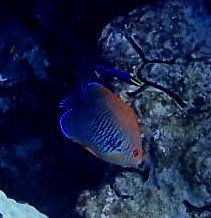
Potter's Angelfish and City of Refuge, June 2017
for pictures and thanked the young man for his fine spot.

   Moving along, we enjoyed a large number of menpachi, as epaulette soldier fish are known in these Very Sandwich Islands.  Its interesting that when a fish is highly edible, it is known commonly by a Hawaiian or Japanese name.  The epaulette soldierfish is a delicacy, like opihi, which is served by locals at weddings, graduations, etc. If they weren't edible we would know them simply as soldierfish and limpets.

    Looking at all the soldierfish and squirrelfish, we were lucky enough to spot a bigeye out in the open and a brick soldierfish, which I have not seen in a while.  Both these fish were skittish enough that when I dove for a picture, they retreated to cover.  Before we turned around, I spotted a Potter's angelfish that was being cleaned in about ten feet of clear water.  Cleaner wrasses, as we have noted in the
Spiteful Cone 
past, can be quite an asset to the fish photographer. In this case, the shy Potters just hung there in the clear water twelve feet down, while I dove for a few pictures.  You will note that this fish does not have a very red head and I speculate that it is either young or a female.  Never the less, this was a fantastic opportunity and I have to give the cleaner wrasse a lot of credit.

   Before we made the club house turn, we enjoyed a handsome spiteful cone sitting peacefully on a ledge about eight feet down.  Diving the poisonous snail, we were able to see the venomous mollusc lurking inside the shell.


   On the way back in, we were treated to a pair of Hawaiian dascyllus spawning.  Wearing very black faces and tails, which contrasted nicely with their virtually white flanks, this elegant pair circled each other and wiggled frenetically over a patch of stones for about a minute.  Following the courtship, one took off
(probably the female) and one remained, inspecting the spot where the deed was done and making modest efforts to keep other fish and humans at bay.
Spawning pattern, Hawaiian Dascyllus

   Back on shore we reclined in our chairs and had tea, or possibly lunch.  It certainly wasn't brunch, because who in their gastronomic mind would call a salami and cheese sandwich brunch?  As we were finishing, the dolphin pod came in a d gave everyone a great show quite close to shore.

   Before heading home we decided to take the one lane road across the desert to Napo'opo'o.  About halfway across we encountered a miracle of nature. The scraggly cactus that we see here in Kona was in bloom.  There were lots of large white flowers poking out at us from the side of the road.  I found a pull out and sweetie disembarked to take the picture you see here.

   Our destination was the coffee company about two miles up the hill from Napo'opo'o.  There we met Angel, who was wearing a Guadalupe hat.  I guess if you are wearing a hat emblazoned with the Virgin 
(pronounced beer-hen) it is odds on that you are Mexican.  That was indeed the case, Angel hailing from Michoacan, was full of good cheer.    We had a great time telling tales of the land of Montezuma.
A Kona Still Life    Pomegranate, Egg Fruit and Aguacate
 Before saying adios, we purchased a pomegranate and an egg fruit, for although they would like to sell you coffee and chocolate covered Mac nuts at great expense, this tienda frequently has unusual local fruits and vegetables at a reasonable price..

   We got the pomegranate because Sandra said it would make excellent coleslaw and we got the egg fruit because I'd never seen one before.  Angel said they had an acre or so of egg fruit trees  (Pouteria campechiana)  up the hill.  The tree is an evergreen tree native to Mexico.  The fruit is the size of a small apple.  One is required to wait until the fruit starts to get soft before cutting into it and enjoying its dry, sweet flesh.  It is not clear if there is an historical basis for the Mexican folk tale in which Guillermo Tell saves the pueblo from the local bully (who may or may not appear in Donald Trump's genealogy) by shooting an egg fruit off his son's head with a  pistol similar to the one that Martin Short used to defeat El Guapo in The
Dragon Fruit Blossom  photo by Sandra Gray
Three Amigos. 


   Just as we were ready to depart, I asked Angel if he would like to see the pictures that Sandra had taken of the amazing blooming cacti. He graciously looked at our pics and said that they looked a lot like dragon fruit flowers.  Of course, he was exactly right and too polite to mock us.  The creeping cactus that grows commonly near the beach is indeed dragon fruit cactus.  Hylocerus undatus, that green scruffy looking cactus, is seen everywhere along our roads and rock walls.  In my consummate ignorance, I had no idea that it was the source of  that oddly shaped red fruit we know as dragon fruit or pitaya.   We see the fruit in the markets occasionally, so I would guess that it is cultivated.  In the wild, it flowers following a large amount of rain.  Well, the recent Kona weather has certainly punched that ticket. The flowers, one of the largest produced by any cactus, turn to fruit over four weeks.  Suffice it to say, it is our intent to get back to those cactus in a few weeks and catch a swim at City in the process.  I hope you enjoy Sandra's wonderful pictures and the next time you see dragon fruit in the market you can put it together with the large yellow and white flower and the scraggly roadside cactus.

    Back at Casa Ono we are incubating our egg fruit with baited breath.  Stay tuned for the exciting tasting notes.

Harry Potter and the Curse of the Cleaner Wrasse


Wednesday, June 21, 2017

The Cauliflower Coral Caper


 A couple days after returning to Hawaii, I received a group email from a local biologist, Lindsey Kramer.  Lindsey works for the Department of Aquatic Resources, based in a trailer hard by the fuel dock at Honokohau harbour.  She is also the coordinator for a loose knit organization called Eyes of the Reef.  I suppose that my presence on the mailing list, makes me an EOR observer.

   The email I received heralded the moment when cauliflower coral, Pocilipora meandrina, would be, or
A Healthy Cauliflower Coral, Kailua Bay 2017
should be, spawning on the leeward side of the Big Island.  I'm sure many of you recall that the cauliflower coral took one hell of a hit n the summer of 2015, when the inshore ocean temperature went up above 90 degrees and stayed there for over a month.  Much of the coral, not just the cauliflower coral, expelled its symbiotic algae in response to the heat stress, bleached and died.  Lindsey's email suggested that 3 to 5% of the cauliflower corals survived this event.  My feeling is that this number is outlandishly high, at least in the Kona area.  In some locations (e.g. Paul Allen's Reef and the bay south of Magic Sands)  it was closer to 100%!  This is based on my observations in early 2016. Last year, a small amount of spawning was reported from City of Refuge.  In other areas in Kona there was none.  It was Ms. Kramer's hope that the EOR would spot multiple spawnings along our coast. 

   Cauliflower coral was so common that we took it for granted.  However, those of us in the business of
Lots of Fish , Lots of Dead Coral    Kailua Bay 2016
finding unusual fish and critters, have always been aware that this branching coral serves as a valuable hiding place.  It serves an important nursery function for some juvenile species of fish, it is home to some small and secretive species (e.g. coral croucher, speckled scorpionfish and fourstripe wrasse) and it serves as a protective home for a variety of hermit crabs.  Not only that, but about six months ago, while listening to Hawaii Public Radio, I learned that P. meandrina protects exposed shoreline, such as we have at Paul Allen's reef and Alii Villas by buffering the surf.  Suffice it to say, we are not taking cauliflower coral for granted any longer. 

   Since the summer of 2015, in some spots the cauliflowers and some other corals have been making a bit of a comeback, although the areas I mentioned above remain decimated.  One essential component of coral recovery is their ability to propagate.  It is possible to break off a piece of coral and attach it to a suitable spot in the sand or by physical means to a rock or piece of metal and it may grow.   But  hopefully recovery will be accomplished by spawning.

   Each species of coral spawns at a certain moment, based on the lunar cycle and water temperature.  At the
What Ant Doesn't Want to Eat a Bale of That?
genetically programmed moment all the coral of a species release their sperm and eggs.  There is a lipid component to these gametes, so they float to the surface, where they seek out a partner, joining to form an embryo.  In the case of coral, this embryo is called a planula. As our friends at NOAA explain:  Planulae float in the ocean, some for days and some for weeks, before dropping to the ocean floor. Then, depending on seafloor conditions, the planulae may attach to the substrate and grow into a new coral colony at the slow rate of about.4 inches a year.

   Most coral species spawn at night, but P. meandrina spawns just after sunrise. We have known about this for about ten years, going so far as to contact a coral biologist at UH Hilo to the find correct day.  But we have never taken the opportunity to get up early and be in the water at sunrise to observe the cauliflower coral spawning.
This Lovely Snapper Greeted Us Early Sunday Morning

     I have a friend at the Kona Public Library, Jennifer Lossalio, who is going to help us put together a display of paper mache Hawaiian dascyllus, to demonstrate the plight of the cauliflowers.  I was telling her this story and when I got to this part about not getting out to see the spawning in previous years I invoked Willie Nelson.  Willie has been quoted, referring to his colleague Waylon Jennings, that Waylon is too lazy to walk across the street to watch a piss ant eat a bale of hay.  It made Jen smile, but I'm sad to say that I may have been that lazy. 
    So last Sunday, we skipped church and  entered the water at the foot of the pier at about 6:45.  Knowing the water was cool, I encouraged Sandra to wear her wet suit.  We identified a few likely looking corals, paddling from one to another for about an hour, not seeing any spawning and getting progressively more chilled.  We waited till about 8 AM before getting out. It should be noted that there were a surprising number of reef fish swimming about, so it wasn't boring, just cold.
Lots of Stocky Hawkfish But No Planulae

   The following morning, Sandra had a doctors appointment so I went by myself.  On my walk to the pier, I crossed Alii Drive and spoke to one of the many anglers who were fishing from the sea wall.  While we were chatting,  the adjacent fisherman landed a fine scale triggerfish, perhaps the one Sandra and I were following the day before.

   The water wasn't any warmer, but I did meet, ever so briefly, a lady named Barbara, who was doing the same thing I was, swimming from coral to coral to basically no avail.  And there was still some fish watching to do.

   There is a certain genre of ladies around here who come to the beach to get in the water and paddle around and gossip.  On this morning two such were floating near the first swim buoy and I heard one exclaim to her friend, "I think he's looking at me!"   There was no way that I could resist that, so I swam over hoping for an octopus.  As it turned out, they had a scorpionfish and immediately started warning me to stay away.  Muy peligrosso!  So I dove down and held onto a nearby rock and got his picture.  I guess I'm a bit like the
I Swear he Was Looking At Me.  Devil Scorpionfish,  Kailua Bay  2017
barber in Penney Lane, with a picture of every stonefish I have known. (And the fishes that come and go, stop to say hello.)  This was my first Devil Scoriponfish for 2017, so I was very pleased.  In addition to being very cold.

  Sandra made her doctors appointment and the following day I saw my dermatologist who excised another skin cancer.  The healing wound kept me out of the water for the rest of the week.  On Friday we were perusing the paper at Jennifer's library and discovered that Kailua Bay had just reopened.  It had been closed to swimming starting Monday morning when a sewage leak was spotted near the King Kam Hotel.  I doubt that had anything to do with the coral spawning (or not) and I didn't get sick, but like so many things in life, I found it a curious coincidence.  If someone had checked the water sample a few hours earlier I wouldn't have met Barbara, or seen the stonefish and we would all be wondering whether or not the coral spawned.

   At the end of the day, we didn't see any coral blooming.  And neither did any of the other EOR watchers along the coast.  I suppose it is possible that a few planulae will float in and start infant coral heads in Kailua Bay.  Luckily, as you can see from my pictures, some of the surviving cauliflower coral is looking pretty good, so we have reason to hope that the normal life cycle will reassert itself next year. 

Spawn, Dammit!


Sunday, June 11, 2017

The King Kamehameha Day Parade in Kona

The Royal Court of King Kamehameha
    Although this blog is primarily aimed at fish identification and events surrounding that most worthy of endeavors, occasionally we feel the need to talk about events happening on our #Island in the Pacific.  This blog falls into that category.

   Yesterday Sandra and I attended the King Kamehameha Day parade here in Kailua Kona.  This was
The Grand Marshall in Top Hat
substantially different than anything I might have expected, which might just show how oblivious I am to events happening around me.  After all, we have lived through at least three of these parades, which certainly make the news.  But I think you might be surprised at what we saw and my conclusions.

   The day was relatively cloudy and a bit cool for the season.  Because Sandra wanted to sit on the sea wall, we were facing east, into the rising sun.  The parade started at 9 AM as the first event in a day of dance, music and other festivities, so as we were sitting on the seawall, the sun was rising in the east.  

   The parade was different in another mundane way (aside from occurring in the morning instead of the late afternoon)  It progressed form the Royal Polynesian resort in the south, north to the old airport; the opposite of all other parades that invariably go from north to south.

    I figured that this would be a fun, festive parade with kids on floats and bands, and there was  a little of that, but basically this was a parade of equestrian groups representing all the islands.  These groups were termed Pa'u units.  They consisted of from three to five women and two men, all riding horses bedecked with leis of plants relating to the pa'u tradition of their particular island. 

   All these horses were brought into Kailua Kona along with their riders.  As you see, the women are clothed in remarkable fashion, the men to a slightly lesser extent, but still consistent with their island theme.

   Pa'u means skirt. You will note that the women are riding astride their mounts and wearing a long culotte, hence the pa'u.  These outfits date back to the introduction of horses in the Hawaiian Islands, the year 1805.  At that time only the Alii were permitted to ride and the Alii women formed the first pa'u groups.  After the royal Hawaiian government was overthrown by the United States military, the pa'u tradition withered.  The
The Pa'u Queen
tradition was brought back about fifty years later and women and their male attendants have been riding in pa'u units for over a hundred years.

   You may recall that I said at the beginning that this procession was not frivolous.  In fact, there was little cheering as the 19 equestrian groups paraded by.  Most were mounted, but there were a couple horse drawn carriages.  The Grand marshall in top hat, drawn by two magnificent draft horses.  And before I go on, I need to mention that the parade was started by a male Royal Court, dressed in alii garb, lead by bearers of kahilis, those feather dusters on steroids that the royal Hawaiians used as standards.

   There was a queen with her own mounted court astride big, strong horses, and she, in fact, was a big strong woman, not some wimpy homecoming queen type.  Each pa'u group that followed was in the color traditional to their island.  In addition (and this surprised me) each island sent a pa'u unit to Honolulu for their King Kamehmeha Day parade.

   So here is my take.  As you may know, there is a significant movement to bring back the royal Hawaiian
Princess Raisha Karratti and the Hawaii Island court
government.  When he was campaigning here, John Kasich was asked what he thought about it and was quoted as saying he was unaware of it.  And why should he be...its not like its really going to happen.  But the Hawaiians take it seriously.  One sees lots of bumper stickers and such supporting the idea.  

   I believe these pa'u groups are representing that ideal.  The mounted princesses were mostly at least part
The Roving Marshalls Brought Peace to Alii Drive
Hawaiian, they represent the deposed government.  The mounted princesses held themselves with a restrained grace as they gave signs of greeting to the crowd.  and at the end of the day, we do live in a Hawaii that until recently (in the great scheme of the universe)  was ruled by the Hawaiians.

Friday, June 9, 2017

We're Back in Kailua and So Is the Milletseed

     After a two month hiatus, during which we exposed ourselves to art in the low countries and hobnobbed with our friends and relatives in the PNW, we have returned to our beloved Kailua Kona.  Although we
Milletseed Butterflyfish,  Kailua Kona,  June 2017
were too exhausted to go snorkeling the day of our arrival, I hit the pier and Kahalu'u on the following two days.

    It only took a moment, as I swam out by the swim buoys on the Ironman side, to know that I had returned at the right time for snorkeling.  The water was really flat and just a little cool.  At 8:30 in the morning there
were already plenty of fish doing their thing among the coral that really looked pretty good. The recreational swimmers were plying the lane beside the buoys, their numbers somewhat reduced from peak tourist season.

   I swam out to the area where, just before we departed for the art of Amsterdam, I had seen the trio of sharks.  I didn't see them that morning and there was no one familiar on the pier to ask for an update.  Swimming seaward I was joined by a turtle who swam right up to me and hung on the surface for a minute catching his breath.  And then a little further out, we hit pay dirt in the form of a single Milletseed
Six Red Labrids  Coris Gaimard,juv
Butterflyfish.

    The milletseed was once seen in large schools while snorkeling in Kailua Kona, but now the individuals that appear at snorkeling depth are so rare that I wonder each time if this will be the last one I will see.  I did not see any in 2015 and saw but one in April of 2016.  I hope to see more than one this year, but I'm not holding my breath.    I did need to hold my breath to get the picture you see here.  This milletseed was in the deep spot past the last swim buoy where we sometimes see scribbled filefish, about 12 feet down.  A
couple good dives and we nabbed the photo.

Yellotail Coris  Terminal Male  Kahalu'u June 2017
    The following day I went down to Kahalu'u.  Sandra tagged along, but didn't swim, choosing instead to work the crowd under the big top.  The tide was out, so I crawled through the sand channel like some amphibious creature from Disney's Rite of Spring.   It was early so there were not a lot of swimmers, but
there was a nice variety of fish. A tiny four spot butterfly was playing hide and seek around a rock near the entrance, but my efforts to get his picture were futile.

The Rubenesque Mermaid by Mary Deveraux
     A patch of shallow coral yielded a novel site: six red labrid wrasses swimming together in a school.  Coris gaimard, schooling together.It made for an interesting sight.  A few moments later, their proud father cruised by and I nabbed his picture as well.

    Occasionally one sees this juvenile (that the uninitiated mistake for Nemo) swimming with a school of small mixed fry.  Its not unusual to see aggregations of baby belted wrasse,for example, but I have never seen a large grouping solely of this species swimming together.  In addition, these youngsters were very approachable.  Usually I encounter a single red labrid juvenile who does his best to elude my photographic efforts.  I'll be back to Kahalu'u soon and I won't be surprised to see this group still hanging out together.  Maybe I'll see you there, as well.

    Over by the decommissioned hotel, hoping for an octopus, my swim was interrupted by a Rubenesque young woman who took a break from swimming to stand on a patch of sand that happened to be right in my path. She was wearing a mask but swimming barefoot.  Having just returned from the art museums of Holland, I was bemused by the idea that she might be a mermaid model for Peter Paul Rubens.  And I wondered, did that giant of the Dutch renaissance ever paint a mermaid? Although we commonly use the term rubenesque to
Rubens and his wife, Helena Fourment
imply an obese woman, that really wasn't the case. Ruben's women carry a little extra weight, but its not excessive; pleasingly plump might be a fit.  One need to look at the self portrait of Rubens and his wife to see where his tastes lay, as it were. 

    So bemused was I, that I swam progressively into the shallows by the breakwater.  By the time I had exited my reverie, I was in quite a pickle. A very shallow coral carpeted pickle. Luckily, there was little surf and so I crept out of the very shallow coral without injury.  During my escape, I saw a pair of saddleback butterflyfish (which are clearly more common that milletseeds.) 

    As it turns out, Rubens did not paint a mermaid.

   My beloved was awaiting me back in the kiosk,  First she needed to warn me about a young man hanging by the stairs with his pants half off and spouting twisted religious jargon.   Then she introduced me to a pair of toddlers who were dancing to the music provided by a gray haired group of ukulele players.  Matt and Donny looked moonstruck as they attempted a few steps.

   On my way to the changing room I was accosted by the young man in the advanced stage of de-pantsing.  He blew smoke in my face and said, "If Donald Trump was Jesus, would we need a special prosecutor to crucify him?"

    We're all set to go swimming with Reverend Sunny this morning and I believe I will pose that question to her, if only to keep her on her ecclesiastical toes. In the meantime, keep strumming your ukulele and keep your eye out for that Rubenesque mermaid.

jeff


Thursday, April 6, 2017

The Sharks of Kailua Bay

     This tale begins three days ago.  On that morning,Sandra and I were completing a large spate of gardening and I had filled the trunk of the Honda to the brim with yard debris.  The last thing to get packed into the trunk was a pile of the nastiest vine in Hawaii.  This is a fern that is feathery at the top and is
A Fine School of Raccoons Hanging at Shark Central
sometimes used as an ornament in bouquets.  The part that isn't feathery is a wicked vine studded with thorns, much like the stem of a rose.  In our yard this viney fern can climb thirty feet or more, so when you remove it you end up with quite a pile of these thorny stalks.

   We headed to the transfer station with the intent of swimming at the pier after dropping off the debris.  In the process of extricating the thorns from the trunk, I dropped one on the ground and managed to impale the side of my foot.  As I am anti-coagulated (aren't all men over 55 taking aspirin?) this small puncture bled into my sandal all the way back to Kailua.  Looking down at my oozing foot, I said, "I guess this means we better stay away from sharks."


    Of course, neither of us had ever seen a shark in Hawaii, so my comment was totally on the side of glib.  But when we got to the pier we ran into the nice lady of a certain age with a large German shepherd of a certain age for whom she has installed an elevator to assist the pooch in getting up the steps into her house.
This Big Eye Was Chilling
After hello, the first words out of her mouth were, "Have you seen the shark?"

   Well, no, we hadn't even heard of the shark.  According to the lady and a helpful man, who was apparently one of her compatriot distance swimmers, a reef shark had been hanging around near the pier for three days.  While the dog attempted to knock Sandra over with his persistent snuzzling, I attempted to ascertain just how we could see the shark.  There was a bit of disagreement as to just what sort of shark it was.  The man, being the accepted authority, said it was a gray reef shark.  The location was said to be thirty yards beyond the last swim buoy and thirty yards towards the beach.

    Sandra got away from the dog long enough to change into her snorkeling outfit and we hit the water.  We got out in front of the palace, the area that fits those criteria, and swam and swam.  Over the next hour we covered everything from the buoy itself to fifty yards in radius three times!  This took us as far south as the
So where's the damn shark?
Kona Inn sign and a fair ways out into the bay.  There were lots of fish, but there was no shark. 

   It must be said that everyone has a different idea of how long a yard is in the ocean. After talking about distances with Bob Hillis a year or so ago,  I decided that I was over estimating by about double.  So when someone gives instructions like this you must both cut it in half and double it if you want to cover your bases.

    The following morning, it was Sandra's turn to work at the church.  She was still tired from the previous day's gardening and swimming, so she was happy to drop me off at the pier and head up to Kona Methodist. While I was changing, two girls of about 30 came ashore and I asked if they had seen the shark.  They said yes, it was just past the last swim buoy and a bit towards shore, hiding in a cave.

 Of course, that was just where we had looked the day before, but had we looked into every possible shark puka?  I headed on out and started diving every hollowed coral head and looking under every ledge  where
Follow me.   Eagle Ray   Kailua Kona   April 2017
the shark might be sheltering.  In the process I met two groups of people who had seen the shark on previous days,  bringing my total number of first hand witnesses to ten.  The first was a group of four adults who were heading in after looking for the shark.  After talking to me they headed back out for another look.

   The second was a pair of ladies of a certain age that I met about half an hour later.  They had seen the shark two days previous and had heard that on this morning the shark was hiding in a cave.  (I wonder who started that rumor?)  One lady said that it was no wonder the shark was hiding with all the people out bothering it.  The other added that if the shark wanted some privacy it had come to the wrong place.

    I swam around some more, adding a few fish to the list for 2017, what with diving and looking into holes.  The most interesting was the big eye with the dramatic silver and red pattern.

   Bottom line, I did not see the shark but came away with the idea that if we went earlier we might have a
Look carefully, that's three reef sharks.
better chance.

   This morning we got up early and were down at the pier around 7:30.  Out we swam, hitting ground zero before 8 AM.  Once again, we covered a large patch of Kailua Bay, with no shark.  After 45 minutes Sandra had had enough and it was hard to argue with her.  So we spread out and started heading in.  At the fourth swim buoy I met a large, dark snapper going in the other direction.  I was impressed by his size and followed him for a bit, never getting closer than a a coupe yards.

   When I came up,  I was back in front of the palace.  There was a young swimmer next to me and he said, "If you want to see an eagle ray there is one right back there, maybe five yards, straight out from the flagpole."  Now I ask you, what jaded so and so doesn't want to see an eagle ray?  I was in luck and I found the ray in just a few strokes, much less than five yards.  He was cooperative and let me take several pictures,
So how manya dese fingers got white tips?
as you can see.  For most of the pictures, I was a foot or so below the surface, which increased the clarity dramatically.

    I followed the eagle ray as he swam toward the palace and then made a sweeping turn toward the pier.  And as he did so, he swam right over the sharks.  Yes, Virginia, there were three sharks!  Trying not to exaggerate, I would estimate that the smallest was five feet and the largest a bit over six.

    They were irrefutably white tip reef sharks... just look at the tip of the tail and dorsal fin in the accompanying pictures.  When I gave my first report to Bob Hillis two days ago, he said that a sighting of a gray reef shark was excellent, that they were usually seen off shore and at depth.  As it turns out, that second witness should be turned over to Cousin Vinny. " I got no use for dat guy!"

    In reading John Hoover, one is instructed that the white tip reef shark is the most commonly encountered in-shore shark.  Luckily, that species is the least likely to attack you.  The latter fact became my mantra as I watched the sharks circle once, passing pretty much about eight feet right below me, and then settle on the sandy bottom.  Another fact that the Great Oz imparts is that the White tipped reef shark is unusual among requiem sharks in having auxilliary muscles of respiration that force water over the gills when it is at rest on the bottom.  Tiger sharks, by comparison, can not perform that trick: they must keep swimming or suffocate.
   
   And while we're at it, why do they cal them requiem sharks?

Definition of requiem

  1. 1 :  a mass for the dead
  2. 2a :  a solemn chant (such as a dirge) for the repose of the dead  b :  something that resembles such a solemn chant
  3. 3a :  a musical setting of the mass for the deadb :  a musical composition in honor of the dead

Do you get the feeling that somebody mighta died here?  Sharks have undergone catastrophic predation by homo sapiens, in large part for their fins, which are turned into soup.   But I don't think the guy that named the largest group of sharks, the ones that swim free and fast in the ocean, requiem sharks was anticipating this turn of ecological events.   To borrow from Papa Hemingway, the bell tolls for you, dude.

    I buttoned up my courage, and dove a couple times towards the sharks to increase the clarity of my
White-tipped Reef Shark  Kailua Kona April 2017  Resting On the Sand
pictures.  I then watched them rest there on the bottom for a minute or two before deciding that there was no point in further tempting fate.  I was, after all, out numbered three to one and I'm not ready for anyone to write, sing or play a requiem on my behalf just yet.

    All kidding aside, its good to keep in mind the sentiments of the two ladies from the day before.  It's an honor to have these reef sharks in our bay and if we can give them enough space, and if some asshole doesn't spear them, they may feel comfortable enough to become regulars.  My observation today differed from previous reports.  It was obvious to me that the sharks are not living out in front of Hulihee's Palace 24/7.  Rather, they are living and feeding somewhere else and coming into Kailua Bay to rest.  There are no laws protecting  sharks similar to those that supposedly protect the dolphins.  Let us hope that common sense and a love of nature prevails and that we have many more opportunities to enjoy these magnificent creatures.

jeff

Mālama i ka manō

 In Ancient Hawaiian culture, the shark,  manō, is one of a few animals who may be the embodiment of an ancestor, an Aumākua.  Ano lani; ʻano honua, which is to say of heavenly and earthly significance.  Another such animal is the pueo, the native short eared owl.  Because of this special relationship, sharks are held sacred and protected. 


Monday, April 3, 2017

On the PAR With Peter and Marla or The Truth about Crinoids

   Late last week we went snorkeling with our friends Peter and Marla.    They drove down from Kapa'au to spend the morning with us and the afternoon with Costco and Home Depot.   We met at 10 AM at the pier,
That's Peter 3rd to the left of the Superstar.
where Peter told us that he couldn't find a place to park.  Parking in Kailua has become quite difficult of late, so this wasn't a total shock.  He dropped off Marla and their equipment and took off in the truck for another try at parking.  He showed up about half an hour later, having been forced to pay to park in the lot by the market.


   Once recently I gave up on an optional meeting downtown when I couldn't find a place to park, but this was unprecedented.  And a bummer.

   The time wasn't wasted, however.  Peter and Marla are real honest to God scientists who get paid to go to American Samoa twice a year and do work for the EPA.  So Sandra and Marla compared notes about the
And that's why we don't go snorkeling at Lake Merritt!

Samoans that go to our church and the ones they encounter in, well, Samoa.  And Marla told us about their upcoming post-job excursion to Western Samoa, where it seems the outer islands are reached more dependably.   

    Eventually Peter made it back and we headed over to the Inner Harbour.  Both he and I had new equipment.  I had a new snorkel, in my ongoing effort to replace the set I lost in the surf at the Mauna Kea.  Peter, on the other hand,  had a new swimming hat.  And what a hat it was: a large silky bandana the color of old gold with olive and violet polka dots.  P&M have connections to UC Berkeley and own a small house in a neighboring community, so I assume he ordered his do-rag special from a head shop on Telegraph Avenue.   I couldn't help but tell him that he looked like the oldest member of the chorus from Jesus Christ Superstar.  In my do rag I look like the wimpiest biker in the pack, but none of us want a burned scalp, so we do, as it were, what we can.

Christmas Wrasse on the PAR, April 2017
    Changed and ready we headed out to Paul Allen's Reef.  We dove down to look at the recovering Pocillopora corals, hoping to find a coral croucher to add to Peter's list.  The only croucher I have recorded came as the result of analyzing a digital photograph of an unknown something in the coral, so heaven only knows what I expected to accomplish.  On my last investigation, I noticed that a large whitemouth moray
Pearl Wrasse in the King Kam Lagoon
was giving me the eye from a mere foot away.  Luckily for the purposes of this blog, he decided that my gloved hand addressing the coral at his front door was not a small octopus or a fuzzy orange shrimp. 


A bit further out, the PAR relinquished the booty.  Patrolling the area about ten yards off the wall, with a bottom of dead coral fifteen to twenty feet below that somehow retains enough structure to create a maze of hiding spots, we saw a large yellowtail file fish and at least three Potter's angelfish. 

   With this success in hand, I went over to the wall, hoping for a five stripe wrasse.  This was the last place that I saw this unusual fish that seems, in Hawaii at least, to prefer shallow surging water.  Of course, there were no five stripes, but I did see a pair of large ornate hermit crabs, or rather ornate hermit crabs in large
Crinoid, Black with red stalks, Tulamben, Bali 2014
encrusted shells, scuttling through a depression in the coral about two feet down.

   While I was preparing to take a photo of the hermits, altering the camera setting to macro telephoto, a plump Christmas wrasse swam into the scene.  It took our friend Anita to convince me that this lens designated for microscopic close ups can be used for bigger animals if the water is clear.  Obviously we had
the clarity and the Christmas wrasse was sufficiently cooperative for me to get these pictures.  I'll have to save the best of them for the eponymous hunt eight months hence.  

    By this time, Sandra and her pal Marla had had enough of this fun, so we all headed in.  Just inside the small jetty, I nabbed this acceptable picture of a pearl wrasse. 


    Ten minutes later, as I was showering off, Peter arrived, saying that he was pretty sure he had just seen a new fish.  This produced a moment of anxiety bordering on dread.  When you beat the other guy out of the
Criniod   C. biareus   Lipah Bay, Bali 2017
water, who knows what he is going to turn up.  As it turns out, he had seen a female Whitley's Trunkfish. 

   Whew.  I told him that this was not an unusual fish for the Inner Harbour and the PAR.  In fact, when Charles and James were eight and five, they momentarily went up a fish on me by spotting a Whitley's in the Inner Harbour while I was snorkeling on the Ironman side.  I believe we see one of those females with the white sidewalls about once every three or four times snorkeling on that side if the pier. 

   But this wasn't a life fish for him.  Under the tutelage of a guide, he had managed to see two male Whitley's trunkfish in very deep water on a dive trip, but had never seen a female.

    Peter has promised to post his picture of the Whitley's trunkfish this week in his blog,  onebreathkohala.  I'm throwing up my best effort over many sightings just to see how I do against someone who is a really talented fish photographer.

    Well, almost a life fish is enough to warrant a beer, so the four of us repaired to the Harbor House at Honokohau for lunch.  Lunch was good, but our waitress was better.  She was a classic Hawaiian beauty, half Hawaiian, half Japanese a third Phillipina and one quarter Portuguese.  She had a face like a moon of Venus and lips, that in the words of that famous private eye, Guy Noir, you'd like to curl up in for a week. 
Crinoid  C. shlegeli, Lipah Bay, Bali 2017
Sadly, Harbor House has this Hooter's wannabe mentality and so this Hawaiian beauty was forced to wear a tight, tucked in shirt which wasn't her best look, Hawaiian girls being such as they are in the avoirdupois department. 

   Anyhow,  pretty Hawaiianas bearing large glasses of beer aside, we soon got into the trip our friends were going to take to Samoa.  Peter's favorite Samoan fish is the titan trigger, which is one of our least favorite fish.  Both Sandra and I are understandably concerned that Mr. Titan might take a bite out of us, like that famous Goya painting of Saturn devouring his young.  (Did you know that Saturn was a titan?)  Well Pietro couldn't care less.  Under that jaunty chapeau, Peter spells his name danger.

   I asked if they had seen...and then I blocked on the name.  So I described these invertebrates, possibly related to starfish that look like a clump of colorful ostrich feathers swaying in the breeze, except of course its under water.  When the pretty girl has given you enough beer you don't sweat such details. 

   Anyway, this wasn't ringing any bells, so, like Sarah Palin,  I had to get back to them.  The animals in
Whitley's Trunkfish November 2015 Kailua Kona
question are crinoids and in Bali we have seen several species, possibly more than five.  They are, indeed, echinoderms and my description may not do them justice.  In general, echinoderms are strange animals.  the ones we are most familiar with are starfish and sea urchins. most species ave an obvious five point radial organization.  Echinoderms lack brains and have a water vascular system that permits motion of tube feet and spines.  Sometimes the five point radial plan isn't so obvious, like in the multi armed crown of thorns starfish.  Well, these crinoids commonly have more than 100 feathery arms, yet we are told that underneath it all they have a five point radial plan, five plates and a central mouth.  And they look like they are rooted to a spot, but these crinoids that we see near the surface in Bali are part of the group called feather stars, which are free swimming.  The other group of crinoids are known as sea lilies, are often found deeper and are truly rooted to the bottom by a central stalk.   Apparently there are crinoids in Hawaii and Samoa, but they are not very pretty and they may be deep.  Sandra and I did not see any in Fiji that we can recall, but most of our snorkeling was done in the shallows.  The internet has pictures from Fiji showing animals similar to those we see in Bali.

   We are waiting for a report from Peter and Marla on our mutual return to Kona.  They are going west and we are going east, so they have a much better chance of seeing crinoids on their journey than we do. Best of all, when we reconvene late in the summer they have promised to show us threadfin jacks at Mahukona.  And we're holding them to it.

jeff


Monday, March 20, 2017

A Few Shots from the Pier and Other Delights


     I have been lucky enough to go snorkeling at the pier the last two days.  I haven't seen anything earth shattering, but I'm presenting this blog so you can see a few fairly nice pictures and get a feel for what Sandra and I have been up to.
"What're  you lookin' at?" Hawaiian dascyllus  Kona Pier 2017

   Adult Hawaiian Dascylus may seem plain on first blush, especially in comparison to their keikis, who are so distinctive that that they have been given their own name, "Domino Damsel."  We seem to have a small resident school just seaward of the third swim buoy on the Ironman side of the Kona pier.  Yesterday the water was clear, so I made a few dives and nabbed these photos of this interesting species.

   As an aside, the smaller species of cauliflower coral,  Pocillopora damicornis, seems to be making a comeback in the swim area.  Wouldn't it be a gift from God if, in a few months we had a cloud of baby dascyllus hovering over a coral head in our bay?

 
With his black tail and white sides this guy is totally elegant.

  Don't think that all is a bowl of cherries on the Pocillopora front.  The larger species,  Pocillopora meandrina, is still in a world of hurt here in Kona, at least down to 25 feet.  It is actually this species that is most likely to be the home to that aforementioned cloud of domino keikis.  So I'm not holding my breath.


    Two days ago as I was finishing my swim, I made one final loop into the shallows of the swim area.  There, resting in a niche of a semi dead coral head, 18 inches above the lagoon floor, I spied a large miter shell, possibly in excess of three inches long. Well, as you may know, miters like this live in the sand, probably at depths greater than 10 feet.  Naturally I assumed that this shell was housing an ambitious hermit crab.  I dove down, hung on to the dead coral and tried to extricate the shell with my bare fingers, while at
Calcinus elegans, the Elegant Hermit Crab, in a well worn Pontifical Miter
the same time avoiding the sharp needles of the resident sea urchins.   

    Suffice it say, regardless of several attempts and what should have been a sufficient amount of cursing, I could not fiddle the fellow into my aging fingers.  I did, however, manage to push the shell further into the crevice.  So far, as it turned out, that the business end of the miter shell was protruding from the far end of the tube-like crevice. 

    After regaining my professional composure, I am, after all, now hailed in this beachside community as a naturalist and wildlife artist.  (Thanks to Jennifer Losalio, the children's librarian here in Kailua, I have the  brochure to prove it.)   Recomposed, I swam around until I found the miter in the coral.  If you have ever had the experience of seeing some stationary object underwater, turning away and then attempting to relocate it, you will appreciate that finding a three inch miter in one of the many coral niches was not a sure thing.  Finally I found
Our little boy is growing up, Threadfin Butterfly at the Pier
the shell and lo and behold, a large elegant hermit crab was clawing his prize estate into a new position.

    Diving down and hanging on to a bit of dead coral, I nabbed a few pictures of the fine fellow as he attempted to situate his Winnebago in its new, thanks to yours truly, resting place.

    Right beside the pier, about five yards on the wrong side of the swim area, I found this adolescent threadfin.  If I am correct, he has been growing in this location for eight months.  Look back in the blog and I'll bet you can find his baby pictures.

   
    And what about that picture at the top of the page?   Look carefully and you might find a twelve year old paddleboarder on the wrong side of the line that delineates the swim area.  The feckless youth finds himself going mano a chico with the tender to the submarine.  Whoops.

    Last but not least, here is a picture of the quilt in progress that has absorbed much of Sandra's time...time that might have been spent freezing in the ocean looking for fish.


   Last but not least, Sandra and I took the opportunity this morning to catch up with Peter's blog, OnebreathKohala,  https://onebreathkohala.wordpress.com/ 

    I know a lot about blogs.  In fact, I know more about blogs than anyone I know.  Peter writes an amazing blog.  If you have the time, give it a look.   I guarantee it that this will be the most amazing blog experience of your life.

   (If you weren't able to recognize my Trump parody, I apologize.)


Quilt till you wilt,
jeff