Tuesday, August 16, 2022

Peterson Prairie: A Butterfly Extavaganza in Skamania County

   Our dialogue with Caitlin LaBar, dealing mostly with the Great Spangled Frit in Western Washington concluded with me confessing  that she was dealing with a couple of geriatrics who don't hike long distances and wondering if she would recommend a good spot in the highlands of Skamania County.  To my surprise she responded with the following:

       For mormonia and zerene, get over to Peterson Prairie within the next two weeks for the most amazing display you'll ever see! 

Zerene Fritillary, Skamania Co.  August 2022

     She went on to provide precise instructions to the location, 7 miles west of Trout Lake, Washington.  We received this email around 8:30 in the morning and with little additional preparation ,we hopped into the car and drove willy nilly to Trout Lake.     Another fifteen minutes got us to the Peterson Prairie Campground.  

    The problem was, the campground was in a dense Lodgepole Pine forest, with no prairie to be seen.  Being totally befuddled, we sought out the campground host.  The nice lady stood on the porch of her  enormous trailer and told us that there had been a spectacular lightening storm the night before; it had only stopped raining a few hours earlier.   As the roadway was still wet, this wasn't a surprise, although we hadn't expected rain this far east. She then instructed us to drive another quarter mile west on the paved road to the meadows.   Once there things were just as Caitlin had described.  

A Zerene Fritillary frolics among the wildflowers.
    It was easy access from good roads into both meadows.  As the morning tuned into early afternoon, the numbers of butterflies increased.  Although the identification of fritillaries relies on heavily on the ventral hind wing, what we saw as we walked through the short grass and numerous wildflowers were the bright orange dorsal wings, which are similar in both species, Mormon and Zerene.  Luckily the Zerene is much larger than the Mormon.  Caitlin LaBar confirmed that the size difference is so great that in this instance it is a valid tool for identification.  We were able to net both species, but only brought one home.  We were having a heck of a time identifying the butterflies in the field.  Only after picture taking and further consultation were we comfortable naming our prize a Zerene Fritillary.

    There were zillions of Common Wood Nymphs, as well.  Far from being limited to the meadow, they fluttered around the car, parked on the side of the road by the pine forest.  We got a few good looks at the two eye spots on the ventral forewing with binoculars and we netted a few, taking one wood nymph home for photography.  

Mount Adams just before the rain.
    A boy that grows up in Portland knows when it is about to rain.  It had been cloudy all day, and by one o'clock the air was heavy, ready to unload.  Not wanting to get caught on a flooded road, we bid Peterson Prairie farewell.  On our way back to Trout Lake, we nabbed a few pictures of Mount Adams, as he poked his head above the trees and into the clouds.

   The next morning we removed our butterflies from the refrigerator.  We had picked a well lit fence post as our studio.  First up was the Common Wood Nymph.  Sandra placed him on the post, I fiddled with the camera for about five seconds and off he flew.  I still have the image in my mind's eye, of the dark butterfly ascending into the branches of  the pine tree.  Bummer.  In lieu of my picture (which doesn't exist)  I am showing you a picture lifted from Pyle and LaBar of the Dark Wood Nymph.  Although Caitlin is definite that these were common, they were mighty dark and I do not have a photo to dispute her.  At any rate, what we saw looked  something like this.  

Dark Wood Nymph, courtesy Pyle and LaBar
 The Zerene Butterfly was much more cooperative.  The thing to look for on this butterfly are the relatively large white spots.  There are several similar butterflies and if one intends to identify them in the field, he or she must really know what to look for.

     With luck, the next animals we have for identification will be easier.  Its unlikely that we will see them in as pretty as spot as Peterson Prairie. 

jeff


Thursday, August 11, 2022

The Great Spangled Fritillary Butterfly in SW Washington

         This week Sandra and I returned to Dougan Falls.  Not only is it a spot of surpassing beauty, but it is the only place nearby where we have dependably found a variety of interesting butterflies.  When one arrives at Dougan falls, he has a choice.  He can turn right, through a small gravel car park and proceed on a bumpy road up the Washougal, at this point a more of a stream than a river, with a series of delightful waterfalls.  In the summer this area is well known to locals and where ever there is a spot to park one finds numerous cars.  Peer over the edge into the canyon and you will see bathers draped over the smooth river rocks, washed by the flow of the playful stream.

Possibly the Woodland Skipper

   Alternatively , one can progress straight ahead.  This road is a bit smaller, used less frequently, and for the first couple miles borders Dougan Creek.  Dougan Creek is is a  modest flow of clear water, surrounded by firs and alders.  The creek winds around river rocks, creating numerous pools, until it empties into the Washougal just below Dougan Falls. Unlike the Washougal, this small flow is relatively undiscovered and one can frequently have a spot to himself,  in the shade, right down by the stream.  Even in the middle of summer.  

    A week ago Sandra and I went first to Dougan Creek.  Parking at our usual spot we wandered down to the creek.  There we found a large number of tiny skippers.  Skippers are lesser butterflies; although it probably isn't true, they seem transitional to moths.  And these guys, in addition to being skippers, were really small.  Less than half an inch in length.  We got a couple pictures and then spent ten minutes trying to catch one.  The best I can say of this experience is that neither of us tuned an ankle chasing over the river rocks. 


    Adding insult to injury, despite what I thought was a pretty good picture, we were unable to identify the diminutive insect.  Expert opinion names it Ochlodes sylvanoides, the Woodland Skipper.  Not a very interesting way to start a blog.

Great Spangled Fritillary Butterfly, female Skamania, Co.

   We then made the turn back at the car park and headed on out the Washougal.  This time we went half a mile further than we usually go and ended up in a small parking area noted as the Yacolt Burn State Forest on Google maps.  As we parked the car, two large orange butterflies zoomed over us. Wow!  

   We disembarked, armed with the tools of the trade and found these two large orange butterflies flying around and around, occasionally alighting on thistles that were growing  on the edge of this artificial clearing.  By stalking the butterflies patiently we could get a look when they paused to dine on the purple flowers.  After about five minutes of this, one flew over the edge of a large berm, created by a bulldozer when clearing the car park.  I climbed the berm and on the other side, to my delight, was possibly the best butterfly I have seen in the Northwest. 


      The butterfly was large.  It had a dark chocolate center, almost black, a fine median band of creamy white freckled with chocolate spots and a black margin.with creamy spots.  It was perched on a thistle, presumably eating, turning ever so slowly.  I was able to take several photos and a short video, limited only by the distance from the berm to the thistle, which was about ten feet.  As I watched, I  was unable to put a name on this beauty. but in fifteen minutes time, as we began our drive home, I was pretty sure that this was a female Great Spangled Fritillary.

    My identification was encouraged by a number of  looks at the  male butterflies, which perched on the thistles.  There were two bright orange males and they, too, stopped to dine,  but never for more than a handful of seconds   I chased them around and around, during which time Sandra threw up her hands and retired to the car.  One has to assume that if Sandra had been taking a movie of a geriatric fool chasing back and forth with his butterfly net it would have been far more amusing that  the video of the butterfly.  Maybe I could go viral on Youtube!

    I never got in a successful swipe with the net, but I had a couple quick looks with binoculars and was able to take two inferior pictures from about fifteen feet.   I finally retired to the BOT-mobile, where Sandra was waiting patiently in air conditioned comfort.  

Distribution of the Great Spangled Frit
      As soon as we got to the field guide, we were able to verify that these were Great Spangled Frits.   Up to this point I had thought that one needed to go to the Cascades to see this species.  But the field guide showed otherwise.  In the Portland area we are on the edge of the range drawn by Pyle and LaBar.  This sighting stretches their map just a little.  To the right I'm showing you the distribution map for the GSF from Pyle and LaBar.  Obviously this species is more widely distributed than I thought.

    This week, while my son and lovely daughter in law are river rafting in Idaho, the Redoubtable SKG and I are taking care of our foster grand puppy.  Thus we were positioned to plumb the stomping grounds of Caitlin LaBar, in the shadow of the Silver Star Mountain in Clark county.  Since we netted the Margined White there,  back in the spring, we have had little luck.  This may be attributed to the cold early summer.  We would go out looking for butterflies and at noon the external temperature, as measured by the Bot-mobile would be 64.  On this Sunday morning at 10:30 it was 84, an ideal temperature for hunting cold blooded bugs.

Great Spangled Frit, male, Clark Co. August 2022
    Being creatures of habit, we returned to the Cold Creek Campground, where we had found the Margined White.  If there was one native butterfly, I reasoned, there must be native plants, potentially host plants for other species of butterflies.  

  Upon arriving in the Day Use Area, where we had netted the Margined White, we discovered that even this early in the day there were several SUVs already parked. As we disembarked we watched three generations climb out of a recent arrival.  There were at least three older kids, two dogs, a mother, father and a granny.  Sort of like Granny Clampett.  As they wandered down to the small creek, which wound its way through fir forest, we could hear one of the ladies screaming, over and over again, at Dan'l, which was either the teenage boy or the large chocolate lab that seemed to be everywhere.  

     With that auditory backdrop we started looking for butterflies.  Soon I saw a Clodius Parnassian which virtually flew into my net.  Immediately another butterfly flew into our area and I netted him, as well.   Well, I now had two fine butterflies in my net.  I had intended to let the Clodius go, and I got him out while retaining the magnificent large butterfly in the net.  

Or is it a Northwestern Fritillary , S hesperis ?

   We transferred him to the wine glass and, although he was remarkably unsettled, we got some good looks.  He was big, citrus orange over the dorsum darker towards the body.  His ventral hind wing, which is key to identifying fritillary butterflies, was fascinating.  He had a dark chocolate disc,  a creamy median band and a brown margin.  in addition to the white spots, there were several spots that looked like shiny pewter or oxidized silver.  I had not seen anything like it before.  

    We didn't catch anymore butterflies, although we saw a sulfur that eluded us and a few more clodius.  In searching we had a chance to meet that big chocolate lab on the trail.  He apparently had no interest in wallowing with his family in Cold Creek.  Perhaps he found their continued screeching as off putting as we did.

   Back at the ranch, I decided that this big butterfly must be a Northwestern Butterfly, Speyeria hesperis.    Also known as the Mountain Silverspot, which sports a "disc...deep chocolate brown with spots mostly silvered"  and a "buffy yellow submarginal band".

    Our butterfly beat his brains out in the glass and the bag, and after dinner, as he chilled out in the refrigerator, Sandra put a bag of of leftover salad on him.  Never the less, these are still pretty good pictures, albeit with bits of wing missing here and there,  The range for S. hesperis is not as extensive as the GSF, does not quite reach into Clark County, and so I wrote to Caitlin LaBar.  I was pleased that she wrote back immediately, but her news was not great.   

Hi Jeff,
The “hesperis” is another Great Spangled, note the widely spaced small silver spots.
Great Spangled Fritillary,  Pyle and LaBar


     To be fair to both of us, these butterflies look very similar. And I didn't know that the GSF had silvered spots. (those silvered spots don't photograph well, but to the eye they are stunning)  I'm showing you the plate from Pyle and LaBar.  Looking at the picture of the female GSF, and my "hesperis",  I can't tell them apart. However,  there is remarkable sexual dimorphism  in the Great Spangled Fritillary.
 
      The butterfly we pictured, with the citrus orange dorsum was definitely a male. And the VHW disc in the male is cinnamon, in my paint box we call it chestnut, more red than dark chocolate.  So I remain unconvinced.Or do we call it confused?    
 
   At the end of the day Caitlin LaBar is the expert with extensive local knowledge.  And as Jeff Pippen says,  "Frits out west can be very tough to ID, and local knowledge is key." But its sad that I don't seem to be able to key out my own butterflies.
 
   On the bright side, Caitlin  gave us a super tip which will be the subject of my upcoming blog.  With any luck, someone will give you a great tip and make your day.
 
jeff  


Sunday, August 7, 2022

The Checkerspot Butterflies of SW Washington or Gun Play on the Washougal

Possibly Queen Alexandra;s Sulfur,  Dougan Falls, July 2022
        Before leaving for Mount Rainier, Sandra and I visited Dougan Falls.  This idyllic spot has become our go to butterfly area by default; it is the only place nearby where we can find a variety of butterflies.

  On this day, as we arrived at the falls,  we chose to head up the Washougal, looking for butterflies in all the usual spots.  Even though it was the middle of the week, the weather was fine and there were lots of cars parked where people could descend into the canyon, down to the river where they could splash around in the cool clear water or sun themselves on the adjacent boulders.  This meant that some of our favorite butterfly spots were unavailable. We weren't in competition with a gaggle of similarly minded naturalists, there simply was no place to park.

     And so we made it all the way out to Reeder Falls before we stopped to look for butterflies.   This is an extremely picturesque spot with a view of the falls from the small wooden bridge.  

Edith's Checkerspot  Dougan Falls, July 2022
    Before long Sandra had captured a medium sized yellow butterfly.  the picture doesn't do it justice..it was a soft, buttery yellow, the color more intense towards the wing margins.  We transferred her prize to a bag and moved the car into the shade in order to keep both us and the butterfly cool while we looked at the field guide.  

   While we were discussing the merits of the sundry sulfurs, a large pick up pulled up beside us. The driver was a lady at least ten years my junior and who outweighed me by at least six stone.  In a rural twang she warned us that this wasn't a good place to park.  She went on to say that the owner of the land watches the spot with video and will come down and accost what he deems as trespassers.  In fact, she said, recently her husband was parked in essentially the same spot that we occupied and the man came down and not only threatened him with a gun but actually fired off a shot to emphasize his point.  Welcome to Skamania County!

Edith's Checkerspot, ventral side, July 2022
       The picture you see was taken the following morning with the assistance of some cooling.  The closest we can come to an identification is Queen Alexandra's Sulfur.  We are in range for this species, but sadly our butterfly lacks a white spot in the middle of the ventral hind wing.  Perhaps it is a Duchess Alexandra.  Seriously, for the moment it must go unnamed.

    On that same day we wandered back around to Dougan Creek, enjoying lunch in our favorite creek side shade.  There were relatively few butterflies on this day, but I was able to catch a small dark butterfly that (the next morning)  was revealed to be Edith's Checkerspot. As the butterfly rests on Sandra's hand, you get a clear idea about the size of this tiny gem.


    Last year we photographed a Snowberry Checkerspot on the Washougal side.   Being parvenues of the first order, we did not realize that it was not Edith's until corrected on the NW Butterfly facebook page.  In our defense, the snowberry was not pictured in the inferior field guide that we were using at that time. Now we are older and wiser.  I believe this handsome fellow will pass muster.

    I'm including here the pictures we took of the Snowberry checkerspot a year ago.  suffice it to say, we are still mighty proud of these images, taken en plein aire, sans rĂ©frigĂ©ration.    for the beginner these butterflies look so similar that its hard to believe they are not the same species.  Careful comparison, however, points up some definite differences.  

   As we say in the bird watching world,  "Tick it off!"


   Just last week we made it back to the falls area.  On the creek side we were enjoying a resurgence of Clodius parnassians with a few

Snowberry Checkerspot, Dougan Falls, 2021
Lorquin's Admirals flying by.  As it happened, there was a discarded tissue in the road not far from where we had parked.  Just as we were getting ready to leave,  this tired warrior  landed in the road and started creeping, such as old butterflies do, towards the tissue.  I managed to net him and he came home for a photo session.  As ragged as he was, this might have been one of his last days.  As it was, he got his picture taken and fluttered back into the SW Washington sky.

     Now that you have the necessary materials, I leave it to you to make the identification.

    Well, you guessed it...Snowberry.  So we have two tiny checkerspots living along Dougan Creek.  Not surprisingly, the snowberry uses the eponymous plant as a host.  Edith's may use a variety of plants, but favors snapdragons.  I like snapdragons, as well.  And I think its pretty cool that they are a native plant.  So the next time you see them growing beside a stream, you won't have to wonder who planted them.  (It was Mother Nature.)

      Thanks for playing and leave those soiled tissues for the butterflies.

jeff


Name that checkerspot, win a soiled tissue!


Captain Checkerspot cleared for take off!


Friday, July 29, 2022

The Butterflies of Mount Rainier

     Leaving Camano Island at eight in the morning, the last Tuesday in July, Sandra and I battled Seattle traffic.  Exiting the freeway just south of Tacoma, we drove through woods, fields and farms for an hour or so, arriving at Mount Rainier National Park at 11:30.  The line to enter the park wasn't short and we didn't actually get in until 12:15.  

Don't be confused.  the line behind us stretched for half a mile.

   Our first stop was the Longmire Ranger Station, where we hoped that a knowledgeable ranger would tell us where the butterflies were and what species  to look for.  Longmire bears the surname of Walt, my all time favorite sheriff, who takes off his boots in Absaroka County, Wyoming,  This Longmire, named for the family that homesteaded here long ago, is a large conglomeration of dusty, log cabin style buildings among which are the National Park Inn (which looks like a well worn bunkhouse), a surprising number of cabins, some of which may be for rent, and an administrative office.  There being no ranger station in sight, I chose to take my chances with the latter.

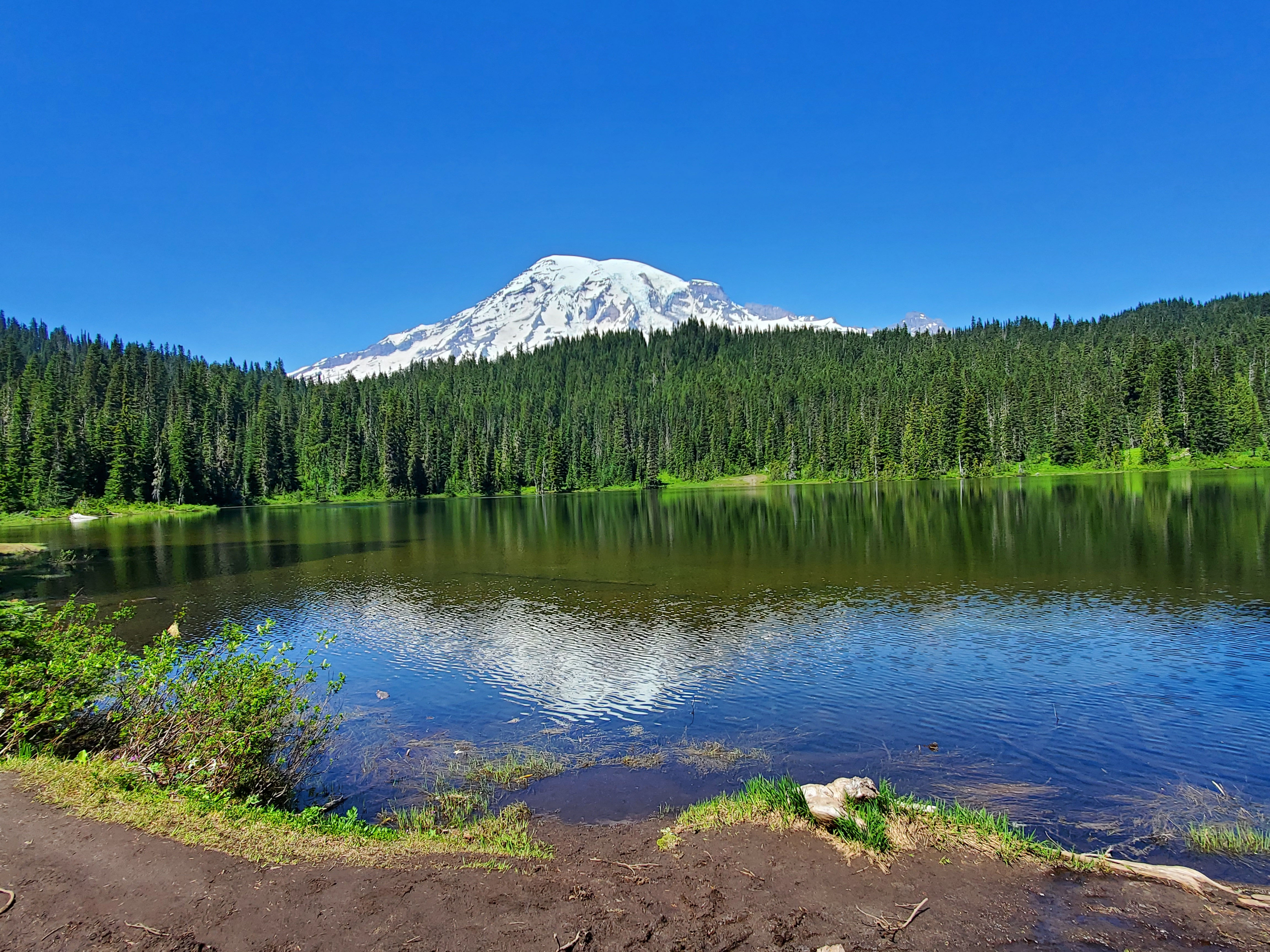
Reflection Lake, Mount Rainier


    The Administrative Office is a large log cabin, looking a bit less dusty than its neighbors.  Inside I encountered a large clean waiting room, blessed air conditioning, and the cutest little ranger you could ever hope for.  Her name was Becca and she hailed from Chicago.  If I had to guess, she had just finished her sophomore year at Northwestern.  As would become apparent, Mount Rainier National Park is staffed with a plethora of well groomed, exceptionally pleasant young adults who are there for the summer.  They work the four month tourist season and possess the minimum amount of required knowledge to get the job done.

Satyr Angelwing under glass.
    I presented our situation, where to find the butterflies, and Becca retired to look in a file cabinet in the adjacent room.  While she looked for a list of butterflies, I looked at her, sharp and petite in her National Park uniform.  After a minute or so, I suggested that she just provide me with her best guess as to where to find wildflower meadows.  She pulled out a map and we enjoyed a moment, during which she made some lines with her pink marker on a map which would guide us to that butterfly mecca and home for the night, Paradise.

   Back at the car, Sandra was ready to do some lepidopterizing.  Although a little older than Becca, Sandra also is petite and comes form Detroit, which is sort of like Chicago.  After a couple years of experience, she knows butterfly habitat when when sees it.  We made the 12 mile drive up to Paradise without seeing much in the way of butterflies or wildflower meadows. Occasional views of Mount Rainier were the star of the show.

Don't grouse about prices at the Paradise Inn,,,its worth it.
    At a bit after 1 PM the parking lot at Paradise was full and we felt lucky to find a spot.  Stepping out of the air conditioned car, we immediately noticed that it was hot.  This shouldn't have been a surprise, since the car told us the outside temperature was 82.  But here we were, a mile high, and shouldn't it be cooler?  The second thing we noticed was that we weren't feeling much like going on a hike.  My beloved was a little short of breath and I was in bigeminy.  Instead of a regular thump, thump, thump, my heart was going ka-dump, ka-dump, ka-dump. Bummer.

    We made the best of our situation by repairing to the inn, which was at least out of the sun, and provided us with a table upon which to eat our lunch and review our materials.  These latter consisted mostly of the book, Butterflies of the Pacific Northwest by Pyle and LaBar and our list taken from the photographs provided by Jeffrey Pippen.  The butterfly wizard from Duke had inspired this expedition with pictures of butterflies taken in 2004.  In a recent exchange of emails,  Jeff wished us good luck, but, as his sole experience on Rainier was in 2004, he had no specific tips.  We did have a list of the species he photographed; he pictures 19 species which you can find on his website at https://www.jeffpippen.com/butterflies/washingtonbutterflies.htm .

A Gray Jay awaits his cake on the Tatoosh Patio.
    After lunch we decided to drive down to Reflection Lake.  There, we sat quietly on a bench and took pictures of the mountain.  When we finally captured an acceptable picture of the mountain and its reflection in the alpine lake, we grabbed our nets and walked back down the lakeside trail.  Immediately we ran into a couple smaller white butterflies, netting one of them.  We got him in the wine glass and identified him as a Spring White.  He never would settle and we don't have any pictures worth showing here.  Soon after that we ran into an flying angelwing, which we missed, and then found one sitting on the forest floor.  While less sporting, it is clearly easier to net butterflies when they are sitting.

    The angelwing in the wine glass eventually settled on Sandra's hand.  We took a couple movies and some still shots through the glass.  The still photos did not turn out well, but two of the movies clearly showed that this was  a Satyr Angelwing, as demonstrated by that double  hooked white comma.  Employing all my patience, and a good deal of luck, I was able to lift the picture you see here from a screen shot of the paused video.  As the butterfly was settled, we took a chance and removed the glass in hopes of getting a picture.  Immediately a small bug hit our butterfly, breaking the spell, and he flew off.  

Myrtle Falls and Mount Rainier
   Although we did not end up with a good picture of the dorsal side of this angelwing, the picture we present here is a very good rendition of the ventral side and provides a crackerjack look at the comma.  The angelwings are difficult to tell apart, even Bob Pyle says so, and the comma, especially in the case of this species is a clear diagnostic mark.   Or in the words of the bard, "The comma is the thing, where in to catch the conscience of the king."

    The Paradise Inn was a great place to spend the evening   After the mob of tourists head down the mountain, you can really spend some quality time with Mount Rainier.  

     The next morning, I was up early to look for animals.  All the trails near the Paradise Inn are paved.  This seems like an expensive way to handle things, for there are a lot of these trails; obviously someone thinks its the best way to preserve the habitat.  On the trail, around 7:30, I spotted a Blue Grouse.  Not the most uncommon bird, but I hadn't seen one in years.  He let me approach within ten feet, but the inferior picture you see here was taken from a bit further away.  

    After my fine morning walk I had the pleasure of giving Sandra coffee in bed and accompanying her down to the Tatoosh Patio, where we enjoyed the lemon cake we had brought with us.  Mid way through a breakfast of cake and nectarines, we enjoyed feeding a few tasty morsels to the resident family of Gray Jays.

   Soon we found ourselves out on the asphalt trail.  It was still early enough that there were only a few hikers joining us and we took turns taking pictures of one another with Mount Rainier, the star of the show.  I made it as far as Myrtle Falls, where a steep flight of steps leads you to the picturesque view you see here.
Callippe Fritillary Butterfly  S. callippe 

    On the way back down, we had a long look at a small blue butterfly.  At this point we had abandoned our nets and he did not land for a photo.  Our best guess is that he was a Silvery Blue, which prefer alpine seeps.

    We were almost back to the lodge when we spotted an anglewing in one of the spruce trees, warming herself in the morning sun. Using the same technique I described earlier, I captured an image from a video and made a still photo, but I thought you might enjoy looking at the butterfly on the gently  swaying branch. so you get eight seconds of butterfly on spruce.

   The four Northwest angelwings are difficult to sort out from the dorsal image, which you see here.  Although we somehow walked away without a photo of the ventral wings, they were not cinder black, the words Bob Pyle uses to describe the Oreas Angelwing.  (The dorsal side of the rare Oreas is virtually identical to the Hoary Comma.) Additionally, the comma was not hooked.  And so will call this handsome beast a Hoary Comma, same as we netted near Bend a month ago.  Curiously, all four of these unusual butterflies might be found above Paradise on Mount Rainier.

Hydaspe Fritillary Butterfly  S. hydaspe

   Soon we were on our way down the mountain.  Having had a successful hunt at Reflection Lake we stopped there first and then headed slowly back towards the main road.  In Jeffrey Pippen's notes, he referenced a spot where he saw several species only at 3 km SW of Paradise.  I had not understood why he was so vague, but now, suddenly I got it.  

    On the side of the road was a patch of wildflowers with a few orange butterflies flitting about.  We stopped and started taking pictures.  In Butterflies of the Pacific Northwest,  Pyle and LaBar list 17 fritillary butterflies (means spots under the wing) that are basically orange dorsally with roughly the same pattern of black lines, which relate to the panels.  Many of these species might be found on Mount Rainier.  In this relatively small patch of roadside wildflowers we photographed three.  It wasn't until we got home and could really get a good look at the pictures that we could sort it all out.

Coronis Fritillary Butterfly, S. coronis
   If you take my advice and look at Jeff Pippen's page of Mount Rainier butterflies, you will find that he, a butterfly wizard in his own right, had Bob Pyle help him with his identifications.

   Watching butterflies is challenging.  Like bird watching,  it gets you out of the house and into intact habitat.  I make a comparison with identifying South American flycatchers, but they were never like this.

  I hope you are able to get out and see something special on one of these warm summer days.

jeff    


They taste even better when you eat them upside down.


Saturday, July 16, 2022

Our First Puddle Party... Looking for Butterflies in Clackamas County

       How many of you use the navigation feature on your cell phone whenever you are heading to an unfamiliar destination?  I used to be a map person.  Before I left home I would study the maps and then, with a little luck, drive to my destination using memory alone.  Not any more.  Now I get close and then ask my lovely companion to turn on the navigation.  Sometimes this works out just fine, but when we are looking for a place that might be reached with obscure country roads, the lady who lives inside my android phone finds them irresistible. 

The Old Railroad Bridge across the Sandy
   Such was the case last week when I had the bright idea to look for butterflies at Bull Run Reservoir.  For those of you who don't live in Portland, the Rose City is blessed with the most delicious drinking water.  This salubrious beverage comes form the watershed of the small Bull Run River that originates in the western foothills of Mount Hood.  A small river in the foothills of the Cascades sounded perfect for butterfly watching.

    We left the I 84 freeway at the Sandy River, just a few miles outside metropolitan PDX.  Sandra hit navigation and we were immediately guided off the beaten path onto a maze of country roads.  After several road changes I had no clear idea where I was;  we were a prisoners of the navigation.  Another ten minutes found us directed onto a road that was signed as a dead end.  Just after that we lost cell phone coverage.

    Following our noses, we wound our way down hill and at 10:30 stumbled across Dodge Park, which nestles in the confluence of the Bull Run and Sandy Rivers.  Considering that it is in the middle of nowhere, this is quite a large park, with lots of picnic tables and grills.  It boasts about a half mile of river frontage, mostly shingle beach with some large patches of fine riverside sand.  

   Dodge Park is named for Frank Dodge, who was the second superintendent of the Portland Water

Ca 1910, Frank Dodge discusses water service to Portland's Chinatown.
Bureau, serving from 1894 to 1914.  In 1911, the Mount Hood Railway and Power Company built a railway line from Montavilla in east Portland to the town of Bull Run. The railway line was built to move materials to the powerhouse at  the Bull Run Hydroelectric Project.  The steam locomotive line served 30 small communities on the way to Dodge Park.

   In 1912, the Portland Railway, Light and Power Company acquired the rail line and converted it to an electric trolley line.  In the 1920s, probably due to this unique access,  Dodge Park was inundated with weekend visitors throughout the summer.

Caterpillar of the Tussock Moth, Dodge Park 2022
    On a sunny Wednesday morning in the summer of 2022, we  had this large park pretty much to ourselves. Selecting a shady parking spot, we grabbed our nets and binoculars and walked down to the Sandy.   At this point it is a small rushing river.  Down stream, we could see the old railroad bridge that a century ago brought supplies to Bull Run.   As we watched, a couple paddled by us in their brightly colored kayak. And among the rocks in the middle of the stream we saw a family of mergansers.  But at this point there were no butterflies.

    We backed off from the river and strolled upstream.  Finding a path down to the river we found willows growing on a sandy bar.  As we walked toward the river a Lorquin's Admiral flew up into the trees.  Suddenly there was a plethora of Tiger Swallowtails in the air. 

    To our surprise, we found a caterpillar clinging to a willow.  Caterpillars are pretty much at your mercy, so we were able to manipulate him onto to twig and get a picture.  We believe this is the caterpillar of the Tussock Moth. this caterpillar is acknowledged to be a handsome animal, but it eats the leaves of the Douglas Fir and at times presents a serious problem in forest management.  Of course, we had no idea what we were looking at, so when the photo session was concluded we put it carefully back in the willow.  

A Puddle Party of Tiger Swallowtails, Dodge Park 2022

    As we passed through the willows we saw a young family enjoying the riverside sand, but even closer we were greeted by a puddle party of Tiger Swallowtails.  As one begins to delve into butterfly lore, he is introduced to two related phenomena.  the first is the puddle party.  If one is lucky, he may happen upon a moist spot where numerous butterflies are resting.  As it turns out, these are mostly male butterflies sucking up water from the moist sand or soil.  The water contains important minerals, such as electrolytes.  It is speculated that male butterflies use up these chemicals in the process of mating and need to replace them in order to mate again. 

    But males have another need for this extra nutrition.  In many butterflies, in the process of mating, in addition to sperm the male inserts nutrients into the female.  These are known as nuptial gifts.  This might be the equivalent of a diamond ring, but are more like a dose of prenatal vitamins.

    If there is a moral to this story, it might be, "When your phone navigation leads you astray, don't be afraid to make the most of it."    And may you have the best of luck wherever life leads you.

jeff

Thanks to Portland.gov for the information on Dodge Park


Wednesday, July 13, 2022

A return to Dougan Falls or Butterfly Catching with Jeffrey

     Having returned from a moderately successful butterfly trip to Central Oregon, Sandra and I regrouped and made a foray to Dougan Falls, which has become our home court for butterflies.  Summer had arrived on the Washougal; spring butterflies, like the

The Lorquin's Admiral
blues and whites, were no longer present.  In their place we found the butterfly community that we experienced in early summer last year.  Now armed with nets and plastic bags, not to mention the morality espoused by Professor Pyle, we took very few home, and we have these pictures to present.

   You will undoubtedly notice that the pictures are not taken on native plants, but rather on the shrubs and stone work adjacent to our condominium.  

    This year we notice that many species of butterflies occur in a range of sizes.  Lorquin's Admiral and Western Tiger Swallowtail were both found in abundance.  From smallest to large, they exhibited what appeared to be a 100% variation in size.  The Lorquin's that we photographed on Dougan Creek last fall was perhaps 50% bigger than the one you see here. 

Lorquin's admiral in resting position
   Sandra is actively posting our butterflies on a blog, which is monitored by Caitlin LaBar, Professor Pyle's junior colleague.  Not long ago one of the participants was speculating on the identification of a butterfly based on size.  Ms. LaBar was all over him for this.  Unlike birds, which have a very narrow range of size difference within a species, butterflies can vary widely.

   Isn't the ventral wing of the Lorquin's Admiral remarkable?  I encourage you, as always , to look at or friend Peter's blog, (Google search One Breath Kohala)  where he has a photograph of a California Sister in similar resting position.  If anything, the ventral surface of that butterfly's wings is even more colorful and complex than the Lorquin's.

   In the case of many butterflies, the ventral surface of the wing is cryptically colored, which makes sense if you are trying to avoid predators, while taking a breather near the forest floor.   I wonder what strategy drove the evolution of this colorful ventral surface?  

    Photographing a subdued butterfly provides some unexpected benefits.  This head on view of a Lorquin's Admiral is amazing, possibly redolent of science fiction.

A face on view of Lorquin's Admiral.


   The Western Meadow Fritillary is widely distributed.  In flight, one is attracted to the citrus orange of the the dorsal wing surface.  However, the pattern of the under wing, with those buttery spots outlined delicately in black, are the best key to identification.

Western Meadow Fritillary shows off his buttery hind wing spots


A Western Meadow Frit, warming up on a shrub


 Clodius Parnassian was now present in significant numbers.   The body of this handsome butterly is rich with yellow hairs, a regular rubio.

Clodius Parnassian


   While we were netting butterflies, at one of our favorite spots in the Naked Falls area, I spotted what I thought was an angelwing / comma on the road.  I took a moment to look at him, which provided the opportunity for escape.  On our next trip to the area, I was hoping for another chance, but it was not to be; the identificaion of this butterfly is  (like the fate of Charlie on the MTA) still unlearned. 

     What we did see, capture and photograph, was a Pale Swallowtail.  You will recall that this species was abundant in Central Oregon.  Perhaps you will remember that we did not see it in Washington in

Pale Swallowtail
2021.  Here you see him warming up on the cement margin of our garden.


   A few days after this trip to the falls, we had the opportunity to spend a  week with our grandson.  We thought Jeffrey would enjoy a look at the falls and the chance to catch a butterfly.  He was able to net a Silverspot Skipper, which appears in abundance on the warm roadway.  At one of the bridges of Naked Falls, we managed to capture him as full fledged lepidopterist.   

     With any luck your experiences out in nature will be as happy as ours.

jeff


Saturday, July 2, 2022

A Tale of Two Commas or Central Oregon Butterflies Part Three

     After four nights with our family, and with an interesting group of butterflies in the bag, Sandra and I headed east to Bend.  Truth be told, we were a little disappointed with our lack success in the Metolius Preserve.  Because of the cold June, spring was creeping in and the explosion of butterflies had yet to occur.  We were hopeful that Tumalo Creek near Bend would provide a spectacular lepidopteran experience.  

Hoary comma, P, gracilis  Tumalo Creek, June 2022

    We arrived at Tumalo Creek about 10 AM Sunday morning.  The sky was blue and the morning warm, and the little river burbled happily less than a fifty yards from where we parked.  This sounds idyllic, right?  Unfortunately Tumalo Creek is the outflow of Tumalo Falls, which is a major tourist attraction.  To reach the falls, you leave the macadam, cross a small bridge and drive hell bent for election five miles down a gravel road.  We were parked in the shade in a pull out with cars racing by and raising dust about once every minute.    

    It was more peaceful down by the creek, where we found two species of blues, Boisduvals and greenish.  The former is quite drab and the latter has the a distinctive pattern of spots, as we discussed previously.  Tiger swallowtails were flying up and down the creek, but not much else on our side.  

    Sandra was getting discouraged, and plagued by mosquitoes, she went to the car for a break.  I went to a small fenced interpretive site which bore three posters dealing with creek restoration.  As I left the area, marked by a handsome split rail fence, a medium sized orange butterfly flew by.  I got lucky and netted him on my first effort.  In fact, he virtually flew into the net.  

Under glass.  Hoary Comma, ventral view with comma.

    In my mind, at least for the next few hours, this would be known as the Golden Swipe, for in the net was a nice big angelwing, satyr or comma, for these peculiar butterflies claim all three monikers.  After netting a butterfly, the lepidopterist grabs the net below his quarry, creating a classic pose.  So as Sandra saw me approaching the car, she popped right out. By this time we had become quite the team, transferring our prize to the wine glass and getting some pictures with the glass resting on a book covered with a blue towel.  

    Following the photo shoot, Sandra gathered the glass and held it on her palm.  To our amazement, the comma settled down on her hand, wings up in resting position.  If one looks at pictures of butterflies on the internet, it is fairly common to see pictures of butterflies on hands.  I suppose we had thought that through incredible serendipity, these butterflies just happened to land on the outstretched hand.  Now we had a more reasonable explanation.  We removed the glass with care and the butterfly remained on Sandra's hand for a minute or more, during which I snapped away.  Look at this fantastic result!  

    After our butterfly flew into the pines, we repaired to Pyle and LaBar and found our critter, the Hoary Comma Butterfly.  Because the angelwings are so visually interesting, I have been making paper mache models of the Green Comma for two years.  I  had not appreciated how different the four species that occur in the Pacific Northwest are.  It was easy to pair the Hoary Comma with the picture in the book.

Abandoned train tunnel on the  Mecca Flats Road.
 

   Off we went to the Bend Holiday Inn Express where we worked on our pictures and prepared for the next day, when we would drive from Bend, over Mount Hood, and on to PDX, hopefully encountering some butterflies on the way.

     Unlike birds, butterflies are late risers.  If one leaves at the crack of dawn he will arrive at his hunting area long before the butterflies set off for work.  Thus we were able to enjoy a leisurely breakfast, leaving Bend around 8:30,  and arriving at Warm Springs around 10 AM.  We had been advised that the Indians in the Warm Springs Reservation were not friendly towards us Caucasians, and were pleased to find that until you cross the Deschutes River, you are not on the reservation.  There is a boat launch right by the road, run by Oregon State Parks.  It is a small area and we saw no butterflies.  However, we did meet a state park employee who gave us a hot tip.  Just before the bridge is a turn off that puts you on a gravel road leading to a BLM campground on the river.  Mecca Flats, he said, is where he goes fly fishing and would be excellent for entomology.  Such a big word for someone cleaning the out houses!

Green Comma Butterfly, P. faunus,  Mt Hood Meadows, June 2022

     Our tour director had added a caveat, "The road looks like something you don't want to drive on." he said.  The implication was that it was OK to drive on the road.  But for us in our Mazda 3, it was, indeed, something  to which we did not want to expose our tires and under carriage; a narrow one lane of sharp rocks on top of a ridge.  We turned around at the first opportunity.  

    Just across the river, on the Warms Springs Reservation, we made a fruitless stop at a wood products company that occupied a charming spot on a creek that emptied into the Deschutes.  Then ensued a long drive over the prairie and into the pine forest that heralds Mount Hood.  Still hoping for one more butterfly, we opted to go to the promising sounding Mount Hood Meadows.   Moist meadows, after all, are frequently associated with western butterflies.  Mount Hood Meadows, on the other hand, is a ski resort, possibly the most popular of these on the eponymous mountain.  At 5,536 feet we found an enormous parking lot and one lift still in operation.  About 200 yards across the car park from the lodge, we found a service road leading into the forest.  

Green Comma Ventral,  Mount Hood Meadows 2022

    Near the car park, we found patches of snow and some moist ground supporting willows.  We saw one orange butterfly in the willows, but he escaped.  Off we went up the service road bordered by Whitebark Pines, tall, beautiful relatives of the ponderosa.  About a hundred yards up the road, Sandra spotted an orange butterfly on a stump.  Binoculars revealed it to be an angelwing.  Our patience was rewarded and he flew down to the road.  We both missed on our first opportunities, but on my third try, chasing willy nilly down the road, I netted him.

   Having transferred him to a plastic bag, we embarked on the drill  Back in the car park, the bright sun created too much glare, so we took our butterfly under glass back into the shady pines.  There we were able to get some adequate pictures.  Then, to our delight, the butterfly perched on Sandra's hand.  As on the previous day we were able to remove the glass and enjoy a minute or so of superb photographic conditions.

    What we had was a green comma, the butterfly I have been modeling for several years.  You can see that his dorsal pattern is very similar, but clearly different, from the hoary.  And if you look carefully, you will note that the "comma" on the ventral wing, is also different.

    What a happy end to our butterfly expedition.

    It is a 35 mile drive downhill from Mount Hood Meadows to Hood River.  About 15 miles above the Columbia, we were treated to spectacular views of Mount Adams.  From Portland / Vancouver, we don't get much of a view of Adams. From this vantage point the mountain is gorgeous.  If you happen to be in Hood river with an hour or so on your hands, a fifteen mile drive up Oregon 35 would definitely be worth your while.  

Mount Adams, June 2022, as seen from Oregon 35  SKG photo

    Long ago, the Great God Sahale, sent three demigods  to Oregon.  There was the beatiful Loowit, and two brothers, Klickitat and Wy'Easat.  The two boys fought over the lovely maiden, creating lava fields of destruction.  Before they could cause more trouble, Sahale turned them into mountains.  Loowit became Mount St. Helens, Wy'East became Mount Hood and Klickitat, was turned into Mount Adams.  Legend from the Multnomah Indians. 

    Fifty years ago, languishing in our unreconstructed darkness, we were unaware of Wy'East.  Now, in this age of enlightenment, it is a common place name in the greater Portland area.  Wy'East Vineyards, above Hood River, is a good place to nab a view of both Mt. Hood and Mt. Adams.

jeff