Saturday, April 16, 2016

April 2016 Life is a beach

   Wednesday dawned bright and blue.  As I sped away from the Kealakehe transfer station, having deposited a trunkful of monstera and hapu'u, which is the Hawaiian name for tree ferns.  This particular cleaning was in preparation for a visit by my last remaining friend from high school, who is the dean of the
Red Shoulder Surgeon Adolescent with Manini  2016
business school at UH Manoa.  As I sped south on the Queen K Highway, I mused on the comparison.  Here is my friend the dean, traveling the world on behalf of UH, while I'm an out to pasture gas passer, spending my days on the beach and making paper mache fish.  Given that we both live in the 50th state, could our lives be more different?  Well, I suppose I could be homeless, but let's hope we don't have to go there.

    Having negotiated the upper reaches of Kailua, I made the turn down Kam III to Kahalu'u.  Always your faithful correspondent, I was hoping to strike up a conversation that would lend itself to some amusing blogging.  Finding a shelter littered with the mundane, I headed into the ocean.

    I had timed my trip to the recycling center, and hence my snorkel, to correspond with the tides.  At 9:30 it was the lower of the two highs, about three quarters of a foot.  Not so high that the waves would wash over the Menehune breakwater and, more importantly, high enough so one could easily slither through the rocky
Imm. Red Shoulder Surgeon  2012
entrance.  Summer is on the way and those of us with tender feet are hoping that the sand entrance will soon be recarpeted with, well, sand.

    Out in the bay, the water was clear and I was soon rewarded with an adolescent Red shouldered surgeon.  The red shoulder surgeon is one of our most common fish and handsomely colored.  The well known adult is two tones of gray, the front two thirds a light gray and the after portion darker.  A long red ellipse is emblazoned just where one might place the shoulder...if fish had shoulders.  This red stripe is remarkably similar in hue to the stripe on the bow of a coast guard cutter.
 
     As it turns out, the red slash, canted 64 degrees forward, was first proposed in 1964 by the industrial design firm of Raymond Loewy / William  Snaith. It may now be revealed that Mr. Snaith,  a navy brat who
Pantone 175
 spent his formative years near Pearl Harbor, was inspired by the shade of red, well on its way to orange, worn so proudly by the red shoulder surgeon..  Officially this color is known as Pantone 179.  Snaith lobbied long and hard for the name, Surgeon Shoulder Red, but the people at the Department of the Navy said enough is enough.  By 1967 all of our Coast Guard vessels were decked out with this inspiring red blaze.

   I, for one, can not remember a time when our coast guard cutters did not bear that red stripe and I secretly thrill every time I see it.  

   The shape of the red ellipse is repeated in a blue surround.  The overall effect is that of the Indianapolis Motor Speedway.  Could this be a coincidence?  The creationist who lives next door claims that God designed all animals, down to the last detail.  Is it possible that the dear good lord is a fan of motor racing?  Food for thought.

Coast Guard Cutter William J. Snaith
    As it matures, the red shouldered surgeon under goes a remarkable transition,  the smallest keikis are the same yellow as the yellow tang, albeit roughly the shape of the mature RSS.  While quite small they acquire the red shoulder patch.  Initially a ghostly outline, the patch becomes more deeply hued as the fish matures.   In this adolescent, we see a a fish that is just emerging from the yellow coat of his childhood and will soon be two tone gray.  If one is observant, he can see the yellow babies commonly in late summer.  To catch a transforming adolescent like this fellow is a rare treat.  I followed him around for a while to catch the photograph you see here.

    For those of you who are playing along at home, I'm including a picture of the adult RSS that I took on the same outing.  Sad to say, as I was reviewing my pictures under the awning at K Bay, I deleted my best effort.  Klutz!  I'm also including a picture of an immature taken in early October of 2012 at Ho'okena.  Sadly, I can not find a picture of the
Saddleback Butterflyfish, C, ephippium   Kahalu'u 2016
extreme immature, lacking the bar or any vestige of the two tone coloring.

   The remainder of this swim yielded two nice buterflyfish pairs.  As you can see, the saddleback butterflies were swiming in bright sun, nibbling tidbits from the rocky bottom.  The Raccoon pair was chilling in the shade of a coral head, one or the other occasionally making a foray out of cover for a bit of tea.  In much of the English speaking world, which is to say that part that is more dependent upon England, per se, for its linguistic traditions, this means a light meal.  Or, at least, such is my conceit.

   We enjoyed our visit with the dean immensely.  On our way down to K Bay the following morning, Sandra announced  (yes, I finally got Sandra to come snorkeling) that it was refreshing to be able to talk intelligently
Raccoon Butterflyfish  C lunula  Kahalu'u 2016

to someone for a change.  She reflected for a moment and then added, "Current company excepted, of course."

   Similar to the day before, there were no worthies to be coaxed into conversation, so we soon found ourselves back in the soup.  The adolescent red shouldered surgeon was not to be found and the pair of saddle back butterflies was similarly absent, but it was a pretty good day for hermit crabs.  Clinging to a coral was a pontifical miter.  Neither Sandra nor I could get him to let loose, so we honored his tenacity and the occupant remains a mystery.

    "How", you may ask, "do you know that there was a hermit crab inside that shell? Would not the legitimate molluscan owner cling tightly to the coral?"   Well.  In our experience as amateur carcinologists, when ever, in these very Sandwich Islands, one encounters a small shell that clearly does not belong where it
For heaven's sake! Don't start pontificating.
is, there is probably a hermit crab inside.  Further, Sandra is fairly confident that somewhere in a box we still possess a pontifical miter shell.  This would be a remnant of the bad old days when we brought hermit crabs back to the aquarium which we kept on the lanai at Alii Villas.  As in this case, sometimes our charges arrived in flamboyant clothes, sort of like Dick Grayson arriving at the Bat Cave.  Once in their new home, they would have to contend with the other hermit crabs, who each night would duke it out for the best shell.  To make a long story short, in the case of Pontifical Miters and hermit crabs, we've got the T-shirt.
Holy Hermit Crabs, Batman!  Can't you make him stop?
    A bit further on, there was a family of Hazlett's hermit crabs wearing a variety of different shells. The pater familias was downright regal in a triton.

    Out near Surfer's Rock we had a close encounter with a large male Ember Parrotfish.  These guys are understandably stand-offish.  When a spear fisherman says he had uhu for dinner, this is probably what he meant.  Ember parrotfish (until rather recently we called them red lipped parrotfish) are perhaps the best tasting of reef fish, surpassing even menpachi, which we know as epaulet soldierfish.  With all this in mind, it was an honor to have this bold fellow pose for a couple pictures.

  Shortly after bidding the parrotfish adieu, I came upon the front portion of a large slipper lobster.  As
Iridescent Fireworms
I dove down to move it to a location more suitable for photography, I found that it was home to a pair of iridescent fireworms, who I assume were dining on the remnants of the lobster.  These worms, who look remarkably like sea going centipedes, did not particularly want to be photographed, scuttling away before I could get a decent picture.  We don't see them very often, so it was a treat in spite of their lack of cooperation.  The  photo of the dorsum of the lobster carapace is dramatically better than the one with the fleeing bristleworms, but they are both interesting.

    Finally (I believe I can hear you say, "Its about time.")  we come to yesterday, where we find our heroes descending the winding, narrow, treacherous road  leading to that hot bed of dengue fever, Ho'okena.  Hard as it is to believe, given the drought that has persisted for more than three months, we are just a few weeks removed from the last reported case of dengue fever on the leeward side of the Big Island, and it is my suspicion the Ho'okena Beach Park remained closed until quite recently. One has to remember, that those Aedes aegypti mosquitoes were probably not relying on fresh rain to supply a breeding ground.  Rather, they were reproducing in residual rain being stored in cisterns such as those the residents of the few dwellings at Ho'okena employ.  One doesn't know if all the A. aegypti mosquitoes have died off.  I feel it is more likely that they were finally denied a fresh human dengue fever carrier for epidemic (read blood sucking) purposes.  Keeping in mind that this is the very same mosquito that spreads the newest international scourge, the Zika virus, I suspect that the Big Island,
Tiger Cowrie,  C. tigris  Ho'okena 2016

especially our favorite beach park, is primed for something dramatically worse than dengue fever.  If one can believe the maps shown on the evening news, A. aegypti lives as far north as San Francisco, so perhaps it is unfair of me to single out the cistern-using residents of Paradise, Ho'okena and Milolii as international criminals.  But to many of us, its pretty clear who is responsible for the prolonged dengue fever epidemic.    

     I moseyed over to the small shelter and occupied a view seat at the makai picnic table.  At the other end was a pleasant young lady from Portland, who was camping.  That she was a camper but better turned out than your author was only mildly embarrassing...I'm used to it.  Sadly, she was just too normal for an amusing blog interview.  While she prepared a papaya,  Sandra and I changed into
our swim wear.  In the process, I noticed that the county has added two camping spots mauka of the
Yellow Tail Coris, transitional adolescent
parking area, thus separate from the beach front sites.  These two sites were occupied while a couple beach front sites remained vacant.  There was no obvious explanation why these people did not choose to camp on the sand. 

     Upland campers aside, we were soon in the water, which was crystal clear.   Swimming along the reef near shore we saw many red labrid wrasses, including one that was transitional to the adult yellowtail coris.  These are always fun and I am threatening to paint one with red and white stripes anteriorly , the posterior will be blue with white stars.  The Patriotic Wrasse!  Good luck finding one on the Fourth of July!

    On a coral nearby I spotted one of the largest cowries I have ever seen.  As you can see, this big boy was nestled into a crevice.  Almost as big as one of those delicious navel oranges that they sell at Costco, he was a tiger cowrie.  According to the Hoover critter book, this cowrie grows larger in Hawaii than anywhere

Plectoglyphodon johnstonianus, the Blue eye Damselfish 2016
else.   I haven't seen this species recently, possibly it was a life cowrie.

    Swimming out to deeper water, we saw a gilded triggerfish.  Despite looking carefully at every congregation of coral, we did not see any angelfish.  Finally we ended up where the reef grows off the end of the old boat landing.  Here the waves sweep in and out; its a perfect place for fish that like a shallow, surging habitat. I had seen some adolescent Blue eye damsels in shore, but here I found one that was willing to hold still and I got a pretty good picture of  this shy yellow fish.

     Looking among some dying coral in a area where the waves were really sweeping through,  I saw a small wrasse that initially reminded me of an ornate in exactly the wrong spot.  In a moment I realized that it was a small five stripe wrasse.  The fish with the fancy face is never large and this one was smaller than most, four
Five Stripe Wrasse, Ho'okena, April 2016

inches at most.  True to character, he swam fast, darting among the crevices in the coral as the surf passed over us.  After taking a few pictures, I was lucky to find him again and show him to Sandra.  Checking my records, I find that I have not seen this fish since January, 2014.

    Ho'okena remains an excellent place to snorkel.  If you can pick a calm day, it provides an easy, sandy entry with superb fish watching.  Just watch out for the skeeters.

    A special thanks to the U.S. Coast Guard and the brave men of Cutter Escanaba.


Ho'okena Pier April 2016   Sandra Gray


Thursday, April 7, 2016

The Hortonville Band and and Update from the Pier

   These days when I go down to Kahalu'u, it's pretty much a toss up whether the people on the beach or the critters in the ocean will be the highlight of the excursion.  Two days ago, Sandra and I made it down to K
 Bay in the morning.  The parking lot was no more full than usual...we found one of the auxiliary spots reserved for locals who realize the the constabulary doesn't actually care about the lines.

   On the contrary, the shelter was packed.  The mass of humanity was not attending a baby luau, but instead was a throng of pale houlies, most of whom were just sitting on the benches, seemingly waiting for something to happen.  The group was distinguished by a large number of sea green towels.  I asked a stout lady a bit younger than myself who was associated with this mass of laundry just what was the deal.  She replied that they were the Hortonville
Marching Band from Hortonville, Wisconsin.  She volunteered that they had marched in the Merrie Monarch parade in Hilo and were now here in Kona for two days.   Looking around, I noticed a bunch of dazed adults sitting at the tables, but there was indeed a plethora of pale adolescents.

    How many people are in the band?"  I asked.  She replied that there were 140 bandsmen on the trip but another 100 adults had come along for the ride.  240 Hortonians? Holy Whoville!

    Before I could finish getting my gear on to head down to the sea, Sandra had returned with this picture.  You can tell that they are bandsmen as they are marching into the water.   If anything distinguished this group from the Badger State, aside from their blue green towels, it was the use of their fins.  Having paid for the rental, they were determined to get their money's worth by wearing them everywhere.  I can only imagine Snorkel Bob throwing up his hands in dismay.
What do you suppose that the band performed at Pearl Harbor?

   Sitting on a rock with my feet in the water, putting on my own relatively ancient fins, I pondered what it must have been like the day the band descended on Snorkel Bob's.  What if there was another customer.  Can you wait just a minute?  How about two hours?

   Swimming in the bay was no more dangerous than usual.  The likelihood of collision was markedly reduced because these Polar Bears (the moniker of the Hortonville High school) apparently can't swim very well.  Or perhaps they just don't like to swim.  At any rate, they mostly stood around in the shallows,  masks pulled up on their foreheads, fins on the rocky bottom.   On the other hand, aside from not actually snorkeling, sometimes standing on the coral, the bandsmen were remarkably well behaved.

    Here is the website for the Hortonville Band with the itinerary:
http://www.hasd.org/Music/Hortonville%20Itinerary%20090215.pdf
Light spotted sea cucumber   H. hilla  (Perhaps)

    As you will note, the kids were subjected to a brutal schedule.  If they looked a little dazed as they stood on the rocks at K Bay, I suppose I can resonate with that.  I mean, who the F*** boards a bus at 5:45 to look at Akaka Falls, marches in a parade at 10:30 and leaves for the volcano at 2?  Seriously?  The itinerary planner at Hawaii State Tours must be a sadist.
 
    The coral standing wasn't limited to the youths.  Out near Surfer's Rock I approached a large female Polar Bear standing on a coral head.  I believe she approached fifteen Wisconsin units.  This method of measuring weight (Wisconsin Units) is employed by snide  medical residents in the cheese making state.  My former colleague, Jim Goeke, reported that the Wisconsin patient
population was much, much larger than the obese of western Oregon.  Hence, according to the disparaging residents back in Madison, they required a different weight scale: Wisconsin Units.

    To be fair, on average the kids and their adult supporters were not any more obese than their peers here in Kona.  A bit pale, perhaps, but no more obese.  Again, to be fair, I've never seen the kids from the Kealakehe High School marching band.  Maybe they, too, are skinny and pale
Beware of Polar Bears

    But I digress.  We left the mother polar bear standing on a coral head with her mask pulled up onto her forehead.  I politely asked her if she could swim, as she was killing the coral.  She replied that she could not, as she was looking for her daughter.  Now I ask you, if you were her chubby daughter, and you were hanging out with 140 of your closest friends following the Bataan death March of Hawaii tours, how likely is it that you would let your mother find you?  The coral never had a chance.

    While swimming, I saw yet another peri-mortem sea cucumber (this one may be the light spotted sea cucumber, H. hilla) and  several Christmas wrasse.  Best of all, I saw the immature of the Blue eye Damselfish, also known as the Johnston Island Damselfish.  This small, furtive fish darted around inside a coral, forcing me to attempt multiple photographs through the fenestrations...with a complete lack of success.  Sadly. this immature is not pictured on the
Immature Beau Brummel sort of like the immature JID
internet, or in Hoover or Randall.  In fact, these two experts make no mention of this phase, despite my (apparently unconvincing) lobbying for his inclusion.   With a blue dorsum, and yellow below, he looks a bit like a Beau Brummel from the Caribbean, a picture of which I am providing here. The immature I see has a little less blue on the dorsum and the yellow is a lighter shade.

  Or it's possible I have experienced a succession of hallucinations over the past twenty years and you should dispatch the men in the little white coats with the large butterfly net to haul me in.

    In researching this blog, I discovered that this species feeds on coral polys, especially cauliflower corals.  With the death of so many pocillipora corals due to high water temperature, we may be seeing far fewer of this handsome species on our shallow reefs. 

    When I returned to shore, poor Sandra was sitting on a table near my gear having been displaced by the ever increasing number of Whos.   She had texted her picture to Bob Hillis, who responded that he was going to get a pair of lace up fins for hiking in the desert.
A bay full of happy Whos!

    Another bus was reported on its way from the King Kam Hotel, where the multitude was lodging (and the origin of those blue green towels) so we beat a hasty retreat.

 The Whos down in Hortonville like loud music a lot.
But the Grinch atop Mauna Kea did not.
He sat on the peak, his ukulele a strumming.
And said, "There must be a way
To keep  Merrie Monarch from coming."

"I hate all the bands with their blustering trumpets.
I despise all the flag girls dressed  up like young strumpets.
And what of the swaying, grass clad hula dancers?
In my learned opinion a telescope is the answer!"

    Who would have guessed that the Grinch was a man of science?   Apparently the Grinch  has given up on  governor Ige standing up to the hula dancers.   Last year, the same Merrie Monarch dancers appeared on KHNL dancing on the top of Mauna Kea, colorful skirts swaying in the thin air, protesting  the 30 meter telescope.   We have probably lost the telescope, but at least we will have the hula dancers. Aloha oy vey.

For those of you who want to see what the poor Grinch is up against, watch this video of the hula dancers from Hilo at the work site:
http://mauinow.com/2015/04/11/video-maui-halau-honors-mauna-kea-amid-tmt-controversy/

    The following morning, yesterday, we got up bright and early and headed down to the King Kam Hotel in hopes of squeezing in another interview or two with the fine citizens of Hortonville prior to thier departure.  I
A Convex Crab in dire straits.

got there around 9:30 and they were gone.  I had just under two hours to kill so I headed down to the pier for a really long swim.

    Shortly after entering the water I happened upon a convex crab.  I doubt that this was the same individual I saw by the pier only a few days before.  He was harboring between a coral and a large rock and was remarkably tolerant of my approach for photographs.  The reason was soon apparent; at least one of his legs was tangled in fishing line.  I attempted to free him with my bare hands, but the line was that stout woven stuff used for leader when you are fishing for whale sharks.

   Failing in my attempt, I swam back to the shore in hopes that one of the swimmers, or the lady who was teaching a well heeled youth to paddle board, might have a blade of some kind.  Of course, this was in vain.  And perhaps it was just as well, because, despite searching for fifteen minutes,  I could not locate the crab. 
Paper mache Potter's Angelfish by the author
What I did find was a large yellow margin moray lurking in one of the nearby coral heads, serving as a reminder that one should approach those rocks and corals with appropriate caution.

    Hoping that my initial effort somehow freed the crab, I swam away.  Attempting to take advantage of the clear water, I searched the reef around the swim buoy for the resident Potter's angelfish.  Not finding him, I swam back to the pier in hopes of seeing the bluestripe butterfly that we spotted a few days before.  Although butterflies often stick around for a week or two, he wasn't there.  I'm including here a picture of a paper mache Potter's Angelfish that I recently completed..feel free to refer to the men in little white coats above.

    Amid the coral I found a fancy green and silver fishing lure, which I retrieved.  It took several attempts to flip the lure up and over the rail, onto the pier.  Appropriately, I was using the hook shot copied from one of the players in the final four.  (Like Mrs Biden, I was cheered by the Villanova victory.)  In the process of hook shooting the lure, I managed to hook one of my fingers.  Now tell me that you are surprised.
Gotta work on that hook shot

    Heading back to the shallows, I found the coral with the yellow margin moray.  I was getting out the camera to attempt a photo when some movement caught my eye.  At the base of an adjacent coral, there was a small  scorpionfishfish.  About three inches, he was chalk white and covered with fringes.  What a treat!  Based on size and shape, I would identify this cute fellow as a Shortsnout Scorpionfish.  John Hoover mentions the pink eye as an additional field mark in separating this species from S. diabolus.   

    I dove twice to get photographs.  I then set the camera to include a flash and dove again.  As I submerged, something raked over me.  Initially I thought I had been hit by a paddle boarder.  Actually, I found myself disentangling  from a dog.  His owner, 20 yards away on the beach, was using one of those sticks to flick a ball past the first swim buoy.  By the time I recovered and decided I wasn't bleeding very much, I was all turned around and could not find this interesting, small scorpionfish again. Hence, I did not get a close look at the presumably pink eye. I did get a really close look at the the dog as he swam by, having retrieved another long throw.  Seeing him coming, I was just able to swim out of his path.  Had I not, I believe he would have dog paddled right into me.

My assailant swimming ashore.
    This is not the first time that I have been clawed by a dog while swimming.  The other time was at the Dog Beach.  What a surprise.  In both instances the dog was retrieving for an owner oblivious to swimmers.  In this instance, the guy was throwing the ball across the heavily used swim lane.  All of which is to say, it probably behooves us fish watchers to be aware of what's happening on the beach.  Neither paddle boarders or dog owners are looking out for us.

    Ashore, I found a  (probably) homeless fisherman under the pavilion maintained on the pier to shade the tourists returning to the cruise ships.  This canvas canopy is one of the fish thrown to the Kailua homeless, at least on days when there is no cruise ship. On a given day you can find a dozen or more reclining in this patch of civic shade by the bay.  The angler was a pleasant fellow and let me photograph the lure, which I assume he will put to good use.  It didn't occur to me to ask him if he had  been greatly inconvenienced by the Hortonville Marching Band. 

jeff

Shortsnout Scorpionfish,   S. brevifrons  Kailua Bay April 2016


Monday, March 28, 2016

An Easter Egg Hunt

  The weather here in Kona has been spectacular, relatively dry with pleasing winds and blue skies.  Saturday night we had dinner on the lanai with friends.  So clear was the sky that we saw a green flash, perhaps only the third that we have witnessed from Casa Ono.  From the standpoint of a green flash, it
The Sand Sea Cucumber  H. arenicola  Kailua Kona 2016
 doesn't hurt that our new neighbor cut down the monkeypod tree that blocked a large portion of our view of the horizon.

   Easter Sunday dawned clear and cool and the Redoubtable SKG and your humble correspondent  made our way to the pier to look for the Easter Coris.  Kahalu'u would have been a virtual lock, but a very low tide was due at 9:43 and Sandra doesn't do low tides at K Bay.  Given that the entrance has been scoured of sand, its hard to blame her.

   We negotiated the traffic, bearing the faithful to mass at St. Michael's and then, to our surprise, had to deal with a large number of recreational swimmers on the Ironman side of the pier.  As it turns out, large numbers of ladies swim on Sunday morning, going out in flights at 8, 9 and 10.  Or so we were informed by a matron of a certain age.   The ladies were there in droves to celebrate the resurrection with a
Bluestripe Butterflyfish  Easter 2016
 vigorous swim. There were certainly a large number of such to contend with as we swam through the cold, clear water.  All collisions were handled with Easterly politeness.

    On the way out, we saw a few fish but no Elegant (Easter) Coris.  We made our turn at the palace.  Immediately I spotted a Sand Sea Cucumber adrift on the sandy bottom in about fifteen feet.  I was able to dive close enough to get the picture you see here.  Along with the Stubborn Sea Cucumber, this makes the second pretty good sea cucumber in a week.   Too bad they need to be in a pre-morbid state for me to get a look.

    As there was no boat traffic on Easter morning, we swam in on the outside of the swim buoys.  Near the orange mooring buoy, I spotted a handsome Potter's Angelfish in about twelve feet.  We were both able to get a good look before he swam under a coral, refusing to reappear.  This is essentially the same spot we saw Potter's two months ago.  Certainly one needs to consider boat traffic before venturing to this portion of the reef, but a glimpse at this handsome angelfish is enticing.

    We swam together to the pier and were treated to a Bluestripe Butterflyfish.  He was swimming around the coral head where we saw the cushion star two months ago, hence he was fairly shallow and he permitted
Convex Crab out for a stroll on Easter morning.
the pictures you see here.  We have seen this butterflyfish near the pier in the past, but it is rather uncommon.  I see less than one a year.

    Shortly after tiring of annoying Mr.Bluestripe, we got the best treat of the day:  a Convex Crab scuttled over the reef right in front of me.  I had the camera in my hand, so I was able to snap a picture before he headed under a rock.  Luckily, he didn't go all the way under the rock, so I was able to dive down and take a couple more photographs with him partially exposed.  This might have been only the second Convex that I have identified; the three white spots are diagnostic. 

    The convex is half the size of the seven eleven crab, the other member of the genus Carpillius that we
Convex Crab hiding out,  Kailua Kona, 2016


 see on the Hawaiian reefs.  Keeping the puffy shape of this genus in mind, it is possible that I have seen a few more and wasn't able to put a name on the crab before he scuttled away.  

    As we swam in, Sandra found a nice Yellowtail Coris in the shallows by a remarkably clod spring.  I don't suppose that we will qualify for the Polar bear Club, but swimming through apatch of 65 degree water will wake you up on an Easter morning.  That was the closest we came to an Easter Chorus on this morning, but I'm sure you will agree that we collected some delightful Easter eggs during our hunt. 


I think I see an Easter Egg in there!


Monday, March 21, 2016

Hanging With Hong

    Lately my brother, who is perhaps the chief inspiration for this literary effort, has been clamoring for another blog.  He is currently laid up in his house just north of Seattle recovering from major knee surgery.
Yellow Tangs at city of Refuge March 2016
We ain't talkin' 'bout no little arthroscopy, either.  He is hors de combat for four weeks.  Suffice it to say, there is nothing like being turned into a virtual shut in to set you to clamoring for a blog.

   With that in mind, the blogmeister and his sweetie have been doing their level best to seek out an adventure worthy of this site.  A few days ago we went to City of Refuge.  We had checked out the surf and tides, timed it perfectly, got a great parking spot and had a pure white bread experience.  The tourists on the beach were friendly enough, the water was calm clear and cool and the fish were about what you would expect. We did see a couple mature Thompson's surgeon and a Thompson's Butterflyfish getting himself cleaned, which might have been exciting five years ago.  Taking pictures of gray fish is a pretty low yield sort of enterprise, so I let it pass.

   One has to wonder if Mr. Thompson, an illustrator for the Bishop Museum, was a particularly drab sort of
fellow.  Obviously he didn't name these fish after himself.  Did some ichthyological wag put Thompson's name on the two dullest reef fish in Hawaii as an inside joke?  You can contemplate this over a bowl of milquetoast.

   The clear water begged for a photo, so I nabbed this group of yellow tangs.   Better than nothing.

    The closest thing we had to a real adventure occurred at the coffee outlet in Napoopoo where we were accosted by the resident flock of chickens.  Ordinarily these chickens are stand-offish; it wasn't why they were so friendly, but we assumed it had something to do with alimentation.   The proprietors were not offering any bakery samples, which we would have gladly purloined for the Fowles (John or otherwise) so I suppose we were as big a disappointment to the brood as City had been to us.

    Struggling to find a story, I went down to the pier two days ago.  Again there were no unusual fish.  In fact, I can pretty much assure you that the blacklip butterfly and the cushion star are no longer in residence.  I did spot this sea cucumber (possibly the Stubborn Sea Cucumber, H. pervicax ) flopping around in the shallows, presumably in a
The Stubborn Sea Cucmber, H. pervicax, Kailua Kona pier 2016
pre-morbid state. We see these lesser known species about once a year, virtually always an individual who has given up the ghost and failed to return to his rubble abode after his nocturnal peregrinations.

    As I got out of the water, I struck up a conversation with a bearded gentleman who was down for a morning dip, no long distance swimming or snorkeling, just hanging in the water.  Years ago he had lived in Kona, but now resides in Los Angeles.  With my new found knowledge of that metropolis, I dared to ask where in LA he lived.  Out in the valley, he said, up against the mountains near San Fernando.  I was able to talk to him about our failed search for Lawrence's Goldfinch in a park not too far from where he lives, fifteen miles being not too far around Los Angeles.  Although I could not remember the name, my description allowed him to name Hansen's Dam.  Sounds like water, but this park is actually a huge complex of  athletic fields surrounded by brush.  We saved the day by crossing the freeway and driving up into the San Gabriels, which were full of spectacular valleys and studded with blooming yucca.  But I digress.

    Well.  All this drivel did not amount to a blog, so yesterday I dutifully repaired to Kahalu'u, after making
Snowflake Moray at Kahalu'u.  Always a pleasure to be seen.
 sure I was not going at low tide. No injured feet for your humble reporter.

    It being Saturday, there was a baby luau occupying the kiosk at K Bay.  At least I assumed it was a baby luau.  There was a bunch of balloons, pink, blue and white, attached to one of the poles, but no posters proclaiming the baby's birthday, no stacks of gifts and only a handful of celebrants.

    Walking around to the ocean side I did run into a baby, a young woman and a man of about my age, the latter two being clearly of the Asian persuasion.  As he plopped the niño in his car seat near my feet, he said, "Excuse me, we have a baby. Our baby!"  and then spoke a phrase or two to the young woman in one of those inscrutable Asian languages.  My first thought was, "You old goat!"  Then, being the friendly amigo that I am, and fishing for a story for the blog, I inquired, "Are you from Japan?"

    "No." he replied.  "Korea....South Korea."  This latter, I assumed, was to reassure me that he wasn't packing a miniaturized nuclear weapon.  Perhaps that wasn't really a baby!  He then went on to say, "But
Submit your vote for the Easter Chorus to Ichthyology Inc.
we live in San Francisco."    I asked if they worked for a company like Google and the young lady replied, "No.  We are in health care."

    As I changed to go into the ocean, we became fast friends.  The man, who is named Hong, is an anesthesiologist, as am I.  The difference being that at 71 he is still working, traveling around the country doing locums jobs, while I, for the past three years, have been a slacker.   His wife is a retired anesthesiologist. And one of his daughters is an anesthesiologist.  And possibly one of his son in laws is one, as well.  Holy Halothane, Batman!

    This whole nest of anesthetists, along with their spouses and children, gradually assembled at the table adjacent to the baby luau, such as it was, and I set off for the sea.  I was in for a disappointment.  Sitting there on the rocks, with my aged derriere in the water, I put on my fins and then, just as I was to plunge into the water, I noticed that I wasn't wearing my mask.   In fact, it was nowhere to be seen.  I recalled, at this
Papa Hazlett's Hermit, Kahalu'u 2016
point, that I had left it on a chair on the lanai in order that it would not be damaged by the fierce Hawaiian sun.

  Well, as we say at the Korean laundry about five blocks up Market Street form Union Square, "No masky, no fishy."   Imagine my chagrin as I reappeared at the table by the baby luau to report my forgetfulness to all my new found friends and depart in disgrace.

   Back at Casa Ono, Sandra took pity on me, we collected the mask and repaired back to Kahaluu.  The family Hong was still there and they bid me good luck as I made it down to the bay.  The water not very cold and cleared as I swam out.  I got a nice picture of a small snowflake moray (perhaps our most handsome eel).  I also nabbed this interesting picture of a male elegant coris.  I am trying to popularize a change in common names for this species, putting  forth Easter Chorus in referece to the cross found on the forehead of the male.
내 블로그를 읽어 주셔서 감사합니다
      Finally I nabbed a mediocre picture of a magnificently  large Hazlett's hermit crab.  It is
always encouraging when one sees an animal that is big enough to  breed.  If this rogue does his duty, there will be another generation of Hazlett's hermits in the offing.  In a way, this is not so different from la familia Hong.  I doubt the hermit crabs will go to medical school or live in San Francisco, but, apparently, that is why God invented Koreans.  South Koreans.

jeff

Monday, March 14, 2016

A Return To Kona or Mind That Burrito

     The morning  after we returned from Mexico, we went snorkeling with our house exchangers.  This was the last morning in Hawaii for Anne and Eric, who had been foiled in their efforts to find some good fish
Anne and Eric Out on the PAR
watching by the persistent high swell.  Lucky for them, I had the best kept secret in my pocket.  Despite the waves battering the coast, it was calm enough on Paul Allen's Reef for the four of us to have a good snorkel.

    At the outset, Anne was determined to explore the area around the end of the pier.  Being raised in New York, she has that "if I can make it there, I can go swimming anywhere!" mentality.  I was reminded of Kozlowski's boy friend in Crocodile Dundee.  He saying, "We don't have any crocodiles, but a fast moving Chevy can sure make a mess out of ya."  My opinion is that those UFO boats that come zipping in to the pier with their rubber nosed parasailors can give a fast moving Chevy a run for its money in a New York minute.  Luckily, Eric was able to prevail upon his bride and we
Stripebelly Puffer, Kahalu'u  March 2016
swam together out to the reef.  The fish watching was pretty much the usual suspects, but if you have been stuck on shore for a week or so, the routine swim out on the PAR is undoubtedly pretty impressive.

   I would like to report that we all made it back to Casa Ono unscathed.  But I wasn't even close to being over the URI that I contract on virtually every airplane trip.  Just after crossing the threshold, I collapsed in bed.  I fear that my swim buddies were a bit horrified by this relapse.  A couple hours later I returned to the land of the living long enough to get them to KOA.   By all accounts our good friends and snorkeling buddies are once again safely ensconced on the rain soaked slopes of Mount Tabor in the Rose City.

    It took a couple weeks, but the swell finally subsided and my immune system won the battle with that tenacious virus.  So at long last, this week we went swimming.  My first outing was to Kahalu'u.  Before
Coral Blenny female,  Kialua Kona Pier March 2016
going in, I was able to secure a report that squid were seen in the bay about two weeks ago.  What I discovered first hand was that all the sand has been scoured form the sand channel, making entry here more uncomfortable than ever before.  Sadly, I saw no squid.  The only thing of note was a brief look at a handsome stout moray.  A large stripe belly puffer was the most interesting denizen I found to photograph.

    A day or two later, I talked Sandra into going swimming with me down at the pier.  The water at K Bay had been surprisingly warm, but we were shocked back to reality as we entered the frigid water at the pier.  The people we met while getting ready to swim had boasted about the clarity and, indeed, the water was remarkably clear.  Swimming out there was precious little to photograph.  Back in by the pier, however, I found  a few animals to admire in the clear water.  A female
Bling!
coral blenny  was begging to have her picture taken.  The coral blenny used to be called the short bodied blenny and it was fairly unusual to see one.  Now on both sides of the pier it is a very common fish.  Last summer, our friends the DeLukes impressed me with their pictures of this odd fish, one that is easy to see but darts for cover when you point a camera at it.  As one usually takes a photograph of this fish from above (it darts away when you try to take a picture from below the surface) I often end up with some odd looks.  Let your eyes go out of focus and see if you can find some other image lurking within those spots. 

    A few minutes later I saw a nice sponge clinging to the base of the pier.  And right beside the sponge was fine bit of bling for my honey.  Sandra is usually the one who finds things, most recently a crisp (well, actually soggy) twenty dollar bill.  Imagine my pride when I presented her with this lovely bracelet bedecked with frolicking honus.  She tried it on and remarked that it
Oval Butterflyfish, Kailua Kona March 2016

was large and that was why it had slipped off a wrist and into the sea.  I commented that it was perhaps made large to fit on the wrist of Bruce Jenner or one of his ilk. 

    I swam around a bit more, hoping to find the cushion star.  (Neither the starfish nor the blacklip butterflyfish was seen this day.)  As I was paddling slowly,  I was approached by a slow moving pair of Oval butterflyfish.   This is hardly an unusual fish on the Ironman side of the pier.  But it is always one step ahead of me, swimming just out of range as I attempt a photograph.  Here I had two oval butterflyfish radiating that inner glow and posing just a few feet away in clear water.  Suffice it to say, I'm very pleased with the resulting picture.

   The word from the PNW is that things are cold and raining.  Sandra and I wish you were all here with us  to enjoy the best weather on the planet as winter comes to an end.      

jeff


Tuesday, February 9, 2016

On the Trail of Los Chilenos

        Having been overcome by island fever,  Sandra and I are spending this week in Mexico.  In this instance, the trip is centered around a certain event, the four or five days preceding lent, known through much of the world with a Roman Catholic influence as carnaval.  

    Back in the Land of Bobby Jindal, carnaval is known as Mardi Gras.   On both the Pacific and  Gulf
The Author and Sergio, Art Restorer
coasts of Mexico,  most remarkably Mazatlan and Veracruz, it bears a striking resemblance to the famous carnaval of Rio de Janiero.  Or so we are told.

    In the Mexican highlands, there is a different tradition.  Dating back 200 years, to a time when the blancos held the high hand on most of the indigenous population, some of the uppity Indians in Xochimilco took advantage of a loosening of class differences associated with carnaval.  They wore masks and poked fun at their European masters.  Over the subsequent centuries, this parody has been refined, especially in the state of Morelos, south of Mexico City, to the carnaval of the Chinelos. 

    The word chinelos is derived from a nauhatl word meaning disguise. (Nauhatl is the language of the Aztecs, which is taught and spoken among their descendents.)   There are perhaps five pueblos in Morelos
Sr. Brady dice, "Jesus Christ!"
 where village revs up for carnaval with the chinelos being the focal point of the event.  Latter day Chinelos have a stylized costume comprised of a robe and a mask that imitates the European landowners of the 17th Century.   Apparently these guys wore colorful capes, pointy beards and tall hats in the shape of an inverted cone. 

    Being a literary fellow, my preparation began with a book, specifically the Lonely Planet guide to Mexico City, which includes outlying communities such as Cuernavaca and Tepoztlan.   Published in 2008, each year it becomes a bit more out of date.  In this instance, the book suggested that the Chinelos of the outlying communities made their way into Cuernavaca during the week of carnaval, thus sparing the less adventurous traveler the trouble of going to the small, primitive villages. 

    Before accepting this premise, I attempted to verify the information.  If I truly spoke  Spanish  and was
Our new friends, Daira, Samara and Japhet
 willing and able to call Mexico, I might have phoned the chamber of commerce in Cuernavaca, assuming that such exists.  As a substitute, I attempted to phone the Holiday Inn Cuernavaca using a number that I found on line.  I suspected that the guy who answered the phone at that Americanized hotel would speak English better than I spoke Spanish.  What I got was a central Holiday Inn number.  A man with a German accent was unable to connect me to the hotel, but put me on hold while he called the hotel in central Mexico and posed my question:  Does the Carnival occur in Cuernavaca and are the carnaval activities close to the hotel?

    After a modest hold, he returned to say that the person at the Mexican hotel said that carnaval did take place in Cuernavaca, but the activities were not walking distance to the Holiday Inn.  However, the hotel
Here comes the band
would provide transportation. He went on to say that he couldn’t understand the concierge in Cuernavaca very well, as he spoke with a Spanish accent.

     “Where are you located?”  I queried.  To which he replied, “I am in Delhi, sir.”

    So at this point we had information obtained by an Indian (spots not feathers) who was taught English by someone from Germany, communicating with a man in central Mexico who might not speak English very well at all.  And most definitely not with a Hindu accent. Perfect.

    Well, the rest is history and a couple days ago we ended up at a really nice little hotel in the historic center
Every Little Chinelo Deserves Such a Mother!
 of Cuernavaca.  By this time we had ascertained that if carnaval was ever celebrated in Cuernavaca, that was not currently the case.  Not even to the smallest degree.  To see the Chinelos, we would have to travel to Tepoztlan, about twenty kilometros from Cuernavaca.

    On our first day here in the City of Flowers, we visited the Museo Brady.  Robert Brady was an American artist of some considerable means.  He settled in Cuernavaca in a large home that backs on to the catedral.  He then proceeded to paint the rooms in bright colors  and fill them with art which he collected while traveling the world.  Hence, this large home has been converted into a delightfully eclectic museum.  The ante room to the master suite is the Crucifix Room, the guest bedroom is the Oriental Room., there is green bathroom full of ceramic frogs.  It goes on and on.

    While at the Brady Museum, we met two people that provided further information about the carnaval in Tepotzlan.  The first was Sergio, a long haired artistic type who was the only person employed by the Brady
Hola, Amigos!  Its Carnaval con Chilenos y Tequila!
 Museum who spoke a word of English.  Although Sergio had never been to Tepoztlan to see the carnaval (it just didn’t interest him) he had some useful insights.  It was his impression that the carnaval would be preceded by a mass which would end at 4 PM.  Following the religious ceremony, the Indios would pour forth from the church and head to the carnaval.  If this were true, we wouldn’t need to arrive before three,
with the intent of doing some sight seeing and shopping prior to the appearance of the Chinelos.

    A short while later, Sandra cornered two charming girls for a photograph in the Oriental Room.  Their father was pleased to have them talk with us as they were learning English.   At the end of our museum tour we joined  Daria and Samara at a table in Sr. Brady’s courtyard.  The girls, remarkably poised at 7 and 9, study music, piano and flute
 respectively,  in addition to English and they clearly enjoyed taking pictures.  Their father, Japhet, named after Noah’s son, was well spoken and exceedingly friendly.  Although he had been to Tepoztlan, he chose not to go to the carnaval because of the associated drunken, rowdy behavior. He agreed that this was most likely to occur later in the evening.

     In the process of settling in to our hotel, the Villa Bonito les Terasses, we met Mario, the owner and manager.  Born in Colombia, he grew up in San Francisco and Orlando.  He agreed that arriving in Tepoztlan later in the afternoon would be a good plan.  Further, he offered to drive us there and pick us up for 500 pesos.  This may sound like a lot of money, but the current exchange rate at MEX was 17.15 per USD.  One does not need to be especially skilled at arithmetic to deduce that this is less that $30.  To have this service provided by a dependable friend was almost too good to be true.  Furthermore, although he
Chinelos Dance in the Zocalo
 had not been to the carnaval, he was fairly certain that the proceedings would be quite safe and there was little likelihood of violence of any kind.

   Yesterday at 2 PM we took off with Mario driving us in his comfortable Nissan Pathfinder.  By 2:40 we were in Tepoztlan, Mario driving the back streets to provide us with the best view of the piramide.  This particular piramide is about 1,000 feet up on the cliffs.  mario invited us to wonder how the Aztecs, or more likely their minions, got the stones all the way up to the top of the mountain.  Nobody knows.

   He dropped us off with intent of seeing us back at the entrance to the village at 7 PM.  Before starting our site seeing, we stepped into a tiny restaurant where the hostess/ chef served quessadillas for 15 pesos.  We
 ordered two, but before she could get them out of the pan, we heard a brass band.  We ran out into the street to see a band warming up a block up hill and a family preparing their chinelo costumes.

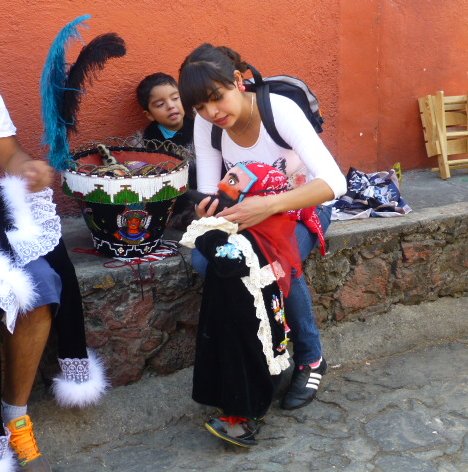
   As the father donned his mask, his lovely wife was dressing their toddler.  At first he didn't like it, throwing off the headgear, but mama outlasted him.  As the band approached, father and son took their place behind.  Chinelos began appearing in the street.  Soon there were twenty or so behind the band, with young men holding banners leading the way.

   At this point Sandra was befriended by a gentleman who insisted on pouring her a tequila and sprite while exhorting the joy of carnaval and los chinelos.  When it became apparent that she was associated with a
Nice Seeds!  (This one's for you, Don, you dirty old Indian!)
certain hombre, he had his assistant pour me a tequila, as well.  We put our arms around each other and shouted,"Amigos!" while the redoubtable SKG took a photo from a safe distance.  No fondling these love handles tonight, bucko.     

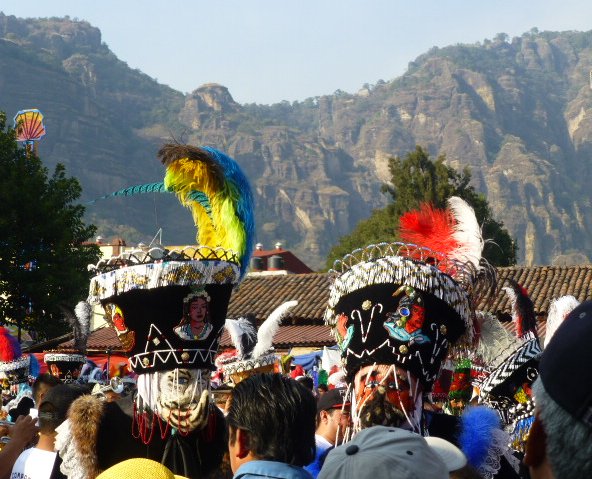
    Sipping on our ersatz margaritas, we walked up the street with the band and the chinelos, which every now and then absorbed a new comrade.  There were thirty or forty chinelos in front of us and then suddenly there were none.  We looked around and listened, finally hearing some band music coming from the far side of a midway.  Walking through, we came to a balcony overlooking the zocalo.  Below were gathered between 150 and 200 chinelos and four brass bands.

    Before embarking on our journey, I had found a youtube video of the chinelos in Tepoztlan.  it showed roughly two dozen men and one child dancing a shuffling step under an awning on a dusty street.  Nothing
The Oldest Chileno
 had prepared me for this spectacle.  While the brass bands played their dancing song over and over, the chinelos hopped, shuffled and twirled.   The entire zocalo was full of them.

     Clearly the town has grown.  Our source in the pulqueria said that there are now 20,000 potential chilenos living in the puebla magica of Tepoztlan.  Its not clear if you need to be invited to be a chileno.  I doubt that just anyone can whip up a costume and join in uninvited.  It was clear from the divisions and the bands that there were four groups, perhaps representing four parishes.  And no parish was to be outdone by the other, either in noise of their band, twirling and jiving or, especially, endurance. 

   We made our way down and took  a bunch of photos.  One might have thought that the music would stop and the party would become less organized.  But it did not.  A band might stop for a minute, but begin again
Frosty the Chileno, Had a Very Shiny Beer ...
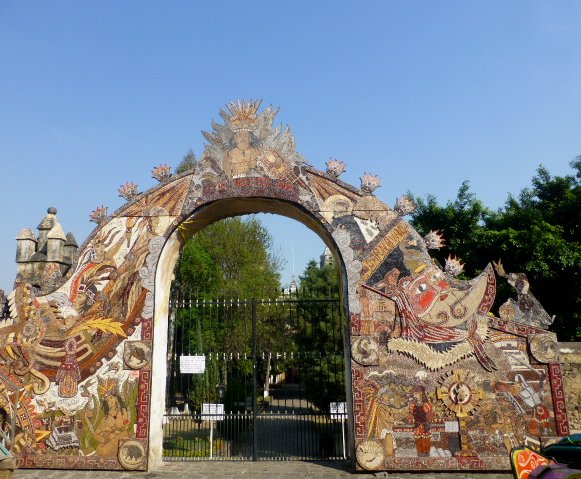
 shortly, and the chinelos danced and danced.  After about fifteen minutes,  Sandra and I took a break.  On the opposite side of the zocalo stands the catedral in a large wooded complex.  the church was not open, but the famous sign depicting the Carnaval de Teopztlan surmounted the cathedral gate.  This sign is made of attached seeds and is re-created with fresh seeds each year.  We rested, photographed the festival gate and then rejoined the dancing, which had gone on unabated.  We met an older gentleman, just donning his chinelo costume.  In by the dancing, I photographed a chinelo who had dropped out, albeit after half an hour of non stop dancing, to share a few frosties with his friends.  Cerveza Corona, breakfast of Chinelos.

   After about forty minutes, the ropes were let down and we were permitted to enter and dance with the chinelos.  We danced for a while, took some more pictures and retired back up onto the main street.  Food
Chinelos in the Zocalo Dance Beneath the Cliffs
booths, novelties and midway games lined the street for its entire length.  It was barely less noisy than the zocalo.  Even some of the chinelos had had enough; we saw a few walking the street, hat and mask in hand.

    Deciding that we had accomplished our goal, at a little after five we called Mario, who said he would pick us up in an hour.  Just as we were wondering where we might go for that period, a young man offered us a sample of pulque.  It was delicious, so we repaired into the pulqueria where we purchased a half liter of the pinon pulque.  It tasted vaguely of strawberries,  Made from agave and only slightly alcoholic, it was delicious.  and the peaceful pulqeria was the perfect spot to decompress after our dance with the chinelos.
You can tell by our costumes that we are Chinelos.  If you had a costume you could be a Chinelo, too!


Thursday, February 4, 2016

The Benefits of Jellyfish

   Yesterday I was dropped off for an afternoon swim while Sandra went shopping.  As I made my way down to the pier I spied a strand of danger tape across the steps down to the little Ironman beach.  I was
The cushion starfish in its new location.
 expecting that there was some physical problem.  Perhaps a tsunami had snuck in unbeknownst and taken out the steps.  But, no.  A piece of paper attatched to the yellow and black tape advised, "Danger!  Jellyfish! Swim At Your Own Risk."

     One thing was for sure, without my cell phone, I was going to be at the pier for the next hour and a half.  Luckily, there was a young lady stripping off her wetsuit who informed me that she had just swum a mile, presumably out past the Royal Kona Resort, and had not seen any jellyfish.  She reported that some people had seen some box jellyfish out on the other side, by which she meant Paul Allen's Reef.

    With that encouraging information, I completed my preparation and made my way under the danger tape, careful not to dislodge the admonishing piece of paper, and down to the water.  It was extremely peaceful there.  No children were engaged in sand fights.  No novice paddleboarders flapped and fell.  No adolescent couples were engaged in their flirtations.  Only a couple of thirty somethings from New Zealand were there.
A Polynesian Halfbeak Swims the bay oblivious to jellyfish
 And they were leaving.  As they strolled out of the sea, the young man reported that they had not seen any jellyfish.

    I was truly alone on the beach.

    As I put on my fins, the Bodyglove set to sea, full of tourists huddled high above the dangerous waters.  Now I was truly alone.  Watching carefully for jellies, I swam through some remarkably clear water.  In fact, the clarity was better than it had been for a while and I was hopeful that, jellyfish not withstanding, this might be a day for a good photograph.  Or two.

    First thing, I swam beneath the floating line and out to the spot where we have seen the cushion star.  He was a bit deeper, but basically in the same spot, opposite the light post where the tenders from the cruise ships dock.   One never really knows how much an animal like that moves around.  In the case of this particular starfish, about three
Shortnose Wrasse, Kailua Kona February 2016
 feet in the course of five or six days. During this time, two cruise ships have come with multiple tenders delivering scores of tourists.  (As the local economy apparently depends heavily on these worthies, my editor forbids me to refer to them as sea going rats.)  Regardless, the starfish appears unaffected by this maritime  activity.

    Having photographed the sea star (again) I made my way back toward the swim area where I caught up with a school of polynesian halfbeaks.  They permitted me to get fairly close and I was lucky to get the picture you see here.

    As there were still no jellyfish to scare me away, I swam out to the first orange mooring buoy.  You will recall that the day we found the cushion star I also spotted a Potter's Angelfish and a shortnose wrasse in the vicinity of this buoy.  I believe those species will stick around in a location for weeks, but the last time I
Hidden Hermit Crab, Ca. latens,  February 2016
 checked, I found neither of these individuals.  It took a few minutes, but the shortnose wrasse finally made an appearance.   I dove several times in about ten feet of delightfully clear water, coming up with the picture you see here, possibly my best picture of this handsome fish.  As we have mentioned before, the shortnose is not extremely uncommon,  If one is observant, he can hope to see one or two individuals in a year.  However, I was really lucky to catch this guy in clear water on the day the jellyfish cleared out Kailua Bay.

   As I was diving the shortnose, I saw a few hermit crabs on the coral.  Diving down and holding on I finished off the day with this nice picture of a Hidden Hermit Crab who had taken up residence in a small triton shell.  So ornamented is the triton that you might mistake the hermit for Aunt Winifred on Easter morning.  Or possibly the queen at Ascot.  One needs to remember that both this
Look carefully for the tentacles
species and guamensis have that black band with a constellation of white spots on the claw.  The Guam hermit crab is introduced while this slightly more uncommon hermit is a native.  This guy was obliging, and when plucked from the coral, he poked his head out and said hello.


   On the way in I did not see any jellies, but I did notice a couple of those jars (so handy for consuming potent potables) in which they are sold up the hill at Safeway.  I leave it up to cousin Don to photoshop a jelly jar bearing the likeness of a box jellyfish.  Smucker's Box Jellies, its got a real sting to it.

jeff


Being a hermit crab, I'll have my Scotch on the rocks. 
And if you don't mind, bring it one of those handy little jars.