Monday, March 21, 2016

Hanging With Hong

    Lately my brother, who is perhaps the chief inspiration for this literary effort, has been clamoring for another blog.  He is currently laid up in his house just north of Seattle recovering from major knee surgery.
Yellow Tangs at city of Refuge March 2016
We ain't talkin' 'bout no little arthroscopy, either.  He is hors de combat for four weeks.  Suffice it to say, there is nothing like being turned into a virtual shut in to set you to clamoring for a blog.

   With that in mind, the blogmeister and his sweetie have been doing their level best to seek out an adventure worthy of this site.  A few days ago we went to City of Refuge.  We had checked out the surf and tides, timed it perfectly, got a great parking spot and had a pure white bread experience.  The tourists on the beach were friendly enough, the water was calm clear and cool and the fish were about what you would expect. We did see a couple mature Thompson's surgeon and a Thompson's Butterflyfish getting himself cleaned, which might have been exciting five years ago.  Taking pictures of gray fish is a pretty low yield sort of enterprise, so I let it pass.

   One has to wonder if Mr. Thompson, an illustrator for the Bishop Museum, was a particularly drab sort of
fellow.  Obviously he didn't name these fish after himself.  Did some ichthyological wag put Thompson's name on the two dullest reef fish in Hawaii as an inside joke?  You can contemplate this over a bowl of milquetoast.

   The clear water begged for a photo, so I nabbed this group of yellow tangs.   Better than nothing.

    The closest thing we had to a real adventure occurred at the coffee outlet in Napoopoo where we were accosted by the resident flock of chickens.  Ordinarily these chickens are stand-offish; it wasn't why they were so friendly, but we assumed it had something to do with alimentation.   The proprietors were not offering any bakery samples, which we would have gladly purloined for the Fowles (John or otherwise) so I suppose we were as big a disappointment to the brood as City had been to us.

    Struggling to find a story, I went down to the pier two days ago.  Again there were no unusual fish.  In fact, I can pretty much assure you that the blacklip butterfly and the cushion star are no longer in residence.  I did spot this sea cucumber (possibly the Stubborn Sea Cucumber, H. pervicax ) flopping around in the shallows, presumably in a
The Stubborn Sea Cucmber, H. pervicax, Kailua Kona pier 2016
pre-morbid state. We see these lesser known species about once a year, virtually always an individual who has given up the ghost and failed to return to his rubble abode after his nocturnal peregrinations.

    As I got out of the water, I struck up a conversation with a bearded gentleman who was down for a morning dip, no long distance swimming or snorkeling, just hanging in the water.  Years ago he had lived in Kona, but now resides in Los Angeles.  With my new found knowledge of that metropolis, I dared to ask where in LA he lived.  Out in the valley, he said, up against the mountains near San Fernando.  I was able to talk to him about our failed search for Lawrence's Goldfinch in a park not too far from where he lives, fifteen miles being not too far around Los Angeles.  Although I could not remember the name, my description allowed him to name Hansen's Dam.  Sounds like water, but this park is actually a huge complex of  athletic fields surrounded by brush.  We saved the day by crossing the freeway and driving up into the San Gabriels, which were full of spectacular valleys and studded with blooming yucca.  But I digress.

    Well.  All this drivel did not amount to a blog, so yesterday I dutifully repaired to Kahalu'u, after making
Snowflake Moray at Kahalu'u.  Always a pleasure to be seen.
 sure I was not going at low tide. No injured feet for your humble reporter.

    It being Saturday, there was a baby luau occupying the kiosk at K Bay.  At least I assumed it was a baby luau.  There was a bunch of balloons, pink, blue and white, attached to one of the poles, but no posters proclaiming the baby's birthday, no stacks of gifts and only a handful of celebrants.

    Walking around to the ocean side I did run into a baby, a young woman and a man of about my age, the latter two being clearly of the Asian persuasion.  As he plopped the niño in his car seat near my feet, he said, "Excuse me, we have a baby. Our baby!"  and then spoke a phrase or two to the young woman in one of those inscrutable Asian languages.  My first thought was, "You old goat!"  Then, being the friendly amigo that I am, and fishing for a story for the blog, I inquired, "Are you from Japan?"

    "No." he replied.  "Korea....South Korea."  This latter, I assumed, was to reassure me that he wasn't packing a miniaturized nuclear weapon.  Perhaps that wasn't really a baby!  He then went on to say, "But
Submit your vote for the Easter Chorus to Ichthyology Inc.
we live in San Francisco."    I asked if they worked for a company like Google and the young lady replied, "No.  We are in health care."

    As I changed to go into the ocean, we became fast friends.  The man, who is named Hong, is an anesthesiologist, as am I.  The difference being that at 71 he is still working, traveling around the country doing locums jobs, while I, for the past three years, have been a slacker.   His wife is a retired anesthesiologist. And one of his daughters is an anesthesiologist.  And possibly one of his son in laws is one, as well.  Holy Halothane, Batman!

    This whole nest of anesthetists, along with their spouses and children, gradually assembled at the table adjacent to the baby luau, such as it was, and I set off for the sea.  I was in for a disappointment.  Sitting there on the rocks, with my aged derriere in the water, I put on my fins and then, just as I was to plunge into the water, I noticed that I wasn't wearing my mask.   In fact, it was nowhere to be seen.  I recalled, at this
Papa Hazlett's Hermit, Kahalu'u 2016
point, that I had left it on a chair on the lanai in order that it would not be damaged by the fierce Hawaiian sun.

  Well, as we say at the Korean laundry about five blocks up Market Street form Union Square, "No masky, no fishy."   Imagine my chagrin as I reappeared at the table by the baby luau to report my forgetfulness to all my new found friends and depart in disgrace.

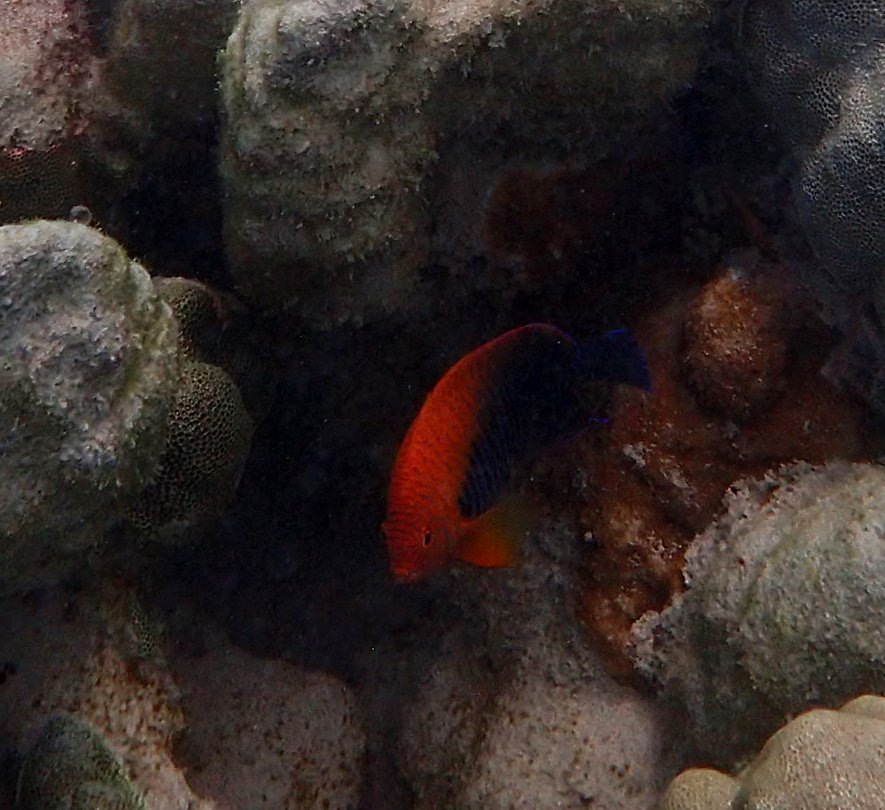
   Back at Casa Ono, Sandra took pity on me, we collected the mask and repaired back to Kahaluu.  The family Hong was still there and they bid me good luck as I made it down to the bay.  The water not very cold and cleared as I swam out.  I got a nice picture of a small snowflake moray (perhaps our most handsome eel).  I also nabbed this interesting picture of a male elegant coris.  I am trying to popularize a change in common names for this species, putting  forth Easter Chorus in referece to the cross found on the forehead of the male.
내 블로그를 읽어 주셔서 감사합니다
      Finally I nabbed a mediocre picture of a magnificently  large Hazlett's hermit crab.  It is
always encouraging when one sees an animal that is big enough to  breed.  If this rogue does his duty, there will be another generation of Hazlett's hermits in the offing.  In a way, this is not so different from la familia Hong.  I doubt the hermit crabs will go to medical school or live in San Francisco, but, apparently, that is why God invented Koreans.  South Koreans.

jeff

Monday, March 14, 2016

A Return To Kona or Mind That Burrito

     The morning  after we returned from Mexico, we went snorkeling with our house exchangers.  This was the last morning in Hawaii for Anne and Eric, who had been foiled in their efforts to find some good fish
Anne and Eric Out on the PAR
watching by the persistent high swell.  Lucky for them, I had the best kept secret in my pocket.  Despite the waves battering the coast, it was calm enough on Paul Allen's Reef for the four of us to have a good snorkel.

    At the outset, Anne was determined to explore the area around the end of the pier.  Being raised in New York, she has that "if I can make it there, I can go swimming anywhere!" mentality.  I was reminded of Kozlowski's boy friend in Crocodile Dundee.  He saying, "We don't have any crocodiles, but a fast moving Chevy can sure make a mess out of ya."  My opinion is that those UFO boats that come zipping in to the pier with their rubber nosed parasailors can give a fast moving Chevy a run for its money in a New York minute.  Luckily, Eric was able to prevail upon his bride and we
Stripebelly Puffer, Kahalu'u  March 2016
swam together out to the reef.  The fish watching was pretty much the usual suspects, but if you have been stuck on shore for a week or so, the routine swim out on the PAR is undoubtedly pretty impressive.

   I would like to report that we all made it back to Casa Ono unscathed.  But I wasn't even close to being over the URI that I contract on virtually every airplane trip.  Just after crossing the threshold, I collapsed in bed.  I fear that my swim buddies were a bit horrified by this relapse.  A couple hours later I returned to the land of the living long enough to get them to KOA.   By all accounts our good friends and snorkeling buddies are once again safely ensconced on the rain soaked slopes of Mount Tabor in the Rose City.

    It took a couple weeks, but the swell finally subsided and my immune system won the battle with that tenacious virus.  So at long last, this week we went swimming.  My first outing was to Kahalu'u.  Before
Coral Blenny female,  Kialua Kona Pier March 2016
going in, I was able to secure a report that squid were seen in the bay about two weeks ago.  What I discovered first hand was that all the sand has been scoured form the sand channel, making entry here more uncomfortable than ever before.  Sadly, I saw no squid.  The only thing of note was a brief look at a handsome stout moray.  A large stripe belly puffer was the most interesting denizen I found to photograph.

    A day or two later, I talked Sandra into going swimming with me down at the pier.  The water at K Bay had been surprisingly warm, but we were shocked back to reality as we entered the frigid water at the pier.  The people we met while getting ready to swim had boasted about the clarity and, indeed, the water was remarkably clear.  Swimming out there was precious little to photograph.  Back in by the pier, however, I found  a few animals to admire in the clear water.  A female
Bling!
coral blenny  was begging to have her picture taken.  The coral blenny used to be called the short bodied blenny and it was fairly unusual to see one.  Now on both sides of the pier it is a very common fish.  Last summer, our friends the DeLukes impressed me with their pictures of this odd fish, one that is easy to see but darts for cover when you point a camera at it.  As one usually takes a photograph of this fish from above (it darts away when you try to take a picture from below the surface) I often end up with some odd looks.  Let your eyes go out of focus and see if you can find some other image lurking within those spots. 

    A few minutes later I saw a nice sponge clinging to the base of the pier.  And right beside the sponge was fine bit of bling for my honey.  Sandra is usually the one who finds things, most recently a crisp (well, actually soggy) twenty dollar bill.  Imagine my pride when I presented her with this lovely bracelet bedecked with frolicking honus.  She tried it on and remarked that it
Oval Butterflyfish, Kailua Kona March 2016

was large and that was why it had slipped off a wrist and into the sea.  I commented that it was perhaps made large to fit on the wrist of Bruce Jenner or one of his ilk. 

    I swam around a bit more, hoping to find the cushion star.  (Neither the starfish nor the blacklip butterflyfish was seen this day.)  As I was paddling slowly,  I was approached by a slow moving pair of Oval butterflyfish.   This is hardly an unusual fish on the Ironman side of the pier.  But it is always one step ahead of me, swimming just out of range as I attempt a photograph.  Here I had two oval butterflyfish radiating that inner glow and posing just a few feet away in clear water.  Suffice it to say, I'm very pleased with the resulting picture.

   The word from the PNW is that things are cold and raining.  Sandra and I wish you were all here with us  to enjoy the best weather on the planet as winter comes to an end.      

jeff


Tuesday, February 9, 2016

On the Trail of Los Chilenos

        Having been overcome by island fever,  Sandra and I are spending this week in Mexico.  In this instance, the trip is centered around a certain event, the four or five days preceding lent, known through much of the world with a Roman Catholic influence as carnaval.  

    Back in the Land of Bobby Jindal, carnaval is known as Mardi Gras.   On both the Pacific and  Gulf
The Author and Sergio, Art Restorer
coasts of Mexico,  most remarkably Mazatlan and Veracruz, it bears a striking resemblance to the famous carnaval of Rio de Janiero.  Or so we are told.

    In the Mexican highlands, there is a different tradition.  Dating back 200 years, to a time when the blancos held the high hand on most of the indigenous population, some of the uppity Indians in Xochimilco took advantage of a loosening of class differences associated with carnaval.  They wore masks and poked fun at their European masters.  Over the subsequent centuries, this parody has been refined, especially in the state of Morelos, south of Mexico City, to the carnaval of the Chinelos. 

    The word chinelos is derived from a nauhatl word meaning disguise. (Nauhatl is the language of the Aztecs, which is taught and spoken among their descendents.)   There are perhaps five pueblos in Morelos
Sr. Brady dice, "Jesus Christ!"
 where village revs up for carnaval with the chinelos being the focal point of the event.  Latter day Chinelos have a stylized costume comprised of a robe and a mask that imitates the European landowners of the 17th Century.   Apparently these guys wore colorful capes, pointy beards and tall hats in the shape of an inverted cone. 

    Being a literary fellow, my preparation began with a book, specifically the Lonely Planet guide to Mexico City, which includes outlying communities such as Cuernavaca and Tepoztlan.   Published in 2008, each year it becomes a bit more out of date.  In this instance, the book suggested that the Chinelos of the outlying communities made their way into Cuernavaca during the week of carnaval, thus sparing the less adventurous traveler the trouble of going to the small, primitive villages. 

    Before accepting this premise, I attempted to verify the information.  If I truly spoke  Spanish  and was
Our new friends, Daira, Samara and Japhet
 willing and able to call Mexico, I might have phoned the chamber of commerce in Cuernavaca, assuming that such exists.  As a substitute, I attempted to phone the Holiday Inn Cuernavaca using a number that I found on line.  I suspected that the guy who answered the phone at that Americanized hotel would speak English better than I spoke Spanish.  What I got was a central Holiday Inn number.  A man with a German accent was unable to connect me to the hotel, but put me on hold while he called the hotel in central Mexico and posed my question:  Does the Carnival occur in Cuernavaca and are the carnaval activities close to the hotel?

    After a modest hold, he returned to say that the person at the Mexican hotel said that carnaval did take place in Cuernavaca, but the activities were not walking distance to the Holiday Inn.  However, the hotel
Here comes the band
would provide transportation. He went on to say that he couldn’t understand the concierge in Cuernavaca very well, as he spoke with a Spanish accent.

     “Where are you located?”  I queried.  To which he replied, “I am in Delhi, sir.”

    So at this point we had information obtained by an Indian (spots not feathers) who was taught English by someone from Germany, communicating with a man in central Mexico who might not speak English very well at all.  And most definitely not with a Hindu accent. Perfect.

    Well, the rest is history and a couple days ago we ended up at a really nice little hotel in the historic center
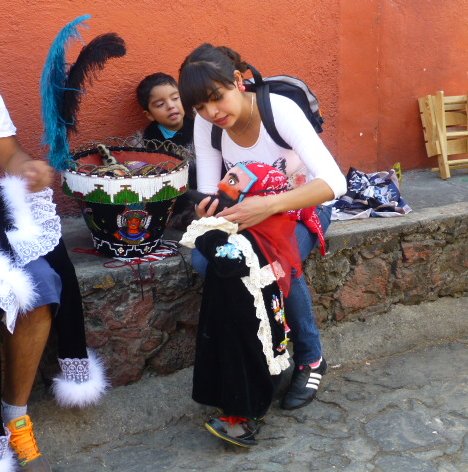
Every Little Chinelo Deserves Such a Mother!
 of Cuernavaca.  By this time we had ascertained that if carnaval was ever celebrated in Cuernavaca, that was not currently the case.  Not even to the smallest degree.  To see the Chinelos, we would have to travel to Tepoztlan, about twenty kilometros from Cuernavaca.

    On our first day here in the City of Flowers, we visited the Museo Brady.  Robert Brady was an American artist of some considerable means.  He settled in Cuernavaca in a large home that backs on to the catedral.  He then proceeded to paint the rooms in bright colors  and fill them with art which he collected while traveling the world.  Hence, this large home has been converted into a delightfully eclectic museum.  The ante room to the master suite is the Crucifix Room, the guest bedroom is the Oriental Room., there is green bathroom full of ceramic frogs.  It goes on and on.

    While at the Brady Museum, we met two people that provided further information about the carnaval in Tepotzlan.  The first was Sergio, a long haired artistic type who was the only person employed by the Brady
Hola, Amigos!  Its Carnaval con Chilenos y Tequila!
 Museum who spoke a word of English.  Although Sergio had never been to Tepoztlan to see the carnaval (it just didn’t interest him) he had some useful insights.  It was his impression that the carnaval would be preceded by a mass which would end at 4 PM.  Following the religious ceremony, the Indios would pour forth from the church and head to the carnaval.  If this were true, we wouldn’t need to arrive before three,
with the intent of doing some sight seeing and shopping prior to the appearance of the Chinelos.

    A short while later, Sandra cornered two charming girls for a photograph in the Oriental Room.  Their father was pleased to have them talk with us as they were learning English.   At the end of our museum tour we joined  Daria and Samara at a table in Sr. Brady’s courtyard.  The girls, remarkably poised at 7 and 9, study music, piano and flute
 respectively,  in addition to English and they clearly enjoyed taking pictures.  Their father, Japhet, named after Noah’s son, was well spoken and exceedingly friendly.  Although he had been to Tepoztlan, he chose not to go to the carnaval because of the associated drunken, rowdy behavior. He agreed that this was most likely to occur later in the evening.

     In the process of settling in to our hotel, the Villa Bonito les Terasses, we met Mario, the owner and manager.  Born in Colombia, he grew up in San Francisco and Orlando.  He agreed that arriving in Tepoztlan later in the afternoon would be a good plan.  Further, he offered to drive us there and pick us up for 500 pesos.  This may sound like a lot of money, but the current exchange rate at MEX was 17.15 per USD.  One does not need to be especially skilled at arithmetic to deduce that this is less that $30.  To have this service provided by a dependable friend was almost too good to be true.  Furthermore, although he
Chinelos Dance in the Zocalo
 had not been to the carnaval, he was fairly certain that the proceedings would be quite safe and there was little likelihood of violence of any kind.

   Yesterday at 2 PM we took off with Mario driving us in his comfortable Nissan Pathfinder.  By 2:40 we were in Tepoztlan, Mario driving the back streets to provide us with the best view of the piramide.  This particular piramide is about 1,000 feet up on the cliffs.  mario invited us to wonder how the Aztecs, or more likely their minions, got the stones all the way up to the top of the mountain.  Nobody knows.

   He dropped us off with intent of seeing us back at the entrance to the village at 7 PM.  Before starting our site seeing, we stepped into a tiny restaurant where the hostess/ chef served quessadillas for 15 pesos.  We
 ordered two, but before she could get them out of the pan, we heard a brass band.  We ran out into the street to see a band warming up a block up hill and a family preparing their chinelo costumes.

   As the father donned his mask, his lovely wife was dressing their toddler.  At first he didn't like it, throwing off the headgear, but mama outlasted him.  As the band approached, father and son took their place behind.  Chinelos began appearing in the street.  Soon there were twenty or so behind the band, with young men holding banners leading the way.

   At this point Sandra was befriended by a gentleman who insisted on pouring her a tequila and sprite while exhorting the joy of carnaval and los chinelos.  When it became apparent that she was associated with a
Nice Seeds!  (This one's for you, Don, you dirty old Indian!)
certain hombre, he had his assistant pour me a tequila, as well.  We put our arms around each other and shouted,"Amigos!" while the redoubtable SKG took a photo from a safe distance.  No fondling these love handles tonight, bucko.     

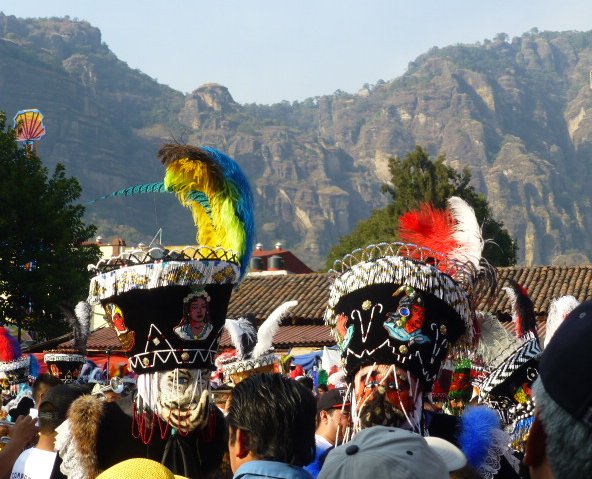
    Sipping on our ersatz margaritas, we walked up the street with the band and the chinelos, which every now and then absorbed a new comrade.  There were thirty or forty chinelos in front of us and then suddenly there were none.  We looked around and listened, finally hearing some band music coming from the far side of a midway.  Walking through, we came to a balcony overlooking the zocalo.  Below were gathered between 150 and 200 chinelos and four brass bands.

    Before embarking on our journey, I had found a youtube video of the chinelos in Tepoztlan.  it showed roughly two dozen men and one child dancing a shuffling step under an awning on a dusty street.  Nothing
The Oldest Chileno
 had prepared me for this spectacle.  While the brass bands played their dancing song over and over, the chinelos hopped, shuffled and twirled.   The entire zocalo was full of them.

     Clearly the town has grown.  Our source in the pulqueria said that there are now 20,000 potential chilenos living in the puebla magica of Tepoztlan.  Its not clear if you need to be invited to be a chileno.  I doubt that just anyone can whip up a costume and join in uninvited.  It was clear from the divisions and the bands that there were four groups, perhaps representing four parishes.  And no parish was to be outdone by the other, either in noise of their band, twirling and jiving or, especially, endurance. 

   We made our way down and took  a bunch of photos.  One might have thought that the music would stop and the party would become less organized.  But it did not.  A band might stop for a minute, but begin again
Frosty the Chileno, Had a Very Shiny Beer ...
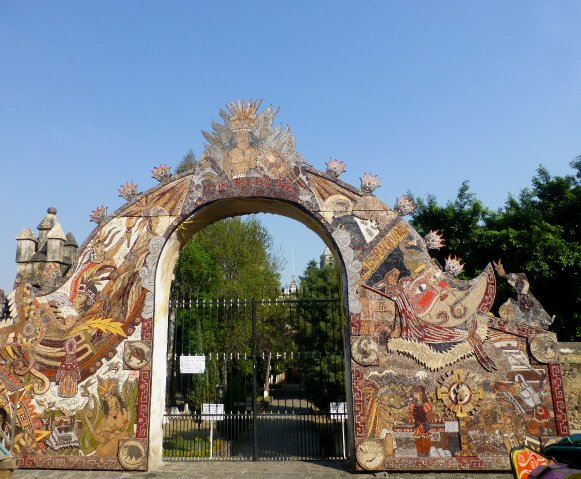
 shortly, and the chinelos danced and danced.  After about fifteen minutes,  Sandra and I took a break.  On the opposite side of the zocalo stands the catedral in a large wooded complex.  the church was not open, but the famous sign depicting the Carnaval de Teopztlan surmounted the cathedral gate.  This sign is made of attached seeds and is re-created with fresh seeds each year.  We rested, photographed the festival gate and then rejoined the dancing, which had gone on unabated.  We met an older gentleman, just donning his chinelo costume.  In by the dancing, I photographed a chinelo who had dropped out, albeit after half an hour of non stop dancing, to share a few frosties with his friends.  Cerveza Corona, breakfast of Chinelos.

   After about forty minutes, the ropes were let down and we were permitted to enter and dance with the chinelos.  We danced for a while, took some more pictures and retired back up onto the main street.  Food
Chinelos in the Zocalo Dance Beneath the Cliffs
booths, novelties and midway games lined the street for its entire length.  It was barely less noisy than the zocalo.  Even some of the chinelos had had enough; we saw a few walking the street, hat and mask in hand.

    Deciding that we had accomplished our goal, at a little after five we called Mario, who said he would pick us up in an hour.  Just as we were wondering where we might go for that period, a young man offered us a sample of pulque.  It was delicious, so we repaired into the pulqueria where we purchased a half liter of the pinon pulque.  It tasted vaguely of strawberries,  Made from agave and only slightly alcoholic, it was delicious.  and the peaceful pulqeria was the perfect spot to decompress after our dance with the chinelos.
You can tell by our costumes that we are Chinelos.  If you had a costume you could be a Chinelo, too!


Thursday, February 4, 2016

The Benefits of Jellyfish

   Yesterday I was dropped off for an afternoon swim while Sandra went shopping.  As I made my way down to the pier I spied a strand of danger tape across the steps down to the little Ironman beach.  I was
The cushion starfish in its new location.
 expecting that there was some physical problem.  Perhaps a tsunami had snuck in unbeknownst and taken out the steps.  But, no.  A piece of paper attatched to the yellow and black tape advised, "Danger!  Jellyfish! Swim At Your Own Risk."

     One thing was for sure, without my cell phone, I was going to be at the pier for the next hour and a half.  Luckily, there was a young lady stripping off her wetsuit who informed me that she had just swum a mile, presumably out past the Royal Kona Resort, and had not seen any jellyfish.  She reported that some people had seen some box jellyfish out on the other side, by which she meant Paul Allen's Reef.

    With that encouraging information, I completed my preparation and made my way under the danger tape, careful not to dislodge the admonishing piece of paper, and down to the water.  It was extremely peaceful there.  No children were engaged in sand fights.  No novice paddleboarders flapped and fell.  No adolescent couples were engaged in their flirtations.  Only a couple of thirty somethings from New Zealand were there.
A Polynesian Halfbeak Swims the bay oblivious to jellyfish
 And they were leaving.  As they strolled out of the sea, the young man reported that they had not seen any jellyfish.

    I was truly alone on the beach.

    As I put on my fins, the Bodyglove set to sea, full of tourists huddled high above the dangerous waters.  Now I was truly alone.  Watching carefully for jellies, I swam through some remarkably clear water.  In fact, the clarity was better than it had been for a while and I was hopeful that, jellyfish not withstanding, this might be a day for a good photograph.  Or two.

    First thing, I swam beneath the floating line and out to the spot where we have seen the cushion star.  He was a bit deeper, but basically in the same spot, opposite the light post where the tenders from the cruise ships dock.   One never really knows how much an animal like that moves around.  In the case of this particular starfish, about three
Shortnose Wrasse, Kailua Kona February 2016
 feet in the course of five or six days. During this time, two cruise ships have come with multiple tenders delivering scores of tourists.  (As the local economy apparently depends heavily on these worthies, my editor forbids me to refer to them as sea going rats.)  Regardless, the starfish appears unaffected by this maritime  activity.

    Having photographed the sea star (again) I made my way back toward the swim area where I caught up with a school of polynesian halfbeaks.  They permitted me to get fairly close and I was lucky to get the picture you see here.

    As there were still no jellyfish to scare me away, I swam out to the first orange mooring buoy.  You will recall that the day we found the cushion star I also spotted a Potter's Angelfish and a shortnose wrasse in the vicinity of this buoy.  I believe those species will stick around in a location for weeks, but the last time I
Hidden Hermit Crab, Ca. latens,  February 2016
 checked, I found neither of these individuals.  It took a few minutes, but the shortnose wrasse finally made an appearance.   I dove several times in about ten feet of delightfully clear water, coming up with the picture you see here, possibly my best picture of this handsome fish.  As we have mentioned before, the shortnose is not extremely uncommon,  If one is observant, he can hope to see one or two individuals in a year.  However, I was really lucky to catch this guy in clear water on the day the jellyfish cleared out Kailua Bay.

   As I was diving the shortnose, I saw a few hermit crabs on the coral.  Diving down and holding on I finished off the day with this nice picture of a Hidden Hermit Crab who had taken up residence in a small triton shell.  So ornamented is the triton that you might mistake the hermit for Aunt Winifred on Easter morning.  Or possibly the queen at Ascot.  One needs to remember that both this
Look carefully for the tentacles
species and guamensis have that black band with a constellation of white spots on the claw.  The Guam hermit crab is introduced while this slightly more uncommon hermit is a native.  This guy was obliging, and when plucked from the coral, he poked his head out and said hello.


   On the way in I did not see any jellies, but I did notice a couple of those jars (so handy for consuming potent potables) in which they are sold up the hill at Safeway.  I leave it up to cousin Don to photoshop a jelly jar bearing the likeness of a box jellyfish.  Smucker's Box Jellies, its got a real sting to it.

jeff


Being a hermit crab, I'll have my Scotch on the rocks. 
And if you don't mind, bring it one of those handy little jars.


Wednesday, January 27, 2016

Surf''s Up

    Last Friday, as Sandra conducted her morning ritual with the phone, reading the news and correspondence while sipping her morning coffee, she announced that her cousin Don in New Hampshire was warning us of a high surf alert.  Isn't it curious, we smirked, that someone on the other side of the
Bienvenue!  Sarah and Lucas at City of Refuge.
 country should tell us what the ocean is doing right outside our door?  From up here at Casa Ono the surf didn't look that bad, the surf predictor suggested moderately clement conditions and we had planned our first trip to the City of Refuge since the outbreak of dengue fever.  Besides that, we are moderately obstinate children, albeit rather old obstinate children. 

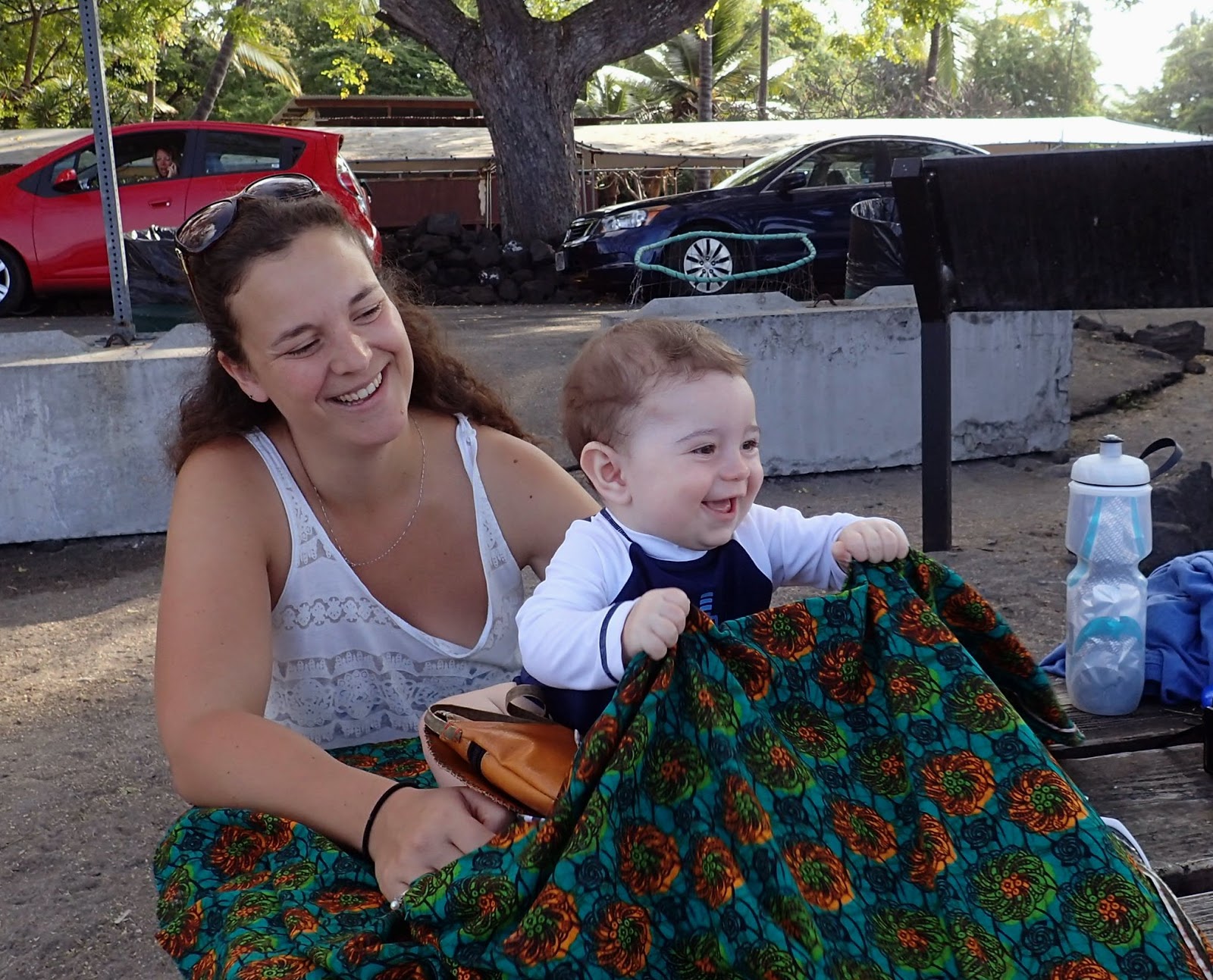
  Thus, around 10 AM we found ourselves donning our gear at the table by the bay, just across from the national park made famous by Samuel Langhorne Clemens.  At our table was a mother and her cheerful baby.  Greeting her, I perceived by her accent that she hailed from somewhere in Europe.  France,as it turned out.  Her name was Sarah and her eight month old was named Lucas.  Luc was the very vision of charm, waving, smiling and chewing on his mothers purse.

    As it turned out, Sarah did not currently live in Paris.  She is a nurse and her husband (who was out swimming in the bay as we spoke with the comely jeune mère) is a teacher.  And they teach in northern
 Saddleback Butterflyfish, Kahalu'u, January 2016
Quebec.  When she says north, baby she means north, like 1000 miles north of Montreal!  Up in the frozen wasteland they minister to a village of First Nations.  I related how my brother in law and his wife taught school in a snowed in Indian village in Alaska twenty years ago.  She was confused by the word Indians, which has apparently been entirely replaced by the appellation First Nations in French speaking Canada.

    As we were putting on  all our warm gear, I asked Sarah if she found the winter water here in Hawaii cold.  She replied that it was 40 below in her village and , no, the water here seemed pretty warm to her.

    After snapping a picture of Sarah and the charmant Luc, we made our way out to the two step entry.  There we encountered a surprising amount of surf.  In fact the water was enjoying a four foot excursion, just slopping onto the second step and then receding so that the rocks below were exposed.  I sat on the edge and put on my fins and then assisted a lady of about our age in her escape from the bounding sea.  Once safely on the hard, she was a non-stop litany, extolling the danger of getting in and out at that moment.

    As I am still here writing, you may infer that we walked away from our two step adventure.  Trudging head down  across the lava, Sandra recounted how many times she had walked away.  It's not many, two or
three times.  As we approached the table, we saw that Luc's father had successfully returned and that Sarah, mask in hand, was preparing to go down to the ocean.  She was wearing only a bikini and I could not help envisioning her milky skin all cut to tatters.  Quelle tristesse!   Sandra warned her of the danger, but after all, her husband had just  safely negotiated the entry and landing.  I can't say for sure what she did, but I'm pretty sure that she did not make the evening news. 
Threadfin Jack, courtesy of Bo Pardau.


   As we were loading our stuff in the car, the lady who had discouraged us from going in was exclaiming about a weird fish, like a Portuguese Man of War with long tentacles, she said.  Wondering why she waited until we were poised to leave to dispense with this tantalizing detail, we identified her fish for her as a threadfin jack, also known as the African pompano.  I am still longing to see one of those guys in the open ocean.  Sandra and I made our way back to Kahalu'u where, although it was low tide, conditions were not life threatening and we managed this picture of a pair of Saddleback Butterflies.

    Having been turned away by the raging sea, the following day we headed up to the Hilton at Waikoloa.  This afforded Schmoopie a chance to look in the Queen's Shops and for me to explore the lagoon at the
resort.  You may recall from previous blogs that this lagoon is a curious entity.  The management swears that
The lagoon at the Waikoloa Hilton.
they have never stalked it with fish.  Rather, fish are washed over the breakwater and then reside in the lagoon.  Just like a bird feeder, it is my position that this makes them fair game.  Of course, anyone would like to see their bird in its natural habitat, in the bush if you will, or his fish swimming in a less contrived situation. But I'm not giving back my immature sailfin tang, my threadfin jack, nor my longtail dragonet.  If serious bird watchers can sit, life list in hand, next to a line of hummingbird feeders in Patagonia, Arizona, I guess I can take mine to the lagoon at the Hilton Waikoloa, man made waterfall and all.

   So, leaving my beloved perusing the shops, I soon found myself on a recliner beneath a palapa in the soft white sand.  There was a young man in his mid-thirties at a nearby chaise who, snorkel mask in hand, had
Shortnose Wrasse, Kailua Kona Pier, Jan 26, 2016
just emerged from the man made wonder.  Being the friendly sort that I am, I asked him if he had seen anything good.  He replied that the lagoon was full of fish.  In fact, he averred that he had snorkeled all over the State of Hawaii and had never seen a greater variety of fish on a wild reef.  So there you have it.  At City of Refuge, one is obligated to brave the surf and the rocks.  At the Hilton Waikoloa he is pushed hard up against the rubber-nosed geeks.  

    With this encouragement, I grabbed my gear and waded out into the cold, turbid water. While I was putting on my fins, a stately lady of a certain age waded nearby.  She helpfully nabbed one of the pads I use to cushion my aging feet inside the flippers.  As she returned it to me, I muttered something about old, deformed feet.  She tilted her head just so, a pose accentuated by her wide brimmed, lilac sun hat, and asked, "What ever happened to the supermen  we once were?"

     Visibility in the lagoon ranged from two to six feet and the water, except in the channel, was mercilessly shallow.  Never the less, your sometimes superman made his way around, dodging paddle boats and the
Cushion Star  Culcita novaeguineae
wading wealthy.  The most curious thing of this veritable panoply of marine life (not) was the abundance of lagoon triggerfish.  In the half hour or so braving these raging waters, I would guess that I saw forty individuals.  The lagoon is not the rarest of fish, but I don't see one every time out.  

    Sadly, I didn't see too much else of note until it was almost about time to get out and meet another, even more glamorous lady. Just then, over by the pen in which the management incarcerates a couple of reef sharks, three Island Jacks sped by.  I didn't have time to take a picture, but there was no mistaking the constellation of mustard colored spots on their flanks. According to my list, I saw this species in 2014, but I had not seen the island jack in well over a year, so our venture into the black lagoon did yield one worthy fish for the list.

   While the waves continued to crash, Sunday was devoted to football on TV and Monday to the completion of a building project on the house.  All of which brings us to yesterday.  That Tuesday had been
Potter's Angelfish  Kailua Pier January 2016
earmarked for Sandra's book club, during which I was to go snorkeling at the pier.  With the waves thundering in, snorkeling didn't seem too likely.  So I dressed in a swim suit more appropriate for playing in the waves and left the camera at home. 

    On the off hand chance that the water around the pier was protected, I threw my mask and fins in the trunk.   Sure enough, although waves were crashing on Paul Allen's Reef, the water on the Ironman side of the pier was flat.

    It was a cool day with sprinkles of rain and there was only one other person on the small beach as I got in.  The water was actually only moderately cloudy and I rued the absence of the camera.  Right away I saw the blacklip butterfly, but didn't see anything else of interest as I swam out to in front of the palace.

   Ever since our ill founded trip to City, I had been thinking about the threadfin jacks.  Two years ago, when I was swimming at the pier with a friend, two fellows in complete dive gear and bearing huge SLR cameras,
Potter's angelfish, Kailua Kona Jan 2016, 10ft
claimed to have seen a couple of the pompanos on the far side of the swim buoys.  With this in mind, and as there was no boat traffic on this rough day, I decided to swim back over the sand and reef in the middle of the bay.   A couple yards in from the first orange mooring buoy I was lucky to spot a shortnose wrasse.   It took me many years to see this fish, probably not because it is extremely rare, but more because it is small and one has to be keyed in to the subtle differences in silhouette between the shortnose and other similar wrasses.  This fish was in ten feet of slightly turbid water; had I not recognized the shape, I never would have investigated it.  He was a nice little fish more than three inches in length and allowed me several close approaches.  At this point I was kicking myself for leaving the camera at home.


   Finally tiring of the shortnose, I swam straight in to the pier.  There, nestled on the reef about three yards from the pier, I saw my second or third cushion starfish in Hawaii.  And I have a vague recollection of seeing
one somewhere else, like the Caribbean or Western Mexico. Suffice it to say, this was a major find for me.  About five inches across and two high, he was only three feet down, sort of tucked into a corner created by
Hi
two adjoining corals.  What a gorgeous animal he was!  Purple on top, at his base where he met the substrate he had a rim of orange papillae in different shades.  These rose to create an elipse at each corner of the star.  So decorative were these that they reminded me of the mihrab in the Great Mosque of Cordoba.

Obviously, this cushion star represented a religious experience.  I observed it for several minutes, wishing I had the camera.  finally deciding ot leave, I saw a single young lady standing knee deep on the beach.  and I thought to myself, "Well, if you can't photograph it, perhaps you can share it."


    What incredible good fortune.  The young lady was extremely well spoken with a Scandinavian accent and she exuded that aura of happy enthusiasm that one always hopes to find.  Her name was Emily and she was not from Sweden, but from Minnesota.   She and her husband, Rob, who was just swimming in to shore, were
 hoping to move to Hawaii and they were happy to swim out and look at the cushion starfish with me.  The three of us enjoyed the star for a couple minutes and then said goodbye on the beach.  I talked about starfish anatomy, Rob talked about training himself to breathe on the opposite side while swimming long distances and Emily stood there just being sublime.  I still didn't have a camera so there is no picture of Emily and Rob.  Take my word for it,  they were a handsome couple of thirty somethings dressed for serious swimming.

   Sandra and I reconnoitered at Casa Ono.  I told her about the starfish and talked her into an afternoon swim.  Around two we were back at the pier, slipping into the cool water.  having carefully noted the position of the cushion star, I swam right to it.  Sandra loved it as much as I did.

   After nabbing a brace of photographs it was off to find the shortnose wrasse.  Although fish tend to move around more than sea stars, its been my experience that the shortnose wrasse tends to stay put for days at a time.  Due to his proximity to the mooring buoy, I was able to swim to my spot and start the hunt.  Nothing
Adapting life to art.  The Starfish Becomes a Mihrab.
 appeared for several minutes and it is a credit to Sandra's interest in the sport that we did not swim away.  This was lucky, for while we were searching for the shortnose, what should appear but a single gorgeous Potter's Angelfish.  Dealing with a treasured species in ten feet of water, I did my best work, diving repeatedly and holding on to the bottom.  The five inch angelfish was elusive, but  multiple attempts paid off with my best pictures of Potter's angelfish. 

     About half way through the angelfish effort the shortnose wrasse made his appearance, creating the opportunity for several more deep dives.  Finally, we got one acceptable picture of him.  Not only that, but while chasing the shortnose across the deep bottom,  I spotted a fine devil scorpionfish and we got his photo as well.

   At this juncture, I have to give a shout out to my mentor Bob Hillis, who in his unassuming way got me diving deeper and for longer duration.  Without Bob's tutelage, we would not have these pictures.  And thanks to Sara and Luc, Emily and Rob, that parvenu on the beach at the Waikoloa  and, of course, the Redoubtable SKG for making this longwinded blog possible.  Sandra is the real Sea Star!

See a fish for me,
jeff


Wednesday, January 20, 2016

Winter at Casa Ono

    I believe that here in Kona we enjoy a monsoon climate.  It has certainly been that this year.    We suffered through a brutally hot wet season that ended in November.  As a result of the large amount of rain,
Honey Bees in the Palm Inflorescence
many things bloomed that we had never seen blooming before.  One would stop in their tracks and say, "So that's what that tree looks like when it blooms."

    For the past month, starting a week or so before Christmas, we have been enjoying a cool dry season.  Neither Sandra nor I can remember the last time it rained... at least three weeks ago.  Every morning I'm out before 7 AM, watering and pruning.  With selective watering, the weeds have essentially died away.  But as you can see from the pictures, we are still enjoying some lovely flowers through the winter.

   Yesterday I went outside and it was a beautiful morning.  One of our palm trees had an infloresence that was full of honey bees.  The dengue fever epidemic is ongoing and a month ago the state was spraying for mosquitoes.  Obviously there is no such thing as an insecticide specific for mosquitoes and,
Tigridia blossom taken with the macro
as a consequence,up until a couple weeks ago we were seeing lots of dying honey bees.  With the dry weather, they must be doing less spraying, hence our tree full of healthy bees.  What a treat!

    Below the palm trees and the avocado, our tigridia plants had gone crazy; there must have been a dozen fabulous blossoms.  As you can see, this flower, which we believe to be a variety of South American iris, is really fancy.  Usually we get only one or two on a given day.  The blossoms last only a single day, so if you are not out in the garden that day yu miss out.

  The avocado and mango are blooming along with the giant heliconia.  There is a variety of begonia that grows on a tall bamboo-like stalk, which lives behind the heliconia and it continues to throw out its pretty pink blossoms. 
Begonia on a Tall stalk.  This one is bent over.


   I love color and so I have planted bougainvillea here and there.  For an encore I'm showing you some that I have growing with the passion fruit on the arbor.

   Hope your day is colorful and full of joy.

jeff


Giant Heliconia


Bougainvillea Growing in the Lilikoi


Ganesha Thanks You for Looking at Our Garden

Sunday, January 17, 2016

Things Are Evolving

   Yesterday was a gorgeous day here in Kailua Kona.  At 10 in the morning it was in the upper seventies with a charming breeze.  As we made our way down to Alii Drive, I noticed a number of buoys and what
A High School Paddling Team on a Gorgeous Day
 looked like a race committee boat at the far end of the pier.  The general absence of a crowd, not to mention the ease with which we had parked, lead me to comment, "I wonder if there is going to be a regatta tomorrow?"  A lady passing us at a good clip said, "There's a regatta right now."  to which I replied, to her receding derriere, "It must not be much of a regatta, or we wouldn't have been able to park."

   I think I saw her nod, but my attention was drawn across the street where a paddling team, of about twenty high school age boys and girls in matching blue T shirts, was going for a run up the street.  Garments below the waist were up to the discretion of the athlete, as was footwear; most of the paddlers were running in bare feet, while a few pantywaists were running the pavement in flip flops.  I was reminded of sending the soccer team off for a run, but, of course, the lads were all wearing sport appropriate boots.  Not to mention that the golden bodies
Adolescent Blacklip Butterfly, Dec. 10, 2015
that pranced by looked nothing like those found on the pitches of Oregon.

   I could dwell at some length on the differences in physiognomy between a 17 year old girl soccer player and her Polynesian paddling counterpart, but then Captain Priapism, who lives next door, would call the thought police and that would be it for the the old blogmeister.   Let us say that one might title such a blog, "Beauty and the Beast".  I leave it up to you and your vivid imagination to correctly assign the roles.

    As it turned out, it was a dual meet, with only two crews on the water at any one time.  Hence, the area around the kiosk was only lightly employed.  As we were donning our neoprene, who should happen by but our friend Marilyn from Alii Villas.  After appropriate greetings were exchanged, she averred that it was cloudy today (meaning the water, of course.)  I asked her if she had seen the blacklip butterfly, knowing full
Mature Blacklip Butterfly, January 16, 2016
 well that she is one of the "All the Pretty Fishes" school of snorkelers.   Although she wouldn't know a blacklip butterly from a black-headed grosbeak, one still has to give Marilyn credit.  As she had hip surgery a few years ago and is therefore unable to safely put on flippers for fear of a dislocation, she still gets down to the pier to enjoy the fish.

    As I was telling her that the blacklip butterfly could be found right in the shallows where she paddles, a young man (which is to say he was under forty) asked if there were any sharks here.  He proceeded to describe the small school of milkfish and I was happy to fill in some gaps and put a name on his find.  What joy to be the yoda of the fish.  Following this mini-dissertation, which Sandra bore stoically, we headed down to the water.

   This January the water is not quite as cold as one might expect.  And contrary to our friend's admonition, it was well on the clear side of diluted milk.  Such was the clarity in the shallows that I was able to nab a
picture of the blacklip butterfly, which has now persisted, as I prognosticated back in December, in the very
I'm a Crab of Constant Sorrow
same spot for over a month.  Not only that, but in my prescience, I have taken a picture of this unusual fish each time I have seen it and now have a series of photographs detailing the development of C. kleinii from adolescent to mature.

    I am sorely tempted to call this fish a waif.  It is living in a space whee none of its ilk are ever seen. Clearly the egg moved by current from another area, most likely somewhere else on this island, but almost certainly from below snorkeling depth.  I ask you, was little Orphan Annie less of a waif for being born in New York, not far from the home for foundling girls?  Was Daddy Warbucks a Democrat?

   Our experience with waifs is elegantly spelled out in The Ballad of Jeff and Sandra, recorded by Ulysses Everett McGill and the Soggy Bottom Boys. (I hope you received a copy of the CD in your Christmas stocking.)  The ballad recounts our experience with a tiny white crab, a humongous jellyfish and, notably, the
Immature hawkfish, P. forsteri,  in recovering coral.
Notorious PID.  Everyone agreed that our Phoenix Island Damsel was a waif, and no one thought the egg came from Phoenix Island.  In fact, the water-borne egg probably came from Maui.  Possibly it came from a nest on (shudder) this very volcanic isle.  Sandra and I were lucky to find the first one, who lived by himself in the Valley of the Sun, a depression on the wave swept reef in front of Alii Villas, for over a year and a half.  Many fish watchers, including the Great Oz, himself, came to see and bask in the glow of his waifliness.  A handsome photograph of the Notorious PID may be found on page 80 of the Ultimate Guide to Hawaiian Reef Fishes.

     All blathering aside, I think this blacklip qualifies as a waif and I hope you enjoy the pictures showing his development.

    Swimming out, we  saw lots of fish but nothing dramatic.  Way out by the last swim buoy, which corresponded with the five colorful buoys marking the finish line for the dual meet,  I spotted a handsome
 adult ornate wrasse in about ten feet.  I dove down to get his picture, but by the time my camera and I got 
An Ornate Wrasse that didn't get away.   Ho'okena 2012

to the bottom, the ornate wrasse was long gone Luckily, nearby was an immature freckle-faced hawkfish, This green capped fellow was perched on a piece of recovering cauliflower coral.  As you can see, what a few months ago (back when Freckle junior was just a flicker in his daddy's fin) would have looked like a bleached coral of incipient death, is now greatly recovered.   There was no reason for any of us, from mere novice to professor of invertebrate zoology, to know that so much of the coral would recover.  The evolution of the over heated and bleached coral is an ongoing experiment right here in Kailua Bay.  Those of us who gather around the swimming cubby and take notice of such things are greatly heartened by this partial recovery.

     On the way in I stalled to point at a stocky hawkfish.  As I surfaced a ladylike voice behind me asked, "What are you pointing at?"
You don't want to mess with this waif.

     "A stocky hawkfish."  I replied after pulling the snorkel from my mouth.  Turning a bit I saw Sandra  swimming five yards away.  Turning a bit more, I continued, "You're not my wife."

   The lady could have said, "Thank God for that!"  But instead she said, " I was hoping you had an octopus."
  
  To quote the Wyoming sheriff cum philosopher Walt Longmire, Boy Howdy.  I guess that I,too, was hoping it was an octopus.  But things are evolving and it was still a  great day a the beach.


jeff