Friday, May 16, 2014

The Rainy Season Comes ot Kailua and the Reef Fish Preservation Act of 2014

     We have now endured six consecutive days of rain.  It hasn't rained all day, everyday, but it has rained
Argus Grouper C. argus Kahaluu
 heavily every afternoon and through the night.  As a result, my snorkeling has been less frequent than it might be otherwise.   The frequency of the blogs has fallen off, partly due to the rain and also because we haven't seen anything remarkable to report.

      We have taken a couple reasonable pictures lately, albeit of relatively common fish. The first one I wanted to show you is a head on shot of an Argus (Peacock) Grouper.  I know that you've seen a million of these guys, but isn't it a nice picture?  This was a smaller fish, brilliantly colored.  And he had the moxie to face us head on instead of shooting into the coral.  This species of grouper was introduced from Tahiti in 1956.  It was intended to be a food fish, but as it is frequently ciguatoxic, it is rarely taken by fisherman.  And that is why you see so many!

     The next picture I wanted to show off is an Arc-eyed Hawkfish.  Hawkfish are doing well on our reefs
 and I was lucky to get a food picture of this handsome fish.  Most Arc-eyed Hawkfish sit still, perched on the coral, apparently under the impression that if they don't move, their prey will not notice them.  I have found that I can dive them once and get a shot, but the second time the fish is approached, he realizes that the jig is up and swims to a new perch.  If one has the time and inclination, he can make life a living hell for an Arc-eyed Hawkfish.  

    The next of  pictures is of a Dragon Wrasse.  This guy was among the largest of this fascinating immatures that I have seen.   Isn't is interesting that these wrasses do not all change into the adult pattern at the same time?  Occasionally you will see a large immature (the Dragon Wrasse phase)
and other times you will see relatively small Rockmovers (the adult pattern).  And every now and then, you see one in transition, a small Rockmover with "antennae".  I was especially pleased with the sharp focus in this shot.

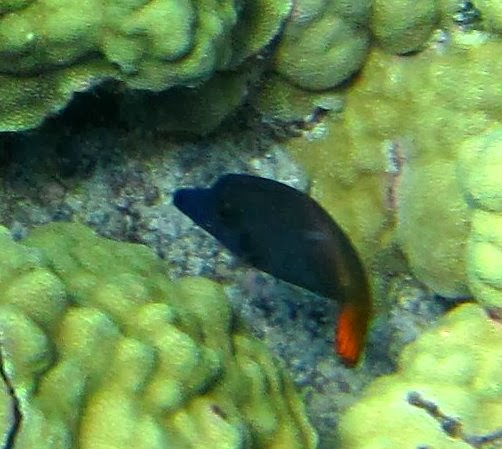
    My last photos show two phases of the Threadfin Butterflyfish.   Sandra noticed this darker phase (the one that all respecting threadfins adopt at night)  and called my attention to it.  Why some of these fish retain the dark gray phase during the bright daylight hours is a mystery.  I'm including a picture of a different fish exhibiting the normal day coloration, taken at the same time, for comparison.

    Before I let you go, I want to mention an incident that occurred  in Kona early this week.  This incident has attracted national attention, due to a video clip that no self respecting TV station could exclude from it evening news.  The footage shows a fish collector attacking a diver who is creating a video of his activities.  He literally rips the regulator from her mouth.   The collector makes the ridiculous statement that he was feeling threatened by the lady photographer.   And the police are doing exactly nothing!

Threadfin Butterfly, the night coloration
    This is an issue I feel pretty strongly about. Fish collecting for the aquarium trade is hardly illegal in Hawaii.  The people on the local news (KHNL) actively took the side of the collector, despite his outrageous actions.

It is a sad fact, that the media and the government in Hawaii are perfectly happy to support anyone who wants to take the marine animals, right up to the point of extinction.  It is obvious to me that the fish collectors are having a negative effect on our fish populations and need to be regulated, preferably put out of business.  I am not holding my breath on this one. 
Threadfin Butterfly, the day coloration

      Governor Abercrombie and the Hawaii State Legislature have showed little  interest in protecting our reefs on the Big Island.  But they should.  Collecting reef fish should be no different than taking songbirds, which our society deemed unacceptable long ago.   The Migratory Bird Act was passed in 1918.  I suggest we call our congressmen in Washington, DC with the hope that the Reef Fish Act be passed in 2014 and this threat to our fish populations be eliminated. 

jeff


http://www.huffingtonpost.com/2014/05/15/aquarium-fish-industry_n_5333537.html

https://www.youtube.com/watch?v=bJ1YYA6nIws

Tuesday, April 29, 2014

    As the year has been moving along, we have been compiling our new list, which began on January 1st.  We have seen at least one new species this year, the Longtail Dragonet.  Just this week I added the
Shortnose Wrasse, April 28, 2014, Kailua Bay
 Shortnose Wrasse to the list for 2014.  I don't know how many shorties I have seen now, but I hadn't seen any until just a couple years ago.  Hence, I am always overjoyed to see this little fish and I never really expect it. 

     This isn't the case for a few fish that have gone missing in the last few years.  The Milletseed Butterflyfish has so far eluded us in 2014.  The Reticulated, Citron and Pyramid have yet to make the list, but they have always been a little difficult.  Every day that I don't see a Milletseed, my heart breaks just a little.

   Of course, there are a few other difficult fish that we have not been lucky enough to see these past four months, a couple unicornfish and a couple parrots.  But there are a few fish that we used to see routinely that just aren't here anymore.  I can't remember the last time I saw Diodon holocanthus in Hawaii.  
Great Barracuda, Paul Allen's Reef, February 2014
But of all the fish not to make the list, the Great Barracuda affects me most deeply.  I know exactly the last time I saw one of these magnificent fish, February 20, 2012 out on Paul Allen's Reef.  Little did I know on that day that this might be the last time I would see a Great Barracuda in Hawaii.   I can find no information that the Great Barracuda is threatened in Hawaii, so perhaps a 'cuda is out there with my name on it.  I certainly hope so.


      As I swam in a couple days ago, I needed to make my way through the Kai Opua canoe regatta.  This regatta features adult teams, men, women and mixed crews, from around the island.  How lucky I was to see
 
the enthusiasm and camaraderie of these adult paddlers at their premier event. The high school regatta is lots of fun, but the enthusiasm of the Kai Opua regatta can't be beat.

jeff

Thursday, April 24, 2014

Birding the Big Island with Allan Richards

      A week ago we devoted a few days to watching birds, as opposed to fish.  Our friend Allan Richards arrived from Sydney, redirecting our attention away from the sea.  Mauka, if you will.

The Gilded Triggerfish is back at Ho'okena
     The week started out with a productive trip down to Ho'okena with Anita.  The dolphins were not there, but there were more Gilded Triggerfish than ever.  You may recall that we had not seen that species this year and I was getting a bit apprehensive on their behalf.  There was lots of plankton in the water which may have accounted for the large numbers of gilded triggers.  Sandra thought the over all number of fish were down, but we did see Heller's Barracuda and three Bridled Triggerfish.

    Our best sighting occurred on the way in.  I spotted a small Flame Angelfish in ten feet of water.  If you are a snorkeler, you probably look through the guides to reef fish and notice that some of the fish you don't see occur at great depth.  Sadly, the book is usually correct.  However,  Flame Angelfish (putatively a deep water fish) are an exception, at least at Ho'okena.  Regardless, we had never seen one that shallow before.  I was able to dive right down to where the three inch angelfish hid inside the coral.  I wonder how many other people have seen the flame that shallow?

Allan poses with the Snorkelkids and Madame Pele
    The next day we drove to the soggy side of the Big Island.  Early in the afternoon we had tea and crumpets with John and Marcia Hoover.  We talked about the fish at Ho'okena and he teased me about the demise (or not) of the trumpetfish.  As it turns out, he and Marcia are very knowledgeable about the birds near the volcano and they gave us some of their best spots for nene and omao.  He also alerted us to the presence of the Bristle-thighed Curlew.  Apparently four BTCs, which look remarkably like the rather common whimbrel, were seen on the beach at Hualalai, north of the Four Seasons Resort.  John provided us with a contact, Keo Lopes, who works with the birds in that area.
 
Sunset at Kilauea
     I contacted Mr. Lopes via email and he  was quick to respond with the bad news that the Bristle-thighed Curlews had left about two weeks earlier. 

    On further investigation, it appears that the Bristle-thighed Curlew does not winter in Hawaii.  Rather, it is a migrant, breeding in Alaska and wintering in Pacific islands to the south and west of the Hawaiian Archipelago.  A few birds stop in Hawaii coming and going in April and September.  Alan had seen them on Oahu at the beginning of his Hawaiian birding expedition.  However, the BTC remains a lifebird for Sandra and me.  As there is no  organized fraternity of birdwatchers on the Big Island (with a helpful hotline telephone number) I don't know how we can expect to find this interesting bird that occurs here with such irregularity.

    In the early afternoon we collected Allan at the Hilo airport and checked in at our volcano lodgings.  That night we got a great look at the volcano.  The noxious vapors, reflecting the lava below, made a pink cloud in the evening sky.

   The following morning, Allan and I went to the Thurston Lava Tube.   John Hoover had suggested that the omao could be seen in the adjacent canopy.  Apapanes were easy at this early morning hour, and we heard the loud short trill of the omao that John and Marcia described as a policeman's whistle.  What we heard was quick, perhaps only two seconds in duration, but recognizing the call helped Allan spot one after about half an hour of searching.  Just like when Sandra and I saw one a couple months ago, this omao was not in the canopy.  Allan spotted him at eye level and we got an excellent look. 
The Mauna Kea Elepaio Is On the Verge of Sainthood

     After a quick breakfast, we left the park and made our way to the golf course, where we saw four nenes.  As it was raining, we headed back to the dry side to continue our birding.

     On our way to Kona, we stopped at Manuka State Park, which is just northwest of Oceanside.  Sandra decided to stay near the car while Allan and I hiked the trail.  The bird we needed was the elepaio, that had eluded us back at the Thurston Lava Tube.   The trail was rocky and uphill, but the habitat was worse.  I could still make out the ohia trees, but many were either covered with vines or almost dead.  Luckily, just as the H. Douglas Pratt (Enjoying Birds in Hawaii) suggested, this disturbed habitat yielded both apapanes and elepaio.   Tick it off and head on out.

    The following morning was devoted to the Palila.  We got an early start and headed up the old Saddle Road.  We saw lots of francolins and turkeys and, luckily, got a Pueo perched on a wire.  It had been about eight years since I saw this iconic Hawaiian owl.  What a treat. 

     The road at the Kilohana Hunting area was dry and inviting and we made our way up to the Sandalwood Enclosure (4.2 miles) without difficulty.  Finding the palila was not so easy.  In January, Sandra and I found one after about twenty minutes.  This time we were unsuccessful at this "best area" for finding this rare Hawaiian finch.  We did have an excellent look at the mamane-naio subspecies of the elepaio.  This was a very important bird for Allan, as the elepaio occuring in the dry mamane forest is now regarded as a distinct subspecies.  As he closes in on 5,000 life birds, Allan keeps track of those birds that may in the future be declared a distinct species.  He now has the Mauna Kea sub-species stashed in his records, should it achieve sainthood in the future. (Watch for a  plume of white smoke erupting  from the summit of the mountain.)
The Bristle-thighed Curlicue Looking for a Gin and Tonic

     We drove up to the area past the cabin and eucalyptus grove.  The three of us worked the mamane forest where we saw lots of amakihis and house finches.  After about an hour of this nonsense Sandra lost interest.  Another half hour of quiet searching finally produced two adults and one immature.  Allan and I got a great look at the immature, which was a bit streaky.  The Audubon Society guide did not prepare us for this, saying that the immature is similar to the female, whose breast is a bit less yellow than the male, but does not have streaks.  To me, it looked like a female house finch on steroids, but Allan noted the light rump, the slightly forked tail and, of course, we both saw the distinctive bill.

      Having seen every life bird that Allan might get that day, we descended towards Kailua.  On the way home we stopped at Costco, which has yet to make much of an impact in Australia.  We enjoyed a couple samples of poke, bought a bottle of wine and made our way back to Casa Ono.  That night we attended a birthday party for one of the neighbor ladies.  In describing our search for birds, I mentioned the BTC.  It can now be revealed that the Bristle-thighed Culicue lives on the beach where the River of Ornithology enters La Cienega de los Borachos.  I've seen some of my best birds in that marsh.  

jeff

Wednesday, March 26, 2014

Better, Biggest and Best Featuring Zebra Moray, Hawaiian Dascyllus and the Blood Crab

   Lots has transpired since the last blog, culminating with a delightful swim today with a few really good pictures.  We will apply the superlatives in a bit.
Pelagic Jellyfish and immature Unicorn Filefish.
    
   The good news is that I was completely full of bologna when I trumpeted the demise of the Pacific Trumpetfish.  Since then we have seen four at City of Refuge and a couple on each side of the pier.  Being the coward that I am, I'm blaming this faux pas on Aubre.  She's young and has broad shoulders.  (And she's not here and she doesn't read the blog.)

   Moving away from my frailties, I'm extremely proud to tell you that John Hoover is going to include our picture of the Pelagic Jellyfish,   Thysanostroma flagelattum, in his revised Sea Creatures book.  When I heard the good news,  I wrote him a glowing reply, commenting that his book presents the biology of these animals in such an understandable and concise fashion that it should be
Longtail Dragonet in the Waikoloa Hilton Lagoon
used as a high school text.  John replied that he wasn't aware that they taught invertebrate zoology in high school, but Hawai'i's Sea Creatures is used as a text by the University of Hawaii!  If he ever revises the Ultimate Guide perhaps he will include the immature Unicorn Filefish that you see cruising among the tentacles.

     In the process of finding those aforementioned trumpetfish, we had a chance to swim with our friends, Bob and Kim Hillis at City of Refuge.  We saw some good stuff, including a Paletail Unicornfish with a nose so long that it would vie with a prevaricating Pinocchio. 

    Bob Hillis has lots of good tales.  When asked about snorkeling Hapuna, he mentioned a dragonet just beyond tne surf line.  Referring to the texts back at the ranch, we were unable to find the fish to which he alluded, but we did find one that had eluded our diagnostic abilities.  After Aubre and Jackie cavorted at great expense with the Waikoloa dolphins (the shame of my association with that junket is almost more than I can bear) we took a dip in the man made lagoon, which is never stocked with fish.  In its own way it is sort of like a bird feeder.  Or perhaps a mist net.  There I saw a fish that I had a hell of a time putting a name on, finally and unhappily deciding it might be a Nebulous Lizardfish. 
Yellowmargin Moray Eel with Cleaner Wrasse,  Kailua Pier
(On numerous occasions, my rivals have stated that nebulous might well describe my taxonomic abilities.)   At any rate, in reviewing the Hawaiian dragonets, what should we find but that species that was peacefully basking on the sand of the Hilton lagoon...the Longtail Dragonet. So one fish off the 2014 list and one (correctly identified) fish onto the list.  Assuming that this unusual, bug-eyed fish is not on your list, it is very likely that it is still camping on the sand in the lagoon.

     This week we went snorkeling with our good friend Anita on consecutive mornings.  The first day we went on the Paul Allen side of the Kailua  pier.  The first part of the adventure did not yield any remarkable sightings.  However the experience was made a tad more interesting by Anita, who, as she goes through life, conducts a bubbling soliloquy about all she sees.  It turns out that when the water is choppy,  it is best not to go on and on about all the beautiful fish.  Such  exclamations may predispose to aspirating seawater.    
    Luckily, we got Anita back before she could drown.  On the way in, under a chunk of  rip rap just beside the heiau, we I saw the largest moray of my storied career.  This guy, which I assume was an enormous Yellowmargin, was as big around as my thigh and about the same color.  This may say more about my thigh than the enormity of the eel, but you get the idea.  The turbulent water was full of debris, not ideal for photography.  After my first effort, Anita noted that the eel had his mouth open.  Another  look revealed that this brute had opened his mouth so that a cleaner wrasse could enter and clean those dagger-like teeth!

The Jantzen Swimmer hovered above the Pool
     When Sandra and I made it back to Casa Ono, we discovered that Anita had left her equipment in our trunk.  She is such a good friend that we decided to rectify this small problem by asking if she would accompany us the following day.  As she had admired the picture of the Hawaiian Dascyllus on the poster at the pier, we suggested Kahalu'u, where I thought we might see the immature dascyllus and a Dragon Wrasse.   She was happy to go along and we saw some nice fish.  So dense was the throng of fellow swimmers, however, that it made observation difficult.  I thought I was back at Jantzen Beach in July.

    Jantzen Beach was an amusement park on Hayden Island on the Portland side of the Columbia River.  The park was somehow affiliated with the company that made swimsuits in Portland.  One of the Jantzen swim models graced the sign by the freeway advertising the park.  The park contained two large pools that spread out beneath the Jantzen Swimwear model on her sign.  In the summer those pools attracted a
Zebra Moray Eel,  Gymnomuraena zebra  Kailua Kona 2014
crowd, mostly over sexed teenagers, that could rival K Bay on a day in March.  The amusement park, with its wonderful wooden roller coaster, an authentic midway and the marvelous pools was closed in 1970, purchased, legend has it, by Judge Doom and his weasels.  By 1972 there were acres of box stores, which metropolitan Portland desperately needed.  The merry go round is preserved in the mall, but the rest is just memories...   But I digress. 

     Today my beloved took a break from all this snorkeling to visit the box stores of Kailua and I was dropped off at the pier.  Swimming on the Ironman side I had the chance to photograph several cooperative animals.  On the way out, I got a chance at the resident Bluestripe Butterfly.  As usual, he was a little too fast for me to get an excellent shot.

    Out in front of the Palace, I had a chance at a large, free swimming Zebra Moray.  Unklike Mr. Bluestripe, this guy was exceedingly cooperative, affording me several good shots, the best of which you see
Hawaiian Dascyllus, Kailua Pier 2014
 here.  This and the following shots were taken with the Canon D 10.  I would like to take complete credit for this work.  Cearly, one has to recognize the shot, get in the correct position and hold still during the exposure.  But isn't it incredible how crisp the camera will focus when given the opportunity?  The zebra moray is far from rare, but it is unusual to see one free swimming during the middle of the day.

    On the way back in I stopped for a chance at the Hawaiian Dascyllus that has been maturing by the first swim buoy.  I would say that he is now an adolescent.  I can not account for his brothers and sisters, but this remaining individual is certainly handsome.  I was able to hold onto a chunk of coral to gain stability and the little guy did his best to pose for me.  Again, a nice crisp focus from the D 10 and the best pic I have of this handsome adolescent dascyllus.  Note that the black eye is clearly seen in the black face, a result that I have not previously achieved.

Episcopal Miter on the coral, Kailua Pier
      And were not done yet.  Before heading to the barn, I took a spin over the coral near the pier on the far side of the swim buoys.  Oooh, am I bad?  On the way out, I didn't see anything, but on the way back my eye spotted this long miter on top of a coral head.  This shell was between five and six inches in length and I wondered, "How did I miss this?"
 
    When I am asked, "How do you find hermit crabs?"  I reply,  "Look for a shell that doesn't belong."  Often this is a rather small shell coated with corlaline algae.  This long Episcopal Miter represented the epitome in shells that don't belong; there had to be a hermit inside to account for this beautiful shell sitting on top of the coral.  Either that or the shell was placed there by aliens.  Or possibly, given the religious connotations of the shell's name, by the ghost of Henry the eighth.
Episcopal Miter and Blood Hermit Crab, Kailua Pier 2014

    Setting aside all those other possibilities, I was certain that there was a hermit inside.   I positioned the
 shell a bit differently on the coral, hoping that the crab would emerge to reposition the shell.  Five minutes of swimming in circles yielded nothing.   So I picked up the shell and soon out came a handsome Blood Crab.

   To get this picture I held the shell in one hand and the camera in the other about ten inches away.  As this was near the surface, the underwater setting on the D 10 over compensated for red.  In producing this wonderful picture, I took a bit of red away by adding a hint of turquoise and reducing the saturation, creating a pretty nice picture of one of our most handsome hermits, if I do say so myself. 

   I wanted to ask Mr. Blood why he chose such a large, colorful shell.  Certainly it makes getting around more difficult than a smaller shell, that would certainly have fit his torso.  We noticed this behavior (larger, ornate shell choosing) in smaller hermits when we kept the aquarium.  The only logical conclusion is that it makes the wearer of the larger, prettier shell a more attractive mate.  Sort of like a Texan with a big belt buckle down in the Long Branch Saloon.

    Well, that's our news from Kailua for the 25th of March, the year of our Lord 2014.  I hope you enjoyed the pictures and the stories and lots of good critters are in your future.

jeff
    

Wednesday, March 19, 2014

The Pacific Trumpetfish Disappears in Kona

    The Pacific Trumpetfish,  Aulostomus chinensis is one of the most endearing denizens of our reef . With its peculiar elongated body and comical mouth it is unmistakable, easily identified by the beginner.  Not only 
Large yellow trumpetfish at Kailua Pier, February 2013
that, but it comes in two different colors, a dark gray and a gorgeous lemon yellow.  There are few sights on the reef as singular as a two foot yellow trumpetfish skulking by a dark rock wall.

    Despite its odd appearance, or perhaps because of it, the trumpetfish is a cold killer.  It is perhaps the prime piscivore (an animal that eats fish) on the reef.  When observed from the side, the way us snorkelers see it,  the trumpetfish makes quite a sight.   Head on, the perspective of the prey, its profile may be almost negligible.  In one of the storied associations of  the reef, the trumpetfish will change color to match herbivores.  It will blend in with a school of yellow tangs, for example, and slurp up an unsuspecting prey.  This behavior is known in scientific circles as riding.  When a trumpetfish associates with a larger fish like a parrotfish, I see a strong analogy to a stalking horse.  In the picture below, taken at Kahalu'u seven months ago, a yellow trumpet is doing just that.  Look closely and note the odd mouth that can expand to accommodate a fish larger around as the trumpet!

     Now for the tale of woe.  Over the last month trumpetfish have all but disappeared from the reefs of
The Trumpetfish uses a Bullethead Parrot as a Stalking Horse
Kona.  My son James was with us exactly a month ago, affording us a chance to compile a list of reef fish during a quick five days of intense snorkeling.  Trumpetfish were common during that period.

     As you will recall,  ten days later we were visited by our friend Jackie and her grand daughter Aubre, who we attempted to train as an apprentice ichthyologist.   Our first day, we saw 21 species in the Inner Harbour in front of the King Kamehameha Hotel.  This number did not include a trumpetfish.  At the time, this didn't mean too much to me.  A couple days later, Sandra and I took Aubre to Ho'okena.  Say what you will about my lovely wife, but you would be foolish to think that she is not an adept finder of fishes.  With Aubre at our elbow, we saw some cool stuff,  including Heller's Barracuda.  But that night, as we were preparing for Aubre's last snorkeling outing, Sandra and I examined her list. No trumpetfish!   We decided that I would take her for a quick outing on the Ironman side of the pier.  Sandra commented that adding a trumpetfish would be easy.  Forty minutes of vigorous searching did not turn up a single trumpetfish!   

     At this point, we still regarded the missing trumpets as an unfortunate anomaly.  Since then we have swam at Kahalu'u and the pier and, although we weren't paying strict attention, we can not recall seeing any trumpets.
A gray trumpet examines the crevices of the Kailua pier
Two days ago, we put this to a test.  We chose Paul Allen's Reef, the best place we could think of for trumpetfish.  We swam for almost an hour, looking in all the spots we have known those big yellow trumpets to favor.  The number of fellow snorkelers we saw out on the PAR outnumbered trumpetfish ten to one. We got that one trumpet, a big gray fellow, on the way in.

     Yesterday I swam the Ironman side with the express purpose of finding a trumpetfish and saw none.  As I was putting my stuff away a friend came by all chirpy about seeing the dolphins from her paddle board.  I was downhearted but yet congratulated her on her sighting.

    And the bad news may get worse.  The four  hawkfish that we see commonly on our reef may also be decreasing in numbers.  Yesterday I saw only a few Freckled Hawkfish, Paracirrhites forsteri, and two had altered coloration.  Where they afflicted by the same fish borne illness as the trumpets?  

    These fish-eating fish may be concentrating a toxin absorbed by the herbivorous fish on which they prey.  Two examples come to mind.  The better known example involves tuna concentrating mercury from their prey, making them less palatable for our consumption.   A second example involves reef fish like groupers concentrating the toxin that causes ciguaterra.   In both cases, we are aware of this because we are affected in turn by the concentrated poison.  And what, I might ask, of the poke you purchased just yesterday at the local Costco?  Food, as it were, for thought.

     I hate to write a blog so negative. We are headed to City of Refuge tomorrow with friends.  I hope we see a heavenly choir of trumpets and a flight of hawks.

jeff

Alas, Poor Freckleface.  I knew him Horatio.  A hawkfish of infinite jest.

Sunday, March 16, 2014

Kahalu'u and the Immature Wrasses

Orangespine Unicornfish with yellow pectoral fin
   As Sandra and I find ourselves in a period between company, we have taken advantage of our relative freedom to poke around the two local snorkeling venues.  At Kahalu'u last week I got a good look at the
Orangespine Uniconfish in its aggressive coloration, a dark black body, bright yellow forehead and the yellow pectoral fin.  That pectoral fin is the most remarkable feature; it returns to black as soon as the fish becomes less agitated.  This time I was prepared and took the picture you see here.  Sure enough, this fish bore its fancy yellow fin for only about a minute.

    We all know that fishes change colors.  In many instances its a little hard to tell why.  Black Durgons are a classic example.  They can turn on electric blue
Orangespine Unicornfish, Kahalu'u, March 2014
lines on their forehead as well as a bright orange cheek patch. But why are they doing this?   Are they excited by a food source?  Are they preparing for mating?

     In this instance, the reason is clear.  I actually see the fish that is the object of the aggression, invariably another orangespine unicornfish, being chased by the fish with the bright yellow pectoral.  Often the non-dominant fish is chased away.  In this
instance, the smaller orangespine did not leave the area, but must have produced some signal that satisfied the aggressive fish.  A dog, for example, might cower and put its tail between its legs.  In any event, the aggressor became less agitated and his pectoral fin returned in a couple seconds to black.

    On this tour of K Bay, I was pleased to see both of the immature wrasses that we think of in spring.  These are the immature of the Rockmover, the Dragon Wrasse (whose picture was featured in a recent blog)
Red Labrid Wrasse, Kahalu'u  March 2014
and the immature of the Yellowtail Coris, the Red Labrid Wrasse.  We don't have too many tulips or daffodils here in Kailua, so we have to be satisfied with these two special fish as a sign of spring.

    Immature wrasses are invariably delightful fish and Kahalu'u has its fair share.  Last summer we logged both the immature Hawaian Hogfish  (she of the fetching yellow bonnet) and the Blackstripe Coris.  We see very few adult hogfish at snorkeling depths in Kona and virtually no adult blackstripes.

   We do see the female of another wrasse, the Old Woman Wrasse (also called the Blacktail Wrasse) Thalassoma balleui, occasionally while snorkeling.  Over the past few years we have seen the immature at Kahalu'u.  She is a small but unmistakable bright green fish.  Unlike all the above wrasses, I have seen this immature in the winter, while our Canadian friends are down here snow birding.  As I thought about
Finescale Triggerfish, Kahalu'u March 2014

 about the dragon and red labrid, it occurred to me that we seem to have missed our chance for this small green wonder for this winter.

    Oh well.  There's always next year.

    On the outer reaches of my tour this day I saw a Finescale Triggerfish.  I don't believe that I have seen this fish in K Bay previously.  The finescale is now a resident at the pier and perhaps it will establish itself in more of our in shore waters.

jeff


Blacktail Wrasse immature November 2011  Kahalu'u

Tuesday, March 11, 2014

Its a Hawaiian Vacation!

    Sandra and I have slowly come to a realization.  When our friends and relatives come to visit us here in Kona, they are coming for a Hawaiian Vacation.  Many  take long journeys by themselves, seeking out
The reef fish would play second fiddle to Kona Shave Ice
our Polynesian culture and enjoying the physical beauty of the Big Island.  A few of our guests have been determined to take arduous hikes.  And all of them like to shop. 
 
      Recently we were visited by a good friend and her 13 year old granddaughter.  Five years ago, Aubre  gained our everlasting gratitude by babysitting our cat.  Knowing that she liked animals, I naturally presumed that she would be fascinated by our fish.  I engage in this particular transference fairly often. It goes without saying, that when one attempts to impose their monomaniacal obsessions on others, they are setting themselves up for a disappointment.  That this version of Hawaiian
Humu humu nuku nuku apua'a
Vacation involved dramatically more shopping than fish watching is probably not much of a surprise to any of you.

    Our guests arrived on Sunday, the morning when Casa Ono was pounded by rain of Biblical proportions. The day before the islands had been hit by a monster swell.  That Sunday afternoon,  we stood under umbrellas and watched the waves pound on the rocks.  

     By Monday, it was only cold and cloudy and drizzly.  Celebrating this improving meteorological trend, the four of us made our way down to the Kailua pier.  Amid the pattering raindrops, Aubre and I did her introductory snorkel in the Inner Harbour.  Despite familial worries, she swam like a fish, patiently holding position off my shoulder while we sought out additional species.  And in these chilly, dark and cloudy waters, we saw a fair number of fish.  Twenty one species in the 25 minutes relegated to us by the observers who took shelter under the eaves by
 the showers.  This included five butterflyfish, five wrasses and six surgeons.  And, of course, the redoubtable Humu humu nuku nuku apua'a.   While this may not be earth shaking news, I will now be more supportive when I see beginners limiting themselves to this peaceful inlet.

    Due to conditions beyond my control, we did not get a chance to don our snorkels in anger for three more days.  Finally, we arranged a day at the beach. Naturally,  Sandra and I chose the best beach, Ho'okena.  There were no dolphins, but the surf on shore was minimal and the three of us were soon swimming into the clear water.   Almost immediately,  we saw an aspricaudus.  Such is the rarity of the Yellowtail Filefish, that I'm pullin' a Jack Randall on ya.  This is a sighting worthy of some note.  I have only
The uncommon Pervagor aspricaudus at Honokohau
seen aspricaudus at the Dog Beach, which due to the presence of Tiger Sharks and rank cowardice on my part, I no longer visit.  Frankly, I did not think I would see that fish again in these Very Sandwich Islands.  Now it is on the list for 2014 with an exclamation mark!
     On the outer reef we were lucky to see a school of Heller's Barracuda.  aubre got right out to them and saw the blue stripe. Before 2014 I had seen Heller's only at the Dog Beach.  A couple weeks ago I saw a small school on the outer bank of the PAR.   With this sighting at Ho'okena, I am left with the conclusion that they are more common.  

    On the way back to the beach, we got a couple good looks at cleaning stations.   Aubre listened patiently while we discussed the hypnotic effect that the Hawaiian Cleaner Wrasse has on a wide variety of reef fish.   A bit later, we had her identify another cleaning station.
The Gilded Triggefish is AWOL at Ho'okena.

     Before we got out, the three of us took a swim straight out for about 100 yards, hoping to see our old friend, the Gilded Triggerfish.  Just as happened with James and Tara a couple weeks earlier, we saw a pair of Flame Angelfish.   But try as we might, we did not see the Gilded Trigger.  for several years I have regarded this species as a sure thing at Ho'okena, which is the only place that I have seen it with some regularity.  I really like this fish and I hope that we will see it at Ho'okena the next time we are there.
 

     This was Aubre's only swim in clear water and I'm sure she enjoyed herself.  It was a lot of fun having her here and I'm glad to say that she really enjoyed the fish and the shopping.  And at the end of the day, Having fun is what a Hawaiian Vacation is all about!

jeff